Radiating Jesus

Hebrews 1 3 (1).png

Jesus > Angels.    Jesus > Moses.   Jesus > the Old Law.
Jesus > everything – except God, His Father.

Hebrews was written to convince its readers (mostly Jewish Christians) that there is none like Jesus.   Some Jewish Christians were being ridiculed and persecuted and rejected by Jews (perhaps family, friends, neighbors, co-workers, classmates) who did not accept Jesus as the Son of God, mediator, Savior, Coming King.   In order to remain strong in their faith while surrounded by doubts and persecution and false doctrine they were in need of a refresher course on the superiority of Jesus, and why it matters.   And, God supplied to them – and to us – the Book of Hebrews.

There is none like Jesus!  No one can do the job he does.  No one else can be the sinless Son of God who died for our sins and rose again.  No one else can mediate between God and man.  No one else can come again to set up God’s Kingdom on Earth.  There is none like Jesus!

One verse in chapter one has grabbed my attention several times before.  It begins, “The Son is the radiance of God’s glory.” (1:3).  Remember when Moses asked to be allowed to see God’s glory. (Exodus 33:18)   And God allowed Moses to see God’s back – but not his face because no one can look on God’s face and live.  And then, years later – Jesus enters the scene.  He is not God Almighty, but he is God’s Son.  Heeradiates God’s glory and so when people see Jesus – they know what God is like.  They see God’s glory when they look at Jesus.

Sadly, there is a large chunk of the world today (as throughout history) who has never seen or acknowledged God’s glory.  They have missed seeing God, and they have not seen His Son.  It is time to get busy.  We have a job to do.  And I was reminded of that a few years ago when the public school principal commended our daughter for “Radiating Jesus”.   What beautiful words to speak of another.  What a goal to live for.

Jesus was radiating God – because frail humanity can’t look directly at the fullness of God’s goodness and majesty and live through it.  Thank God for Jesus – who shows us God – better than Moses and the prophets and the Old Testament law and even angels ever could.    We have seen Jesus through the pages of the gospel writers and now it is our job to radiate Jesus.  For when we help them see Jesus, they will see God’s glory, too.

Marcia Railton

Having a Christ-Centered Life

What's at your Center_

Hi everyone, my name is Brenan Dominguez. This week I will be sharing with you all daily devotions of topics that have been laid upon my heart. But first, I would like to share some information about myself. I live in Ponchatoula, Louisiana and attend the New Beginnings Christian Church in Hammond, Louisiana. I’m very active within our church. I hold numerous positions including Worship Coordinator, Vacation Bible School Director, and a Deacon, among other things. This is my senior year at Ponchatoula High School. I’m involved in several clubs and activities which include the Greenback Staff (Yearbook), Advanced Choir, and Student Council. Throughout all of the activities and events that I am a part of, there’s one thing I keep my focus on and that is Jesus Christ. He’s my central focus. Everything that I am involved in, I bring Jesus with me. That’s what I would like to share and discuss with you today!

Having a Christ-centered Life:

As teenagers and adults, we are busy people! One of my favorite sayings is that “I have people to see, things to do, and a life to fulfill.” And in all honesty, that is true! Everyday we see people. Some people often, others not so much. Everyday we have things to do and events going on. It might be something you do everyday, once a week, or just on occasion. But ultimately, we have a life to fulfill. Think about all of the things that occur in your life on a typical day. Things such as the people you interact with, the places you go, the things you say and so forth. How prominent are these things, places, and people in your life? Are they fulfilling your life? Do you actually know what fulfillment is? According to Google, fulfillment is defined as “the achievement of something desired, promised, or predicted.”

What’s your fulfillment?

What is the achievement or promise that you desire? What is your fulfillment? As Christians, we desire Christ. We desire a relationship with our Heavenly Father, and His Son Jesus Christ. That relationship is our fulfillment. In John 6:35, Jesus said to them, “I am the bread of life; he who comes to Me will not hunger, and he who believes in Me will never thirst.” We desire Him and He satisfies us! He’s our fulfillment.

Nothing in this world will fully satisfy you except Jesus Christ. He’s our fulfillment. One of the ways that I am fulfilled is having Christ centered around everything. I bring Jesus Christ into everything that I do. I am frequently told that I always bring up the Bible, or Jesus, or God in almost every conversation. In my Yearbook class at school, I constantly talk and share testimonies of what God does in my life. In choir class, I print contemporary Christian piano sheet music that we can sing. I’m constantly singing hymns, choruses, and worship songs! Jesus gives me joy! He gives me hope! He gives me peace! And he gives me life worth living!

You can do that too! Make Jesus the center of your life. Whatever events that are ongoing within your life, bring Jesus into it! Don’t be afraid! Let His light shine! Be the light into this world of darkness! Share God’s Word, share the message of the Gospel, and share fulfillment! Allow others to see what Christ can do in their lives.

I encourage you to make your life Christ-centered and you will be fulfilled.

Brenan Dominguez

brenanPicture

Paul’s Letters

1 corin 15 58

The third division of the New Testament includes the 13 books called the Pauline Epistles – which are letters that Paul wrote.  Many of the letters are written to churches which Paul had visited or heard about during his 3 missionary journeys.  As it turns out, the issues that troubled churches 2,000 years ago, are so similar to the issues of our churches today: immorality, false teachers, disunity, the need for wise and godly leaders, and more.  The final four letters are written to individuals – pastors and friends of Paul.

Here is a general overview of each of Paul’s letters…


Romans – Righteousness – The Romans Road

Written to the church in Rome (which Paul had not yet visited) to explain God’s plan of salvation.  Some have called a selection of verses the Romans Road as they lay out how to be right (righteous) before God: Romans 3:10, 3:23, 5:8, 6:23, 8:1&2, 10:9 & Acts 2:38


1st & 2nd Corinthians – Warnings & Replying to False Teachers

Written to the church in Corinth (a large, immoral city in Greece).  1st letter warns against factions, immorality, jealousy, lawsuits, marital issues, misuse of spiritual gifts and public worship, etc.  Chapter 13, the Love Chapter, teaches us how to love supremely.  Chapter 15, the Resurrection Chapter speaks of the hope we have for a future resurrection.  In 2nd Corinthians Paul defends himself against false teachers attacking his integrity and credibility.


Galatians – Faith & Freedom in Christ

Written to the churches in the region of Galatia (Turkey) to correct the teaching that the new Gentile Christians had to follow the whole Old Testament law to be saved.  Instead, with God’s grace and our faith in Christ we can be free from the Law and the power of sin.  We are not free to disobey Christ or practice immorality.  We are to use our freedom to serve God and others.  See Galatians 5 – Fruit of the Spirit


Ephesians – One Body of Christ – The Church

Written to the church in Ephesus  which Paul had visited several times, and even stayed for 3 years during one of his trips.  Paul encouraged the church to remember they were the body of Christ, to keep Christ as the head and work together as a body does, also to stand strong against evil forces with the full armor of God (chapter 6).


Philippians – Rejoice!

Written to the church in Philippi when Paul was in jail.  He was thanking the church for a gift they had sent while also encouraging them to remain strong when persecuted and to be joyful in all circumstances.  The 4 chapters include ‘joy’ (or a version of the word) 16 times.


Colossians – In Christ Alone

Written to the church in Colosse to stress again that the church must not mix worldly and pagan beliefs with the good news of Jesus Christ.  He wrote about Jesus, the Son of God – the head of the church and the only way to God’s salvation.


1st & 2nd Thessalonians – Jesus is Coming Again

Written to the church in Thessalonica (Greece) which Paul had only visited for 3 weeks before being forced out by a violent mob.  Timothy had reported to Paul that the church was doing well despite the persecution – but needed a few clarifying points.  One of which was they must control their bodies in holy and honorable ways.  Also, false teachers were teaching that Jesus had already returned to Earth so Paul gave more details on what Jesus’ return would be like (which everyone would see and know) and said to keep working until then.


1st & 2nd Timothy – Paul’s Words to Young Pastor Timothy

Perhaps some of Paul’s last letters – one more opportunity to pass along godly council to one who would continue the work of making disciples.  Timothy had been a helpful companion on some of Paul’s missionary journeys, and Paul had sent Timothy to pastor the church in Ephesus.  Now Paul was writing to help solve some of the church’s problems, including legalism and false teaching.  He also listed qualifications for church leaders.


Titus – Paul’s Words to Church Leader: Titus

Titus had travelled with Paul and Timothy.  Then Paul left Titus in Crete (an island in the Mediterranean Sea) so that he could, “straighten out what was left unfinished and appoint elders in every town as I directed you.” (1:5).  And, since the people of Crete were known for being liars, evil brutes and lazy gluttons (1:12), that was a big job to do.  Paul described again the qualities to look for in a church elder.  He told what to preach to various people and to teach God’s people to do good (a lesson we still need today for sure).


Philemon – Paul Urges Philemon to Forgive Onesimus

Philemon was a wealthy landowner and the church in Colosse met in his house .  His slave Onesimus had run away – and met Paul while he was in house arrest in Rome.  Paul shared the good news with the run away and Onesimus accepted Jesus – and knew he had to return to Philemon.  Paul wrote to Philemon interceding on Onesimus’ part – asking him to forgive Onesimus and to welcome him back as a helpful brother in Christ.  We are reminded of our need for forgiveness and our need to forgive, and that all are brothers and sisters in the body of Christ.


There are so many timeless truths, warnings and nuggets of encouragement in Paul’s letters.  And they are even more meaningful when we remember they were written by the man Paul of the book of Acts, as he was teaching and preaching about the Son of God as found throughout the 4 books of Gospels and prophesied of during the Old Testament.   God’s Word has a beautiful, orderly progression to prepare God’s people for salvation and to love and serve Him and others.  And Paul’s Letters are a wonderful piece of the puzzle.


Keep Reading His Word!
Marcia Railton

Church

matt 18 20

We hear all the time that church attendance is down. It is. We could share the statistics, but we don’t need to. If you haven’t heard that, look around you. Church buildings, once central to communities, now stand empty or are used for other purposes. Restaurants, stores, and even more annoyingly, community and kids’ events are now regularly open/held on Sunday mornings without thought. But, why shouldn’t they be if attendance or business doesn’t decrease? And if you aren’t sure from observation alone, there are plenty of statistics out there to satisfy the most analytical of researcher. Home churches have increased in recent years, but even this increase doesn’t begin to make up for the decrease in overall church attendance. This certainly brings several questions such as “Why don’t people attend church?” or “Why have people left the church?”. . .but also. . . “What is the church?”

In our English language and contemporary society, the word “church” generally conjures up ideas of a building. Maybe a white building with a steeple and an organ. Maybe a cathedral, centuries-old with beautiful stained glass. Maybe a megachurch with full band, coffee shop, and million-dollar electronic equipment. Whatever the picture in our minds. . .it is generally far different from the meaning of the Biblical “church” and its references to the church family.

 “Remember those who led you, who spoke the word of God to you; and considering the result of their conduct, imitate their faith.” (Hebrews 13:7)

Be on guard for yourselves and for all the flock, among which the Holy Spirit has made you overseers, to shepherd the church of God which He purchased with His own blood.” (Acts 20:28)

Let the word of Christ richly dwell within you, with all wisdom teaching and admonishing one another with psalms and hymns and spiritual songs, singing with thankfulness in your hearts to God. (Colossians 3:16)

“For where two or three have gathered together in My name, I am there in their midst.” Matthew 18:20)

“. . .let us consider how to stimulate one another to love and good deeds, 25 not forsaking our own assembling together, as is the habit of some, but encouraging one another; and all the more as you see the day drawing near.” (Hebrews 10:24-25)

“These all with one mind were continually devoting themselves to prayer. . .” (Acts 1:14)

“They devoted themselves to the apostles’ teaching and to fellowship. . .All the believers were together and had everything in common. They sold property and possessions to give to anyone who had need. Every day they continued to meet together in the temple courts. They broke bread in their homes and ate together with glad and sincere hearts, praising God and enjoying the favor of all the people. And the Lord added to their number daily those who were being saved.” (Acts 2:42-47)

In scripture, the Greek word “ecclesia” refers to the group of believers. . .and clearly the content of scripture indicates that it doesn’t matter where that group meets, but who that group is. We are God’s children united in one church, one body.  We may “attend” a wedding or funeral, but we ARE the church. If we separate from the church, the body is injured. And if we think that church is something we “do” or somewhere we “go”, then we injure the body and minimize its potential. Our church family is our most important family and within it is the way we are called to seek the kingdom and spread the gospel.  If we wonder why people don’t attend church, or don’t do more than show up for a “service” and leave, perhaps we need to look at ourselves and encourage one another to amp it up a bit with a few of these things. Actions can speak louder than words sometimes, and it doesn’t help anyone to simply bemoan the state of society and the lack of church attendance and tell someone they should “come to church”. Instead, let us share it by remembering those who led us and imitate, be on guard, be thankful, teach, admonish, forgive, share, stimulate, encourage, persevere, and prioritize. We love our church, and we love even more the hope of one day being in the kingdom in a perfect, Christ-led body together. That day is ever-approaching. Let us not give it up now.

–Brian and Jennifer Hall

A Lesson from Nicaragua: Community


Missions Spotlight: Nicaragua

alex davila

Alex Davila leads a small group Bible study in Nicaragua.  He also maintains a public YouTube channel and radio broadcast, sharing the Good News.  If you would like to check his website out (La Biblia y las religions: The Bible and religion), you can visit http://labibliaylasreligiones.com. He is also a perfect Spanish-English bilingual and would love to hear an encouraging message from you! 


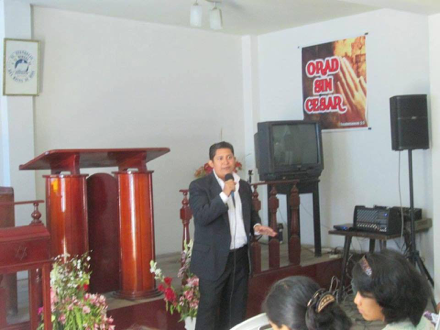
Pictured above is Alex preaching at the Lima Church in Peru.  We love it when Alex accompanies us when we travel to Peru. 


Community is a compound word: common and unity.  This means that we are a group of people unified by what we have in common.  This is a perfect example of the Body of Christ: unity through common beliefs. Just like our human bodies are unified by the drive to survive, the body of believers are unified by Christ.


Sometimes, as Christians, we can get caught up in our differences.  Quarrels over wine vs. grape juice for communion, tattoos vs. no tattoos as a Christian, and Sunday school before or after the church service take place all over the nation.  Now, some of these quarrels seem silly, but you know as well as I do that feelings are hurt over simple differences in ideas.  In Galatians 5:6, Paul reminds us “for in Christ Jesus neither circumcision nor uncircumcision means anything, but faith working through love”.  It is our faith, exemplified by our love, that counts, not the small differences (or similarities) we may have.


Today, I want to remind you that we have more in common with one another than we have differences.  The Church should be the tightest-knit group of people in the universe.  We should have the highest sense of morale and comradery.  Watching the Olympics gets me hyped as I see hockey teams, and ice skating duos, curling teams (yes, even curling can be exciting) accomplish big things together.  Their sense of togetherness and years of hard work to achieve a common goal awakens my drive to seize the day.  Guess what, we have GOD and His son, JESUS CHRIST living in US!!! Imagine the radical acts of love we can achieve with divine power, strength and grace living in us.   Jesus says that the world should be able to know who we are by how we love one another.  What are you doing to show your neighbor your radial love?


You have probably heard this verse before, but I want to take it back to its original Greek.  1 Corinthians 6:19 – “Do you not know that your body is a temple of the Holy spirit, who is in you, whom you have received from God?  You are not your own..”. All of the times that you and your are mentioned in this verse they are actually plural which translates from the Greek into English as ‘you all’. Grammatically, this is known as the second person plural, and something our English Bibles hide from us sometimes because we do not have a direct translation for the second person plural that sounds nice in English. The closet thing we have in English is ‘you all’ or if you are in the south then ‘y’all’. Can you imagine your Bible saying “do you not know that y’all’s bodies are a temple of the Holy spirit”? Due to the mistranslation of this verse into English people usually take this verse on an individual level. The meaning of this text then becomes a verse used to support exercise to keep your “temple” nice however what the author originally intended was to mean the body of Christ is the temple. This means that how we treat each other as the body directly correlates to what the temple is like. That is a very important statement! When we are angry with or hate our fellow believers, we are desecrating the new temple that God has set up.


If you look at how the temple was treated in the Old Testament we see how holy and sacred it was. We need to translate the holy aspect of the Old Testament temple to the body of Christ today. So what exactly does it look like to be holy to each other? It is patience, kindness, forgiveness, and love. Next time you want to be angry at someone remember that how you treat them affects the holiness of the temple, the place that God dwells. Reading the passage for its original meaning is much more difficult than a simple command to exercise and eat well.  It is a command on how we should be as a community. Try reading the passage in this way, “Do you not know that your community is a temple of the Holy spirit, who is in you, whom you have received from God”. This is Paul lifting the community of believers to a higher level. I encourage you to take up that call and to bring even more glory to God’s community of believers.


The latter half of Acts 2 describes a true community of Christ.  The Church devoted themselves to teaching, to fellowship, to breaking bread together, to giving to the needy, and all the while with glad and sincere hearts (Acts 2:42-47).  Let’s reach out to each other.  Let’s strive to love each other in a radical way that makes the world hunger for what we have.


Reaching out is exactly what Alex is doing in Nicaragua with his radio ministry.  Our love doesn’t stop within our culture, or backyard or our nation; we are an international community.  Although we can’t break bread with our brothers and sisters in Nicaragua, we can encourage them even from afar.  Alex would love to hear from you!  Just a simple message saying hi, the church you attend, and that you are thinking of him can go a long way.  You can find him on Facebook under the name ‘Alexander Davila’.  Remember, he is a perfect bilingual, so no need to use a translator.  Radical love awaits us ❤


Love,

Josiah & Amber Cain


Living Simply

Luke 10

luke 10 2

In Luke 10 Jesus is appointing 72 of his followers to go out ahead of him and to spread the message and to see which towns will be open to his message.  Now I think that his instructions to this group of believers is unique to their purpose in aiding Jesus’ earthly ministry, but there are also some useful instructions for us today.  In verses 2 and 3 he tells them to pray that God will send his missionaries into the world, and then tells them that they are the ones that are being sent, but that it will be dangerous.  At that point in Jesus’ ministry I think that some of the disciples had been living in a bit of a bubble and hadn’t yet realized the kind of persecution that they would undergo in their lifetimes, and Jesus was preparing them for what was to come.  I think that similarly Christians in America, and especially those who have grown up in the church have been living in a bubble.  We have been a predominantly Christian nation for several generations, but our nation is quickly moving away from God and I personally believe that within my lifetime we will start to see a lot more persecution of the church.  So those of us that plan to be bold with our beliefs and plan on spreading them to those around us need to be ready and understand that there are dangers associated with being a Christian and being different from the world.


In verses 4-8 Jesus describes how they should move about and how they should act while they are staying in these towns they are visiting.  The summary of these instructions is that they need to move with haste and purpose and while they are staying as a guest in these towns they need to live simply and humbly.  They were to take whatever was given to them gladly and not complain about any food or accommodations.  I think that for us today we need to remember to live with a purpose and to not let ourselves be distracted by fancy living or money or other things of this world.  Our lives are relatively short and there is a great deal of work to be done for the Kingdom.  I’m not saying that we should go around without a wallet or purse or shoes like these disciples were instructed, but that we should lead simple lives so that we have more time for God.


At the end of Luke 10 in verses 38-42 we have the story of Mary and Martha, sisters who hosted Jesus while he was traveling and teaching.  Mary sat at Jesus’ feet and listened to all that he said while Martha ran about getting food and things ready for all of the visitors.  Finally Martha had enough and told Jesus to tell Mary to help her with the housework.  Jesus replied.


41 “Martha, Martha,” the Lord answered, “you are worried and upset about many things, 42 but few things are needed—or indeed only one.  Mary has chosen what is better, and it will not be taken away from her.”


Again a lesson to live simply and to put spiritual matters ahead of physical issues in our lives.

-Chris Mattison

Right from Wrong

WEDNESDAY

In understanding right from wrong, the most important thing is to know what God has said.

1Th. 4:1   Finally, brothers and sisters, we ask and urge you in the Lord Jesus that, as you learned from us how you ought to live and to please God (as, in fact, you are doing), you should do so more and more. 2 For you know what instructions we gave you through the Lord Jesus. 3 For this is the will of God, your sanctification: that you abstain from fornication;


The church at Thessaloniki was made up of mostly non-Jews, so Paul knew that it was important to teach them about sexual purity, because that was not something that was expected in their society. As Demosthenes wrote:


“We keep mistresses for pleasure, concubines for our day-to-day bodily needs, but we have wives to produce legitimate children and serve as trustworthy guardians of our homes.”

This attitude was not acceptable to God’s people. In Acts 15, when the leaders of the Jerusalem church welcomed the Gentile Christians into the body, they thought it important to remind them to abstain from fornication (Acts 15:29).


We live in such a world today. How do we make moral decisions? As we continue in this chapter we will see three more important points, but Paul begins with what we have been taught. In understanding right from wrong, the most important thing is to know what God has said. Paul writes that they have been taught to abstain from fornication, meaning every type of sexual sin.


-Greg Demmitt

Hearts of Flesh

Empathy

This week, we have explored the ways in which empathy informs and shapes our call as Christians to love one another.  We’ve learned how empathy is sitting with and understanding another’s perspective.  We’ve looked at how empathy allows us to love others in ways that uniquely speak to their circumstances.  We’ve even seen how we have a high priest in Christ who’s empathy has brought us salvation.


Today, I would like to end our time together by encouraging each one of us to live our lives more empathetically in light of our readings.  In a society that often seems more and more connected, we can increasingly find ourselves alone.  At its very root, empathy stands against such isolation by opening our own hearts to those around us.


This is hard.  This is dangerous.  It’s a path that has even led to the cross.  But when we refuse or close our eyes to the full humanity of those around us, we begin to break the very ties that make us human.  Because out of everything that God has made, only loneliness was not good.


To be human – the way that humanity is meant to be – is to be in community, relationship, and connection with all those around us.  Who is our neighbor? Everyone.  Am I my brother’s keeper? Yes.  Who should I love? Even my enemies.


The work of God, from the emancipation of the Israelites to the salvation of the resurrection, is a story of an ever widening circle of people that are called to love and care for one another in the glory of God.  That cause has not changed even today.


We are called to love and care and expand the boundaries of our own comfort so that the unlovable will be cared for and the lonely will no longer be alone.


Empathy is the tool that protects our hearts from becoming stone.


As we part ways today, my prayer for each of us is that we are transformed and empowered to carry hearts of flesh that can love beyond human comprehension.

-Graysen Pack

Integrity!

Proverbs 20

prov 20-17 (1)

We read previously that honest scales and balances belong to the Lord so we understand that God wants us to possess fairness, honesty and integrity.  Proverbs 20 shows us the importance of being honest with everyone around us in our daily lives.  For instance, in verse 23 we are told that the Lord detests differing weights, and dishonest scales do not please him. Dishonest scales refers to the loaded scales a merchant might use in order to cheat customers. Those who cheat others think that their actions will not be discovered and they will have benefited from what they did. Unfortunately, Statistic Brain estimates that $270,000,000,000 is lost annually by the U.S. Treasury due to unreported income. Maybe they cheat because they just don’t think they will be caught.  After all, this same report states that 79% of people think it is morally wrong to cheat on their taxes.

But as Christians we value what God thinks of us.  We want His approval.  As verse 17 explains “Food gained by fraud tastes sweet, but one ends up with a mouth full of gravel.”  Sometimes, it is tough to do the right thing, but we should always take the moral high ground.  After all, integrity can be described as doing the right thing when no one is watching. And as Children of God, we know God is not only watching, but helping us by “directing our steps”(v.24).

Something to think about. What is verse 1 saying about the abuse of alcohol leading the unwise astray? How could this affect someone’s integrity or honesty?

By Rebecca Dauksas

Victorious God

Revelation 8-12

1023-REV011015ENGKJV08000480ISP02066256000

Wednesday July 19

Seven is the number of completion, of fulfillment.  The number seven appears repeatedly in Revelation:  seven Churches, seven seals…. and now seven trumpets.  A trumpet is blown to get people’s attention- something important is about to be announced.  The seven trumpets here announce the judgment of God upon the earth.  God is about to bring this evil age to a close to make way for the age to come, when the Kingdom of God replaces fully the kingdoms of this world.
Each of the seven trumpets are blown by an angel of God followed by some great disaster.  There is hail, fire, blood, large burning rocks falling from heaven (a meteor or asteroid).  Then stars fall from heaven, the sky becomes filled with darkness, more heavenly bodies fall to earth opening deep pits in the earth which release demonic creatures.  There are plagues and wars and all manner of destruction heaped upon the earth.  Here it’s important to remember that much of this is symbolic language.  The point is that there will be calamities which bring about destruction on the earth, some are ecological, some are interstellar, and some are man made.  This Summer there’s a t.v. show on called Salvation.  The premise of the show is that NEO object is heading toward earth and is likely to cause massive death or even total extinction.  In real life, under Yellowstone National Park in Wyoming there is a super volcano, which, if it erupts, would place nearly all of the continental US under a cloud of darkness that would result in massive famine.  Of course, we hear regularly dire predictions about global warming, rising sea levels, the melting of the Arctic permafrost etc…  And don’t forget the expanding nuclear arsenals of places like North Korea and Iran.  There are any number of ways that global destruction could occur.  This is a part of our human consciousness… and it was a part of human consciousness in the first century as well.  There has always been the understanding that there is much that is outside the limits of human control: drought and famine, earthquakes and fire from heaven.  These events were usually linked to belief that whatever gods that community worshipped were angry.  Destruction was linked to judgment, which was linked to human sin.  The normal response was to bring sacrifices to the gods and a promise to stop doing bad things.
In this section of Revelation, we see that the one true God is behind these disasters, but there is no willingness of the people to repent. In Rev. 9:20-21 the people refuse to repent of their idolatry, of their murder, of their sexual immorality.  The people will not link the calamities that befall them and the earth with their own bad actions that violate God’s word.
Revelation 12 gives another picture. It’s an overview of the history of the earth and it shows the cosmic dimension of the battle that’s taking place.  There is a spiritual warfare. Behind it all is this picture of evil described as the dragon, or the ancient serpent, or the devil or Satan.  Evil is making war on God’s people.  Yet, evil will be brought down and God’s people who refuse to submit to evil will be victorious.  Even though they may be killed by evil, yet will they ultimately be victorious.
Remember, when John received this vision, Christians were suffering at the hands of the powerful evil empire of Rome.  It seemed like a powerful or insurmountable monster that was able to impose his will on God’s people.  Imagine how hard it would have been to stay faithful to Jesus Christ during such a difficult time.  Yet here is a message of hope, a message of victory.  Evil and the human faces of evil will not win.  God has far more power available to him than evil does.  Those whose hearts are turned against God and refuse to repent will not be swayed by these displays of judgment and power, but those who are faithful to Jesus Christ and remain faithful, even to the point of death, will emerge victorious.
There are always events that happen in our lives that tempt us to doubt God or to turn away from Him.  These apocalyptic texts in Revelation serve as a vivid reminder that, no matter how bad things may get in the world, even for believers in God, God will be victorious.  Let us stay faithful and keep trusting God and our faith will not be disappointed.

-Jeff Fletcher