When was the last time you made a truly eternal promise? If you’re married, hopefully, you’ve made an eternal promise of love and commitment. I’m sure if you have children, you’ve vowed to love and cherish them always. Even something as seemingly simple as getting a tattoo is a promise to yourself that you’ll carry that image on your body for the rest of your life.
Today’s scripture, 2 Samuel 7, reveals the profound truth of God’s eternal promises. This passage contains the Davidic Covenant, where God promises that David’s house will rule forever. We know this promise will be fully realized when Jesus returns to establish God’s Kingdom on earth. Think about it: God has been keeping this promise for over 3,000 years! Despite Israel’s occasional disappointments and frustrations, God remains steadfast.
While our most sincere promises can falter due to betrayal, anger, misunderstanding, or irreconcilable differences, a promise from God is unwavering. That’s a reason for a true celebration!
David’s response to this incredible promise is one of humility and awe: “How great you are, Sovereign Lord! There is no one like you, and there is no God but you, as we have heard with our own ears.” Today, may we find ways to celebrate God’s faithfulness that has endured all this time and will continue long past us.
-Hope Fletcher
Reflection Questions
When have you witnessed or experienced God’s enduring faithfulness?
When have you responded to God with humility and awe saying (similar): ““How great you are, Sovereign Lord! There is no one like you…”?
How are you at keeping your promises? Can your word be trusted?
Integrity is a part of your character that you can’t develop overnight- it involves a lifetime of good, honest, and moral decision-making. In Psalm 101, we read words written by David telling us how he desires to live with integrity in both his personal life and in his rule. Though none of us are likely to ever be kings, we can still apply a lot of this wisdom to our own lives, but you should probably leave the destruction of the wicked to others.
So, how can we walk with integrity like David? First, we see that he will “ponder the way that is blameless.” It’s a good practice to consider what it means to live in a way that glorifies God. Ponder your life and seek to be blameless in the way you live and make changes that you need to make.
Then, “I will not set anything worthless before my eyes.” What are you focusing on? What gets most of your attention throughout the day? Do me a favor and take a moment to check your Screen Time Report on your phone. Now, answer honestly- how many of the things you set before your eyes are worthless? Replace these worthless things with things that will improve your life, your mental health, and your relationship with God.
We also see that David is actively avoiding “perverse hearts,” “those who slander their neighbors,” “those with a haughty look and arrogant heart,” and those who “practice deceit.” Take a look at the people you allow to influence you, the people in your inner circle. Are they fostering your growth or hindering it? Surround yourself with people who will offer you godly advice and support. Build a community around you that will carry you when you can’t carry yourself.
-Hope Fletcher
Reflection Questions
What do you see as the importance of pondering the way that is blameless? What in your life this month has brought glory to God? What has not?
What is worthless? What is not? “What are you focusing on? What gets most of your attention throughout the day?”
“Take a look at the people you allow to influence you, the people in your inner circle. Are they fostering your growth or hindering it?” Who could you intentionally spend more time with in order to work towards your own godly growth? Set up some time together with this person/these people and pray about your time together.
Today, in Psalm 15, David gives us some great advice for living in a way that glorifies God. The things listed here are kind of no-brainers, but are also things that I think are so simple that perhaps we tend not to think of these things as being important.
Be honest. All the time. And not just with the words that come out of your mouth- make sure your intentions and motivations are truthful as well. Being honest in your heart is just as important as being honest with your words.
Don’t talk poorly about others. Even when everyone else is venting about that annoying co-worker that you all can’t stand. Or even if it’s your dorky sibling that just won’t leave you alone. Protect the reputation of others by holding your tongue.
Keep your promises. Even if a more appealing offer comes up, stick with what you’ve agreed to do. Even if it becomes costly to you, honor your agreement. Let your “yes” be “yes” and your “no” be “no.”
Be generous with people- be compassionate and share with others without wondering how they can pay you back.
This Psalm reminds us that true Godliness is woven into the fabric of our everyday lives. It’s about choosing honesty, kindness, integrity, and generosity in every interaction, big or small. These qualities, though simple, are the very things that shape us into people who are fit to dwell in God’s presence.
-Hope Fletcher
Reflection Questions
Of these four characteristics which one do you struggle with most?
When have you recently missed the mark of “true Godliness”? What could you have done instead? What difference would this have made – to yourself, others and God?
Next time you find yourself in a similar situation how might you steer yourself towards the “true Godliness” response?
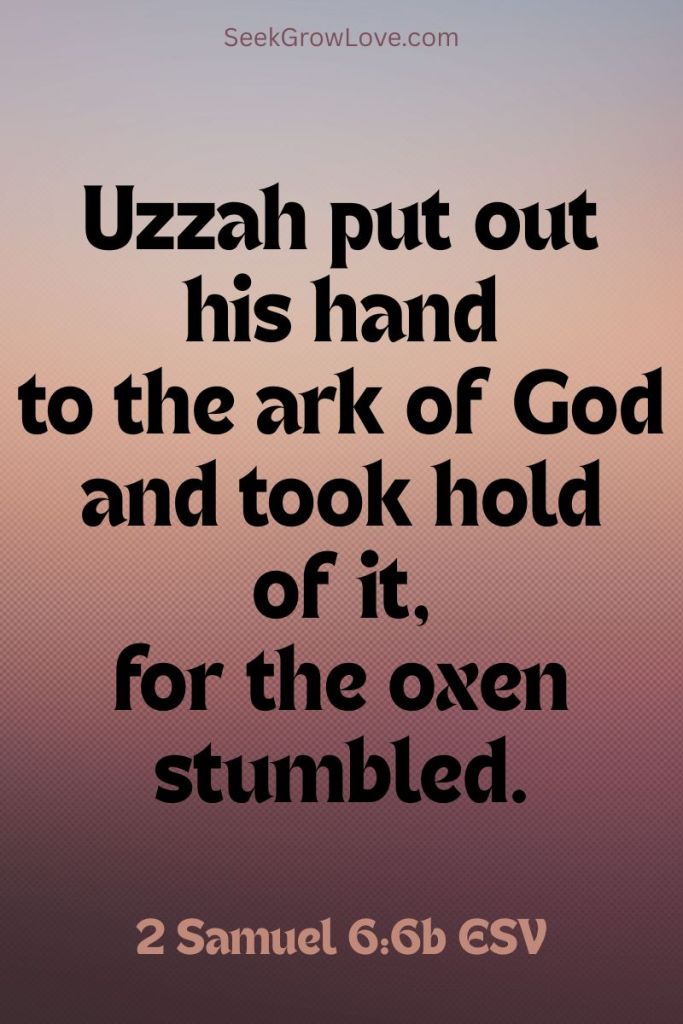
2 Samuel 6 is one of those stories in the Bible that never sat well with me in my youth. Here, we have a scene of a joyful celebration as the ark of the Lord Almighty is brought to its rightful home in Jerusalem. We’re singing, we’re dancing, we’re having a grand time. Suddenly, the oxen stumbles, and the ark begins to fall. Here, we have Uzzah, who reaches out to steady the ark to keep it from falling. See, to me, that seems like a noble thing to do. After all, we’d hate for the ark to fall to the ground, wouldn’t we? Yet, God strikes him dead for this act. Come on…the guy was just doing the best he could do! It always seemed to me that God acted unfairly to someone who seemed like they were trying to do a good thing.
You know, now that I think of it, I tend to have that same attitude toward acts of disobedience in my life. Sure, I know that sometimes I do wrong things, but if my intentions are good, isn’t it ok? I know that God doesn’t want me to lie, but if my lie has a good outcome, wouldn’t God say that’s ok? I know I’m not supposed to touch the ark, but if I keep it from falling, wouldn’t that be ok? Unfortunately, that’s not the way it works.
If you’ve been following along with the Bible readings, you’ll remember that in 1 Samuel 15, we learn that to God, “it is more important to obey than to sacrifice.” God prefers faithful adherence to His commands more than grand gestures performed according to our own understanding. I think God would rather have had Uzzah follow his commands, treating his instructions with respect and reverence than try to do what was right in his own eyes.
And another thing, the disobedience didn’t start with him reaching to steady the ark. Uzzah wasn’t even supposed to be one of the men transporting the ark as he wasn’t a Kohathite (the Levites specifically instructed by God to be in charge of this task). Not only that, but they weren’t even transporting it the right way. They made a cart for the ark, but God gave specific instructions for how to carry this thing around, and a cart was not part of the deal! Things could have been so different if only they had done things the way God said.
What we learn from Uzzah and the mistake that he made is to pursue obedience even when our own understanding leads us a different way. In this life, you will be drawn toward doing things that go against God’s teachings. Even if it doesn’t make sense, God’s way is always the best.
-Hope Fletcher
Reflection Questions
How do we avoid getting caught up in doing things our own way instead of God’s way? How do we learn what God’s way is? What are the differences between my way and God’s way?
How does Uzzah show us our need for a Savior? How important is Jesus’s death – and resurrection?
Thank you for joining me this week as we examined Scripture together! Let’s close out with a few more Psalms, written by David.
The word ‘wonderful’ primarily means “very good”, but can also mean “astonishing”. Today’s Psalms are beautiful reflections of God’s wonderful works. Despite some of those works being consequences of rebelling against God, and certainly not our definition of “good”, there is no denying they are still wonderful in the sense of the astonishing, awe-inspiring, power God displayed in these moments.
All people were created by the omnipotent God, whether or not they acknowledge Him. All people experience God’s wonderful works, whether or not they know those works are done by God alone. In our world today, there are plenty of people that either do not know or choose to deny God’s power. But that lack of understanding does not change the undeniable truth that God is the Almighty, and that someday, every knee will bow in acknowledgment of Him. And oh what a glorious day that will be!
Until then, as Christians, we should be remembering God’s wonderful works, and sharing them with others regularly. We should praise the doer of these works, giving thanks and announcing them with shouts of joy (107:22)! Our God is truly an awesome God, and worthy of all praise and recognition. In our day to day, it can be challenging at times to pause and reflect on how God is working in the world and in our life, but it can make so much of a difference in our day when we simply say, “Thank You, awesome God.”.
Sarah Johnson
Reflection Questions
From today’s reading, which verse stuck out to you most?
As we close out the week together, I challenge you to not only take some extra time to give God praise for all He has done, but find a brother or sister to share in all His wonderful works, together!
Today we are reading three brief, but powerful, psalms, totaling 85 verses. The phrase “Praise God” (or some similar variation) is found 12 times in these passages. And that’s just that phrase, not the verses describing why God is worthy of praise, which make up the majority of the text!
Much of the praises today are focused on God’s compassionate character as the Creator of the world and everything in it. The praise is focused on God’s works, and forgiveness, despite humanity’s faults. Even in Psalms 102, where the author is lamenting over their life circumstances, they still give praise and recognition to an eternal and compassionate God before the psalm ends!
Most Psalms have all these similar themes of praise and recognition of God’s character, just phrased differently and from different perspectives in different life situations. They are not written to recount a story from long ago like most of the other books in the Bible, but are written by people experiencing very real, raw, emotions. It’s basically like reading someone’s personal prayer journal! Because these authors were real people, there is a strong likelihood you resonate with their real feelings of real life situations. And because we praise an unchanging God, we can have confidence that we too, can experience the same comfort and joy when we praise Him. No matter if you are in a time of lament, a time of needing redemption, or a time of awesome recognition of our creator, you can find a way to Praise Yahweh.
Sarah Johnson
Reflection Questions
How’s your “praise life” been lately? Are you taking opportunities to Praise God instead of just petition Him in your prayers? How can you improve this week?
Pick your favorite “praise” verse from today’s reading to focus on this week. Consider memorizing it to add to your own prayers!
In our 1 Chronicles passages today we read about the death of Saul due to his unfaithfulness towards God. Saul began consulting others instead of God, and certainly did not praise Him for all the provision he had been provided. Read Psalms 103 again, keeping this story in mind. What can you apply from the message of this Psalm to Saul’s life and death?
Today’s reading takes us across several different life experiences many (if not all) Christians also experience in today’s modern world:
Psalm 81 is a reflection of God’s provision for Israel, and a reminder of the good things they could be experiencing if they would only listen to Him.
Psalm 88 is an example of low places so many of us have experienced in our Christian walk. The writer is calling out to God to save them from suffering, to answer their prayers, and to bring them comfort in a place of loneliness. It is a lamentation and pouring out of a soul that is broken and hurting.
Psalm 92 is a psalm of praise and excitement over the wonderful works of God! This author is experiencing joy and astonishment over a Heavenly Father, and being sure to sing it loud and proud!
Psalm 93 is another praiseful psalm that focuses more on the sovereignty of God and His mighty power, recognizing the strength of God and His position over the entire earth.
While each of these Psalms hold different perspectives of a human’s viewpoint of God, we can also see how in each of these, God’s unchanging, steadfast, supreme authority remains. No matter what our current reflection of God is, He has never become anything but God. Whether we are disobedient, hurting, praising, or fully recognizing His power, God is still, and has always been, the Creator, Yahweh, the One True God. The God who formed and controls every aspect of the earth, that pulled the Israelites out of Egypt, and held them accountable to His commands, is the SAME GOD that you and I worship today.
This fact can (and probably should) be both comforting and convicting. Comforting because there is an amazing God who loves us with an everlasting love that will never change from that! Convicting because there is a powerful God, who has high expectations for believers, that won’t change from that either. As Christians today, I believe we must consistently balance these feelings of comfort and conviction in order to best live out our days.
-Sarah Johnson
Reflection Questions
Using the four options listed, what would you classify as your current reflection of God in this season? Are you content to have that reflection?
What verses most stood out to you from the reading? Why do you think those verses impacted you the most today?
Another Psalm, another author! Asaph was a Levitical musician appointed by David. As a musician, it makes sense why the Psalms in his name invoke quite a bit of feeling!
In each of these Psalms we see components of the author’s experience that we have likely felt in our own lives. For example, Psalm 73:12-14 highlights the feeling that it seems the wicked seem to prosper while the pure in heart still experience suffering! Has anyone else had that thought cross their mind? I know I have. Or from Psalms 77:7-9, the feeling that God has withheld His love and compassion from you? Or, in recounting the Israelite experience in Psalm 78, have we been in moments of testing God, and ignoring His redemption from our enemies?
Throughout these chapters, we see a theme of remembrance. Whether this is people finally remembering God’s awesome power, generations being reminded of God’s miracles, or God ‘remembering’ that people are only people, remembrance is a prominent component to these musical psalms.
When people remember God, it is after they have experienced hardship, caused by the complexities of life, or God’s wrath towards their sin. It comes with recognition of God’s mighty works and requires humility. Remembering God then brings about a change from a destructive path, back to a path of righteousness and holy pursuit of God’s presence. Forgetting God and His wonders results in separation from Him for as long as someone forgets. Remembering Him correctly as the omnipotent Creator is what brings us back to His gracious and compassionate presence.
However, when God ‘remembers’ His people, it is not because He at some point forgot the way people forget, but rather He re-extends His grace yet again after His people have sinned; He acknowledges them (us!) in their sinfulness. God’s remembrance is not for His benefit, but for the benefit of His people. And without it, it wouldn’t be possible for people to experience redemption.
Remembering God, and His remembrance or compassion towards people is something worth sharing! Psalm 78:1-8 describes how important it is to tell others, future generations, about God’s works and power. Whether or not you have children of your own, you do have the opportunity to impact the next generation of believers. You can do this by reminding believers of our awesome God – reminding them of the importance of following His commands and pursuing His presence in their own lives. No matter your age, you may feel like your generation has forgotten God. But you, yes YOU, have the ability to start remembering Him today, to impact yourself and those around you, tomorrow.
-Sarah Johnson
Reflection Questions
Are there seasons in your life that you have really remembered God? What stood out to you during that time? How could you carry that over to all seasons of life, especially ones where you may be more likely to forget Him?
What could you share about God’s works in your life with people in your circle that would help you or them remember Him today?
I recently had a baby boy, who decided, after about 3.5 weeks of false labor contractions and me walking around 4cm dilated for a week, he would grace us with his appearance 2 days after his due date. For comparison, my firstborn came a week early with only those pesky Braxton Hicks contractions leading up to his debut. Anyone who has known me over the past 9 months knows that I was fully convinced this second baby was coming early. It felt like my entire mind was consumed by thinking about going into labor every moment of every day! I was grouchy, distracted, and mentally exhausted. My yearning brought me no closer to my baby, and really only made me more distant from everything positive going on around me.
The sons of Korah write in Psalm 84:2 “My soul yearns, even faints, for the courts of the LORD; my heart and my flesh cry out for the living God.” (NIV). The NET translation phrases it as “with my whole being, body and soul, I will shout joyfully to the living God”. This verse paints a picture of absolute, consuming, desire for closeness with God. The chapter continues on to describe a blessed happiness that can be found when focused on praising the Almighty, when trusting in the Lord of Hosts! (v. 4, 12).
Psalm 85 continues this picture of desiring closeness with God, but takes a slightly different perspective. In Psalm 84, I get this imagery of excitement, anticipation, energized passion for God, whereas Psalm 85 depicts an image of peace, protection, and righteousness in relationship. There is still a deep longing for a connection, but it’s like comparing the honeymoon, “puppy-love” phase of a new marriage, to a secure, content, lifelong covenant marriage.
Verse 9 describes this type of relationship through salvation by fearing God. This “fear” is derived from the Hebrew word “yare”, which means to revere, or be afraid of because of profound respect . It’s not meant to be a fear that causes us to avoid approaching the throne, but rather a fear that places us in rightful, humble, submission to an awesome God, worthy of being revered, and yearned for. One that should make us say, “my whole source of joy is in you” (Ps. 87:7).
Even though babies are one of the greatest gifts, my yearning to deliver my son began to impact my relationship with God (and others!) as I began to prioritize birth over my spiritual relationship with the One who made life. I wanted to control the timing, and I wanted it to be now! But, when I started to misplace my priorities, I felt less joy, less excitement, and less peace about the whole situation. How often does this happen in our lives? We begin to place closeness to someone or something above our desire for closeness with God… and unsurprisingly, we don’t get the same satisfaction we may have been hoping for. We can become bitter, resentful, stressed, you name it… anything but joyful. Yearning with such intenseness for the wrong things in life, even when they are good things, will never lead to a joy-filled life. BUT, when we keep ourselves yearning intensely for a relationship with God, and when we humble ourselves to Him, we experience true joy, true peace, and true satisfaction, only He can deliver!
(And baby boy arrived healthy and happy, just when God intended him too 🙂)
Sarah (Blanchard) Johnson
Reflection Questions
Evaluate your faith walk right now – would you describe yourself as yearning for a relationship with God? What other aspects in your life might you be misplacing above your relationship with Him?
What steps can you take to practice fearing, or revering, God today?
This week we will be primarily focusing on the Psalms passages, although you can find some very interesting name ideas as you read through the lineage passages in 1 Chronicles 🙂
All of the Psalms we are reading today are said to be written of “the sons of Korah”. If you’re like me, you may not be completely aware of who these people are. Although there are multiple ‘Korah’s mentioned in Scripture, most scholars believe the Psalmists come from the line of Korah who led the rebellion against Moses, and as a result was swallowed up by the earth and his followers burned with heavenly fire (Numbers 16). BUT, Korah’s sons did not die as we see in Numbers 26:11. With this historical knowledge, it can be helpful to put some of these Psalms into perspective.
Starting off in verse 1 of Psalm 43, I am immediately resonating with the writers as I consider our own nation for the last decade (and then some). No matter what someone’s political perspective is, I feel confident we can all agree that this world, our nation, is in desperate need of God’s light and truth to lead us (v. 3). It can be easy to feel rejected or abandoned by God when we focus on the world around us. The Korahites express this very sentiment in chapter 44, calling an immortal, omnipotent Creator to Wake Up (v. 23) and remember them in their affliction. Interestingly, the writers here don’t ask for rescue because they are so holy, or because of their own personal status. Rather, they ask God to redeem them for the sake of His steadfast love (v. 26). Their motive in asking is based in an understanding of the love of a powerful Father. Despite their affliction, their feelings, and their very real enemy oppression, they are recognizing the love of God and praising His name, calling Him their greatest joy (43:4). They are acknowledging His power while also acknowledging that they are in a pretty sucky situation they didn’t actively pursue like generations past.
Of all people, the Korahites understood the power God had and what He could do to those who did not follow Him. They knew this because of what their own generational line experienced! They would have been painfully aware of Korah’s poor choices, and of God’s miraculous provisions for the Israelites throughout the years, because of their ancestors (44:1). Rather than lashing out at God for His decision with Korah, or living in crippling fear with the knowledge of His mighty hand, they instead tied themselves closely to a God they saw as loving, protective, and desiring to redeem them (49:15). They placed their trust in an Almighty authority with the capacity to bring eternal salvation, rather than the things of this world that wouldn’t follow them beyond the grave (49:17).
When we experience challenges in life, it’s easy to place blame outside of ourselves (sometimes rightfully so!), become angry, or focus on all of the sucky parts around us. During these moments, we can instead consider our greatest joy, remember our Sovereign God, and His redeeming love. This doesn’t mean we have to ignore or hide the situations we’re in – that isn’t what these Psalmists did at all! Instead, they placed their situations in perspective of a God they knew to be loving and eternal, worthy of praise no matter the circumstance. Do you?
-Sarah Johnson
Reflection Questions
What is your first response when you experience or observe injustice in the world? Does this reflect the knowledge you have of God?
How can you place your current situations into perspective of God’s power? How does this change your attitude about your situation?
Do you pull a different theme from the Psalms today? What was God speaking into your unique circumstance?





 Seek Grow Love