A Mystery

1 Samuel 27-28
Psalm 51
Romans 9

-Devotion by Sarah Johnson (MN)

Some people are a big fan of mysteries.  I am not one of those people.  When getting a new fiction book, I start by reading the last paragraph of the last chapter just so I know what to expect (trust me, I know it’s weird…).  So you can imagine there are many things within our faith that are a challenge for me to grapple with as “mysteries of God”.  Romans 9 is a great example of one of those things that requires me to acknowledge that I simply do not, cannot, and most definitely should not know everything there is to know about our Creator.

Paul starts this chapter off by attempting to describe how deeply he loves his Jewish community and desperately wants them to understand Jesus, so much so that he wishes he himself could simply be cursed and cut off for the sake of his people (v. 3).  This is similar to how Moses offers himself to be blotted out of God’s book when he watches his people worshipping a golden calf (Exodus 30:32).  In both of these instances, these men have a deep love for their people, and yet their love alone is just not enough to change their salvation.  There was only one who was capable of holding that type of power in substitution, the man Jesus Christ.  Paul references many Old Testament passages that point to a coming Messiah and how salvation may be brought to the Gentiles in this letter – he knows exactly what doubts his fellow Jewish believers may have, and tries to proactively present his case, as he often does in his writing.

And then we start getting into that mystery part of things… God is sovereign, the Ruler over all, the one who decides who he extends mercy to, and who he hardens (v. 18).  Well that’s just not fair, is it??  I want to justify these verses in my own mind to make them “nicer” – somehow I want to twist these words, rationalize them, make them more presentable, and far less mysterious.  But in doing so, I remove God from His rightful place of sovereignty in my mind.   I am absolutely the type of person Paul references in verse 19 – “one of you will say to me: Then why does God still blame us? For who is able to resist His will?”.  I am nothing more than a mere clump of clay, pretending as if I have any right to tell the potter what to make of me.  

In his study of Romans book, author Jared C. Willson writes this on my very thoughts above: “If we dictate to God what he must be like, then we are not in fact worshiping God – we are worshiping an idol, for it is a god of our own making.”  When I try to over-simplify or “clean up” these mysterious moments of God, I am no longer genuinely focused on Him.  I am focusing on the more presentable parts of the gospel, when in reality, we must wrestle with ALL parts, praying for wisdom and understanding as we navigate the mystery.

I will not pretend to know why God does what He does.  I will not pretend to understand why some people just won’t grasp the gospel.  I will not pretend I can figure out the mysteries of God.  So while it may be confusing, and at times slightly disheartening or even frustrating, I will also choose to find comfort in the fact that it does not depend on human desire, or effort, but on God’s mercy alone (v.16).  What a beautiful mystery!

Reflection Questions

  1. Have there been moments in your faith walk when you attempted to dictate to God what He must be like?  Looking back now, are you able to see what you missed in doing so?
  2. The last few verses of this chapter describe Jesus as a stumbling stone.  How might believers stumble over the truth of Jesus?

Prayer

What an honor it is to speak to You Lord God, the Maker of Heaven and Earth and me. Help me see You for who You are – a God too big and great and right for my comprehension. And help me see me for who You made me to be, and do what You want me to do.

A Kingdom Appetizer

1 Samuel 25-26
Psalm 51
Romans 8

-Devotion by Sarah Johnson (MN)

Romans 8 is truly a big chapter when I consider all of Paul’s letters… there are so many amazing ideas, reminders, and encouragements within these verses.  I encourage you to read this chapter more than just once to see what stands out to you each time through.

Woven throughout this whole chapter is the impact and role the Holy Spirit has in the life of a Christian.  This gift is one that brings life, sonship, righteousness, advocacy, and victory.  It makes sense why David is practically begging God to not remove it (Psalm 51:11) when he is caught in sin with Bathsheba!

In David’s example from Psalm 51, we are reminded of the contrast to Spirit-living: living in the realm of the flesh, which leads to death.  In this instance, though the death was not his own, David’s acting on his sin did lead to the death of Uriah as well as his son who was conceived in sin.  Not only that, but you have the heartbreak Bathsheba must have been experiencing by being taken advantage of, losing her husband, and her baby.  And yet in all of this, David writes “Against you, you only, have I sinned…” (v.4).  He understood the magnitude of his actions that caused him to be drawn away, into the realm of the flesh, which is full of death.  

At times, I think we can forget about the power we have access to that connects us deeply with God and His Son.  Sometimes, as non-trinitarians, I find we even tend to shy away from discussing the Holy Spirit.  But when we do, I fear we truly miss out on one of the greatest gifts we have access to in this lifetime!  Obviously, Jesus’ death and resurrection that bring about eternal life is truly the greatest gift.  But that is a promised gift – something we will experience and reap when Jesus returns.  The Holy Spirit is the gift we can use right NOW, a taste of what is to come…an appetizer to the Kingdom if you will. 🙂

Unfortunately for David, he did not have the bigger picture we have today to keep him going during times of struggle.  He knew of a coming Messiah, but did not know who, or when, or how.  As modern-day Christians, we have so many advantages we must remember and utilize.  One of those advantages is access to the Scriptures.  We are so fortunate to know of the final verses in Romans 8:

For I am convinced that neither death nor life, neither angels nor demons, neither the present nor the future, nor any powers, neither height nor depth, nor anything else in all creation, can separate us from the love of God that is in Christ Jesus our Lord.”

Reflection Questions:

  1. There are many benefits we gain when we access the Holy Spirit, and those benefits are part of what make us so unique as Christians.  Think about your own life, have there been moments where you have experienced a supernatural peace, joy, or patience?  Have you been called to move in a way that brought about a significant change?  Have you been at a time so challenging in your life you couldn’t imagine taking another step, and yet found strength to carry on?  All of these are moments where the Holy Spirit may be interceding in your life.  
  2. What would you add as a reminder to yourself to Paul’s list of things that cannot separate you from God’s love?
  3. What other verses or key concepts stood out to you today from our reading?

Prayer:

Dear God, I praise You for Your incredible love and mercy. Thank you for the incredible gifts of Your Son and coming eternal life and thank You for Your presence and Your Spirit. Help me live daily in Your Spirit!

Stuck at a C Average

1 Samuel 23-24
Psalm 50
Romans 7

-Devotion by Sarah (Blanchard) Johnson (MN)

Anyone else out there a rubric fan?  You know, someone who absolutely LOVES a rubric… an exact description on how to get that A+… As a student, I would get so much joy in having a clear answer as to how to get 100% in class.  If I knew the expectation, I could ensure I did exactly the right amount of work to meet the standard.  The Israelites had the law as their rubric.  The problem was, the law was essentially impossible to follow in its entirety to “get an A” with God.  Enter, Jesus.

In Romans 7 Paul describes how the law interacts with sin and God’s grace.  Though Jesus had already fulfilled the law, Paul is reiterating how the law still carries value when it comes to experiencing life and deliverance through Jesus Christ.  How exactly does this work?  It is through the law that sin is revealed in our lives – the law recognizes sin as sin, which is ultimately death (v.13).  Sin is what keeps us from life, and if we do not know what sin is, how will we know what to avoid or rid ourselves of?  

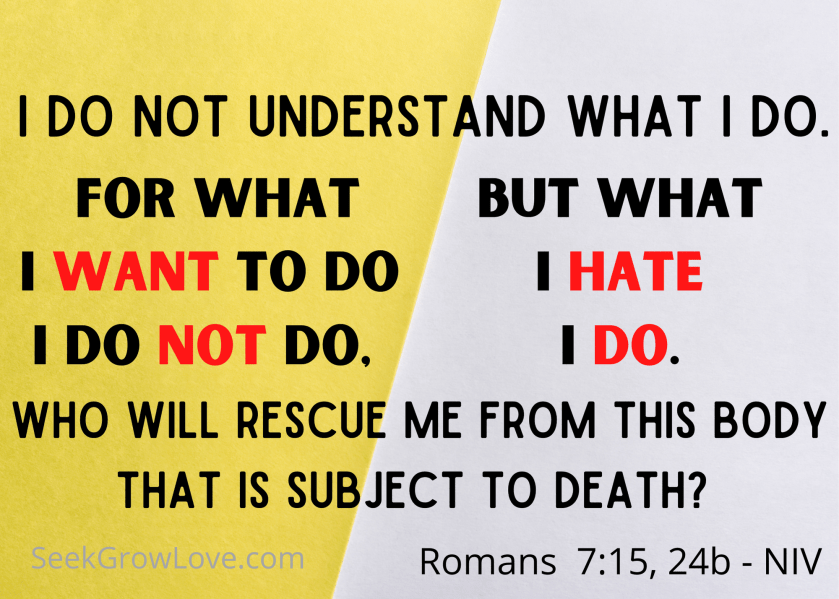
Paul’s personal confession provides a vulnerable look at the reality we ultimately all experience – “For I have the desire to do what is good, but I cannot carry it out.” (v.18).  Even with a rubric, Paul was incapable of rising to the standard due to the sinful nature in his own life.  This is the same for every Christian in all of history!  Even at our closest to perfection, we are simply never going to be above a C average.  

BUT, thanks be to GOD, who delivers us through Jesus Christ our Lord (v. 25)!  

From my perspective, this is the tension that every Christian walk holds: I am a sinner, yet I am redeemed.  There must be humility and confidence in my identity; the recognition of the death that comes from sin allows for the opportunity of salvation through my Savior.  These seemingly conflicting truths are our reality as born-again Christ followers.  Thanks be to God indeed!

Reflection Questions:

  1. As a Christian, what then is our response to the reality of these truths?  Looking to Paul as an example, it seems to start with gratitude!  How can you practice this today?
  2. Reflecting on Paul’s vulnerability in verses 18-23, have you experienced similar feelings?  How have you reminded yourself of God’s grace in these moments? 

Prayer:

Dear God – You are worthy of all my praise. Thank You for Your holy, just and good law that shows us what sin and death is. Thank You for loving us even when we were stuck at a C average, or worse. Thank You for the new union You provided for us, to Your Son Jesus whom You raised from the dead. Help me to live each day in the newness of the Spirit, bearing fruit for You.

Set Free

1 Samuel 21-22

Psalm 50

Romans 6

-Devotion by Sarah Johnson (MN)

 I am excited to be back with you all again this year!  We will be focused primarily on our Romans passages this week, but will pop back and forth between our others as well.  Be sure to take time to continue to read the story of David, and enjoy the Psalms!

In Romans 5, we read about the abundance of grace God offers to us through the death of Jesus.  Paul begins chapter 6 assuming the rigid Romans would now be attempting to “logically justify” their own fleshly desires, to which Paul gives them NO opportunity to misinterpret his message.  In verses 1 and 15 Paul calls out “By NO means” are we to continue to live in our sinful nature!   We are set free from whatever struggles we may face, and instead bound to a loving, faithful, and holy God that promises us an everlasting life with Him when we become slaves to righteousness.


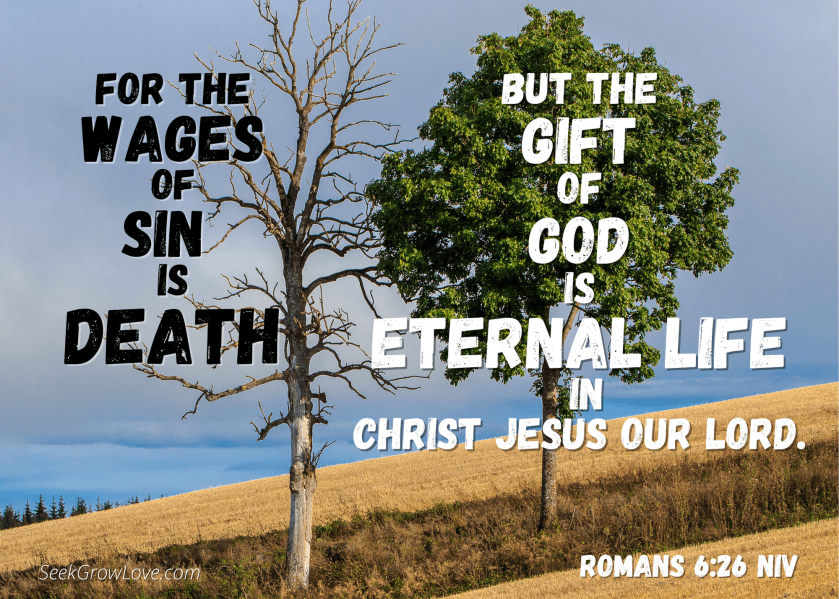
What’s more remarkable is that this ‘slavery to God’ does not fit the typical role of slavery.  Slaves offered something to their masters – labor resulting in some profit.  Their sacrifices brought about something of value and worth to their masters.  In case you forgot, God needs no laborers.  He needs no profit.  There is nothing we could ever do that would give something to God He could not get Himself.  There is no sacrifice we could offer that would bring more value or worth (see Psalms 50) to us in His eyes.   AND YET, we are called to offer every part of ourselves as instruments of righteousness (v. 13).  Why?  Because we know the wages of sin is death, and we have been given a gift of eternal life (v.23) when we submit ourselves to the One who created us. 

This simple truth of the gospel so easily loses its grandeur.  Pause a moment here and reflect on this:

You are no longer bound to sin that leads to death.  

You are free to accept the gift of eternal life.  

Jesus Christ has indeed died to sin once for all, so we may reap the benefits of eternal life.

You are under God’s grace.  

You too, may live a new life, my friend.  

Reflection Questions:

  1. Is there a sin in your life you are allowing to hold you captive?  Confess it now, and experience freedom. 
  2. What practical way can you offer every part of yourself to God today?

Prayer:

Dear Father,

Thank you for being a great God and master who gives the incredible gift of grace through Your son Jesus. Thank you for making a way out so I no longer need to be a slave to sin. Help me walk in newness of life now and eternal life in Your Coming Kingdom.

God’s Wonderful Works

Psalms 106-107, 133

Thank you for joining me this week as we examined Scripture together!  Let’s close out with a few more Psalms, written by David.

The word ‘wonderful’ primarily means “very good”, but can also mean “astonishing”. Today’s Psalms are beautiful reflections of God’s wonderful works. Despite some of those works being consequences of rebelling against God, and certainly not our definition of “good”,  there is no denying they are still wonderful in the sense of the astonishing, awe-inspiring, power God displayed in these moments. 

All people were created by the omnipotent God, whether or not they acknowledge Him.  All people experience God’s wonderful works, whether or not they know those works are done by God alone.  In our world today, there are plenty of people that either do not know or choose to deny God’s power.  But that lack of understanding does not change the undeniable truth that God is the Almighty, and that someday, every knee will bow in acknowledgment of Him.  And oh what a glorious day that will be! 

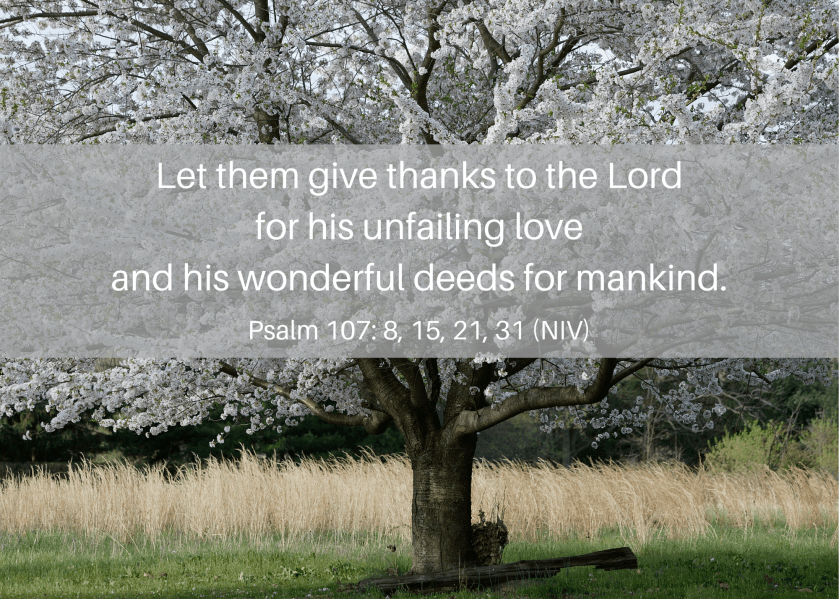
Until then, as Christians, we should be remembering God’s wonderful works, and sharing them with others regularly. We should praise the doer of these works, giving thanks and announcing them with shouts of joy (107:22)! Our God is truly an awesome God, and worthy of all praise and recognition.  In our day to day, it can be challenging at times to pause and reflect on how God is working in the world and in our life, but it can make so much of a difference in our day when we simply say, “Thank You, awesome God.”.  

Sarah Johnson

Reflection Questions

  1. From today’s reading, which verse stuck out to you most? 
  2. As we close out the week together, I challenge you to not only take some extra time to give God praise for all He has done, but find a brother or sister to share in all His wonderful works, together!

Personal Prayer Journal

Psalms 102-104

1 Chronicles 9-10

Today we are reading three brief, but powerful, psalms, totaling 85 verses.  The phrase “Praise God” (or some similar variation) is found 12 times in these passages.  And that’s just that phrase, not the verses describing why God is worthy of praise, which make up the majority of the text!  

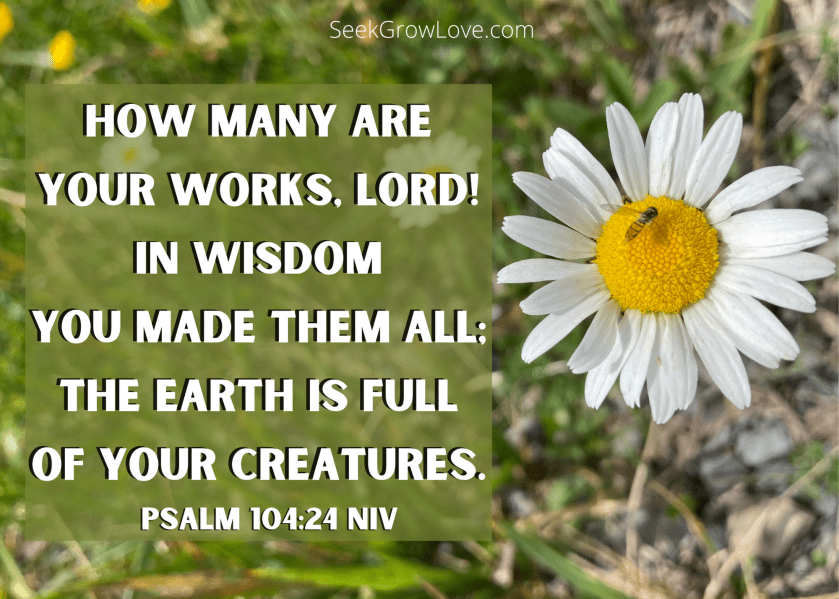
Much of the praises today are focused on God’s compassionate character as the Creator of the world and everything in it.  The praise is focused on God’s works, and forgiveness, despite humanity’s faults. Even in Psalms 102, where the author is lamenting over their life circumstances, they still give praise and recognition to an eternal and compassionate God before the psalm ends!

Most Psalms have all these similar themes of praise and recognition of God’s character, just phrased differently and from different perspectives in different life situations.  They are not written to recount a story from long ago like most of the other books in the Bible, but are written by people experiencing very real, raw, emotions.  It’s basically like reading someone’s personal prayer journal!  Because these authors were real people, there is a strong likelihood you resonate with their real feelings of real life situations.  And because we praise an unchanging God, we can have confidence that we too, can experience the same comfort and joy when we praise Him.  No matter if you are in a time of lament, a time of needing redemption, or a time of awesome recognition of our creator, you can find a way to Praise Yahweh.  

Sarah Johnson

Reflection Questions

  1. How’s your “praise life” been lately? Are you taking opportunities to Praise God instead of just petition Him in your prayers? How can you improve this week?
  2. Pick your favorite “praise” verse from today’s reading to focus on this week.  Consider memorizing it to add to your own prayers! 
  3. In our 1 Chronicles passages today we read about the death of Saul due to his unfaithfulness towards God.  Saul began consulting others instead of God, and certainly did not praise Him for all the provision he had been provided.  Read Psalms 103 again, keeping this story in mind.  What can you apply from the message of this Psalm to Saul’s life and death?

The Same God

Psalms 81, 88, 92-93

1 Chronicles 7-8

Today’s reading takes us across several different life experiences many (if not all) Christians also experience in today’s modern world:

  • Psalm 81 is a reflection of God’s provision for Israel, and a reminder of the good things they could be experiencing if they would only listen to Him.  
  • Psalm 88 is an example of low places so many of us have experienced in our Christian walk.  The writer is calling out to God to save them from suffering, to answer their prayers, and to bring them comfort in a place of loneliness. It is a lamentation and pouring out of a soul that is broken and hurting.  
  • Psalm 92 is a psalm of praise and excitement over the wonderful works of God!  This author is experiencing joy and astonishment over a Heavenly Father, and being sure to sing it loud and proud!
  • Psalm 93 is another praiseful psalm that focuses more on the sovereignty of God and His mighty power, recognizing the strength of God and His position over the entire earth. 

While each of these Psalms hold different perspectives of a human’s viewpoint of God, we can also see how in each of these, God’s unchanging, steadfast, supreme authority remains.  No matter what our current reflection of God is, He has never become anything but God.  Whether we are disobedient, hurting, praising, or fully recognizing His power, God is still, and has always been, the Creator, Yahweh, the One True God.  The God who formed and controls every aspect of the earth, that pulled the Israelites out of Egypt, and held them accountable to His commands, is the SAME GOD that you and I worship today.  

This fact can (and probably should) be both comforting and convicting.  Comforting because there is an amazing God who loves us with an everlasting love that will never change from that! Convicting because there is a powerful God, who has high expectations for believers, that won’t change from that either.  As Christians today, I believe we must consistently balance these feelings of comfort and conviction in order to best live out our days.

-Sarah Johnson

Reflection Questions

  1. Using the four options listed, what would you classify as your current reflection of God in this season?  Are you content to have that reflection?
  2. What verses most stood out to you from the reading?  Why do you think those verses impacted you the most today?

Remember – and Share

Psalms 73, 77-78

1 Chronicles 6

Another Psalm, another author!  Asaph was a Levitical musician appointed by David.  As a musician, it makes sense why the Psalms in his name invoke quite a bit of feeling!

In each of these Psalms we see components of the author’s experience that we have likely felt in our own lives.  For example, Psalm 73:12-14 highlights the feeling that it seems the wicked seem to prosper while the pure in heart still experience suffering!  Has anyone else had that thought cross their mind?  I know I have. Or from Psalms 77:7-9, the feeling that God has withheld His love and compassion from you? Or, in recounting the Israelite experience in Psalm 78, have we been in moments of testing God, and ignoring His redemption from our enemies?

Throughout these chapters, we see a theme of remembrance.  Whether this is people finally remembering God’s awesome power, generations being reminded of God’s miracles, or God ‘remembering’ that people are only people, remembrance is a prominent component to these musical psalms.  

When people remember God, it is after they have experienced hardship, caused by the complexities of life, or God’s wrath towards their sin.  It comes with recognition of God’s mighty works and requires humility.  Remembering God then brings about a change from a destructive path, back to a path of righteousness and holy pursuit of God’s presence.  Forgetting God and His wonders results in separation from Him for as long as someone forgets.  Remembering Him correctly as the omnipotent Creator is what brings us back to His gracious and compassionate presence. 

However, when God ‘remembers’ His people, it is not because He at some point forgot the way people forget, but rather He re-extends His grace yet again after His people have sinned; He acknowledges them (us!) in their sinfulness.  God’s remembrance is not for His benefit, but for the benefit of His people.  And without it, it wouldn’t be possible for people to experience redemption.  

Remembering God, and His remembrance or compassion towards people is something worth sharing!  Psalm 78:1-8 describes how important it is to tell others, future generations, about God’s works and power.  Whether or not you have children of your own, you do have the opportunity to impact the next generation of believers.  You can do this by reminding believers of our awesome God – reminding them of the importance of following His commands and pursuing His presence in their own lives.  No matter your age, you may feel like your generation has forgotten God.  But you, yes YOU, have the ability to start remembering Him today, to impact yourself and those around you, tomorrow.

-Sarah Johnson

Reflection Questions

  1. Are there seasons in your life that you have really remembered God?  What stood out to you during that time? How could you carry that over to all seasons of life, especially ones where you may be more likely to forget Him?
  2. What could you share about God’s works in your life with people in your circle that would help you or them remember Him today?

Yearning for God

Psalms 84-85, 87

1 Chronicles 5

Have you ever yearned for something?  

I recently had a baby boy, who decided, after about 3.5 weeks of false labor contractions and me walking around 4cm dilated for a week, he would grace us with his appearance 2 days after his due date.  For comparison, my firstborn came a week early with only those pesky Braxton Hicks contractions leading up to his debut.  Anyone who has known me over the past 9 months knows that I was fully convinced this second baby was coming early.  It felt like my entire mind was consumed by thinking about going into labor every moment of every day!  I was grouchy, distracted, and mentally exhausted.  My yearning brought me no closer to my baby, and really only made me more distant from everything positive going on around me. 

The sons of Korah write in Psalm 84:2 “My soul yearns, even faints, for the courts of the LORD; my heart and my flesh cry out for the living God.” (NIV).  The NET translation phrases it as “with my whole being, body and soul, I will shout joyfully to the living God”.  This verse paints a picture of absolute, consuming, desire for closeness with God.  The chapter continues on to describe a blessed happiness that can be found when focused on praising the Almighty, when trusting in the Lord of Hosts! (v. 4, 12).  

Psalm 85 continues this picture of desiring closeness with God, but takes a slightly different perspective.  In Psalm 84, I get this imagery of excitement, anticipation, energized passion for God, whereas Psalm 85 depicts an image of peace, protection, and righteousness in relationship.  There is still a deep longing for a connection, but it’s like comparing the honeymoon, “puppy-love” phase of a new marriage, to a secure, content, lifelong covenant marriage.  

Verse 9 describes this type of relationship through salvation by fearing God.  This “fear” is derived from the Hebrew word “yare”, which means to revere, or be afraid of because of profound respect .  It’s not meant to be a fear that causes us to avoid approaching the throne, but rather a fear that places us in rightful, humble, submission to an awesome God, worthy of being revered, and yearned for.  One that should make us say, “my whole source of joy is in you” (Ps. 87:7). 

Even though babies are one of the greatest gifts, my yearning to deliver my son began to impact my relationship with God (and others!) as I began to prioritize birth over my spiritual relationship with the One who made life.  I wanted to control the timing, and I wanted it to be now!  But, when I started to misplace my priorities, I felt less joy, less excitement, and less peace about the whole situation.  How often does this happen in our lives?  We begin to place closeness to someone or something above our desire for closeness with God… and unsurprisingly, we don’t get the same satisfaction we may have been hoping for.  We can become bitter, resentful, stressed, you name it… anything but joyful.  Yearning with such intenseness for the wrong things in life, even when they are good things, will never lead to a joy-filled life.  BUT, when we keep ourselves yearning intensely for a relationship with God, and when we humble ourselves to Him, we experience true joy, true peace, and true satisfaction, only He can deliver!

(And baby boy arrived healthy and happy, just when God intended him too 🙂)

Sarah (Blanchard) Johnson

Reflection Questions

  1. Evaluate your faith walk right now – would you describe yourself as yearning for a relationship with God?  What other aspects in your life might you be misplacing above your relationship with Him?  
  2. What steps can you take to practice fearing, or revering, God today?

Dear Church in Laodicea – and You

OLD TESTAMENT: Jeremiah 43-45

POETRY: Psalm 119:73-80

NEW TESTAMENT: Revelation 3:14-22

Rev. 3:14-22 – Letter to Laodicea

You’ve made it to the last letter!   Thank you, as always, for joining me as we grow in our faith walk.  It is always a pleasure and a growth experience for me as well!

Laodicea is one church briefly mentioned outside of these Revelation verses.  While writing to the Colossians, Paul also mentions the church in Laodicea, encouraging them throughout his letter there, and reminding the Colossians that this letter was meant for the Laodiceans as well (Colossians 4:16).  By some verses, it seems that Paul himself did not travel there, but did have fellow believers he was connected with that traveled there on his behalf and supported the ministry.  There is some scholarly debate as to if Paul ever wrote Laodicea a letter directly that may be hidden in one of the other New Testament books, or lost, or simply is a misunderstanding of translation.  A mystery you could choose to explore yourself… but not our main point for today.

Laodicea was a very wealthy, abundant city.  When destroyed by an earthquake, they refused to take Roman funds but instead paid themselves to rebuild it back to its prosperous state.  It was full of strong, independent, rich people.  And yet, it is listed as a church with no positive attributes and only rebuke from Jesus. In fact, Jesus writes of his desire to spit or vomit them out (v.16). Ouch.  

So, what’s so bad about being lukewarm?  At least they weren’t called spiritually dead like in Sardis, right?? Well, Sardis was at least doing something, and there were a few members still actively living out the truths of Jesus’ ministry.  It seems that Laodicea was truly doing nothing… they weren’t being useful in any capacity, and were so inflated with their own sense of self that they didn’t even notice they were really poor, blind, and naked (v.17)!  They had turned their hearts so far towards their own wealth and recognition, that they truly just abandoned their faith.  Maybe they still met at church for a social gathering, but there was no discussion, no action, no edification, no growth.  They weren’t doing one thing wrong, they were doing absolutely nothing.

To correct this, Jesus gives them advice to buy gold from him that has been refined by fire, clothes to cover their nakedness, and salve to heal their blindness (v.18).  In the context of this particular church and city, this probably felt a bit like a slap in the face.  They had their own gold, they made their own beautiful linens, and they even were known for their medicinal salve! Why would anyone tell them they needed to go anywhere else to get those things?  Well, Jesus was trying to point out the fact that what he was “selling” was nothing they could find in their own material possessions. He was intending to knock them down a few notches and realize what they needed was God’s grace, and that wasn’t something they could just buy at one of their various stores around town!

In verse 19, Jesus reminds this church that he rebukes and corrects the people he loves.  One thing this church has going for them, that really every single person has, is that Jesus loves them enough to call them out!  In this letter he reminds them that he is present, he is knocking at their door, calling for them, with an invitation to spend time with him (v.20).  Jesus is actively pursuing this group of people with a desire to include them, to lift them up to a place of majesty (v.21).  He deeply wants them to be part of the Kingdom, but they needed to first recognize how much they needed him to get there.  There is a destruction coming that they aren’t going to be able to pay for themselves… and Jesus wants them to be on the side of redemption instead.

When we experience worldly wealth and success, we run the risk of becoming lukewarm in our faith, because we lose the recognition of our true need for God.  We must have a level of humility and respect (or fear!) for the Creator of all things in order to really put our faith in action daily!  We are dependent on God for so much more than we may consciously think throughout our days, but when we ignore how we desperately need His Grace, His Son, and His plan for salvation, we miss out on the opportunity to be in His Kingdom.  Not to mention so many other blessings we could experience in this current life!

My prayer for anyone reading these devotions this week is that you were able to find something that spoke to you.  Whether it was conviction, encouragement, or an idea for how to apply it in your home and church, I hope you found something in it for you.  I pray it was a blessing and that you continue to dive deeper in Scripture to continue strengthening your faith!  

Reflection Questions:

  • Have there been seasons in your life where you “forgot” to rely on God?  Have there been seasons where you were reminded of just how much you needed Him?  What were the biggest differences in your life at those times?
  • What barriers do you see in your life that prevent you from relying on God, and may get in the way of you focusing too much on your sense of self?
  • If you’re anything like me, you probably saw a bit of yourself in each letter.  When reflecting on each letter, which do you resonate with the most?  Re-read Jesus’ correction for the church you feel most like, and see how you can apply that rebuke to your life this week. 

-Sarah Johnson