When was the last time you made a truly eternal promise? If you’re married, hopefully, you’ve made an eternal promise of love and commitment. I’m sure if you have children, you’ve vowed to love and cherish them always. Even something as seemingly simple as getting a tattoo is a promise to yourself that you’ll carry that image on your body for the rest of your life.
Today’s scripture, 2 Samuel 7, reveals the profound truth of God’s eternal promises. This passage contains the Davidic Covenant, where God promises that David’s house will rule forever. We know this promise will be fully realized when Jesus returns to establish God’s Kingdom on earth. Think about it: God has been keeping this promise for over 3,000 years! Despite Israel’s occasional disappointments and frustrations, God remains steadfast.
While our most sincere promises can falter due to betrayal, anger, misunderstanding, or irreconcilable differences, a promise from God is unwavering. That’s a reason for a true celebration!
David’s response to this incredible promise is one of humility and awe: “How great you are, Sovereign Lord! There is no one like you, and there is no God but you, as we have heard with our own ears.” Today, may we find ways to celebrate God’s faithfulness that has endured all this time and will continue long past us.
-Hope Fletcher
Reflection Questions
When have you witnessed or experienced God’s enduring faithfulness?
When have you responded to God with humility and awe saying (similar): ““How great you are, Sovereign Lord! There is no one like you…”?
How are you at keeping your promises? Can your word be trusted?
Integrity is a part of your character that you can’t develop overnight- it involves a lifetime of good, honest, and moral decision-making. In Psalm 101, we read words written by David telling us how he desires to live with integrity in both his personal life and in his rule. Though none of us are likely to ever be kings, we can still apply a lot of this wisdom to our own lives, but you should probably leave the destruction of the wicked to others.
So, how can we walk with integrity like David? First, we see that he will “ponder the way that is blameless.” It’s a good practice to consider what it means to live in a way that glorifies God. Ponder your life and seek to be blameless in the way you live and make changes that you need to make.
Then, “I will not set anything worthless before my eyes.” What are you focusing on? What gets most of your attention throughout the day? Do me a favor and take a moment to check your Screen Time Report on your phone. Now, answer honestly- how many of the things you set before your eyes are worthless? Replace these worthless things with things that will improve your life, your mental health, and your relationship with God.
We also see that David is actively avoiding “perverse hearts,” “those who slander their neighbors,” “those with a haughty look and arrogant heart,” and those who “practice deceit.” Take a look at the people you allow to influence you, the people in your inner circle. Are they fostering your growth or hindering it? Surround yourself with people who will offer you godly advice and support. Build a community around you that will carry you when you can’t carry yourself.
-Hope Fletcher
Reflection Questions
What do you see as the importance of pondering the way that is blameless? What in your life this month has brought glory to God? What has not?
What is worthless? What is not? “What are you focusing on? What gets most of your attention throughout the day?”
“Take a look at the people you allow to influence you, the people in your inner circle. Are they fostering your growth or hindering it?” Who could you intentionally spend more time with in order to work towards your own godly growth? Set up some time together with this person/these people and pray about your time together.
Welcome back! We are taking a brief break from our Psalms passages today 🙂
When David was anointed king over Israel, we are told that all the Israelites, all the elders, and several warriors from other areas were fully committed to the decision of making David king. That’s pretty darn impressive to get so many people on the same page about who the next leader is going to be!
But, considering the prophecy Samuel communicated to Israel earlier on, we should not be surprised this was the response to David’s reign. This wasn’t the first time David was anointed, this was simply the fulfillment of a prophecy started years earlier. And, it continued the groundwork for the Davidic covenant that connects the dots between Jesse (David’s dad), and Jesus the Messiah, which would be the fulfillment of a prophecy to come several hundred years after! It would become a pivotal point for believers, they just didn’t know it yet.
Today is Good Friday, last Sunday was Palm Sunday, and while our passages don’t reflect the story of Jesus triumphantly entering Jerusalem, they are part of the history that took place to make it possible for people to shout out “Hosanna to the Son of David!” 28 generations later. When David was anointed king over Israel, all around were filled with great joy over his rule (1 Chron. 12:40). When our King returns again to fulfill the final, greatest prophecy yet, we will experience an even greater joy than this! Praise God for all the stages of history He aligned to give us full confidence in the returning, rightful King!
Sarah Johnson
Reflection Questions
Are there moments in your life that you look back at and see how significant it was to getting you where you are today? Take a moment to reflect on those moments now and thank God for how He works in your life!
How are you preparing your heart and mind for the Easter season this year?
2 Samuel begins with Saul’s death. Chapter one tells of his death and David’s reaction. Chapter two shows David seeking God’s advice and being anointed king over Judah, the northern kingdom. Also, we see Abner anointing Ish-bosheth, Saul’s remaining son, king over Israel, the southern kingdom.
Both armies met at the pool of Gibeon. 2 Samuel 2:14 says, “And Abner said to Joab, ‘Let the young men arise and compete before us.’ And Joab said, ‘Let them arise.’” They arose, each sending 12 men to fight. They each caught their opponent by the head and thrust their sword in their opponent’s side. All 24 died. Not the brightest way to fight! A battle broke out after this and one of Joab’s brothers, Asahel, ran after Abner; Abner ends up killing him. That brings Joab and his other brother, Abishai, pursuing Abner. Joab ends up retreating, but David’s men won the battle 20 deaths to 360 deaths. Chapter three tells of Joab and Abishai getting their revenge on Abner and of Ish-bosheth’s death.
There you have the cliff notes version of the first four chapters of 2 Samuel.
There are two stories in these chapters that show David’s moral character. If you remember, there were a couple of times when Saul was chasing David when David could have killed him and did not because Saul had been anointed by God. Even though it would have been viewed as a proper response to the situation, David didn’t do it. In 2 Samuel 1 an Amalekite man comes to David to report Saul’s death. He tells how Saul, near death already, asks to be put out of his misery and how he honors that request. David kills him. In 2 Samuel 4 we read that after Abner was killed Ish-bosheth lost his courage. Two captains of raiding bands for Ish-bosheth realized they were on the losing side and wanted to find a way to show their loyalty to David. They killed Ish-bosheth and brought his head to David. They were proud of their actions, and thought David would be as well. Just like the Amalekite man, David has them killed.
One more side note…In chapter four we are also introduced to a character who doesn’t come into play until chapter 9. Verse 4 says, “Jonathan, the son of Saul, had a son who was crippled in his feet. He was five years old when the news about Saul and Jonathan came from Jezreel, and his nurse took him up and fled, and as she fled in her haste, he fell and became lame. And his name was Mephibosheth.” Just keep that mouthful in mind (muh·fi·buh·sheth).
Amy Blanchard
Reflection Questions
When you think of your own moral character, how would you rate yourself?
When the world says something is right and good do you consider if that is how God views it? Who do you choose to follow?
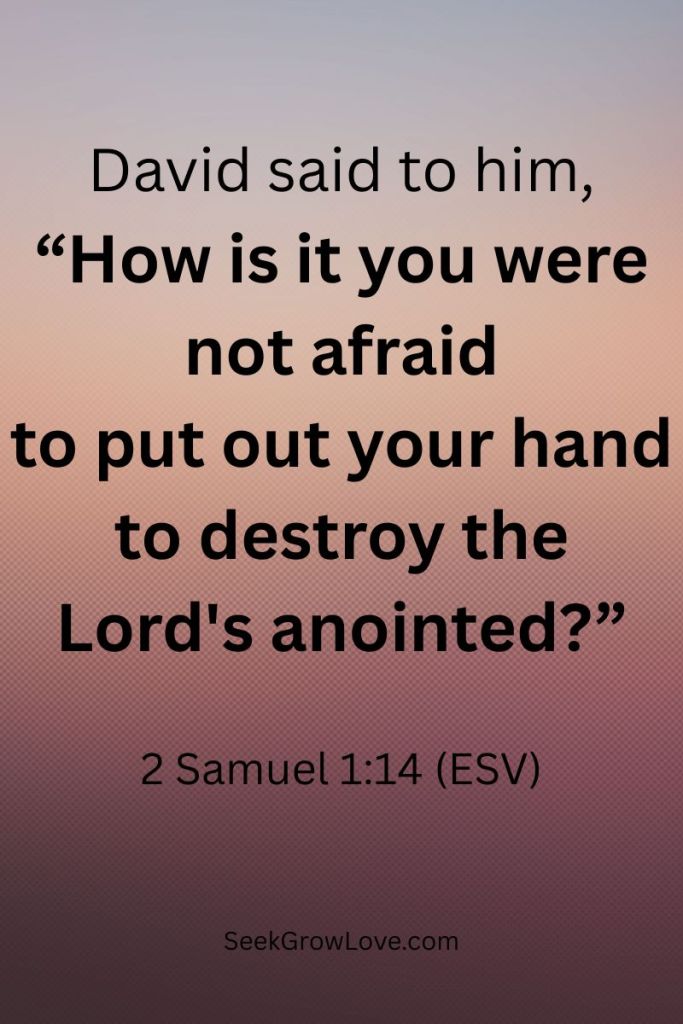
Keeping in mind 2 Samuel 1:14, what are some things that David – and God – would suggest we should be afraid of?
Do you have good days? Days when you feel God’s hand moving in your life. Days when you feel protected. Days when you feel good about doing what is right.
David wrote this Psalm on a good day. On a day that God delivered him from his enemies. Here is a small sample of what David faced:
Vs 4 – the cords of death encompassed me
Vs 16 – he drew me out of many waters
Vs 17 – rescued me from my strong enemy, from those who hated me
Vs 18 – they confronted me in the day of my calamity
Vs 48 – my enemies, the man of violence
I’m guessing most of us don’t face literal enemies who are trying to kill us. However, we do face the enemy every day. Does that sound crazy to you? Do you consider that Satan is attacking you on every front every day?
Here are some ways Satan attacks each one of us: temptations, deception & lies, discouragement, fear, doubt, and the list goes on. But, as I often ask, what does that look/sound like? I believe it’s different, specifically, for each of us. What tempts me might not tempt you at all. Here are some examples:
A group of friends or co-workers are talking about someone you know. They are suggesting this person is doing some really bad things. You feel included when you are part of the conversation and you like that feeling. You feel important being “in the know” when you see others later and share the details discussed. Information is power and you like holding that power.
Things haven’t been going well for you. Maybe it’s being overlooked for a job promotion. Maybe it’s relationships falling apart. Maybe it’s an illness. You begin to be discouraged. You start to doubt God’s goodness and love for you. You listen to the voice telling you that you will always be a failure, you won’t ever get well, God doesn’t care, nobody cares….
So what did David do when he faced all of these enemies? He called out to God (vs 6 “In my distress I called upon the Lord; to my God I cried for help”). That should be our first response to any attack by the enemy.
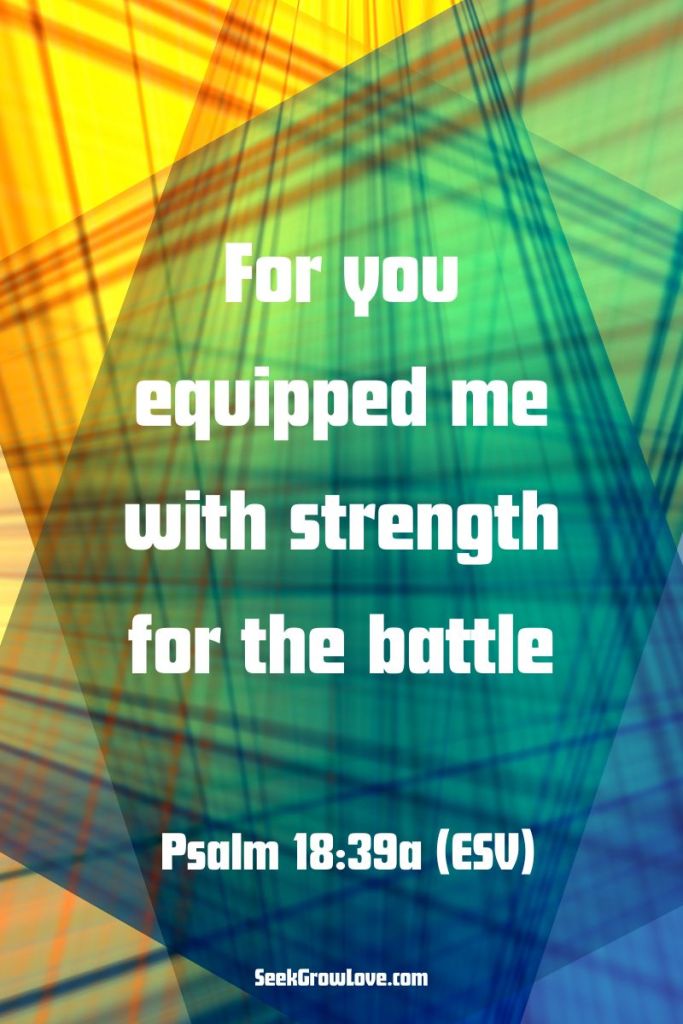
In verses 20-24 David tells us how he made the right choices, followed God’s rules, and was blameless before him. I know I can’t say that about myself. But, looking at what we know of all people, and what we know about David later in his life, we know no one always does what is right (except Jesus, but this was long before his time…). David wanted to do what was right. I want to do what is right. David expresses in this Psalm that his strength to be blameless (forgiven?) comes from God; that his support comes from God; that God rescues him from his enemies. We, having the same God as David, can trust in God’s strength, in His support and in His deliverance.
Amy Blanchard
Reflection Questions
Do you call out to God FIRST when your enemies attack? Think of a time you called out to God for his help (even if it was as a last resort) and you saw His deliverance. Share that with someone who is struggling (maybe that’s you).
Cross check your thoughts against God’s Word. We often “hear” what we want to hear when it is really the enemy speaking, not God. God will never tell you something or lead you somewhere that contradicts Scripture.
On your good days, don’t forget to thank God. Did you call out to God for help, clarity, protection, strength, etc. today? What can you thank Him for, even while you wait for other answers?
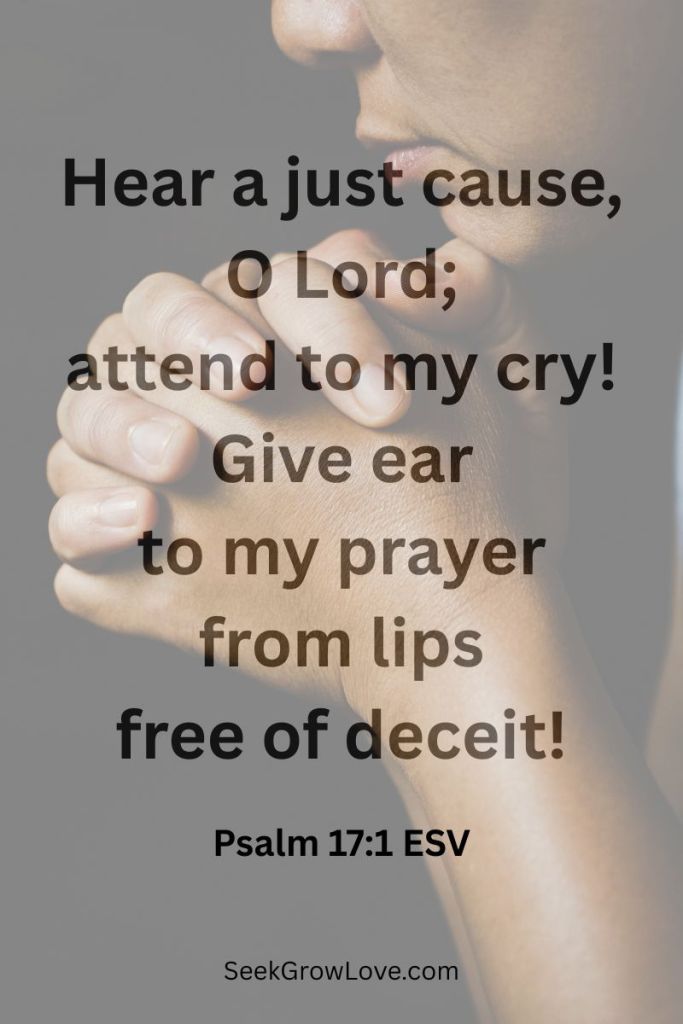
We all think that what we want, the way we think something should be, is a just cause. But is it, really? Lots of things can sound like noble causes, but would they be in God’s eyes? I have been known to think I’m right about something when I’m actually wrong. For example, because texts & emails don’t allow for any verbal cues or body language to help with interpreting the message, they are often misunderstood. I have made the mistake of assuming someone’s intent based on a few words I read on my phone. I have made the mistake of responding unbecomingly – by responding directly to the person with a bad attitude, or worse yet, talking to others about what they sent to me, pleading my “just cause”. I have found myself in the position of having to humble myself and apologize. Maybe you’ve been there, too.
David considered his cause to be just and he wanted God to be the one to vindicate him.
In Psalm 17, David calls on God
To hear him – verse 6b: incline your ear to me; hear my words.”
To show him His love – verse 7a: “Wondrously show your steadfast love,”
To protect him – verse 8: “Keep me as the apple of your eye; hide me in the shadow of your wings,”
David also takes a look at himself
Verse 3b: I have purposed that my mouth will not transgress.”
Verse 4b: “I have avoided the ways of the violent.”
Verse 5: My steps have held fast to your paths; my feet have not slipped.”
David tells God what his enemies are doing
Verse 9a: “the wicked who do me violence”
Verse 10: “they close their hearts to pity; with their mouths they speak arrogantly.”
Verse 12: “…like a lion eager to tear”
David asks God to stop the wicked
Verses 13: “Arise, O Lord! Confront him, subdue him! Deliver my soul from the wicked by your sword,”
David raises his just cause before God. He fully trusts God will see the good and right as well as the ugly and evil. He believes God will respond justly, because that is His character.
Amy Blanchard
Reflection Questions
Taking time to do a self-evaluation can help us see our “causes” (desires) in a more accurate light. When faced with a negative situation, before responding or reacting ask yourself some important questions:
Are my priorities what I want them to be?
Am I being self-centered?
Do I need to right a wrong?
Are you confident in your choices to welcome God’s testing of your heart? If not, what can you do to move in that direction?
Like Psalm 34, which we highlighted yesterday, Psalm 56 for today was also written when the Philistines had seized David in Gath. And just like yesterday’s psalm, this one starts with David begging God for help.
Then, in verses 3 and 4, David says this, “When I am afraid, I will trust in you. In God, whose word I praise, in God I trust; I will not be afraid. What can mortal man do to me?”
I see a pattern here that David liked to repeat:
He acknowledged his fear, “When I am afraid.” Fear is a natural reaction when in danger – either real or perceived.
David then made a deliberate decision to trust God. This is not a normal reaction, it is an intentional decision, flying in the face of the natural fear.
David praised God for delivering him – before he had been delivered. (In this case, David praised God’s word, but often, he just praised God.) When David did this, he was stepping out on faith, believing God would answer his prayers.
Finally, in the assurance God would help him, David banished his fear, “I will not be afraid.”. Notice he chose to not fear what mortal man could do to him.
This reminds me of Jesus’ words in Matthew 10:28, “Don’t be afraid of those who want to kill your body; they cannot touch your soul. Fear only God, who can destroy both soul and body in hell.”
This is a pattern I have also tried to follow in my own life. Many times, I have cried out to God, confessing my fear. I have then made a deliberate decision to trust that whatever God has for me is best, whether I know it (or like it) or not. Then praise God for his promise that all things work together for my good – because I love God. Finally, with God’s help, I let Him lift my burden off my shoulders, whether it is fear, or whatever else it is.
With the fears swirling around now, whether Covid-19, or unemployment, or difficulty finding what you want at the grocery store, or … You have a choice. You can succumb to fear, or you can follow David’s example.
I challenge you to try this pattern with whatever makes you fearful today. Then you can say, like David wrote in yesterday’s reading from Psalm 34:8, “Taste and see that the Lord is good; blessed is the man who takes refuge in him.” And from today’s reading in 56:11, “In God I trust; I will not be afraid. What can man do to me?”
–Steve Mattison
(originally posted April 15, 2020 for SeekGrowLove)
Reflection Questions
What have you been afraid about in the past? What has God already successfully brought you through?
When is fear helpful? Do you have a healthy fear of God? Do you fear only God?
What makes you fearful today (besides God)? Would you like to conquer this fear? Write out David’s steps to replace fear with faith and keep them in a place you will see often and practice working through the steps – over and over again.
Today’s reading, found in 1 Samuel chapters 18 through 20, highlights how far Saul has fallen from his successes of chapter 14. (Remember from chapter 15, that Saul had deliberately disobeyed a direct command from God, and things have been going from bad to worse for him since.)
In 18:10-11, we read, “The very next day a tormenting spirit from God overwhelmed Saul, and he began to rave in his house like a madman. David was playing the harp, as he did each day. But Saul had a spear in his hand, and he suddenly hurled it at David, intending to pin him to the wall. But David escaped him twice.”
Once Saul decided to abandon God, God not only abandoned Saul, God tormented Saul. This should be a lesson to us – never disobey God – there are always negative consequences.
Saul became jealous of David, after David had killed Goliath, because the women of Israel sang this song, “Saul has killed his thousands, and David his ten thousands.” As a result of his jealousy, Saul tried to kill David with his spear in 18:11 and again in 19:10. Saul also tried to kill David by having the Philistines kill him in 18:17, 21, 25. In 19:1, Saul urged his servants and his son Jonathan to assassinate David. In 19:15, Saul ordered his men to bring David (and his bed) to Saul to be killed, when Saul thought David was sick in bed. In 19:20, 21 and 22 Saul unsuccessfully sent troops to get David three times.
In 20:30, Saul boiled with rage at his own son, Jonathan, who was friends with David, and in 20:33, Saul hurled his spear at Jonathan, intending to kill him.
So much for Saul, what about David?
If you were David, how would you react? What would you do?
Remember that Samuel had anointed David in chapter 16, and declared that David would be the next king over Israel. So what did David do? He wrote some songs about this. Let’s see what he said in those songs…
David wrote Psalm 59 when Saul sent his soldiers to watch David’s house in order to kill him. This psalm starts out, “Rescue me from my enemies, O God. Protect me from those who have come to destroy me. Rescue me from these criminals; save me from these murderers. They have set an ambush for me…”. This makes sense. David was in trouble, so he cried out to God for help. David continues in verse 9, “You are my strength; I wait for you to rescue me, for you, O God, are my fortress.”
Then an astounding thing happens. David starts praising God – in advance of God’s rescuing him. Psalm 59 ends with, “But as for me, I will sing about your power. Each morning, I will sing with joy about your unfailing love. For you have been my refuge, a place of safety when I am in distress. O my strength, to you I sing praises, for you, O God, are my refuge, the God who shows me unfailing love.”
David, the man after God’s own heart was actually praising God when he was literally afraid for his life. This shows his great faith that God will indeed rescue him. Maybe this is one of the reasons he was called a “man after God’s own heart.”
Psalm 11, the other chapter from today’s reading also shows David’s faith through difficulty. It starts out, “I trust in the Lord for protection…”, and ends with “For the righteous Lord loves justice. The virtuous will see his face.”
I believe David’s response is a good example for us. When times are tough, it’s natural to cry out to God for help. We need to move on from just asking for help, and follow David’s example to also have faith and praise God, even before the answer comes. And in the process, we, too, may become people after God’s own heart.
–Steve Mattison
(originally posted April 12, 2020 for SeekGrowLove.com)
Reflection Questions
Compare and contrast Saul and David based upon what we know from 1 Samuel.
What do you see in your own life that is similar to Saul? And David?
What does it look like to show faith in God during the difficulty?
What difficulty (big or small) have you recently found yourself in, in which you can practice giving God praise even before the answer comes?
Scripture: “David assembled all the leaders of Israel and all the leaders of the tribes and the commanders of the divisions that served the king and the commanders of the thousands and the commanders of the hundreds and the officials in charge of all the property and livestock of the king and his sons, together with the officials and the mighty men, and all the seasoned warriors, at Jerusalem.” — 1 Chronicles 28:1 (LEB) “So teach us to number our days that we may gain a heart of wisdom.” — Psalm 90:12 (LEB) “Devote yourselves to prayer, being watchful in it with thanksgiving.” — Colossians 4:2 (LEB)
In 1 Chronicles 27, we see David’s meticulous organization of the military and administrative divisions of Israel. This structure ensured that the kingdom functioned smoothly and effectively. David’s leadership shows the importance of planning and preparation in carrying out God’s work.
Chapters 28 and 29 highlight David’s preparations for the construction of the temple. Although David was not permitted to build the temple himself, he gathered materials, made plans, and charged Solomon and the people to carry out the task. David’s forward-thinking mindset underscores the value of preparing for the future and investing in God’s work, even when we may not see the final outcome.
Psalm 90:12 calls us to live with an awareness of the brevity of life: “So teach us to number our days that we may gain a heart of wisdom.” David’s actions in these chapters reflect this wisdom, as he uses his final days to ensure that Israel is prepared for the future and that God’s temple will be built.
Colossians 4:2-18 emphasizes the importance of prayer and watchfulness. Paul encourages the Colossians to be devoted to prayer and to be thankful. This devotion to prayer is essential for effective leadership and preparation, as seen in David’s reliance on God throughout his life.
David’s detailed organization of Israel’s military and administrative divisions highlights the importance of structure and planning in achieving God’s purposes. David’s preparation for the temple, even though he would not build it, teaches us the value of investing in God’s work for future generations.Psalm 90’s call to number our days encourages us to live wisely and make the most of our time, as David did in his final acts. Colossians 4:2 reminds us to be devoted to prayer, a crucial aspect of effective leadership and preparation.
Like David, we do not always see the results of our work. Our Lord teaches us, though, to number our days and live with wisdom, making the most of our time for His purposes. Serve the Lord with a heart of wisdom and a spirit of prayer, investing in His work for future generations.
-Jeff Ransom
Reflection Questions:
How can you apply the principles of organization and planning in your own life and service to God?
In what ways can you prepare for the future and invest in God’s work, even if you may not see the final outcome?
How can Psalm 90’s call to number our days inspire you to live more wisely and purposefully?
What steps can you take to deepen your devotion to prayer, as encouraged in Colossians 4:2?
This phrase shows up twice in chapter eight of 2 Samuel. The repetition of this phrase tells me that it must be an especially important message that God wants us to hear. Reading this sentence calls to mind the passage in Deuteronomy 31:6: “Be strong and courageous. Do not be afraid or terrified because of them, for the Lord your God goes with you; he will never leave you nor forsake you.” (NIV) We know this promise was not just reserved for the Israelites because this promise is referenced again in Hebrews 13 in a message to all believers: 5 Keep your lives free from the love of money and be content with what you have, because God has said,
“Never will I leave you; never will I forsake you.”
I also want to throw in verse 6 for good measure since it really helps drive home the point.
6 So we say with confidence,
“The Lord is my helper; I will not be afraid. What can mere mortals do to me?”
I love that the passage in Psalm 71 is coupled with today’s reading. We can see that David is ever mindful of his source of help and strength and this whole passage reads like a recipe for having joy in the midst of suffering.
6
From birth I have relied on you;
you brought me forth from my mother’s womb.
I will ever praise you.
7
I have become a sign to many;
you are my strong refuge.
8
My mouth is filled with your praise,
declaring your splendor all day long. (NIV)
19
Your righteousness, God, reaches to the heavens,
you who have done great things.
Who is like you, God?
20
Though you have made me see troubles,
many and bitter,
you will restore my life again;
from the depths of the earth
you will again bring me up.
21
You will increase my honor
and comfort me once more. (NIV)
Psalm 71 reminds us that we are not promised a trouble-free life. In fact, Jesus promises us just the opposite in John 16:33: “I have told you these things, so that in me you may have peace. In this world you will have trouble. But take heart! I have overcome the world.”
Notice the promise that we can have peace in spite of suffering and trouble. Peace is even a fruit of the Spirit listed in today’s passage of Galatians 5:22:But the fruit of the Spirit is love, joy, peace, patience, kindness, goodness, faithfulness, (NASB 1995).
What is the key to having this peace? Abiding in Christ and holding fast to our hope that Jesus has overcome the world is key!
We are further reminded of this promise in today’s passage of 2 Samuel 7 that unfolds God’s covenant with David that will be fulfilled through Jesus Christ:
12 When your days are complete and you lie down with your fathers, I will raise up your descendant after you, who will come forth from you, and I will establish his kingdom. 13 He shall build a house for My name, and I will establish the throne of his kingdom forever. 14 I will be a father to him and he will be a son to Me; when he commits iniquity, I will correct him with the rod of men and the strokes of the sons of men, 15 but My lovingkindness shall not depart from him, as I took it away from Saul, whom I removed from before you. 16 Your house and your kingdom shall endure before Me forever; your throne shall be established forever.” (NASB 1995)
No matter what life throws our way, we can have peace and joy by abiding in Christ and holding fast to the hope we have in him thanks to the loving plan of our Heavenly Father. May we be especially comforted by God’s promise that He will never leave us or forsake us. We are not alone in this journey and God—the maker of the universe—cherishes us and is with us every step of the way! Wow!
Luke 12:7 Indeed, the very hairs of your head are all numbered. Do not fear; you are more valuable than many sparrows. (NASB 1995)
-Kristy Cisneros
Reflection Questions
When have you needed to hear Psalm 71? How can you relate to David and his words?
If you were to make a poster, memory card or bumper sticker of one or two verses from Psalm 71 which verses would you choose and why?
Where would you rate your peace – even in the midst of trials? Where would you rate your joy? What can you do to increase your peace and joy? How can you abide more closely to Jesus, how can you trust more fully in His Father and yours?






 Seek Grow Love