
Love is the Greatest Motivator

Proverbs 19-21

Every chosen action is a result of a complex combination of a variety of motivations, but each one can be traced back to a source of love. Some form of love is at the base of every decision, as people prioritize what they love most. The recipient of love could be God, oneself, another person, a physical object, or even intangible concepts such as happiness or power. Loving God is a common commandment and suggested motivator throughout the Bible, but not every other object or concept is as desirable to love from a biblical perspective. Wisdom is needed to differentiate between what should be loved, and what shouldn’t be, which will ultimately have a great impact on what decisions are made and what actions are taken. 

Proverbs is known for describing wisdom and contains numerous examples of valid sources of love and others that should be avoided. Wisdom itself is a great concept to love according to the Bible, as Proverbs 4:7 commands to “Get wisdom. Though it cost all you have, get understanding” (NIV). Wisdom is so valuable that it is worth sacrificing all else. In other words, the love for wisdom should be greater than the love of money, material resources, fame, power, or anything else. All those concepts and objects are discouraged as primary sources of love throughout Proverbs. 

While there are many things not worthy of love, Proverbs and the rest of the Bible offer several suggestions to give one’s love to. Most notably, aside from God, are other people. The command to love others is present throughout the Bible, but it is even more meaningful and impactful than simply being nice to one another. Not only is some form of love at the root of all motivation, but the recipient of that love is commonly love itself. People love to be loved. God designed people to need to be loved, and Proverbs 19:22 claims that “what a person desires is unfailing love”. Many people are willing to sacrifice a lot to be loved. It is the greatest motivator and is often the force causing many actions and behaviors. While it is still beneficial to simply be kind to a neighbor or provide for the physical needs of others, genuinely loving others requires providing what is needed most—love. Building a strong and unselfish relationship on unfailing love increases the impact one can have in the lives of others. It makes it easier to spread God’s word and His Kingdom. 

As with all things, it might require some sacrifices to love others effectively. However, that isn’t a problem if love for others is greater than the love of whatever is put aside. Sacrifices will always be made for what is loved the most. Therefore, carefully prioritize what is loved. Love God and love others to use the natural motivation to encourage godly choices, behaviors, and actions to have the greatest impact in the world.

-Josiah Railton

Reflection Questions

  1. “Some form of love is at the base of every decision, as people prioritize what they love most.” – What do your decisions show that you love most?
  2. What do you WANT to love most? What is getting more of your love now than it deserves?
  3. What sacrifices have you already made for what you love most? What additional sacrifices might be ahead? What sacrifices have others made for you?
The Voice of Wisdom

Proverbs 7-9

Do you ever find yourself looking at someone else’s situation or decisions and think, “I would have done that completely differently”? Of course you have. We all have. The world is full of armchair quarterbacks and side seat drivers. It’s so much easier to look at someone else’s situation and evaluate it as an outsider without the pressures of personal consequence. 

In the heat of the moment, standing at our own crossroads, however, we get wrapped up in the “what ifs” and the worries about whether or not we are making huge mistakes. So how do you know when you’re doing something wise or foolish? 

Chapters 7 and 8 of Proverbs personify danger/foolishness and wisdom as two women. The first woman is the strange or adulterous woman, luring in a simple youth. She uses “smooth talk” and “persuasive words” to seduce him. I feel it’s worthy to note that sexual sin is being used in this personification, probably because it’s the most common and most dangerous. And her opposite is wisdom, who doesn’t use tricks or wordplay, but speaks plainly. She promises no shortcuts, but offers instruction, knowledge, and truth. 

Both women have some similarities though. They are both crying out to those around them, trying to persuade others to follow them. They are both offering up benefits to listening to their words. So how do we know which to listen to? 

It seems obvious when we read the chapters, right? It’s less obvious in our own realities, though. Less obvious, but it’s still possible to make the correct choice. As in all decisions, we should test our options against scripture. If you want to know if your actions are wise or dangerous, test them against God’s word. Discernment, the ability to judge well, is a skill that everyone can, and should, develop through practice. The more we know of God’s word, the better equipped we will be to look at the paths before us and choose the wise one, the one that aligns best with scripture. 

When wisdom calls out to you, don’t you want to be familiar with her voice? 

My prayer for you is that you become so familiar with the voice of wisdom, the words of God, that you are not easily fooled or led astray. I hope you will love instruction so that you will continue to grow in wisdom and righteousness. I pray that you find the benefits of wisdom listed in chapter 9: “For through wisdom your days will be many, and years will be added to your life. If you are wise, your wisdom will reward you.”

-Jenn Haynes

Reflection Questions: 

What decisions do you face right now? Have you placed your options up against scripture? 

How is your scripture study? In what ways can you make yourself more familiar with God’s word, and the voice of wisdom, so that you can easily recognize it?

Are there any voices of temptation in your life right now that are trying to call out to you? Take a moment to honestly analyze and reflect. Often we want to shy away from facing the hard truth that there are likely things in our lives that we enjoy but that we should give up because they are unwise. Does that hold true for you? 

Gotcha!

Joshua 9-11

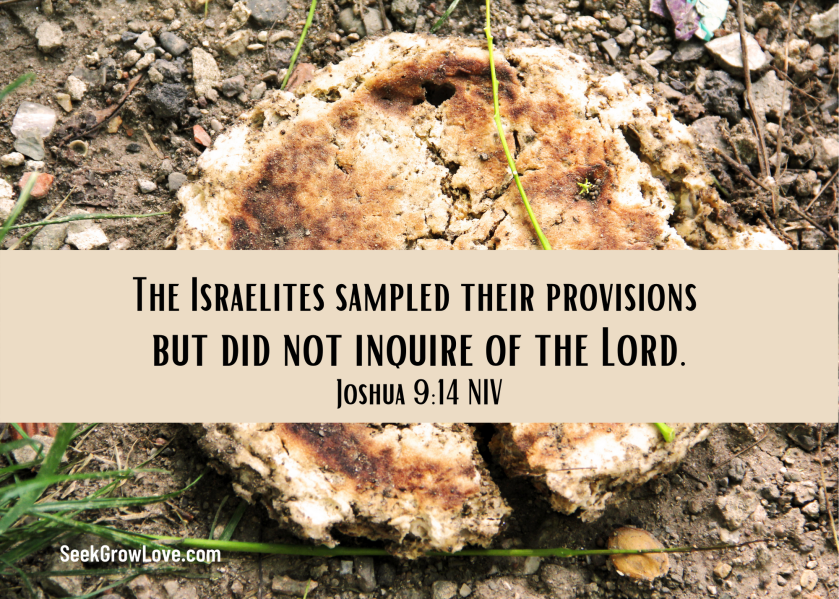
When the inhabitants of Gibeon heard what Joshua had done to Jericho and Ai, they acted deceptively. They gathered provisions and took worn-out sacks on their donkeys and old wineskins, cracked and mended. They wore old, patched sandals on their feet and threadbare clothing on their bodies. Their entire provision of bread was dry and crumbly. They went to Joshua in the camp at Gilgal and said to him and the men of Israel, “We have come from a distant land. Please make a treaty with us… Then the men of Israel took some of their provisions, but did not seek the LORD’s decision. 15 So Joshua established peace with them and made a treaty to let them live, and the leaders of the community swore an oath to them. Joshua 9:3-6;14-15  (CSB)

“Be skeptical of everyone, including the skeptics”. I don’t know where this quote or phrase came from, but I often find myself in that mindset. Why? Because of stories like this. There are those out there who would try to deceive and use this deception to take advantage of others. I used to get calls and emails all the time at the church from people who were looking for money to help with something. There was always a story about why they were in this tough situation. The second half of that quote also resonates because sometimes people just like the status quo or throw cold water on other people’s ideas.

Maybe some of those people were deceptive, and maybe some of them were genuine. I don’t know. What I do know is that there were occasions where I would try to give something, but there were times that I did not. I did my best to discern who was authentic, but I couldn’t really know. What I could do was pray about it and see if God gave me a push in one direction or another, but if he didn’t, I’d need to make a choice. In situations of meeting needs or requests, you can’t help everyone, we have finite resources. I do think it is important not to be dismissive of every request because there are people who genuinely have needs and come to churches as a last resort.

When the Gibeonites came to Joshua and the men of Israel, they did their best to pull one over them, and it worked. The leadership did appear to be skeptical and questioned the Gibeonites, but they neglected to check with something powerful that they had at their disposal: access to Almighty God! Rather than checking on what God wanted them to do, to seek wisdom in this situation that some of them even thought might be a little fishy, they made a knee-jerk decision and swore a treaty to do no harm.

Don’t you think that it would have been wise to consult God when there were treacherous peoples all about the land? The Gibeonites got their protection, but they found themselves indentured to the Israelites because of their shenanigans. I guess that beats death? Some might disagree.

When faced with big decisions, we should come before God and seek wisdom. Especially when we are the leaders of his institutions. Whether leading the Israelites four millennia ago or leading in Christ’s Church today, when we face big decisions (skeptical about what is going on or not), we must always ask what God would have us do. We have scripture to guide us, as well as the Spirit of God that will guide us when we are earnestly seeking after him. When we see leaders fall or make ruinous decisions, we can probably rest assured knowing that they did not honestly seek God’s will and input for that decision. Unless God is intent on making a statement with you like he did with Hosea, he is not going to tell you to make decisions that would be considered dubious by wise observers.

-JJ Fletcher

Reflection Questions

  1. Can you think of a time that not seeking God’s decision burned you? How did you respond or recover after?
  2. Do you find yourself to have a healthy level of skepticism, or do you often find yourself being a bit too Pollyannish? Is there value in both? What are some of the drawbacks of each of these traits?
  3. Do you think Joshua and the leaders learned something from this experience?
  4. How do you think it best to navigate people who are too extreme on the scale of being too trusting or distrusting? What can we do to be a good emissary of Jesus in those situations?

The Battle Rages On

Proverbs 9

Wisdom vs. Folly

This chapter starts with wisdom again calling out to the naïve and the foolish.  Wisdom is calling for everyone to forsake folly and proceed in understanding.   This is very similar to what we saw in chapter 8.

Starting in verse 7, it changes topics a bit.

He who corrects a scoffer gets dishonor for himself,
And he who reproves a wicked man gets insults for himself.
Do not reprove a scoffer, or he will hate you,
Reprove a wise man and he will love you.

It seems like we should try to help everyone gain wisdom, and that would be great.  However, is someone does not want to gain wisdom, or isn’t open to listening to you, you need to be prepared for their reaction.  You may be insulted or even hated for trying to impart wisdom.  I don’t think this means that you should give up on those who insult you, but possibly there are times to back off or change tactics.

On the other hand, we should each look at how we respond to someone who is trying to Proverbs 9 9 NIVhelp us seek wisdom.  Are we upset when someone points out that we are not making the best decision?  Or, do we appreciate the instruction being given to us.  This is a sign of where each of us are in our pursuit of wisdom.  Verse 12 says:

If you are wise, you are wise for yourself,
And if you scoff, you alone will bear it.

If we are scoffers, we are lacking in wisdom and will have to deal with that ourselves.

Then, starting in verse 13, we see another section where folly is being personified and calling out to people, trying to pull them away from wisdom.  There is a battle between wisdom and folly shown between the beginning and the end of the chapter.  This is showing us that gaining wisdom is not easy, even when that is what we want.  We know the outcome of seeking wisdom, and the outcome of folly.  So, we need to make sure we are continuing to seek wisdom and not be lead astray by folly.

Andrew Hamilton

Decisions, Decisions…

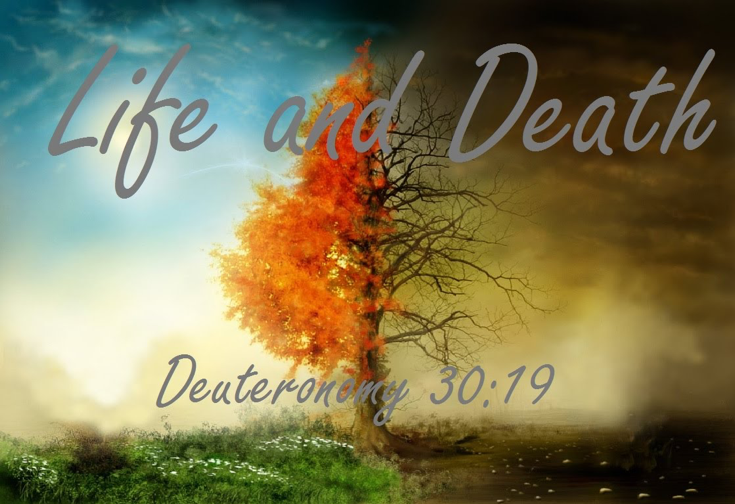
Deut 30

Deuteronomy 30: 15-20 has become one of my most often used passages. It is talking about our decision and the true choices we have. I think these verses need be used in all of our decisions. Deut. 30:15-20   “See, I have set before you today life and prosperity, and death and adversity; in that I command you today to love the Lord your God, to walk in His ways and to keep His commandments and His statutes and His judgments, that you may live and multiply, and that the Lord your God may bless you in the land where you are entering to possess it. But if your heart turns away and you will not obey, but are drawn away and worship other gods and serve them, I declare to you today that you shall surely perish. You will not prolong your days in the land where you are crossing the Jordan to enter and possess it. I call heaven and earth to witness against you today, that I have set before you life and death, the blessing and the curse. So choose life in order that you may live, you and your descendants, by loving the Lord your God, by obeying His voice, and by holding fast to Him; for this is your life and the length of your days, that you may live in the land which the Lord swore to your fathers, to Abraham, Isaac, and Jacob, to give them.”

These are the choices that God has set before us “life and prosperity, or death and adversity”, is that a difficult choice. Who would willingly say, I would like more death and adversity in my life. But we are saying that when we choose to live in a way that is anti-God. When we choose to go against the will of God, we choose those things. Then he says, the Lord wants to bless us in our lives, but he only blesses us when we choose to love Him and walk in His ways and follow His commands. But all of His commands are for our own good and leads to a much better way of life. It’s not really a hard choice but it is one that we have to make everyday! Choose Life – the choice is ours but there’s really no comparison, and we can ask ourselves which one leads to the best results. There is only one choice that makes sense.

Sherry Alcumbrack

good choice bad choice