Make a Choice! – 2 Chron. 34


scrolls
This picture is from the Memorial Scrolls Trust (http://www.memorialscrollstrust.org/), a collection of 1600 Czech Torah scrolls saved from the destruction of the Holocaust.


Wow! This week has been such a great reminder for me about the importance of scripture! We began this week by looking at our memory verse from Deut. 30:19-20:

 This day I call the heavens and the earth as witnesses against you that I have set before you life and death, blessings and curses. Now choose life, so that you and your children may live and that you may love the Lord your God, listen to his voice, and hold fast to him. For the Lord is your life, and he will give you many years in the land he swore to give to your fathers, Abraham, Isaac and Jacob.”

We’ve learned how we can choose life through desiring and studying God’s word this week. What does choosing life look like?

Let’s pause for a moment this Saturday morning and turn to 2 Chronicles 34, our key text. The Israelites in the Old Testament always seem to be getting into trouble and turning away from God’s paths. At this point in 2 Chronicles, the kingdom of Israel that Saul and David had established had been divided in two, with the ten tribes in the north making up Israel and the two in the south, Judah. The nation of Israel had become so wicked that God had sent them into exile. The kingdom of Judah had not gotten that bad, yet. But still, the people, under the king’s directions, had begun to worship other gods and neglected the one true God. In 2 Chronicles 33, we find the temple in disrepair and the law of God lost. The nation of Judah was choosing death.

But, in 2 Chronicles 34, we find hope in the form of a boy named Josiah, anointed king at only 8 years old. The Bible said that “he did what was right in the LORD’s sight and walked in the ways of his ancestor David; he did not turn aside to the right or the left” (v. 2). Josiah according to this verse was obviously choosing the path of life. But, what does that actually mean? What did he do that was so righteous?

The rest of this chapter goes on to say that he tore down the false gods that his people were worshiping and cleansed the land. Then, he began to restore God’s temple to how it should be. While the priests were looking through the temple and cleaning it out, they found something pretty important. In verse 14, it says that “Hilkiah the priest found the book of the law of the LORD written by the hand of Moses.” The people of Judah had walked so far down the path of unrighteousness that they totally neglected the law of God and lost it. Later on, it says that the court secretary, Shapan, just told King Josiah, “Hilkiah the priest gave me a book.” The law to him was nothing more than an old book!

Shapan read the law aloud to Josiah and when Josiah heard this, he got so upset that he tore his clothes! He realized that his people hadn’t been choosing the way of life; they hadn’t been keeping “the word of the LORD in order to do everything written in [it]” (v. 21).

choose life

This week, we’ve been meditating on the importance of scripture. We have a wonderful gift already because we have such easy access to the word of God! But, just like the people of Judah, we may neglect it to chase after other things. This year, we have another opportunity to commit ourselves to learning how to choose life from God’s word, both through these devotions and more simply through dedicating ourselves to God. Beginning tomorrow, we will learn more Godly wisdom from the book of Proverbs. Make a choice now to dedicate yourself like Josiah did to the daily reading of God’s word so that we can follow the paths of righteousness that lead to life.

Bible Study Crash Course: Part 1


Bible-Reading-2-3-John
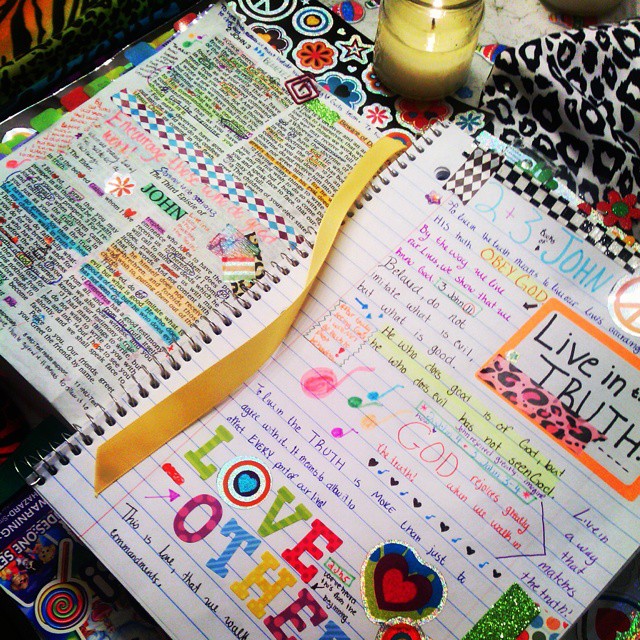
Shar’s Bible Journal from http://www.womenlivingwell.org 


This week, we’ve been talking a lot about the Bible and its importance in our lives. Even if we know how big a difference daily reading the Bible can make in our lives and we desire to know God’s word more, it can seem a bit overwhelming to actually dive into reading the Bible daily. Luckily, these devotions, regardless of whether you have spent the past year with us, have helped to give you some direction as to how to study the Bible. Still, it can be daunting to really dive in to creating this habit that can literally change your life. So, today, we’re going to be talking a little bit about how to study the Bible. For some of you, this will be old stuff that you already know. For others, some of this might be a little new. But, that’s okay! Wherever you are at in your walk with Christ, it’s always important to be intentional about your time with God. So, let’s dive in!


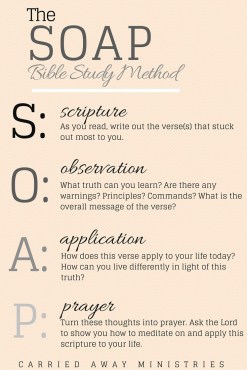
Today, we will talk about one aspect of studying the Bible: What should our daily time with God look like? Before we begin studying the Bible each day, it’s a great idea to pray. Why? During this time, we want to make sure we are coming to our studies with the right attitude to get the most out of it, and we should be sensitive to the Holy Spirit while we are studying. Prayer helps us to keep those things in mind.

SOAP-Method-of-Bible-study-1

Then, we dive into our actual studies. If this is your first time reading the Bible, it may be helpful to you to just mark some interesting passages with a pen or highlighter as you read. If you’ve been doing this for a while, you may ‘code’ your Bible, marking topics that are similar across texts. Even if you don’t do this every time you read the Bible, once you begin reading regularly, you’ll start to see the ways that the different books of the Bible interact with one another. If you see something, it’s a great idea to write it down in your Bible! This is called cross-referencing and can be a great way to go deeper in your Bible study. Plus, think of all the notes and ideas that your Bible can hold if you keep doing this over a long amount of time! Another way to go deeper in your study is to look up the meaning of words using a dictionary. If you are unsure why an author used a certain word, look it up! You may find something really cool about the original Hebrew or Greek words.

After this, it’s a great idea to write down some of what you found in your study in a journal. Writing things down (1) helps you to work through problems in your mind and (2) will help you remember it later on. If you skim through something, it will be hard for you to really write about it. Or if you read something, but are confused with what the author is trying to say, you may be able to work it out in a journal. Then, like you did in the beginning of your study, it’s great to pray again. Remember, you don’t read your Bible just to know more of what it says. That’s important. But, the main reason why we do it is to get closer to God! Bible study without real heart-changing conversations with God can lead us down the same road as the Pharisees.

Whew! That sounds like a lot, doesn’t it? Once you’ve done all this, it’s awesome if you can find a group of friends or a mentor to help you work through what you are studying. Have questions? You can ask them about it! Sometimes, it may be hard to find times to sit down and read for 30 minutes, or you may be thinking that you would never journal your insights and prayers. That’s okay too! Listening to your Bible in the car or online can be a great way to learn more about what God is trying to say even if you don’t enjoy reading.


Tomorrow, we are going to look at another aspect of studying the Bible. In the mean time, take a moment to put some of these Bible study tips into practice as we read the context around a verse (2 Tim. 3:16) I mentioned yesterday in 2 Timothy. Read through 2 Timothy 2-4. While you do this, think about the importance of learning what God’s word has to say. Like 2 Tim. 3:15 says, the Bible is “able to give you wisdom for salvation through faith in Christ Jesus.” Let’s get in the Word! And, if you still feel a little overwhelmed, you can be reminded of what Richard J. Foster writes in his book Celebration of Discipline:

“Study produces joy. Like any novice, we will find it hard work in the beginning. But the greater our proficiency, the greater our joy. Study [of the Bible] is well worth our most serious effort.”


Does your Bible study look different than this? Do you have any other Bible study tips you would like to share? You can share them in the comments below!


(Check out more about Shar’s Bible Journal at http://womenlivingwell.org/2014/09/good-morning-girls-bible-study-journal-amazing/)

Word Power – Psalm 119:57-120

path-of-dawn-bible-journaling

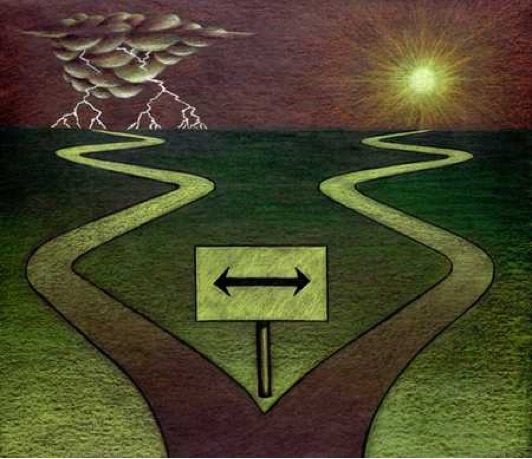
This week, we’ve been talking about the importance of choosing life. How do we choose life? By gaining godly wisdom and following God’s commandments, we can choose the path of life for our lives that our memory verse for this week talks about (Duet. 30:19-20). Though discipline and commitment are good for creating and sustaining a good relationship with God, it’s also incredibly important to long for that relationship, to desire it. Yesterday, we talked about what it means to desire God and his word and how that can transform our lives. Like Psalm 119:107b says, “LORD, give me life through your word.” When we choose to invest in God’s word, we are choosing life.

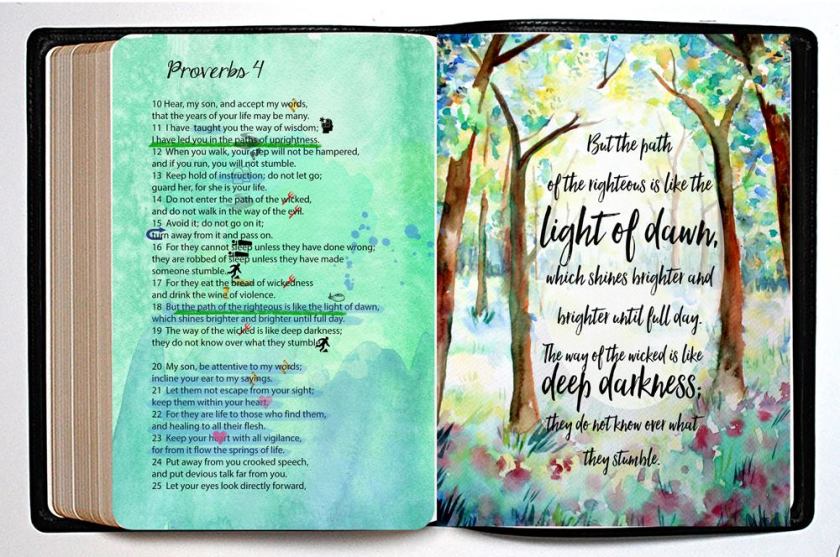
Today, we are going to continue talking about the Bible and its importance for our lives. Specifically, we are going to talk about what the Bible can do in our lives, according to what it says. In our reading passage for today, verse 105 says, “Your word is a lamp for my feet and a light on my path.” One important way that the Bible gives us life is by shining a light for us to find our way through this dark world. Matthew 5:14-16 describes the Christian believer as a light shining on a hill for the world. If we don’t know God’s way of light through prayer and his word, then we are still living in darkness. How then can we be the light that Jesus describes? Paul describes us as the children of light, who do not belong in darkness (1 Thess. 5:5). Because of this, we need to dedicate ourselves to seeking that path of light, and we do this by pursuing God’s word.

Why does the word of God have this power? We can think back to the beginning in Genesis 1 where God spoke and the world came into being! His word is just as powerful now. We have been given his inspired word. This means that though people wrote it who were not God, the message that it says comes from God. This message now is just as important as it was 2,000 or 3,000 years ago. 2 Timothy 3:16-17 says, “All scripture is inspired by God and is profitable for teaching, for rebuking, for correcting, for training in righteousness, so that the man of God may be complete, equipped for every good work.” If we want to train in righteousness, we need to commit ourselves to learning and internalizing God’s word!

When we do this, we have to be prepared for a major heart change. If you remember what we talked about on Monday, we can see how the heart is fickle and doesn’t always follow the right paths of righteousness. We need something to test our ways against those of God (Isaiah 55:8-9). That is what the Bible can do! Hebrews 4:12 says, “For the word of God is living and effective and sharper than any double-edged sword, penetrating as far as the separation of soul and spirit, joints and marrow. It is able to judge the ideas and thoughts of the heart.” When we test our thoughts and actions against God’s word, we can begin to discern if we are following God’s ways of light or the world’s ways of darkness. The Bible can truly be a light to our path towards living a righteous life that mirrors Christ!

Tomorrow, we will talk more about some practical ways to study God’s word. But, today, let’s rest in the power that comes from God’s word. God’s word accomplishes what it sets out to do in our lives. If we can speak his truth over our lives, we will begin to see him working in them in mighty ways.

“For just as rain and snow fall from heaven and do not return there without saturating the earth and making it germinate and sprout, and providing see to sow and food to eat, so My word that comes from My mouth will not return to Me empty, but it will accomplish what I please and will prosper in what I sent it to do.”                -Isaiah 55:10-11

Choose Life!

two paths

This year at Fuel, we have talked about honor. We know now that we should honor God first with our lives and honor other areas of our lives like our parents, the Bible, Christ, relationships, others, and our internal and external selves. As we move into the upcoming year at Fuel, our Grow Devotions will look a little different. We want to keep growing in our understanding of who God is and in our relationship with him. To do this, we have to make it a daily task to get into God’s word. And, we shouldn’t only get into it! We have to write it on our hearts. We have to make it something that is our reflex reaction to turn to in hard situations. Each week, we are going to begin the week with a video, audio clip, or blog introduction of our devotional writer for the next week. Then, we will dive into our scripture reading which we will read daily throughout the week, followed by a recap on Saturday about some of the highlights of the previous week. We encourage you to memorize the weekly scriptures and write them on your heart so that you can have them be the truths that you go to for encouragement and wisdom, instead of turning to the lies of the world.

View the video clip above to learn about our memory verse this week and what we will be talking about this week!

Our Memory Verse:

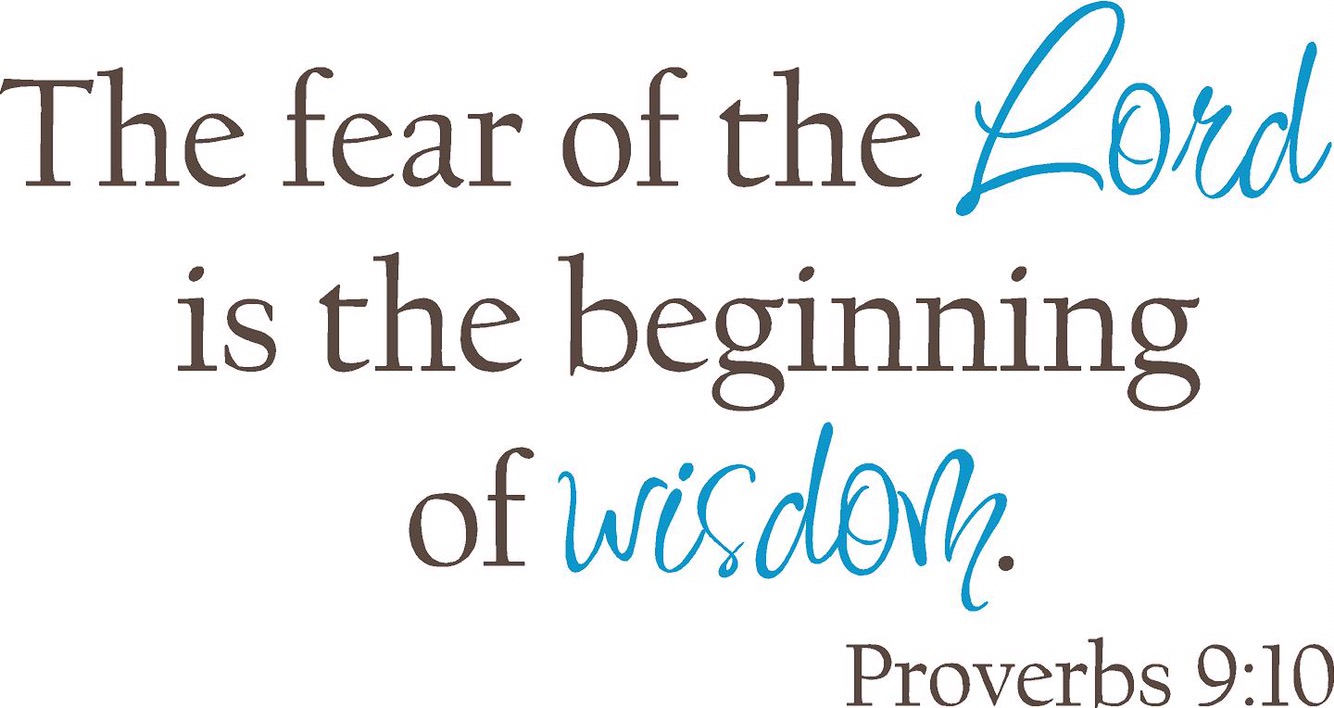
I call heaven and earth as witnesses against you today that I have set befoore you life and eath, blessing and curse. Choose life so that you and your descendants may live, love the LORD your God, obey Him, and remain faithful to Him. For He is your life, and He will prolong your life in the land the LORD swore to give to your fathers Abraham, Isaac, and Jacob.                                            ~ Deuteronomy 30:19-20

Victorious God

Revelation 8-12

1023-REV011015ENGKJV08000480ISP02066256000

Wednesday July 19

Seven is the number of completion, of fulfillment.  The number seven appears repeatedly in Revelation:  seven Churches, seven seals…. and now seven trumpets.  A trumpet is blown to get people’s attention- something important is about to be announced.  The seven trumpets here announce the judgment of God upon the earth.  God is about to bring this evil age to a close to make way for the age to come, when the Kingdom of God replaces fully the kingdoms of this world.
Each of the seven trumpets are blown by an angel of God followed by some great disaster.  There is hail, fire, blood, large burning rocks falling from heaven (a meteor or asteroid).  Then stars fall from heaven, the sky becomes filled with darkness, more heavenly bodies fall to earth opening deep pits in the earth which release demonic creatures.  There are plagues and wars and all manner of destruction heaped upon the earth.  Here it’s important to remember that much of this is symbolic language.  The point is that there will be calamities which bring about destruction on the earth, some are ecological, some are interstellar, and some are man made.  This Summer there’s a t.v. show on called Salvation.  The premise of the show is that NEO object is heading toward earth and is likely to cause massive death or even total extinction.  In real life, under Yellowstone National Park in Wyoming there is a super volcano, which, if it erupts, would place nearly all of the continental US under a cloud of darkness that would result in massive famine.  Of course, we hear regularly dire predictions about global warming, rising sea levels, the melting of the Arctic permafrost etc…  And don’t forget the expanding nuclear arsenals of places like North Korea and Iran.  There are any number of ways that global destruction could occur.  This is a part of our human consciousness… and it was a part of human consciousness in the first century as well.  There has always been the understanding that there is much that is outside the limits of human control: drought and famine, earthquakes and fire from heaven.  These events were usually linked to belief that whatever gods that community worshipped were angry.  Destruction was linked to judgment, which was linked to human sin.  The normal response was to bring sacrifices to the gods and a promise to stop doing bad things.
In this section of Revelation, we see that the one true God is behind these disasters, but there is no willingness of the people to repent. In Rev. 9:20-21 the people refuse to repent of their idolatry, of their murder, of their sexual immorality.  The people will not link the calamities that befall them and the earth with their own bad actions that violate God’s word.
Revelation 12 gives another picture. It’s an overview of the history of the earth and it shows the cosmic dimension of the battle that’s taking place.  There is a spiritual warfare. Behind it all is this picture of evil described as the dragon, or the ancient serpent, or the devil or Satan.  Evil is making war on God’s people.  Yet, evil will be brought down and God’s people who refuse to submit to evil will be victorious.  Even though they may be killed by evil, yet will they ultimately be victorious.
Remember, when John received this vision, Christians were suffering at the hands of the powerful evil empire of Rome.  It seemed like a powerful or insurmountable monster that was able to impose his will on God’s people.  Imagine how hard it would have been to stay faithful to Jesus Christ during such a difficult time.  Yet here is a message of hope, a message of victory.  Evil and the human faces of evil will not win.  God has far more power available to him than evil does.  Those whose hearts are turned against God and refuse to repent will not be swayed by these displays of judgment and power, but those who are faithful to Jesus Christ and remain faithful, even to the point of death, will emerge victorious.
There are always events that happen in our lives that tempt us to doubt God or to turn away from Him.  These apocalyptic texts in Revelation serve as a vivid reminder that, no matter how bad things may get in the world, even for believers in God, God will be victorious.  Let us stay faithful and keep trusting God and our faith will not be disappointed.

-Jeff Fletcher

Praying Hard

James 1-5

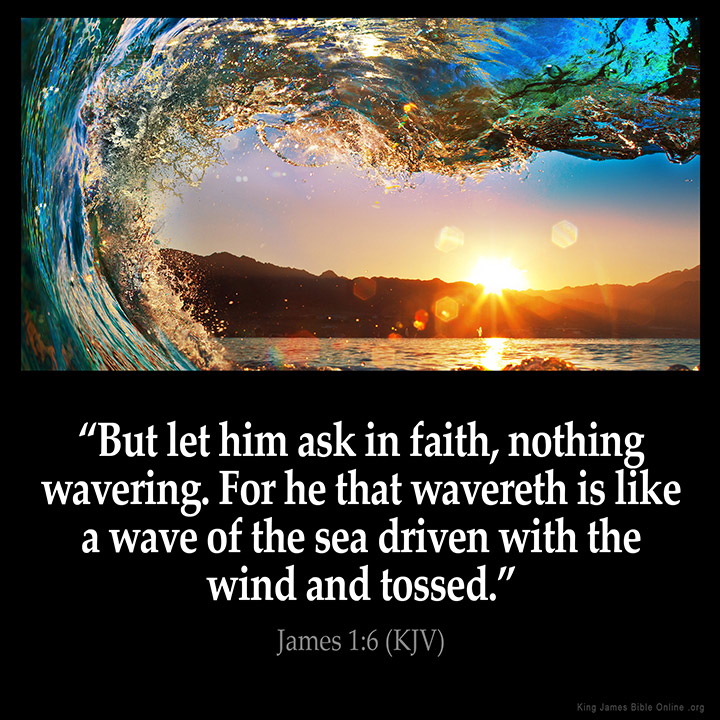
James_1-6

Wednesday, July 12

I have seen several ruined relationships within families, friendships, and significant others due to not taming the tongue. Most of these situations would probably have been avoided if everyone were “quick to listen, slow to speak and slow to become angry” (James 1:19 NIV). It is frowned upon to show favoritism to one person over another because it shows discrimination; instead we should be loving our neighbors as ourselves by showing them mercy and compassion.

Within the community that I live in, there has been a lot of (verbal) fighting via complaining, judgment, swearing, and insults. According to James 3:9-10: “With the tongue we praise our Lord and Father, and with it we curse men, who have been made in God’s likeness. Out of the same mouth come praise and cursing. My brothers, this should not be.” The community dynamic would undoubtedly be a lot better to live in, despite having completely different personalities and interests, if the people involved thought before they spoke avoiding hurt feelings and strained relationships.

As Christians, our faith will be tested numerously throughout our lifetimes. This testing produces endurance and develops perseverance. Through the testing of our faith, it is imperative to follow what God’s word says while facing several trials. To live wisely, we need to show our faith to God and Jesus through our actions because “…faith by itself, if it is not accompanied by action, is dead” (James 2:17 NIV). We also need to submit ourselves to God and never have doubts when asking for His provision. If we have the right intentions in asking, God will provide. It is important to humble ourselves before the Lord and stop boasting about the future. As a planner—I love making lists, looking at events to attend, and making plans with friends. However, I have no idea if I will even be here tomorrow. James 4:15 says that we should say “If it is the Lord’s will, we will live and do this or that,” instead of making plans that might not even happen.

Prayer is significant and powerful in every life situation. I know quite a few people who have given up on hope and stopped being patient in waiting for God. As Christians, it is our job to help those who have wandered away from the truth. James 5:20 states that “… whoever turns a sinner from the error of his way will save him from death and cover over a multitude of sins.” So please pray for everyone you know that may need God and Jesus back into their life.


Dear Heavenly Father,

I pray that whoever reads this will ask you for help in whatever situation that they may be facing. I pray that people will stop fighting and instead listen to each other with better understanding. I hope that people turn from their wicked ways and “confess their sins and pray for each other so that they may be healed” (James 5:16). Please help me find a way to aid my friends back to you so that they may be saved. Thank you for sending Jesus Christ to die on the cross for our sins. I love you, Lord, and cannot wait for your return.

In Jesus’s Glorious Name, I pray, Amen.

-Cynthia Fyfe

(Photo Credit: https://www.kingjamesbibleonline.org/James-1-6_Inspirational_Image/)

Faith Check

Hebrews 11-13

hebrews-11-1

Tuesday, July 11

Faith is an interesting concept. Many people live their lives just “going through the motions and rarely stop to smell the roses.” Their focus is mostly on themselves and they are distracted by the interruptions the world presents daily. Faith is extremely important to have as a Christian because “without faith it is impossible to please God, because anyone who comes to him must believe that he exists and that he rewards those who earnestly seek him” (Hebrews 11:6 NIV). Faith directed the lives of Abraham, Moses, Isaac, Jacob, and continues to direct the lives of God’s children to this present day.

During my lifetime so far, I have had a struggle living for God and Jesus daily. I have tried to live peacefully with everyone and live a life pleasing to God. However, I am not perfect and, unfortunately, have sinned. An important lesson that I have learned through my everyday life as a child of God is that He will always forgive my sins if I ask for forgiveness. Hebrews 12:1-3 states, “… let us throw off everything that hinders and the sin that so easily entangles, and let us run with perseverance the race marked out for us. Let us fix our eyes on Jesus, the author and perfecter of our faith, who for the joy set before him endured the cross, scorning its shame, and sat down at the right hand of the throne of God. Consider him who endured such opposition from sinful men, so that you will not grow weary and lose heart.” It is imperative that we, as Christians, pay attention to when the Lord disciplines us and that we listen when God speaks because we should serve God with fear and awe in a way that pleases him.

Lately, I have been going through my possessions to figure out what I can donate or sell because I have a plethora of things that I do not need any more. The items that I own are causing me anxiety and making it hard to focus on the more significant things in life. Hebrews 13:5-8 reminds us to “keep your lives free from the love of money and be content with what you have, because God has said, ‘Never will I leave you; never will I forsake you.’ So, we say in confidence, ‘The Lord is my helper; I will not be afraid. What can man do to me?’” Knowing that God oversees my life makes it much easier to have a clear conscience and a desire to live honorably in my faith.

Today, I want you to remember Hebrews 13:15-16: “Through Jesus, therefore, let us continually offer to God a sacrifice of praise—the fruit of lips that confess his name. And do not forget to do good and to share with others, for with such sacrifices God is pleased.” God wants us to continue to love each other through good actions, to not fall in love with money, and to endure when life gets tough because gaining inner strength from God’s kindness is good for us. I pray that your faith grows significantly in the coming days and that you pay attention to what God is trying to tell you. In Jesus name, I pray, Amen.

-Cynthia Fyfe

(Photo Credit: http://www.dailylifeverse.com/posts/2014/03/hebrews-11-1)

Requirements

Titus & Philemon

Did you panic a little bit when you found you had to read two entire books of the Bible today? As you have hopefully found now both Titus and Philemon are pretty short books. In fact, Philemon checks in as the third shortest book of the Bible (only 2 John and 3 John are shorter).

First, let’s talk about Titus.  If you owned a business and were looking to hire managers to oversee the company what would you require?  Would your job posting read that the applicant needed silky hair, mad four-square skills, and a deep love of chicken nuggets?  If so your company would probably not be in business for long because there would be no purpose behind the requirements you wanted. Hopefully, your requirements might be along the lines of:  must be self-controlled, honest and just.  If so you and God have those requirements in common except these are the requirements that God asks of the elders of the church which is a person who “manages God’s household” (Titus 1:7).

He also has requirements for those who aren’t elders.  In chapters 2 and 3, Paul outlines what God expects from everyone who claims to be a follower of Christ. It says in chapter 3 verse 1- 2 that we are, “to be subject to rulers, to authorities, to be obedient, to be ready for every good deed, to malign (which means to harm) no one, to be peaceable, gentle, showing every consideration for all men.”

Paul carries over the idea of being peaceable and gentle in the book of Philemon.  Paul writes to Philemon, who is a brother in Christ, concerning a slave named Onesimus.  It seems that Onesimus was full of passion for spreading God’s word so he ran away from his master Philemon to join Paul.  Paul sent Onesimus back to Philemon and requested that Philemon would, “accept him as you would me” (vs.17).  Paul treats both parties with grace and love to resolve the issue at hand and so once again practices what he preaches showing that he is a fully committed follower of God just as we are to be.

-Lacey Dunn

Perseverance in Suffering

2 Thessalonians 1-3

What does it mean to suffer? By Webster’s definition, it is, “To submit to or be forced to endure.”  In chapter 1 verse 5 we find that Paul speaking about how the Thessalonians are suffering.  They don’t appear to be suffering from hunger, thirst or illness but instead, Paul says they are suffering for The Kingdom of God. They are suffering persecution for their faith and because they have chosen to commit themselves to endure suffering they are commended for their great faith and perseverance.

Sadly until God’s Kingdom is established we, as Christians, will suffer persecution.  Chapter 2 even discusses that the Kingdom will not come until after a period of suffering where a “man of lawlessness” will “display himself as being God” (vs.4). This will be a dark time for all Christians and whether or not we witness this event we must always encourage each other.  If we spread love and encouragement to one another in our current sufferings it will continue to ripple through to generations in times to come.

Remember that no matter what comes, you were created and loved by the God who created the entire universe.  It is He who can give you the peace, wisdom, and strength you need to endure the suffering you are faced with every day.  The suffering is only temporary, the outcome is the eternal gift of God’s Kingdom where there will be no suffering ever again.

-Lacey Dunn

We Will Rise

1 Thess. 4-6

IMG_6135

I am by no means an art expert but I love walking around an art museum and observing all the different colors and variations an artist can use to awaken our senses and bring ordinary things to life. Some artists tell stories about the past or present with their works and yet others imagine the future. The future is the image that Paul details as he paints a picture of what the return of Christ will look like.
Imagine suddenly seeing the sky open up and watching as the Son of God comes down with the trumpet of God. He shouts and calls to your fellow brothers and sisters in Christ who have died to rise. You feel the earth tremble and see the dead rise from their graves and return to life. You watch them wake to see their hopes come to fruition and meet their Savior in the air. After all the dead have risen you stand in awe because you are finally seeing your Savior when you feel yourself begin to rise into the clouds. Here is the most beautiful piece of this image, it says in the last part of 1 Thess 4:17 that “we shall always be with the Lord.”
For us to be a part of this magnificent image we must encourage each other to stand firm in God’s word and to be alert to the difficult trials that we may face. The last half of chapter 5 gives us some ways we can do that. We are to “live in peace” with each other and to “be patient with everyone.” We are to “rejoice always” and “pray without ceasing.” Take time to consider how you can be an encouragement to others as we together await the day we meet our Savior face to face.


– Lacey Dunn