Begins with Love, Ends with…

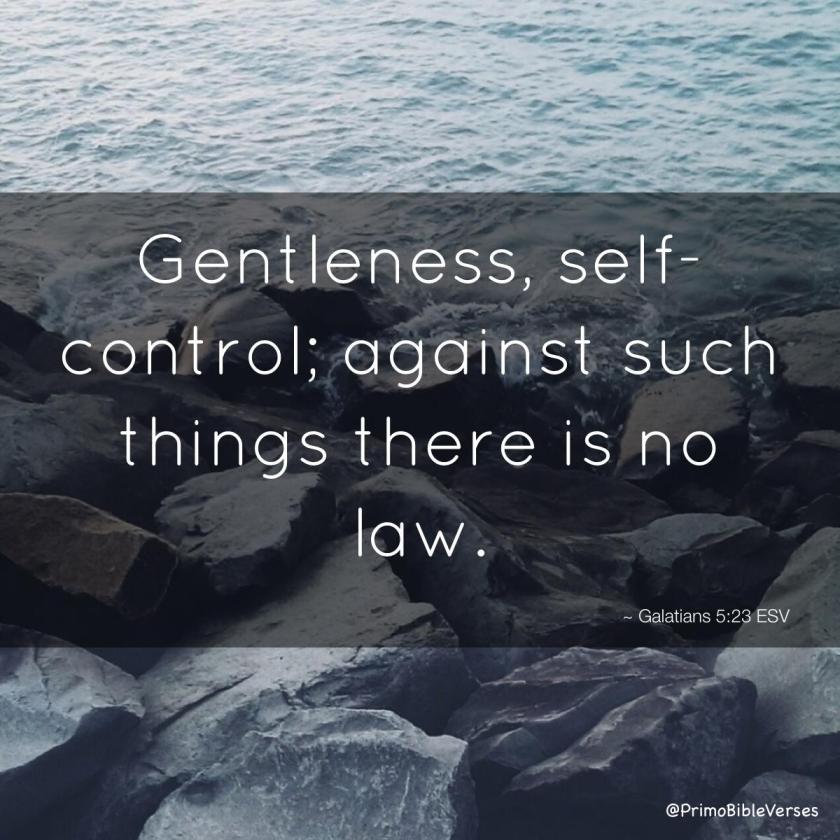
gentleness-self-control-against-such-things-there-is-no-law-esv copyWe sometimes get the wrong thing in our mind when we think about gentleness or meekness. We associate meekness with timidity or with shyness. Today, we use the word as a negative character quality, but that’s not what Christ or Paul had in mind when calling on us to be meek. Instead, they are calling on us to have a quiet strength that we are capable of holding under control, even under provocation.

James calls on us to receive God’s word with meekness. It’s a central component to our ability to be faithful. Peter also writes that we should be able to convey our hope to others in meekness,  and James tells us we should be living in meekness and wisdom. Our examples should be gentle. Teaching others should be approached with gentleness. Galatians says we can take a soft approach when standing firm in the truth, and this requires self-control. If we are going to stand firm in the truth under pressure while remaining gentle and meek, we have to develop self-control.

The last item listed in the qualities of spiritual fruit is self-control. These qualities begin with love and end with self-control. Love cascades through all of these qualities, and they all require a foundation of self-control. This is a capacity to restrain our own impulses so we might serve God and others. Whether we’re talking about faithfulness, patience, forgiveness, or any other quality of Spirit living, we require self-control. By contrast, the items Paul lists in Galatians as defining worldly living demonstrate a lack of control.

Romans tells us we should be transformed from this world through God’s renewal.  Self-control allows us to overcome the sinful and self-destructive behaviors that can consume a life without control. When Paul says, in Galatians, that we are called to freedom, we are freed from the bonds created by worldly living, but we can’t grow this self-control by ourselves. We have to accept help from others. As we rejoice together and we sorrow together, we should also be helping each other grow. Ephesians tells us we are to work together to grow in maturity and be more like Christ. Self-control has to be self-contained, but it does not have to grow alone.

-Katie Beth Fletcher
Submit Your Ways to God

Faithfulness-Instagram copy

Do you ever find yourself thinking “I’ll believe it when I see it?”  It’s easy to slip into the mindset of doubt. We live in a broken world, and we may have gone through painful experiences that cause us to lose our trust in others.  For this reason, faithfulness, a fruit of the Spirit, can be a challenging trait to possess. Faithfulness comes from a place of trust and loyalty. Hebrews 11:1 says, “Now faith is a confidence in what we hope for and assurance about what we do not see.”  As a Christian, it is important to be faithful to God. It is one thing to simply believe in Him, but another to be faithful to Him. When we are truly faithful to God, this shapes the way we live. Faithfulness requires us to submit our ways to God.

Proverbs 19:21 says, “Many are the plans in a person’s heart, but it is the Lord’s purpose that prevails.” We are to be faithful to God, because He is faithful to us.  In the Bible, the story of Abraham demonstrates the importance of faithfulness. Abraham and his wife Sarah struggled to trust God, but learned the value of faithfulness when they submitted to Him.  For example, Abraham and Sarah waited many years for God to fulfill His promise of giving them a son. Because of her lack of faith, Sarah insisted upon Hagar, her maid, giving birth to her son. This resulted in pain and conflict. However, when Abraham and Sarah put their faith in God, Sarah was able to give birth to Isaac despite being past childbearing age.  Ultimately, the story of Abraham shows how God blesses those who are faithful and trust in His plans.

So, how do we grow in our faithfulness?  We can grow in our faithfulness by having a personal relationship with God. If we are truly faithful to Him and obey His commands, this will be evident in our lives.  My challenge to you is this: Think about the ways you show your faithfulness to God. Are there things that are getting in the way of your faithfulness? What areas of your life have you not given over to Him? Through spending time in prayer, ask God to make these things clear to you, so that He can grow you in your faithfulness.

-Katie-Beth Fletcher

Kind and Good

Kindness & Goodness 2

Some have referred to kindness and goodness as the twin fruits. Kindness and goodness are so closely related that sometimes it is not easy to distinguish between them. A kind person is also a good person; a good person is by nature a kind person. Both of these characteristics stem from love. Some have said that patience is suffering love; kindness is compassionate love; and goodness is ministering love.

Kindness is more about our attitude and goodness is more about the things we do for others.  Some people are born with a kind, gentle personality. This may come natural to them. But others have to lean on the power of the Holy Spirit to help them be nice.

These characteristics which are produced in us by the Holy Spirit have to do with our relationships to others. We usually think of kindness as an expression of love from one person to another, and of goodness as a quality of being pure.  It is striking that parents are forever telling their children to “be good,” but they never need to suggest the opposite to them. Being “bad” seems to come naturally.

Without the Holy Spirit within us, our nature is inclined toward that which is evil and bad. But the Holy Spirit produces in us kindness and goodness, helping us to minister to the world with the love of Jesus. What the world needs is Jesus—that means more love, kindness, goodness, gentleness, and caring generosity.

Katie-Beth Fletcher

How We Respond While Waiting

Patience

Patience is translated as forbearance in some translations of the Bible.  Forbearance has a deeper meaning. It includes self-control, restraint, and tolerance, implying that we have a choice about how we response to God in our times of waiting.  We can, for example, receive patience as a gift that helps us develop restraint or we can become resentful and anxious, bucking against the reality that we have very little control over our circumstances.

While giving in to our impatience can feel good in the moment, it often sends us spiraling downward into frustration—because even if we do send that email to check on the status of a job we applied for or to find out about the grades we’re waiting to be posted, the fact remains that we can’t do much to change the circumstances. We have a choice in moments of impatience: let Jesus cultivate our inner world or escape into destructive behaviors or attitudes.

So what can we do while we’re waiting to embrace the fruits of patience (self-control, restraint, and tolerance)?  We can pray while we work. The world doesn’t stop while you’re waiting for something. There are things and people that still need your attention. Your own soul needs your attention too, as does your body. So, while you’re waiting, pray while you wait by focusing your attention on something you actually do have influence over. Make a date to go bowling with friends, clean your bathroom fastidiously, read a novel, or cook a new food from a different country.  Patience is a virtue and a virtue can’t hurt you. So keep waiting. Work on what you can.

Katie-Beth Fletcher

Real Peace

Peace

What is peace? We often define it in terms of what it isn’t—as in, it’s the absence of conflict or distraction or anything that makes us feel uncomfortable or disturbed. A nation is at peace when they’re not involved in any wars; a person is at peace when they feel relaxed and comfortable.  But what if I told you that the biblical idea of peace sometimes means diving into conflict, choosing discomfort, and being disturbed?

“For he himself is our peace, who has made us both one and has broken down in his flesh the dividing wall of hostility by abolishing the law of commandments expressed in ordinances, that he might create in himself one new man in place of the two, so making peace, and might reconcile us both to God in one body through the cross, thereby killing the hostility.” (Ephesians 2:14-16)


According to Ephesians, Jesus is our peace, and Jesus came to reconcile us both to God and to each other. And the biblical idea of peace is much broader than our modern understanding; it is not simply the absence of conflict but also the presence of harmony. It’s not ceasefire; it’s community.  Sometimes, we get so caught up in seeking peace for ourselves that we create discord for others. Or we isolate ourselves from the problem, so that we can pretend like it doesn’t exist or isn’t relevant to us. But conflict avoidance is not peace.

We can trust Jesus to provide miracles, because Jesus is our peace. And while pursuing perfect harmony and reconciliation may be hard, it is far from hopeless. In fact the truth is just the opposite: peace is promised to us from God.

Katie-Beth Fletcher

A Character Defined by Love

Fruit of the spirit

The Holy Spirit produces these things in our life.  It is important that we know and understand them well, so that we can apply them to our lives.  When the fruit of the spirit is at work in our lives, amazing things happen. Your whole life blossoms and bears fruit.  One of the most wonderful fruits of all is the giving and receiving of love.

The word love can mean many different things, as you can see from the many different dictionary definitions.  We also find different kinds of love throughout the Bible, four of them specifically. Eros is the Greek word for sensual or romantic love.  Even though the term is not found in the Old Testament, Song of Solomon vividly portrays the passion of erotic love.  Storge is a term for love in the Bible that you may not be familiar with. This Greek word describes family love, the affectionate bond that develops naturally between parents and children, and brothers and sisters.  Philia is the type of intimate love in the Bible that most Christians practice toward each other. This Greek term describes the powerful emotional bond seen in deep friendships, this is the most common type of love.  Agape is the highest of the four types of love in the Bible. This term defines God’s immeasurable, incomparable love for humankind. It is the divine love that comes from God. Agape love is perfect, unconditional, sacrificial, and pure.

There are so many people who go through life without feeling human love.  However, God’s plan is for every person to eventually experience His love flowing through them, so that each person can say “my cup runneth over with love.”  The funny thing is that when people are trying to feel love they often forget to read the greatest book ever written about relationships, the Bible. The Bible reveals how we can experience love for God and people that exceeds human capability.  The highest and purest form of God’s love is God’s divine and sublime love that He offers to share with us!  The perfect example of the ultimate nature of God is, “He who does not love does not know God, for God is love” (1 John 4:8).  God wants to transform us so that our character is also defined by love.

-Katie-Beth Fletcher

Battle to the Death

Galatians 4-6

galatians-5-25

Tuesday, June 27

There is a life and death battle going on inside all of us.  In one corner we have the flesh and in the other corner we have the Spirit.  It is a battle to the death.  One will win; the other will die.

The desires of the flesh are listed in Galatians 5:19-21.  They are sexual immorality, impurity and debauchery (excessive indulgence in sensual pleasures); idolatry and witchcraft; hatred, discord, jealousy, fits of rage, selfish ambition, dissensions, factions, and envy; drunkenness, orgies, and the like.  We all have some of these desires and verse 21 says that if we give into these desires we will not inherit the kingdom of God.  Thus, if our flesh wins the battle, on judgment day you will be sentenced to death.

However, Galatians 5:24 states that those who belong to Christ Jesus have crucified the flesh with its passions and desires.  Galatians 5:16 says if you walk by the Spirit, you will not carry out the desires of the flesh.  I am sure most of you have heard of the fruit of the Spirit in Galatians 5:22-23:  love, joy, peace, patience, kindness, goodness, faithfulness, gentleness, and self-control.  I think many people look at the fruit of the Spirit as a list of good attributes that we ought to try to attain, but that is not what this verse is saying.  It says the FRUIT of the Spirit are these attributes, meaning you will automatically receive these attributes if you live by the Spirit.  You don’t have to try to be more patient; you will automatically be more patient because of the Spirit that is in you.  You will be more loving due to the Spirit and so on.

You will want to ask to be filled with the Spirit so you can be more loving because Galatians 5:14 says the whole Old Testament Law can be fulfilled by loving your neighbor as yourself.  Think about it.  If you crucify the selfish desires of your flesh and love others instead of yourself, you are fulfilling the whole Law.  You are not required to fulfill that Law, but it is pretty awesome to think we could do that by just living for others instead of ourselves.

Galatians 6:8 says, “For the one who sows to his own flesh shall from the flesh reap corruption, but the one who sows to the Spirit shall from the Spirit reap eternal life.”  We will reap what we sow.  The next verse (6:9) then tells us to not lose heart in doing good, for in due time we will reap if we don’t grow weary.  Verse 10 then adds that while we have the opportunity, we should do good to all men, but especially to those that are of the household of the faith.  Paul admits that it is not always easy to do good to all people.  You have to sacrifice your own desires to use your time and resources for others, and to make it even more difficult some people are not very deserving of your help and not at all grateful for the good you do for them.  It can be very tiring continually sacrificing for others even if they do appreciate it, but remember not to grow weary and you will reap the reward.

It sounds difficult to crucify all of your fleshly desires and live for others instead of yourself, but are you really sacrificing that much if the reward you get for doing this is eternal life in the Kingdom?  You will actually gain a WHOLE LOT MORE if you can stop living for yourself now in this short lifetime and live for others instead.  Seems like a REALLY EASY choice to make; crucify your fleshly desires and live by the Spirit.

-Rick McClain

(Photo Credit: http://www.dailylifeverse.com/posts/2014/11/galatians-5-25)