
Begins with Love, Ends with…

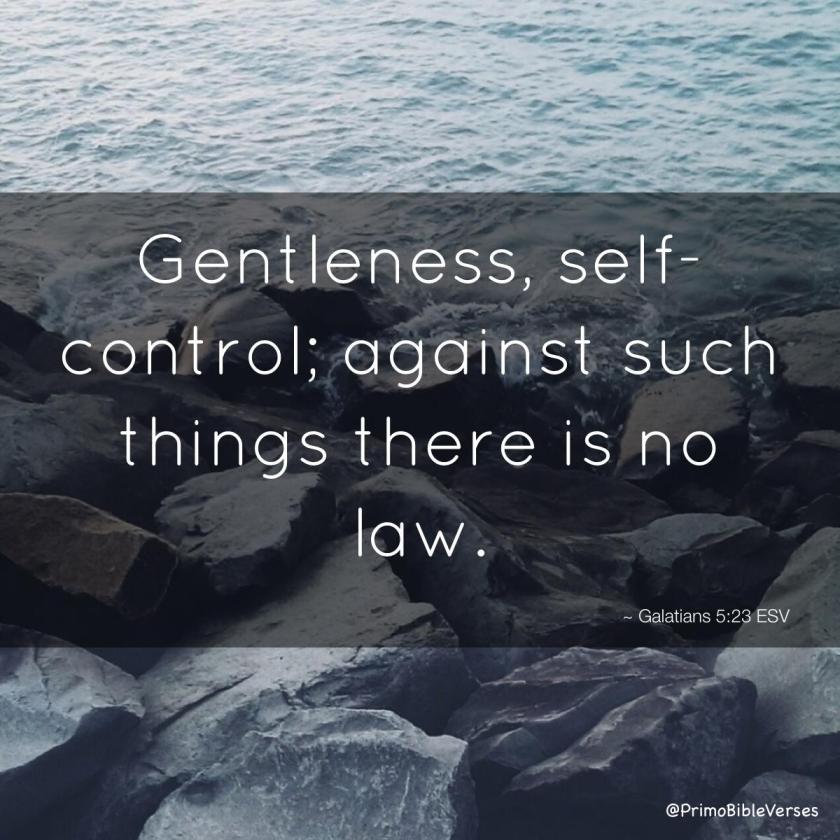
gentleness-self-control-against-such-things-there-is-no-law-esv copyWe sometimes get the wrong thing in our mind when we think about gentleness or meekness. We associate meekness with timidity or with shyness. Today, we use the word as a negative character quality, but that’s not what Christ or Paul had in mind when calling on us to be meek. Instead, they are calling on us to have a quiet strength that we are capable of holding under control, even under provocation.

James calls on us to receive God’s word with meekness. It’s a central component to our ability to be faithful. Peter also writes that we should be able to convey our hope to others in meekness,  and James tells us we should be living in meekness and wisdom. Our examples should be gentle. Teaching others should be approached with gentleness. Galatians says we can take a soft approach when standing firm in the truth, and this requires self-control. If we are going to stand firm in the truth under pressure while remaining gentle and meek, we have to develop self-control.

The last item listed in the qualities of spiritual fruit is self-control. These qualities begin with love and end with self-control. Love cascades through all of these qualities, and they all require a foundation of self-control. This is a capacity to restrain our own impulses so we might serve God and others. Whether we’re talking about faithfulness, patience, forgiveness, or any other quality of Spirit living, we require self-control. By contrast, the items Paul lists in Galatians as defining worldly living demonstrate a lack of control.

Romans tells us we should be transformed from this world through God’s renewal.  Self-control allows us to overcome the sinful and self-destructive behaviors that can consume a life without control. When Paul says, in Galatians, that we are called to freedom, we are freed from the bonds created by worldly living, but we can’t grow this self-control by ourselves. We have to accept help from others. As we rejoice together and we sorrow together, we should also be helping each other grow. Ephesians tells us we are to work together to grow in maturity and be more like Christ. Self-control has to be self-contained, but it does not have to grow alone.

-Katie Beth Fletcher

Paul’s Final Exhortation for Unity

Philippians 4

IMG_0280

Yesterday we took a break from our discussion on unity in the body to talk about our union with Christ—the head of the body. Today we’re back to the theme of unity in the Church and looking at Philippians 4, where Paul offers the Philippians some final exhortations for unity. From Paul’s advice to the church at Philippi in this passage, we can see four principles that, if applied, will help promote unity in our own churches.


The first principle we see here is reconciliation. In verse 2 Paul calls attention to an apparent disagreement that was causing strife among two of the woman in the church. He urged them to “be of the same mind in the Lord.” These women had been workers, alongside Paul, for the Gospel and this disagreement between them was hindering their ministry. Personal differences should never get in the way of our commitment to the Gospel. When disagreements arise, the church should work together towards reconciliation so that it can get back to its primary focus.


The second principle we can take from this passage is to live gently. Paul says in verse 5 (NRSV) to “Let your gentleness be known to everyone.” Gentleness is one of the Fruit of the Spirit, but one that I think is often overlooked. This comes from a misunderstanding of what gentleness is all about. Many people equate gentleness to weakness, but it is actually a sign of strength. A weak person is one who lacks strength but a gentle person is one who appears weak for the benefit of others. Gentleness allows us to care for those who are weak and need special attention. Jesus was gentle—this aided him greatly in his ministry to sick and inflicted. If we want to have inclusive churches that minister to the needs of those who are weak, we must promote gentleness.


Living worry free is another principle Paul pushes in this passage that can aide our goal of church unity. In verses 6 and 7 (NRSV) he says “Do not worry about anything, but in everything by prayer and supplication with thanksgiving let your requests be made known to God. And the peace of God, which surpasses all understanding, will guard your hearts and your minds in Christ Jesus.” Worry and anxiety are enemies of the Gospel. Worry is a prison; the Gospel is freedom. Worry keeps us focused on the evils of the age we live in—all the bad things that come about from our sinful nature. It takes our minds off the hope we have in the future Kingdom of God, where everything will be made right and worry rendered obsolete. When bad things do happen in our lives, we shouldn’t spend time thinking about how much worse they could get or why it is happening to us. We should instead bring our concerns before a God who can offer us peace that we won’t find anywhere else, and that can get us through this evil age until we dwell with him in His kingdom. A church at peace and without worry is one that is focused on the future and making a difference in the present.


The final unity principle Paul offers in Philippians 4 is filling our minds with that which is good. In verse (NRSV) he says, “Finally, beloved, whatever is true, whatever is honorable, whatever is just, whatever is pure, whatever is pleasing, whatever is commendable, if there is any excellence and if there is anything worthy of praise, think about these things.” There are a lot of things in this world that try to grab our attention and many of them are not beneficial. Our minds our shaped by what we take in, just as our bodies are by the food we eat. This is why what we think about is so important. If we want to get good out, we must put good in. If we want to be unified in our purpose, we must be unified in our thinking, and that thinking should be on things that are true, honorable, just, pure, pleasing, commendable, and excellent.


While they are not always easy to follow, these four principles will go a long way towards promoting unity within the Church.


– Joel Fletcher