
Forevermore!

Old Testament: Judges 13 & 14

Poetry: Psalm 113

New Testament: Luke 13

Psalms 113-118 are known as “Hallel,” which means praise. These Psalms are recited, either in unison or responsively, in Jewish observances such as Passover and Hanukkah. This specific passage of Psalms is a prayer of thanksgiving and praise to God for the blessings He poured out on Israel during the Exodus from Egypt. Though “Hallel” typically refers to Psalms 113-118, two other sections of Psalms are also referred to as “Hallel.” Thus, Psalms 113-118 are also specifically referred to as the “Egyptian Hallel” due to recounting of the Exodus story in Psalm 114.

In Passover remembrances, the Hallel is used within both the temple and homes. Before the Passover meal, Psalm 113-114 would be sung together. Most scholars believe that Jesus and his disciples would have sung these verses together while gathered for the Last Supper. When you read the verses of Psalm 113 closely, they seem a fitting hallmark to Jesus’ ministry.

In verses 7-9, we read, “He raises the poor from the dust, and lifts the needy from the ash heap, to make them sit with princes, with the princes of his people. He gives the barren woman a home, making her the joyous mother of children.” Throughout Jesus’ ministry, his work angered many because he focused on the ones that others forgot or ignored. Just like the words of the Psalm, he shook social norms. How many instances can we recount of him healing the less desirable, such as the woman at the well, or socializing with sinners, such as Zaccheus? Jesus acknowledged in words and actions that all will be made equals in God’s kingdom? 

In today’s New Testament text, we read another example of Jesus lifting the needy, while others found fault. In Luke 13: 10-13, we read, “Now he was teaching in one of the synagogues on the sabbath. And there was a woman who had had a spirit of infirmity for eighteen years; she was bent over and could not fully straighten herself. And when Jesus saw her, he called her and said to her, “Woman, you are freed from your infirmity.” And he laid his hands upon her, and immediately she was made straight, and she praised God.” Later in the text, we read how the Synagogue leaders were indignant that Jesus healed on the Sabbath, causing Jesus to rebuke them. He had once again turned expectations upside down.

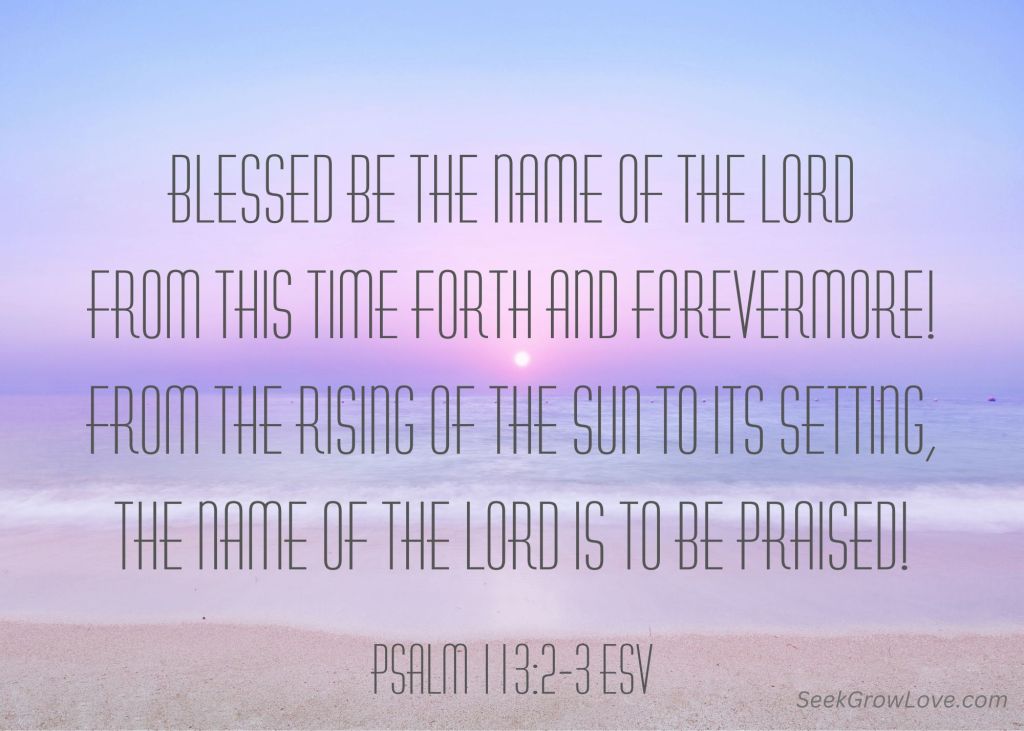
While reciting this Psalm during their Passover meal, did any of Jesus’ disciples connect his ministry to the words they were singing? It’s also poignant to think that despite his imminent betrayal and death, Jesus could recite this prayer of praise and thanksgiving from the Psalm. “Blessed be the name of the Lord from this time forth and for evermore! From the rising of the sun to its setting the name of the Lord is to be praised! The Lord is high above all nations, and his glory above the heavens!” 

When we are faced with trials, can we do the same as Jesus? These verses remind us that in all things, the Lord is worthy of continual praise. It does not instruct us to be thankful once. Rather, it is imploring us to offer thanks “forevermore.” God is unchanging and there will never be a time in which we cannot offer homage to Him. 

My daughter’s teacher has her students complete a daily task in their agendas. At the end of each school day, the students are tasked with reflecting on the day and writing down two positives that happened to them. The teacher is striving to enable a mindset of gratitude and positivity within her class.

Could we take on the same task in order to offer continual praise to God? At the end of each day, let’s take time to reflect on that day. What can we praise God for? Perhaps your day at work was rough. But could you thank God that you had a job to go to that will provide for your needs such as food and shelter? This week, I challenge you to find at least two things in your day for which you can offer God praise and thanksgiving.

~Jen Siderius

Jen Siderius is a member of the Fair Oaks Community Church of God in Virginia. She and her husband Dan live in Maryland, where she works as an elementary school media specialist. When she’s not busy being entertained by the antics of their 9-year-old daughter, she loves to read, run, knit, quilt and try new crafts.

Reflection Questions

  1. Where do you see Jesus upsetting social norms? What was his purpose in doing so? Where have you – and can you – follow Jesus’ example?
  2. How would you rank yourself in the thankfulness category? Do you daily praise God for what He has done and who He is? How can you work at increasing your spirit of thankfulness?
  3. What did you see about God in today’s reading that you will praise Him for? What is Jesus revealing about His Father and God that we can praise God for?
Giving is Like a Garden

Old Testament Reading: Numbers 26 & 27

Psalms Reading: Psalm 72

*New Testament Reading: 2 Corinthians 9

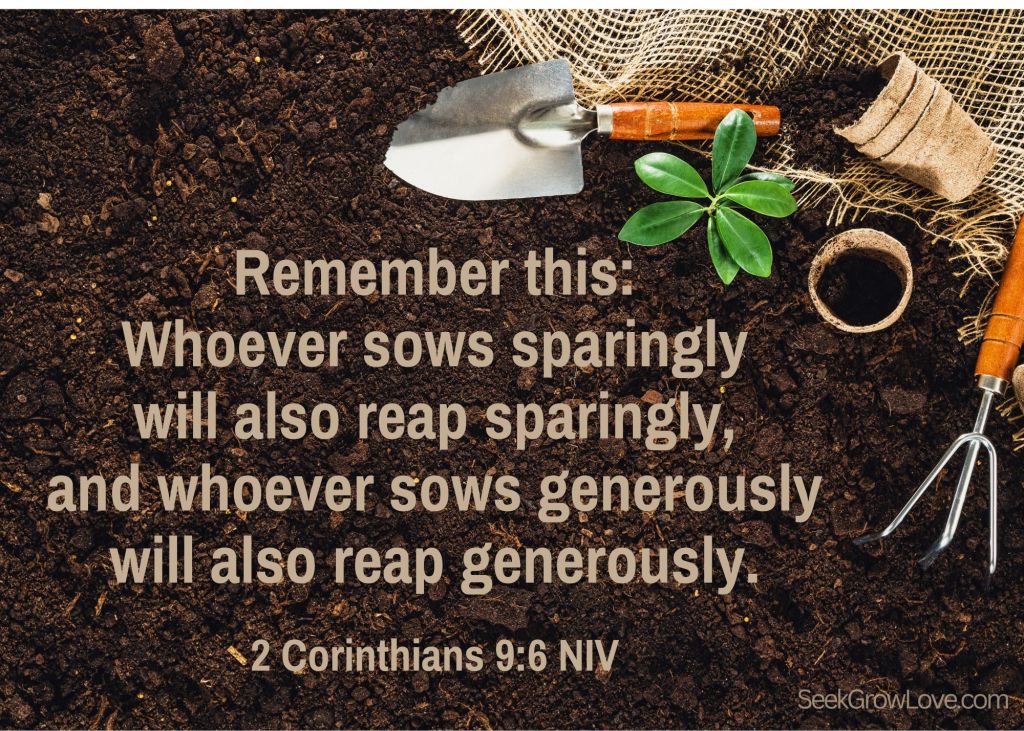
Giving generously is like sowing seeds in a garden. Just as a farmer must plant a plentiful amount of seeds to reap a bountiful harvest, Christians must give generously to receive God’s blessings. In 2nd Corinthians 9, Paul emphasizes the importance of giving with a willing heart, not out of compulsion or obligation. When we give with a cheerful heart, it is like planting our seeds in rich soil, knowing that they will grow into a plentiful harvest.


Furthermore, just as a garden requires consistent care and attention, our giving requires consistent effort and a dedication to meeting the needs of others. Paul reminds us that our giving is not only an act of obedience to God but also a way to meet the needs of others. When we give generously, we are like gardeners tending to our plants, making sure they have enough water, sunlight, and nutrients to thrive. Our giving provides the necessary resources for those in need to grow and flourish.


Like a garden, our giving should also be done with a spirit of thanksgiving and praise. When we give with a joyful heart, we are like flowers blooming in the sun, displaying their vibrant colors and beauty. Giving generously not only blesses those in need but also brings glory and honor to God. It is like a garden bursting with life and color, a testament to the abundance of God’s grace and provision.


Finally, just as a garden produces a bountiful harvest, our giving produces a harvest of righteousness. When we give generously and joyfully, we are like farmers reaping a plentiful harvest, knowing that God’s blessings will overflow in our lives. Our giving is a tangible way to demonstrate our faith and commitment to following Christ’s example of selflessness and generosity.


In conclusion, 2nd Corinthians 9 teaches us that giving generously is like sowing seeds in a garden. Just as a garden requires consistent care and attention, our giving requires consistent effort and a dedication to meeting the needs of others. When we give with a cheerful heart, it is like planting our seeds in rich soil, knowing that they will grow into a plentiful harvest. May we be inspired by the simile of the garden to give generously and joyfully, trusting in God’s abundant provision and blessings.


-Austin Kizer

Questions for Reflection

  1. How can you cultivate a heart of generosity and joy in your giving?
  2. In what ways have you seen God bless your giving, whether it be in material provision or in the transformation of lives?
  3. What steps can you take to consistently care for and tend to the needs of those around you?
  4. What has God revealed about Himself in your Bible reading today?

Give Careful Thought to Your Ways

Haggai 1 – 2

The book of Haggai records events that took place in 520 B.C.  The foundation of the temple had been laid in 536 B.C. (Ezra 3:8-13), but building stopped because of opposition.  In Haggai 1:2, we see that people were making excuses, “The time has not yet come for the Lord’s house to be built.”  The people themselves were living in fine houses, but just hadn’t gotten around to building God’s temple.  Their priorities were wrong.

God pointed out that He had been undermining the people’s prosperity because they hadn’t made God a priority.  Haggai 1:6 tells us, “You have planted much, but have harvested little.  You eat, but never have enough.  You drink, but never have your fill.  You put on clothes, but are not warm. You earn wages, only to put them in a purse with holes in it.”

Once confronted with this, the people obeyed God and began to work on the temple.  The word of the Lord came to Haggai again in chapter 2, where God told Haggai in 2:9, “The glory of this present house will be greater than the glory of the former house, says the Lord Almighty…”

Interesting.  When Solomon’s temple was dedicated, fire fell from heaven to consume the offering, and God’s shekinah glory appeared so the priests couldn’t enter the temple.  The ark of the covenant, the representation of God on earth had been there.  But in this new temple, there was no ark of the covenant, no urim or thumim, no fire from heaven, no shekinah glory.  So how would this new temple have greater glory than Solomon’s magnificent temple, you may ask.  Here’s how:  Over 500 years later, Jesus taught in this new Temple.

Further, God promised that starting on that very day, God was going to bless them because of putting one stone on another.  In Haggai 2:19, we read, “From this day on I will bless you.”  Because they were finally putting God first in their lives.

How are things going for you?  Does it seem that you’re working harder and harder, but getting farther and farther behind?  Does it seem like your wages go into purses with holes in them?  Could it be that you have prioritized enjoying the good life for yourself, but haven’t made serving God the priority you should?  Only you can answer these questions.

If this is true for you, I challenge you to rededicate your life to serving God wholeheartedly.  He will certainly bless your commitment to Him.  Maybe even materially.  But ultimately, you will gain a far greater reward – eternal life.

I’m reminded of Joshua 24:15, “But as for me and my house, we will serve the Lord.”

May we each say that – and live it.

-Steve Mattison

Read or listen to today’s Bible reading passages at BibleGateway.com here – Haggai 1-2 and Revelation 14