
Exhortation

OLD TESTAMENT: Isaiah 34 & 35

POETRY: Song of Songs 7

NEW TESTAMENT: Hebrews 13

The end of the book of Hebrews gives an exhortation to them to listen to what was likely just read. Exhortation is a pleading with someone to act. I hope they did. I’ve been persuaded to. 

What they, and by extension we, should have understood by the end of this portion of the letter was that Jesus is a better high priest than the Levitical priests because his sacrifice was perfect. We learned that he was chosen by God. We learned that to be chosen means that you choose God back. Jesus chose God back by being faithful to his part in God’s plan of salvation, which was to shed his sinless blood on the cross to save us. This inaugurated the New Covenant through him, with better promises so that we can all partake in the Kingdom of God.

What he saved us from was being slaves to sin that kills. We learned that we are saved from sin because his sinless sacrifice takes away sins (makes people perfect). We learned that the Old Covenant sacrifices of animal blood couldn’t take away sins, but they did remind the people of God of their sin (to help them stop sinning and live well).

God is perfect because he is always faithful to do what he says he’ll do according to his promises, which are always for our good. Jesus was made perfect as a result of his faith, causing him to always do what his father asked of him, for his good, and for the good of the world. We were made perfect when we entered into the New Covenant with God through Jesus.

Remaining perfect happens by being faithful to do what we said we’d do until our race is finished, just like the people of old were required to do whatever was required of them under their covenant. What God required of them, of Jesus, and of us, is to do his will; to be faithful.  

The will of God for us is to love as Jesus loved, which is the new commandment in the New Covenant. The way Jesus loved was through self-sacrifice to save the world. Self-sacrifice saves because it demonstrates one’s love for others. Those who love others are those who will be in God’s Kingdom for all eternity. Self-sacrifice for us is doing whatever it takes (according to God’s will) to save someone; to bring them into the covenant so that they too can be made perfect. If we are doing this, we are freed from sin. We are freed from sin because we chose to do the will of God.

We read however that we can get sluggish in doing God’s will. We can even get entangled back in sin. We heard that to get out of being sluggish, sinning, and to get back to doing God’s will, that we need endurance. We learned that endurance comes through discipline.

The last chapter in Hebrews gives us a few more practical examples of how to be disciplined. We were taught that being disciplined by our father who loves us is for our good. Being disciplined helps us to adhere to our part in God’s plan of salvation. It helps us to be faithful, with endurance to the end of our race.

The Hebrews were given a grand letter reminding them of how awe-inspiring Jesus is, how much better God’s work is through him than any work he’s done before, and that it’s available to everyone who comes through Jesus. They tasted of it, but they got sluggish, and were in need of some exhortation to finish their race faithfully.

The children of God, including us, have a high calling. We’re being exhorted to endure this life race with faith all the way to the end through discipline. The stakes are high, we can’t faint back into our old ways. Said more with the desire written on my heart, we’re being exhorted to be Jesus to the world to save it.

-Juliet Taylor

Reflection Questions

1. If this exhortation has persuaded you to act, what are you going to do (how will you discipline yourself)? You can find many examples in the chapter.

2. God is pleased with what 3 sacrifices according to Hebrews chapter 13?

3. The Hebrews were exhorted to imitate the faith of the ones who taught them the word. What action stands out the most that you’d like to imitate from someone who taught you?
Herb’s Last Words

Old Testament: Isaiah 19 & 20

Poetry: Psalm 68

*New Testament: Hebrews 13

     Chapter 13 closes out the book of Hebrews. Here Herb (my name for the author of Hebrews, for simplicity) states concerns for his audience, along with a blessing. Without this last section it would be difficult to see Hebrews as a letter, rather than a sermon. But he comments about the needs of the people he is writing to, and gives a benediction, as is the normal pattern for New Testament letters. Herb’s comments show that false teachings were affecting the people the letter went to, “varied and strange teachings” that must not be allowed to carry them away (v. 9). The specifics are not made very clear for us.

     Before Herb raised the issue of false teaching he advised: “Remember those who led you, who spoke the word of God to you; and considering the result of their conduct, imitate their faith.” (v. 7). We aren’t told the roles of these leaders, they could be everyone these people ever encountered who guided them and have died, whether apostles, traveling missionaries, disciples in their own congregations, etc. (The term “led” here is a different form of the Greek word translated “leaders” in 13:17 and 24.) They spoke the word of God to them. They told them the truth. So now the idea is to consider the outcome of these people’s conduct – the end of each one’s life – and based on that imitate their faith. In a way Herb is asking for his audience to work out Hebrews 11 on a small scale, thinking about the faithful of the recent past who they have known. We can do the same with people we have known, evaluating if they held true to the end, which was a big concern expressed by Herb in his book, and if they did hold true we should imitate their faith.

     “Jesus Christ is the same yesterday and today and forever.” (v. 8). Jesus Christ doesn’t change. The truth about him doesn’t change. Those who were trustworthy about him before would be trustworthy now, were they alive to still be saying the same things. The faith they held in Jesus before was well founded before, and it would continue to be well founded if they were still alive to continue advocating it. So, you can take up that belief and take up that faith for yourself and hold firm in it. Jesus Christ doesn’t change. And, to the extent that we have obtained to the Christian maturity we ought to hold, neither should we change.

     Lord, let me have proper firmness. Let me care deeply. Let me be willing to give the sacrifices of praise and of doing good. Please help me to be who I ought to be, with faith like that of the loving leaders I have known. Please guide me with your Spirit, and work what is pleasing in your sight. And may your blessings also go to the readers of these words who seek your guidance. In the name of your blessed son Jesus, I pray these things, Amen.

-Daniel Smead

Reflection Questions

1.  What do you figure happens if a whole congregation of people take up the faithful attitudes of their leaders (or former leaders)?

2.  Perhaps most of us had some familiarity with Hebrews before we read it these last weeks, and anyway we were able to back up and re-read sections if we wished to. Most of Herb’s audience was first exposed to his letter when it was read aloud. Probably it was then repeated so they could go over it again. Perhaps a group of leaders read it first to understand it better so they could address questions for the group. They may have wanted to look at related Old Testament texts, as well. Thinking about these scenarios, how many times through do you think it would take before they “got” the message of Hebrews?

3.  Do you expect that Hebrews succeeded with encouraging its first audience and bringing them to a new commitment? Has it succeeded in encouraging you?

On a personal note, I wanted to ask for prayer because I have been suffering from migraine issues for just over 48 months. Basically, a constant migraine began in August 2019. I had suffered from migraines before then, just not so badly. Yes, I’ve been seeing a neurologist. Yes, I’m on drugs for this (several drugs). I’ve made lifestyle changes, including ones to reduce stress and relieve eye strain (like hardly reading from paper books anymore). The pain is not as bad now as it was three years ago, though it fluctuates, but I would appreciate it if the headache stopped at some point. Thank you.

Do Good

Hebrews 13

Saturday, October 1, 2022

I get to finish the book of Hebrews today with you, and wow have we covered a lot!  The last chapter is full of little gems like marriage, money, peace, faith, prayer… each are uniquely different, making it hard to write a quick devotional.  So, I’m going to cover the topic that spoke the most to me this week!  You may be drawn to a different aspect of the text, and I encourage you to listen to God’s voice and what He has to tell you versus my own thoughts and ideas.  Hopefully I’ll have something to add though!

I’m going to focus on the relational aspect of this chapter.  Verses 1 and 2 talks about loving others; specifically, strangers.  Now, it may be the “Minnesota-nice” in me, but I seriously love this reminder!  One of my biggest pet peeves is when people are rude to others they don’t even know.  Anytime I encounter someone new who is rude, or even just has a scowl on their face, it automatically turns me off from anything they have to say.

We are told to be examples of Christ, and as Christians, we absolutely are whether or not we think so!  If we are outspoken in our faith, if someone knows you go to church on Sundays, or whatever the situation might be, to anyone we interact with, we are examples of Christianity as a whole.  That is a big responsibility!  These verses are great reminders to love one another and to show hospitality to everyone we meet.  Who knows, maybe you’re loving on an angel!

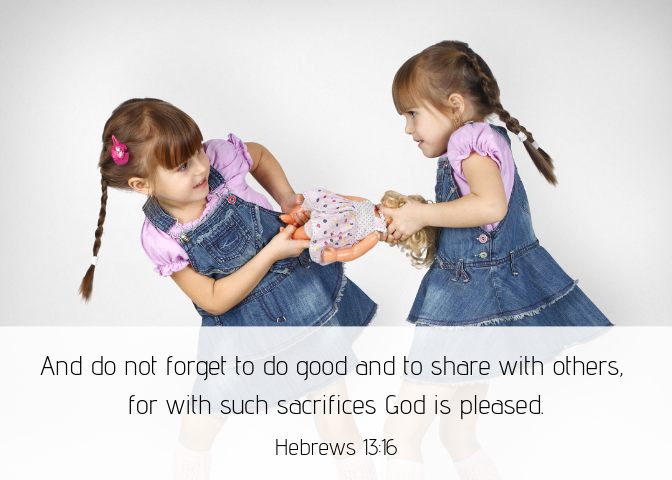
Skipping ahead just a bit to verse 16, we have another reminder in how to act towards others.  We are told to do good and share with them.  Obviously, this is another way in which we can show the love of God and demonstrate Christianity to new believers.  But, I’ll be completely honest, I’m not always in the best mood to share or do good for other people.  And quite frankly, sometimes people don’t deserve it!  But this verse isn’t telling us to do these things for other people alone.  We are told to offer these things as sacrifices to please God.  Depending on the person, sacrifice might be a good word to describe it!  I think it makes it easier to do good and share if I think of doing it for God versus for man.

Looking at the word sacrifice in verse 16 and the verse directly before that, I am reminded at how the Hebrews originally viewed that word.  Remember, they are still learning that sacrifice no longer has to be the shedding of blood!  That must have been a little confusing to go from sacrifice being blood to being worship and sharing!  This is just another way that shows how drastically Jesus can change our lives.  He took the unclean, messy, death and changed it in to praising God and showing love to others!

We are so incredibly lucky to have a Savior that has changed our world for us.  As a show of gratitude, we can focus on loving one another and spreading the same grace we receive from him to others.  In times like this when our world is hurting from the loss of people to things such as mass shootings, plane crashes, abortions, wars, natural disasters, and so many other horrible things in this life, I encourage you, brothers and sisters, to show a little love.

Grace be with you all!

-Sarah Blanchard Johnson

(originally posted for SeekGrowLove on February 17, 2018)

Application Questions

  1. Reading through Hebrews 13 which of these final instructions is most powerful to you?
  2. How will you share and do good to others this week – remembering that this is your sacrifice which pleases God.

He Will Never Leave You nor Forsake You

Hebrews 13


Hebrews 13 16

Boy, it is hard to think about our life after reminiscing about the lives of those faithful giants listed in Hebrews 11.  We tend to compare ourselves with them, both in the good and the bad.  We’d love to do something great, something extraordinary for God just like them.  When we think of Enoch we can only image what it would be like to be translated.  Translated?? Somebody needs to translate that word for me, so Paul did.  He says that Enoch was translated “so that he should not see death” (Heb. 11: 5).  Wow! His faith was so great and powerful that God allowed him to cheat death.  I want that!  Or Abraham.  God called him to leave his home, his life, and go to a new home even though Abraham did not know where in the world God was sending him.  Nothing like a little adventure with God in control.  Sarah, the wife of Abraham, had a baby in old age because God promised her a son.  When she had Isaac, she had lived longer than most of us will live, yet she was having her first baby. Remember that Abraham was Sarah’s husband and he was ever older than she was.  Through this old man and old lady they had descendants more numerous than the stars in the sky or the grains of sand on the beach.  Each time you run your toes through a sandy beach think about that a little.

Of course God was not through with Abraham yet, so He led him up to a mountain and told Abraham to use his only son as a sacrifice in his worship to Him.  That was tough, but it certainly made life exciting for Abraham!  Even though this looked like a bad thing for Abraham, it certainly appears as though God had some special plans for Abraham.  God just needed to make sure that Abraham was on His side.

It is tough being a parent, I am sure.  But being asked to offer up your son to God might be going a bit too far, but not for Abraham.  Or in the case of Moses’ parents, they chose to refuse Pharaoh’s orders and hid their son for three months.   They were not afraid of Pharaoh and his commandments!  And that courage paid off big time.  For after Moses was grown up he lead the children of Israel safely through the Red Sea—something that Pharaoh and all of his horses and mighty men could not do!

The story of Rahab is a hard one to swallow.  We all know about Rahab.  After all, she was a harlot, not exactly a pillar of the community.  She had a reputation.  Everyone knew who she was.  Surely God knew.  The word was out on the street, after all.  But Rahab, of all people, was chosen for a special part in God’s work.  She hid two spies (and lied about it) sent out by Joshua to check out the land including Jericho.  What she did took great daring on her part.  And what did she get out of all of this?  She got great faith, God spared her, she got a mention in the faith chapter (Hebrews 11), and she became an ancestor of the Messiah, Jesus (Matt. 1:5).  Sometimes it just doesn’t seem right, that someone like Rahab who lived such a bad life, could then be used in such an extraordinary way by God.  In comparison, our lives, which we try very hard to live in a worthy manner for Him, are pretty boring.  I wonder, are we, am I, doing something wrong?  Why don’t we have stories to tell like Enoch, Abraham, Sarah, Moses, and even Rahab, about how God is using us?  What is wrong with us?

At times we feel as though we are not accomplishing anything for God.  Are we still on the same team with God? Everything is going smoothly, but we are not doing anything really big for God.  I’d love to hide a few spies!  What is wrong with us?  Have we lost our way?  Or, is it God who has quietly slipped out the back door of our lives?

Maybe Paul has read our minds.  Because he seems to speak about these same things, if we look closely and maybe read between the lines a bit.  Hebrews 13 begins with the simple things, the simple acts that we are to accomplish.  Not a lot of fanfare.  Not a lot of glory or bells and whistles.  Certainly no sea parting and walking on dry ground stuff.  Just the basics.

“Through Him then let us continually offer up a sacrifice of praise to God, that is, the fruit of lips that acknowledge His name.  Do not neglect to do good and to share what you have, for such sacrifices are pleasing to God. Let brotherly love continue.  Do not neglect to show hospitality to strangers, for thereby some have entertained angels unawares.  Remember those who are in prison, as though in prison with them, and those who are mistreated, since you also are in the body.  Let marriage be held in honor among all…Keep your life free from love of money, and be content with what you have, for he has said,      ‘I will never leave you nor forsake you.’”( Hebrews 13: 15-16 and 1-5)

 No, He has not quietly slipped out the back door of our lives.

It’s just that God does not demand extraordinary things from us.  He simply wants the simple things.

-Luke Elwell