
Heart Change

OLD TESTAMENT: Isaiah 44 & 45

POETRY: Psalm 107

NEW TESTAMENT: James 2:14-26

Faith or Works

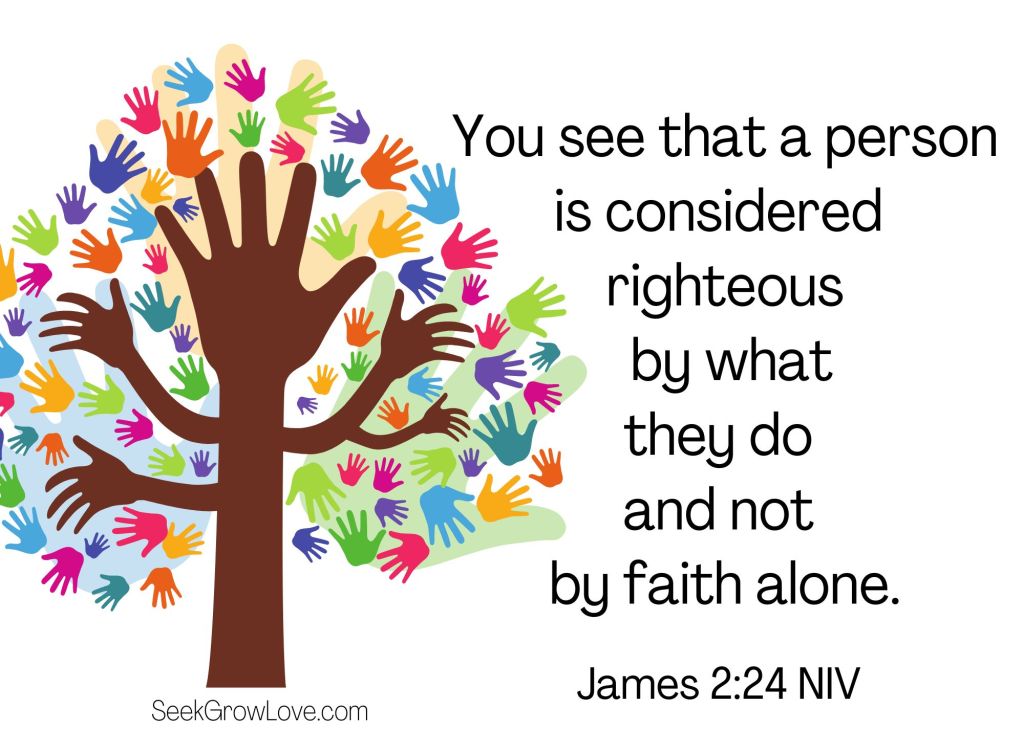
How are we saved?  We are saved by grace alone, through our faith in Jesus Christ.  But what comes out of our faith?  Shouldn’t it be works?

If we start with works and try to earn our righteousness, we won’t get there.  We cannot earn salvation.  However, if we have faith, works should come out of that.

I think most people reading this probably know these things.  You’ve probably heard a sermon, read a devotion on it, etc.  But do we live that way?  Do we live in a way that is trying to work on all the individual things in our lives, to clean them up one by one, to do the good things we are supposed to?

Alternatively, we can focus on growing our faith.  On accepting the gift given to us and let the good works come naturally as a result of that.

The youth group at our church recently read in Romans 12 which lists many snippets on how we should be living “love must be sincere…be joyful in hope…share with God’s people who are in need.  Practice hospitality…live in harmony with one another…do not be conceited…” and many more. 

We could use this as a checkbox of good works to make sure that we are doing the right things to show our salvation.  But that doesn’t address our hearts.  If we need a checklist to make sure we are loving one another, we need to go back and look at our hearts.  What we talked about in class was to pray to have our hearts changed so that living this way would come naturally out of the overflow of our hearts.  And I think this relates to the faith vs works question. 

If our faith is sincere, our hearts are changed, and the result of that is good works.

A checklist can be a good way for you to ask yourself – am I living as one whose heart has been changed – but I don’t think it is good to be living our lives based off of a checklist.  It focuses you more on the tasks rather than the effects of what you are doing or the purpose behind it.

So maybe ask yourself if you are doing these good things, or avoiding the bad, but if you aren’t meeting the things on that list, don’t place your focus there.  Instead, pray for God to change your heart and you should start to see that happen more and more.

~Stephanie Fletcher

Reflection Questions

  1. Where have you seen faith without works? Where have you seen works without faith? Why, do you think, God is looking for both, working together?
  2. Are you living as one whose heart has been changed? Are you living out your faith daily? What evidence do you have to support your answer?
  3. What specific heart change can you pray for?
The Faith/Works Dilemma

James 2

Monday, October 3, 2022

In the second chapter of his letter, James continues with his onslaught of practical but difficult advice.

“What good is it, my brothers and sisters, if you say you have faith but do not have works? Can faith save you? If a brother or sister is naked and lacks daily food, and one of you says to them, ‘Go in peace; keep warm and eat your fill,’ and yet you do not supply their bodily needs, what is the good of that? So faith by itself, if it has no works, is dead. But someone will say, ‘You have faith and I have works.’ Show me your faith apart from your works, and I by my works will show you my faith. You believe that God is one; you do well. Even the demons believe—and shudder.” (James 2:14-19 NRSV)

It would seem from this section that just believing things is no good. If my interpretation of James is correct, that means it’s not enough to go around quoting John 3:16 and telling people they only need to believe in Jesus and they will be saved. There is no checklist of beliefs where you can just tick all the boxes and receive salvation. No single belief will save you, and neither will any magical combination of beliefs.

James is asserting that action must accompany faith in order for it to be the real thing. Doing good works is the evidence of your faith. Faith and good works don’t live isolated lives, but are coupled together. To decouple faith and works is to reveal an inconsistency.

Imagine that someone claims to believe in the value of human life as the image of God, yet they go around hurting or killing people. Or maybe they just neglect to help someone else they know is in need. You would notice the inconsistency in that. They must not truly believe in the value of human life since their actions show they don’t value it. James is telling us that actions are louder than words. He cuts right through the nonsense and says, “Hey, don’t just tell me what you believe. Show me.”

When we talk about this passage, it’s likely that we’ll also think of a passage from Ephesians that seems to be in tension with it.

“For by grace you have been saved through faith, and this is not your own doing; it is the gift of God—not the result of works, so that no one may boast. For we are what he has made us, created in Christ Jesus for good works, which God prepared beforehand to be our way of life.” (Ephesians 2:8-10 NRSV)

Paul here is saying that works can’t save you; it’s a gift you accept through faith. James is saying faith alone doesn’t save or justify you; you need works too. Is there a conflict between what James and Paul are saying?

Part of the beauty of this collection of writings we call the Bible is that different authors often have different perspectives on things. We have four different gospel accounts, each with their own angle and emphasis. The general story and message are the same, but some of the finer details differ. This is exactly what you would expect if you asked four different people to describe something they witnessed years ago. This is not a problem at all for the gospels, and in actuality, bolsters the case for their authenticity. It shows that four people didn’t get together in a room for a weekend and collude to produce the exact same fairy tale. Four real people wanted to pass on what they witnessed, and they did so under the inspiration of God.

We see the world with two eyes, each from a slightly different angle. This allows us to perceive depth, in other words, to see things in 3-D. Your brain does some kind of trigonometry with the signals from your eyes to give you an idea of how far away something is. If you had only one eye, it would be much harder to judge depth.

We can regard James and Paul as two eyes looking at the topic of salvation from two different angles, and the result is seeing it in 3-D. It’s the same core truth with different emphases. James sees something Paul doesn’t see, and Paul sees something James doesn’t see. At great risk of oversimplification, I’ll try to bring their viewpoints together. They would agree that faith and works go hand-in-hand. James is saying faith alone is not enough, and Paul is saying works alone are not enough. Neither would say that you can earn salvation by works, but would agree that the works are evidence of a saving faith. Well, I took a stab at it. My only hope is that they can get together sometime to discuss this topic and release it as a long-form podcast.

-Jay Laurent

Question Time

1. Why do you think it is so hard to really live out what you believe?

2. What small steps could you take this week to put your faith in action?

Faith ____ Works

James 2

James 2 14 NIV

In Chapter two of James he continues to tell us that we need that Humble Pride and we are not to judge others in partiality. We must not look at others and decide that God isn’t going to use them because we don’t like the way they look. Just as we may turn away from a book when the cover is worn and frayed, we occasionally turn away from people when we see they are worn and frayed. The thing we must remember is sometimes the books, and people, that are worn the most are worn from use not from neglect. When we look at someone we should seek the potential that our LORD sees. When Samuel went to anoint the king he would have overlooked David but God was looking at David’s heart.

In the same way that we tend to judge by what we see on the surface James tells us that our faith is to be more than mere words.

When you look at Faith ______ Works, what would you place in that blank?

  • Faith or works
  • Faith VS. works
  • Faith and works

We know that we are cleansed of our sins by faith (not by works), so why would James ask in 2:14, “Can faith with no works save you?” Do Paul and James have a long-standing disagreement on this matter? No, they agree beautifully! James is not saying that we are saved by our works but that our works are evidence of our faith. In verses 15 and 16 he says that empty words mean nothing. For example, if I simply say I am feeding my dogs regularly, yet I give them no food; eventually they starve. They will not survive on my words or good intentions alone. The same is true of our faith. Luke just told us last week of that “great cloud of witnesses” in Hebrews 11 that were all shown to be faithful and that faith was made evident in the works they did for God.

James says if we have true faith it will be shown by our actions! He says in verse 19 that if all it took was a belief in the truth that God is one then even the demons would be okay, because they believe and shudder. Although they believe, their actions and their allegiance are not inline with God’s plan. They understand truth but choose to do their own thing. We need to understand truth AND let that truth move us to action for God!

James says that we need a Faith that Works!

If our faith is not causing us to work for God we must ask ourselves, “Do I truly have faith, or do I have empty words?”

-Bill Dunn