The Vine and the Branches

John 15 “I am the true vine, and my Father is the gardener.  2  He cuts off every branch in me that bears no fruit, while every branch that does bear fruit he prunes [a]  so that it will be even more fruitful.  3  You are already clean because of the word I have spoken to you.  4  Remain in me as I also remain in you. No branch can bear fruit by itself; it must remain in the vine. Neither can
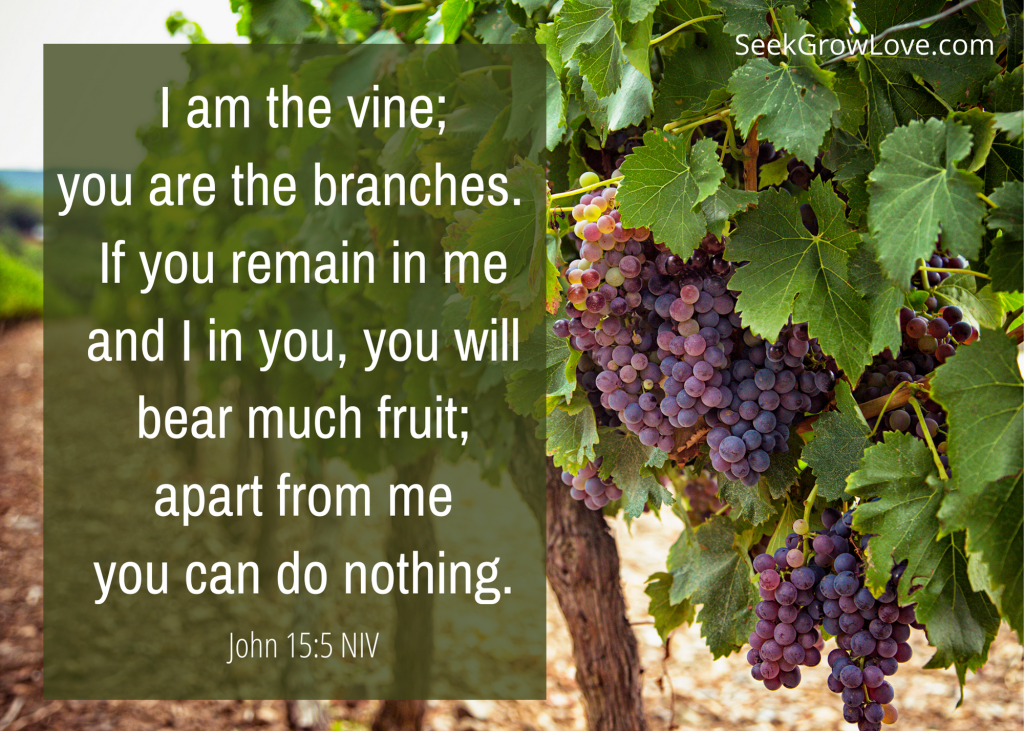
you bear fruit unless you remain in me. 5  “I am the vine; you are the branches. If you remain in me and I in you, you will bear much fruit; apart from me you can do nothing.  6  If you do not remain in me, you are like a branch that is
thrown away and withers; such branches are picked up, thrown into the fire and burned.

One of my favorite things about summer is the chance to have a garden and watch seeds grow from tiny seeds into plants taller than me sometimes. This summer I planted a spaghetti squash seed for the first time. The tiny seed I planted in the spring has now become a huge plant, growing into a vine so big that it keeps spreading into the neighbor’s yard and crowding many of
my other plants. At first I tried to wind it around our fence to keep it climbing there, but that vine continued to spread and really wanted to bear fruit next door too! It has forced me to really watch to see which branches have the flowers turning to fruit and which do not so that I can determine which to remove.


The branches I cut off are tossed away, turning brown and withering very quickly. While I have removed many branches and seen withered plants over the years, this particular squash plant has been so prolific with fruit (which not everyone in my household is thrilled about!) and grown into such a large vine, it has really been a good practical lesson for me regarding this passage.

Fruit doesn’t grow unless it is attached to the vine. But, flowers/branches attached to the vine can grow bigger and bigger producing exponentially more seeds than I started with in April. It is clear from the book of John that is true of us also. It is a nice picture really, but one we should take seriously considering what happens to the branches in verse 6. God is the perfect creator and gardener. He knew we couldn’t bear fruit alone and sent His son, Jesus, to be our mediator and through his sacrifice and forgiveness we are able to have a relationship with God and bear fruit for His glory. To bear fruit we must remain on the vine. If you read further in John 15 you will see some descriptions of what remaining in the vine involves. Keeping the commands of Jesus, laying down our lives for other followers of Jesus, and loving one another as we have
been loved.


But, we aren’t asked to do it alone. We are asked to bear fruit alongside other believers growing in love and obedience to Jesus together. And we aren’t told to do it just so we aren’t cast away and die. In fact, we are appointed to do it “so that my joy may be in you and that your joy may be complete (v.11)”. God’s master gardener plan is to bring us joy, and that can be found nowhere but in Him.

-Jennifer Hall

Even when the devotions are on other great passages – you can keep on reading through the Bible plan – read or listen to today’s passages at BibleGateway.comJob 9-10 and 2 Corinthians 6.

United in Hope

john 3 17

I remember learning in a college psychology class that the two emotions most commonly selected by people meeting the criteria for clinical depression are guilt and shame. I saw the list that was given out in the assessment, and it included lots of others that I thought might have topped the list. Ones like grief, anger, fear, sadness, despondence, loneliness, rejection, etc. But, the two that were the most common consistently were guilt and shame. At the time I was a little surprised by that just because there were so many choices and they all seemed so “depressing”, but as the years go by, I am more surprised that I was surprised.

That is because guilt and shame are crippling and powerful negative emotions that we all experience. In definition, guilt and shame are a bit separated in the sense that guilt refers to the feeling associated with our behavior while shame is associated with a negative feeling of ourselves. Sin causes both. Because we all sin, we all experience the devastation of both emotions. And in a world where we find ourselves with divisions of race, socioeconomic class, culture, language,  and background. . . let it be known. . .we all experience guilt and shame because we are all guilty and shameful. If there is one thing uniting us all, it is that we are all intrinsically unworthy desperately in need of a savior. There aren’t those who are “really guilty” and those who are a “little guilty”. And even if that were the case, I think I’d want to be the former because in human reasoning, that is where the “man after God’s own heart” falls, and I believe those who recognize their unworthiness also recognize their need for God more. The human race is made up of innately sinful people completely unrighteous and unworthy constantly falling short of our perfect sovereign God.

“As it is written: “There is no one righteous, not even one” (Romans 3:10, NIV)

“The LORD looks down from heaven on all mankind to see if there are any who understand, any who seek God. All have turned away, all have become corrupt; there is no one who does good, not even one. (Psalm 14:2-3)

But, long before our existence God knew this and had an eternal plan. A plan to send a savior, His begotten son, Jesus.  So, while we experience that guilt and shame, we are also able to experience mercy, forgiveness, and hope. His desire is not to condemn us because of our guilt, but to save us from it. We feel shame because we don’t deserve that love and favor, but despite how we feel about it, it is there for the taking. Always. Again and again.

“For God did not send His Son into the world to condemn the world, but that the world through Him might be saved”  (John 3:17, NIV)

“For He made Him who knew no sin to be sin for us, that we might become the righteousness of God in Him” (2 Corinthians 5:21, NIV)

“If we confess our sins, he is faithful and just and will forgive us our sins and purify us from all unrighteousness.” (I John 1:9, NIV)

Just as we are united in the sense that we all sin and experience guilt and shame, we are also able to share forgiveness and hope together. We all have the opportunity to be forgiven by God, but not so we can “feel better”. . . so we can glorify Him. One of the most beautiful ways to do that is to forgive others. Who doesn’t love the story of the Prodigal Son? So, may we seek to live with the mercy of the father and not with the bitterness and pride of the brother. The inheritance that matters is our shared one. And part of loving our giver is sharing the gift with others.  It is worth returning for. It is worth staying for. It is worth learning about. And it alone is the lasting source of hope.

Then I saw a new heaven and a new earth; for the first heaven and the first earth passed away, and there is no longer any sea. And I saw the holy city, new Jerusalem, coming down out of heaven from God, made ready as a bride adorned for her husband. And I heard a loud voice from the throne, saying, “Behold, the tabernacle of God is among men, and He will dwell among them, and they shall be His people, and God Himself will be among them, and He will wipe away every tear from their eyes; and there will no longer be any death; there will no longer be any mourning, or crying, or pain; the first things have passed away.” (Revelation 21: 1-4, NASV)


–Jennifer Hall

God Willing

psalm 37 5

“What do you want to do when you grow up?” can be an entertaining enough question to ask a young child if we are looking for an answer that can’t be taken too seriously and a lighthearted conversation starter. For example, our daughter might tell you “a fish” on any given day because “they can swim underwater and I want to swim underwater and see it there”.  Too quickly though, it seems those questions turn into the far more burdensome “What are you doing when you graduate?”, “Which job pays more?”, “How many kids do you want”, “When are you going to get married?”, “Where do you want to live?”, “What do you want to __________”. . .and the list goes on.

We often particularly burden our youth with questions like these it seems at a time when they are trying to make sense of life and the overwhelming array of choices and decisions sweeping over them in a world that interprets life as far more human-driven than God-driven. Even in the church. Even in our families. We have all answered (and to be honest, likely asked) our fair share of questions similar to the above, and in many cases, these questions are asked by Christian friends, church members, and spiritual leaders around us. So, we answer, right? Even if they should know better than to ask those questions in those ways, we have to answer with something more than “I dunno” or our families frown, we feel stupid, or we know they are just going to ask again next week so we might as well spit out something now.  Sometimes the answers might roll off the tongue quite easily.  Sometimes, the answers might be more guarded and careful, hiding some personal or relational turmoil and confusion. And, sometimes. . .very occasionally it seems. . .the answers might actually be honest, beneficial, and edifying to the Christian body in that they come from scriptural ideas and are remotely indicative of an understanding of what it means to live as a follower of Christ versus just doing what we want. Something, like. . .

“Many are the plans in a person’s heart, but it is the Lord’s purpose that prevails” (Proverbs 19:21, NIV)

or

“In their hearts humans plan their course, but the Lord establishes their steps.” (Proverbs 16:9, NIV)

Seriously. It doesn’t really matter what we major in (32%+ of graduates will never even use what they major in anyway), what worldly skills or academic honors we have, how many kids or goats we want, which school/job offers more money, when we think we’ll be ready to get married, what “he” did, what our family says, or what our friends say. It does matter tremendously what God says. Our temporary earthly life gives us so many twists and turns that we need to rely on God for the steps because no path is what we thought it was going to be when we planned for it. If we planned for it. Not now. Not ever. Sometimes the paths we thought were God’s plan turn out to be nonexistent or wrong. Sometimes the paths we wished for or planned for are not God’s plan at all. Remember Abraham? Jonah? David? Joseph?( It doesn’t even matter which Joseph this time, does it?) The point is   . . .God alone knows, and He is not self-seeking and narcissistic like….umm…..all of us a lot of times more than we care to admit it?! He alone is our sovereign Creator and there is absolutely no one else we can trust to know best for us. If we spent even a fraction of the time we spend on things like completing personality tests, FAFSAs, career surveys (last one Jennifer took told her she should be a rabbi or farmer so obviously that was useful), figuring out our love languages, and listening to the always-bountiful opinions of others . . .and instead, invested it in seeking to know God better, love and obey Him . .surely this would be a good thing for us, the entire church body, and our world.

Recently we were ran across Psalm 37. It is a fabulous psalm full of good stuff . . .particularly if you want to be reminded of the fact that you do NOT KNOW and that is not only okay, it is what God desires. Because, He knows. He knows it all . . .so much more than we can understand in this life. And He reminds us of this all throughout His word time and time again. Here are just a few:

“Commit your way to the Lord. Trust also in Him, and HE shall bring it to pass.” (Psalm 37:5, NKJV)

 “The steps of a good man are ordered by the Lord, and He delights in his way” (Psalm 37:23, NKJV)

“Father, if you are willing, take this cup from me; yet not my will, but yours be done.” (Luke 22:42, NIV)

“Then he said to them all: “Whoever wants to be my disciple must deny themselves and take up their cross daily and follow me. For whoever wants to save their life will lose it, but whoever loses their life for me will save it. What good is it for someone to gain the whole world, and yet lose or forfeit their very self?” (Luke 9:23-25, NIV)

“For my thoughts are not your thoughts, neither are your ways my ways,” declares the LORD. (Isaiah 55:8, NIV)

We’ve tried to be intentional in teaching our daughter to understand that life decisions aren’t about what we want, what others want for us, or what others do. And so somewhere along the line, we used the phrase “God willing” and explained the concept of James 4 to her. Interestingly, she catches us all the time in our shortcomings in this area. Just the other day, Brian told her goodbye and said, “I’ll see you after work” to which his daughter cheerfully responded, “God willing. Because, you might die today and not come home. Or there might be an emergency like a tornado or our house might burn or Mommy might go to the hospital. . .”  God willing, kid. You are right. You are more right than us sometimes. And God is more right than us all the time. Regardless of if we like it.

If you want some great advice straight from the mouth of none other than the man after God’s own heart, we think you’ll enjoy Psalm 37. God willing.


–Brian and Jennifer Hall


Brian Hall grew up in Michigan and had fun attending FUEL/RYOT/youth camp each summer for all of his years as a youth.
Jennifer Koryta Hall grew up in Indiana and has lots of wonderful memories of FUEL from attending as a camper and counselor for many years (1997-2007). She hasn’t actually been to FUEL since becoming Jennifer Hall, but would love to come back sometime. 

Brian and Jennifer live in Indianapolis, Indiana with their daughter, Emily,  and attend New Covenant Bible Church there. They value their friendships from FUEL and their greater church family.

This Little Light of Mine

John 8 12

It is now officially summer. I love summer. I love the warmth of sun on my skin, the colorful growth and plant life around me, and the sound of voices as people are outside living life. I appreciate the simplicity of walking out my door without dragging a coat, scarf, and layers that never seem to be comfortable no matter what I do, and being able to simply open the door of my car versus brushing it off, warming it up, or on really bad days. . . digging it out. In general, I prefer sweat to shivers or snot (my nose pours this out in anger toward the cold within a few seconds of me being out there usually). I would rather have mosquito bites itch for a few days than itchy, dry skin for months just longing for warm sunshine days to come. Summer has its cons, but it has its pros, and I appreciate them.  As a child I remember dreaming of carefree summer days to come while sitting at uncomfortable desks in sterile classrooms with not even a window or glimpse of the “outside world” in sight. As an adult working 11 hour shifts, during winter months I would drive to work in the dark and get off in the dark, restricting my only sunlight exposure to the occasional view through a hospital hallway. I do not prefer to live this way.

The sunlight has so many benefits. Of course, lying out in the sun for hours in vanity or laziness are bad ideas. Blistering skin is a bad idea. And since anything can be misused, I do not want to condone anyone making unwise choices for skin or physical health this summer on account of this reading. But, just a little research will tell you how our western “indoor” culture is significantly deprived of sunlight in general. Sunlight helps us synthesize Vitamin D which is essential for so many bodily functions I won’t even begin to name them. Sunlight increases oxygen in our blood, lowers blood pressure, and builds the immune system. Sunlight improves our mood. In fact, areas of the world where there is more sunlight compared to cloudy northern climates further from the equator have significantly less diagnoses such as multiple sclerosis, ADHD, mood disorders, sleep disturbances, etc.  There are many known benefits to sunlight, and I find that concept to be quite spiritually relevant.

When I was in college, I remember being paired up with a girl from my college dorm Bible study, and we were asked to come up with the lesson for the following week.  She said her idea was “Let’s talk about light. It comes up a lot in the Bible it seems”. So, we had a week to casually research light references in the Bible we thought and come up with a little lesson of some sort…..and we realized by the middle of the week that we were not going to even touch the tip of the iceberg of what is there in the Bible in one study. Light is contrasted with dark throughout scripture, and darkness or a lack of light is correlated to evil numerous times. The light is good stuff. God’s son is the light. We are to walk in the light. We are to turn from darkness.  So, I can only provide a drop in the bucket of the idea of light here today. . .but here are some things to think about:

“You are going to have the light just a little while longer. Walk while you have the light, before darkness overtakes you. Whoever walks in the dark does not know where they are going.  (John 12:35, NIV)

 “Then Jesus again spoke to them, saying, “I am the Light of the world; he who follows Me will not walk in the darkness, but will have the Light of life.” (John 8:12, NIV)

We can be overtaken by darkness and lost. We need to intentionally seek and follow the light. The light has been lovingly and freely given to us by our Creator and sovereign God. We don’t know where we are going if we aren’t following the light of his son, Jesus. And, we aren’t following Jesus if we aren’t living like Jesus lived. If we are followers of Jesus, we are also a source of light to others.

“You are the light of the world. A town built on a hill cannot be hidden. Neither do people light a lamp and put it under a bowl. Instead they put it on its stand, and it gives light to everyone in the house. In the same way, let your light shine before others, that they may see your good deeds and glorify your Father in heaven.”  (Matthew 5:14, NIV)

Ultimately, we need to identify the contrast between light and dark by believing the light is good and turning away from evil.  We are called to accept the light God has provided through the forgiveness and salvation made possible by the gift of His son, our Messiah. As part of that belief, we are instructed to follow Jesus and in turn bring glory to our Father. Also, by doing this, we shine a light for others who are lost, just waiting for a glimpse of that summer sun on a cloudy, wintry day.

I appreciate so much those who have been a light to me on this earth, and those who have taught me of a day to come. One without tears and mistakes and disappointments. A day so bright we won’t even need the sun at all according to Revelation!  Followers of Jesus long for that day where we can reign together with him in his kingdom, but as we wait for it with open arms, let’s not forget to continually seek the light, love the light, and shine the light.


–Jennifer Hall

Lukewarm Caterpillars

2 Corinthians 5_17

A few weeks ago, we got to experience an up-close view of a bit of a twist on the classic caterpillar to butterfly spiritual analogy. Maybe you’ve heard the classic version in youth group, Bible School, or a devotion book….the idea that we are all new creations if we are Christians. That we start as these creepy, crawly, fuzzy little beings and then as a gift of God, through faith in Christ….voila….we are made completely new into creations of beauty and wonder like a butterfly.

Thanks to our friend, Terri Tschaenn, and her milkweed stash….we have gotten to watch this truly amazing experience of God’s creation several times, and it hasn’t gotten old yet. We’ve gotten to feed those adorably cute little caterpillars as they grow at amazing rates each day. We’ve watched the miraculous chrysalis formation, and we’ve gotten to hold brand new monarch butterflies on our pinky fingers before they fly off. It is amazing. It is beautiful. And, it certainly is representative of the hope of new life and transformation God tells us about in 2 Corinthians 5:17.

But. . .does every caterpillar turn into a butterfly? Hmmm.

Terri told us the unfortunate story of one of her baby caterpillars that accidentally met a predator while she was trying to keep it safe in her school classroom….and….chomp. All gone. No butterfly.  And, recently, we watched our caterpillar which we had been watching grow for several weeks, for some unknown reason, never develop his chrysalis at all. Instead, he slowly wasted away and died. It was rather depressing to watch. He had eaten milkweed like all the rest, had gotten to full size, and had looked “just right” to us from the surface. But, inside….something was wrong. He never experienced the stage of transformation. And, instead of achieving beauty and new life, he died a caterpillar. It is common. It is sad. And, it is also certainly representative of what God tells us about in scripture whether or not it makes for as many Sunday School craft ideas on Pinterest.

The Bible warns us about the Christians who look like Christians, but who haven’t experienced a transformation through repentance and faith in the Messiah, Jesus Christ. These Christians are lukewarm. Just like the caterpillars who die, they lack something inside. But mind you, these aren’t atheist caterpillars or caterpillars who don’t go to church. These are Christian caterpillars. Ones who look just like us. Ones who go to church with us. Maybe us. They haven’t achieved the transformation of repentance and faith in Christ which leads to obedience. And their demise if they don’t repent? “I will spit you out of my mouth” (Revelation 3:16, NASV).

Truth can hurt, but it matters. It matters because God and Jesus love us. And true love includes speaking honestly and intentionally. It also matters because unless we repent, at the judgment day, we do not become “butterflies” to live eternally with God and his son Jesus in the kingdom of God. The alternative to that option is death. Today, we live in a world telling us that almost any belief imaginable is “Christian”, and it can get quite confusing as we seek to be on the narrow road and not in the lukewarm masses. It requires diligent searching of scripture and faithful prayer on our parts. We cannot rely alone on our teachers, our families, our churches, and traditions of men. We must not just believe “in” God and Jesus, but know what they say and apply those words to our lives. So, if we find ourselves lukewarm and amongst lukewarm believers. . .what does Jesus say to us?

Those whom I love I rebuke and discipline. So be earnest and repent. 20 Here I am! I stand at the door and knock. If anyone hears my voice and opens the door, I will come in and eat with that person, and they with me. To the one who is victorious, I will give the right to sit with me on my throne, just as I was victorious and sat down with my Father on his throne. (Revelation 3:19-21, NASV).

Let’s seek and pray to be more than lukewarm this week and to be victorious in Christ.

-Jennifer Koryta Hall