

An Obedient Servant

*Esther 3-4

*Psalm 91

*Hebrews 2

-devotion by Jeremy Martin (TN)

                        I love the story of Esther, because without her obedience and willingness to sacrifice herself if needed, a pretty horrible pre-Holocaust destruction of the Jews would have taken place.  While it’s hard for me to imagine it being on the same scale of intentional diabolical evil that occurred in World War II, I suppose if you are one of the ones that’s being murdered you’re far less concerned with intent than action. 

            In Esther 3 today, we see that the King (Ahasuerus) “magnified Haman” and advanced him, “above all the princes who were with him” (v1), to the point that the king had commanded folks to bow to him (v2).  It’s not really clear in scripture why Haman was advanced, but Haman was promoted to (presumably) the second highest level of authority in the kingdom, and was enraged when Mordecai the Jew wouldn’t offer him obeisance.  Read Esther 3:5-6 and see how Haman’s pride caused him to feel/act: then take a moment to flip back to 2 Sam 16:5-14 to see how David (the king) responded to an even greater insult.  Ponder them both in your hearts for a moment: their level of pride, their reactions, and then their fates.  It’s good food for thought.

            Something that I had kind of read past when I was younger jumped out at me when I was reading this morning, in 3:7 we see that Haman, after becoming enraged at Mordeai, had lots cast (cleromancy)  for almost a full year before acting on his rage with his plans to commit genocide on the Jews.  Haman is a man who acts on his impulses, but absolutely does not act impulsively: he festered on his rage for almost a year before approaching the king to begin his attempt against the Jews, and sought supernatural guidance to find the best time to begin.  Haman offers the king 10000 talents (a talent was @75 lbs!) of silver, but the king said “the silver is given to you” and handed Haman his signet ring (effectively giving him full authority and funding) to sign his petition in to law.  Decrees were issued, messengers were sent out, and the king and Haman settled in to drink, but the “city of Susa was in confusion”.  The regular citizens, in other words, had no idea why this was happening.  (This is all detailed in Esther 3:7-15).           

            When Mordecai hears of this, he informs Esther  that she must act.  Initially she is hesitant to do so since there is a distinct possibility that she’ll be killed (Esther 4:1-12).  Mordecai’s response to this in 4:13 gives us a critical understanding: “For if you remain silent at this time, relief and deliverance will arise for the Jews from another place, and you and your father’s house will perish.  And who knows whether you have not reached royalty for such a time as this?“(LSB).  So here’s the thing: God has a plan.  We see throughout scripture that God interacts with his creation through his agents (shaliach) to further His plans and purposes, and many times He has placed a person in just the right place at just the right time to fulfill His purpose.  What do you think happens to those agents who allow fear to prevent them from doing Gods purpose? (Hint: see bold text above). Think about it for a moment: God will ensure His purposes, whether or not you choose to participate obediently determines whether you are rewarded richly or die unknown in disgrace.

            Keep this understanding in mind, while we move forward in time to when God sent Jesus as His obedient agent of salvation for the world.  In the book of Matthew, directly after being baptized, Jesus is led (by the holy spirit) into the wilderness and fasts for 40 days and nights,  after which The Adversary approaches him and tempts him: first with food (pretty obvious), then with a confirmation of authority (subtle and insidious), and then with a blatant offer of power (a last desperate attempt).  So what if Jesus had responded differently or disobediently, with arrogance instead of firm humility? Think about it.  If Jesus had not been obedient, it might be someone else’s name we all recognized today.

            A couple very important things to be noted: God cannot be tempted (James 1:13).  Even if you have a confused understanding about your Christology this should be a giant waving red flag to a “traditional  orthodox” understanding, regardless of “nature”,  because God cannot be tempted irregardless of how you try to rationalize or justify that.  Secondly, we know firsthand that our adversary is insidious and clever, hitting us at our weakest points.  In Matt 3:17, God says “This is my beloved son…” after Jesus obediently gets baptized.  In Matt 4:3, the tempter said “IF you are the son of God…” turn these stones into bread, and Jesus responds with scripture (Dt 8:3).  Then he took Jesus to the pinnacle of the temple and said “IF you are the son of God…” throw yourself down, and quotes today’s reading of Psalms 91 (v11-12).  Jesus responds by quoting scripture back (Dt 6:16).  You know the story, probably so well that you’ve not dug into it too deeply.

            Here’s the thing, and why this is so insidious: in each of these instances above, the tempter is trying to plant a seed of doubt:  “IF you are the son of God…IF you are…” (“Are you really?  Are you sure?  We haven’t seen any miracles yet…how do you know?  Maybe this could show me and the world that you really are, prove yourself, let people see, won’t that be awesome?  Are you the messiah, do you really think so?  Are you reallySHOW US…prove it to us and to yourself…”).  This is downright diabolical.  This is why it’s just so humbling and beautiful that Jesus remained faithful, because he overcame all of these diabolical temptations, these targeted attacks on him.

            “Weeell, he wasn’t really tempted…” I’ve heard some folks say, but YES, HE WAS!  In each of the points of potential weakness that the shrewdest adversary that exists thought he could penetrate.  Have you ever not eaten for a couple days?  Try it.  You start fantasizing about what foods you will eat when you eat again.  This is a pretty obvious first stab.  The second attempt (“throw yourself down…IF you are the son of God you’ll be fine…”) is the most insidious one, in my opinion, because as humans we are always just filled with doubt.  “Are you really the son of God?  Really? Prove it…” Imagine as a man that you believe that you have a God-given destiny, that you are to be the one to redeem not only Israel but all of the earth: but you’ve been out by yourself for over a month and haven’t eaten, you’re starving and beginning to wonder, and here is the opportunity to prove not only to your enemy but to yourself that you really are the chosen one, the Christ, the Anointed One.  You can prove it.  Are you tempted?  Of course you are.

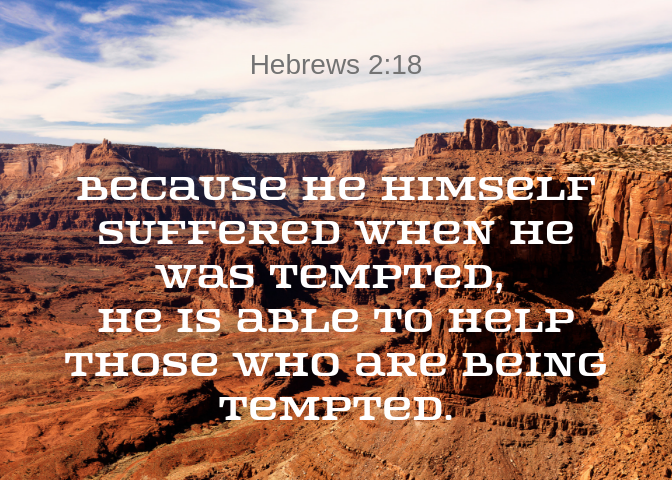
            Thank God that Jesus overcame.  In our reading today of Hebrews 2:16-18 it confirms that Jesus was the seed of Abraham (A Jew, fulfilling the prophecy in Dt 18:18), that he was our brother (A human being, fulfilling the prophecy of Gen 3:15 and Ps 89:19), and that he himself was tempted (which God Himself can’t be, see James 1:13 again for clarification) so that he is able to come to help those who are tempted (ie, us, the other humans).  As our brother, Jesus is our role model of obedience and humble submission to God’s will. We can do it, because Jesus did.  We are called to be obedient and to submit just like Jesus did, just like Esther did, because if we don’t God will just raise up someone else in our place: His purpose will be fulfilled, whether you participate or not.
REFLECTION QUESTIONS:

  1. Do you think you’d have ever heard about Esther, if she’d chosen to be safe instead of obedient?
  2. Same question, but with Jesus?
  3. Can you think of a time in your past where you had a choice but were scared?  What happened?  Do you feel as if you passed or failed that test, and why?

PRAYER

Father God, thank you for life, and breath, and all things.  Help me to be humble and obedient, even as the Christ was, and even to the point of death.  Allow me the honor of fulfilling the purpose that You have determined for me in this life, even unto death, and allow me to see Your kingdom.  May the lips of all creation offer You the praise deserved.  In Jesus name, Amen.

The Unlikely Pair

John 19

April 16

Each year, we talk extensively about Jesus’ death on Friday and resurrection on Sunday. The in-between often gets skipped in our remembrance, those long hours of grieving—and for Joseph of Arimathea and Nicodemus—burying Jesus’ body.  

Later, Joseph of Arimathea asked Pilate for the body of Jesus. Now Joseph was a disciple of Jesus, but secretly because he feared the Jewish leaders. With Pilate’s permission, he came and took the body away. He was accompanied by Nicodemus, the man who earlier had visited Jesus at night. 

Joseph of Arimathea and Nicodemus were both secret disciples. They feared making their public allegiance to the controversial Jesus. Both were members of the Sanhedrin, the highest Jewish council—the same institution that crucified Jesus. They used their status as religious elite to approach Pilate and ask for Jesus’ body to bury properly. 

They used to follow Jesus in hushed voices and under the veil of night. Now, they are boldly professing their faith in the same circle they once feared persecution. 

Nicodemus brought a mixture of myrrh and aloes, about seventy-five pounds.Taking Jesus’ body, the two of them wrapped it, with the spices, in strips of linen.  At the place where Jesus was crucified, there was a garden, and in the garden a new tomb, in which no one had ever been laid. Because it was the Jewish day of Preparation and since the tomb was nearby, they laid Jesus there. (John 19:38-42)

Although Joseph and Nicodemus were an unlikely pair to care for Jesus’ body, they were chosen by God for two apparent reasons. 

First, belief in the resurrection hinged on the testimony of those who witnessed Jesus’ lifeless body. Joseph and Nicodemus weren’t one of Jesus’ ragamuffin friends whose testimony would likely be questioned. No, they were respected and trusted as members of the religious elite. In this way, Joseph and Nicodemus were two of the first agents of Christian apologetics. 

Second, ordinarily, crucified criminals like Jesus would have been buried anonymously in a field. Joseph, however, brings the body to his own designated tomb. This fulfilled the prophecy that Jesus would be buried with the rich (Isaiah 53:9)

He was assigned a grave with the wicked, and with the rich in his death, though he had done no violence, nor was any deceit in his mouth. (Isaiah 53:9)

Ultimately, God positions people for His purposes. Joseph and Nicodemus were perfectly positioned for this holy task, which begs the question: what has God positioned you to do? 

Child of God, you are chosen and well-equipped. 

-Mackenzie McClain

Discussion Questions: 

  1. What has God positioned you to do? Can you recall any circumstances in your life that God used for His purposes?

God Willing

psalm 37 5

“What do you want to do when you grow up?” can be an entertaining enough question to ask a young child if we are looking for an answer that can’t be taken too seriously and a lighthearted conversation starter. For example, our daughter might tell you “a fish” on any given day because “they can swim underwater and I want to swim underwater and see it there”.  Too quickly though, it seems those questions turn into the far more burdensome “What are you doing when you graduate?”, “Which job pays more?”, “How many kids do you want”, “When are you going to get married?”, “Where do you want to live?”, “What do you want to __________”. . .and the list goes on.

We often particularly burden our youth with questions like these it seems at a time when they are trying to make sense of life and the overwhelming array of choices and decisions sweeping over them in a world that interprets life as far more human-driven than God-driven. Even in the church. Even in our families. We have all answered (and to be honest, likely asked) our fair share of questions similar to the above, and in many cases, these questions are asked by Christian friends, church members, and spiritual leaders around us. So, we answer, right? Even if they should know better than to ask those questions in those ways, we have to answer with something more than “I dunno” or our families frown, we feel stupid, or we know they are just going to ask again next week so we might as well spit out something now.  Sometimes the answers might roll off the tongue quite easily.  Sometimes, the answers might be more guarded and careful, hiding some personal or relational turmoil and confusion. And, sometimes. . .very occasionally it seems. . .the answers might actually be honest, beneficial, and edifying to the Christian body in that they come from scriptural ideas and are remotely indicative of an understanding of what it means to live as a follower of Christ versus just doing what we want. Something, like. . .

“Many are the plans in a person’s heart, but it is the Lord’s purpose that prevails” (Proverbs 19:21, NIV)

or

“In their hearts humans plan their course, but the Lord establishes their steps.” (Proverbs 16:9, NIV)

Seriously. It doesn’t really matter what we major in (32%+ of graduates will never even use what they major in anyway), what worldly skills or academic honors we have, how many kids or goats we want, which school/job offers more money, when we think we’ll be ready to get married, what “he” did, what our family says, or what our friends say. It does matter tremendously what God says. Our temporary earthly life gives us so many twists and turns that we need to rely on God for the steps because no path is what we thought it was going to be when we planned for it. If we planned for it. Not now. Not ever. Sometimes the paths we thought were God’s plan turn out to be nonexistent or wrong. Sometimes the paths we wished for or planned for are not God’s plan at all. Remember Abraham? Jonah? David? Joseph?( It doesn’t even matter which Joseph this time, does it?) The point is   . . .God alone knows, and He is not self-seeking and narcissistic like….umm…..all of us a lot of times more than we care to admit it?! He alone is our sovereign Creator and there is absolutely no one else we can trust to know best for us. If we spent even a fraction of the time we spend on things like completing personality tests, FAFSAs, career surveys (last one Jennifer took told her she should be a rabbi or farmer so obviously that was useful), figuring out our love languages, and listening to the always-bountiful opinions of others . . .and instead, invested it in seeking to know God better, love and obey Him . .surely this would be a good thing for us, the entire church body, and our world.

Recently we were ran across Psalm 37. It is a fabulous psalm full of good stuff . . .particularly if you want to be reminded of the fact that you do NOT KNOW and that is not only okay, it is what God desires. Because, He knows. He knows it all . . .so much more than we can understand in this life. And He reminds us of this all throughout His word time and time again. Here are just a few:

“Commit your way to the Lord. Trust also in Him, and HE shall bring it to pass.” (Psalm 37:5, NKJV)

 “The steps of a good man are ordered by the Lord, and He delights in his way” (Psalm 37:23, NKJV)

“Father, if you are willing, take this cup from me; yet not my will, but yours be done.” (Luke 22:42, NIV)

“Then he said to them all: “Whoever wants to be my disciple must deny themselves and take up their cross daily and follow me. For whoever wants to save their life will lose it, but whoever loses their life for me will save it. What good is it for someone to gain the whole world, and yet lose or forfeit their very self?” (Luke 9:23-25, NIV)

“For my thoughts are not your thoughts, neither are your ways my ways,” declares the LORD. (Isaiah 55:8, NIV)

We’ve tried to be intentional in teaching our daughter to understand that life decisions aren’t about what we want, what others want for us, or what others do. And so somewhere along the line, we used the phrase “God willing” and explained the concept of James 4 to her. Interestingly, she catches us all the time in our shortcomings in this area. Just the other day, Brian told her goodbye and said, “I’ll see you after work” to which his daughter cheerfully responded, “God willing. Because, you might die today and not come home. Or there might be an emergency like a tornado or our house might burn or Mommy might go to the hospital. . .”  God willing, kid. You are right. You are more right than us sometimes. And God is more right than us all the time. Regardless of if we like it.

If you want some great advice straight from the mouth of none other than the man after God’s own heart, we think you’ll enjoy Psalm 37. God willing.


–Brian and Jennifer Hall


Brian Hall grew up in Michigan and had fun attending FUEL/RYOT/youth camp each summer for all of his years as a youth.
Jennifer Koryta Hall grew up in Indiana and has lots of wonderful memories of FUEL from attending as a camper and counselor for many years (1997-2007). She hasn’t actually been to FUEL since becoming Jennifer Hall, but would love to come back sometime. 

Brian and Jennifer live in Indianapolis, Indiana with their daughter, Emily,  and attend New Covenant Bible Church there. They value their friendships from FUEL and their greater church family.