Today, we are in the middle of the week and we find ourselves in the middle of our Lectio Divina (Sacred Reading) of Psalm 37.* Today’s reading is a little more in-depth, so if you’re in a hurry you might wish to come back to this at a time later today when you can invest a few minutes into reading/praying. My goal here is not just to give you a fish and feed you for a day but to teach you how to fish so you can learn to feed yourself for the rest of your life (and feed others).
Remember, the purpose of Lectio is to draw us into God’s presence and rest through reading, meditating upon and praying with the Bible. While the goal is not simply intellectual understanding, but relationship with God, it is still important that when we read and meditate we are doing so correctly. We want to be as accurate as possible about the meaning of God’s Word. We want to think about what it actually says and what it meant when it was written and what it means for us today. It wouldn’t make much sense to spend a lot of time meditating upon something that was not correct.
If you have internet access, there are some tools readily available which cost nothing and can help you.
One tool is Bible Gateway. I began working in a Christian bookstore when I was attending George Mason University back in 1982. I became aware of a lot of different Bible translations that were available (beyond the King James). I started building a library of various Bible translations and nearly 40 years later I have over 50 different translations on my bookshelves. You can now get almost every one of those translations (and many more) on Bible Gateway. Choose the text you wish to study, and choose which translations you wish to use and you can see a side by side comparison of the texts. This can be helpful when you are studying a Biblical passage. It can help you understand the nuances of meaning. Some translations are more or less word for word, while others are more thought for thought. There are also paraphrase versions which attempt to convey the meaning in modern contextual language.
The second tool is Blue Letter Bible. While the available translations are fewer than on Bible Gateway, BLB allows you to do a detailed analysis and word study of various words. You can look up the original Hebrew/Aramaic or Greek words and see some of the various ways that word is used in the Bible and have a greater understanding of what the Bible was saying back when originally written and you bridge that into modern day language/ways of thinking and speaking.
With that said, I’ve identified 4 key words that are used in today’s reading and give you a summary of the word meaning and usage in the Bible:
תָּמִים tâmîym, taw-meem’; entire (literally, figuratively or morally); also integrity, truth:—without blemish, complete, full, perfect, sincerely, sound, without spot, undefiled, upright, whole.
אָבַד ʼâbad, aw-bad’; to wander away, i.e. lose oneself; by implication to perish:—break, destroy(-uction), not escape, fail, lose, (cause to, make) perish, spend, be undone, utterly, be void of, have no way to flee.
כָּלָה kâlâh, kaw-law’; to end, to cease, be finished, perish, consume, destroy (utterly), be done, , expire, fail, faint, finish, fulfill, wholly reap, make clean riddance, spend, take away, waste.
כָּרַת kârath, kaw-rath’; to cut off, down or asunder, by implication, to destroy or consume; destroy, fail, lose, perish.
With that background in place, you are ready to proceed with today’s Lectio Divina reading of Psalm 37:18-22.
- Read. Read through the passage slowly, at least 3 times:
18 The blameless (תָּמִים tâmîym, taw-meem’) spend their days under the Lord’s care,
and their inheritance will endure forever.
19 In times of disaster they will not wither;
in days of famine they will enjoy plenty.
20 But the wicked will perish (אָבַד ʼâbad, aw-bad’):
Though the Lord’s enemies are like the flowers of the field,
they will be consumed (כָּלָה kâlâh, kaw-law’), they will go up in smoke.
21 The wicked borrow and do not repay,
but the righteous give generously;
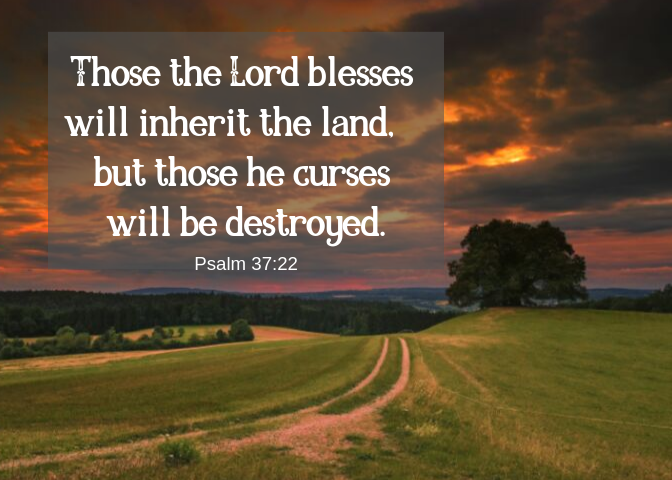
22 those the Lord blesses will inherit the land,
but those he curses will be destroyed (כָּרַת kârath, kaw-rath’)
- Meditate. Choose a word or phrase from the text to meditate upon/ think deeply about.
For me, I chose 3 words- perish, consumed, and destroyed. Those who are wicked will perish, be consumed and destroyed. The Hebrew abad contains the idea of wander away, lose oneself, have no way to flee, be destroyed.
As I think about what this means I’m reminded of the story of Christopher McCandless whose story is recounted in the book “Into the Wild” (and later movie) written by Jon Krakauer. Chris was just a few years younger than me and grew up just a few miles from me in Northern Virginia. After college he decided to ditch everything and walk into the wilderness of Alaska and live off the land. Unfortunately, he did almost no preparation and he lacked the minimal survival skills necessary for such an adventure. He crossed through a small stream and found temporary shelter in an abandoned school bus. Unfortunately, within a short time the stream swelled to an un-crossable raging torrent and Chris was essentially trapped. He spent weeks and months unable to escape that spot and soon ran out of food and was forced to forage. He ended up dying of poisoning from eating poisonous berries.
I tell that brief story because it illustrates the meaning of abad, kalah and karath. He wandered away and got lost, trapped and had nowhere to flee to and his own foolishness ultimately destroyed his life. That’s what the Psalm says is happening or will happen to the wicked. I know that sometimes people have trouble thinking that a loving God would punish or destroy people. As I think about this Psalm, the greater nuance emerges – God doesn’t choose to punish anyone. Ultimately we end up punishing ourselves when we wander off the path that God has given us to life. It’s a matter of cause and effect.
A few weeks ago I went hiking in Zion National Park in Utah. A gorgeous place. It had paths and the signs on the paths warned “stay on the path- it is dangerous and life threatening if you leave the path.” I stayed on the path, it was difficult at times, but I remained safe and returned alive. Had I veered off the path and ended up falling down a steep embankment to my death, then I alone would have been responsible for my destruction, not the park rangers, or God.
This Psalm is like the sign on the path: stick to the path or you’ll destroy yourself. But if you stick to the path, you’ll be blessed with a beautiful inheritance God has planned for you.
As I personalize this reading I have to ask myself. When have I gotten off the path God told me to stay on? Have I ever wandered and gotten lost? Isaiah 53 says that I, like everyone else, am like a sheep that sometimes wanders away. How has Jesus, the good shepherd, come searching for me when I’ve wandered astray? How does the Gospel reveal God’s merciful love and grace that sends his son to seek and save me when I’m lost. How am I called by Jesus to do this same work of seeking those who are lost and leading them back to the path?
You might choose a different word or phrase upon which to reflect, but that is an example of how my deep reading of a short part of this text raises some important issues in my mind and heart.
- Pray– I pray a prayer of gratitude to God for loving me enough to go looking for me when I get off the path. I pray a prayer of confession to God, for I am still “prone to wander” off the path. I recognize the important mission that I’ve been given by God to join the search for others who have gone off the path and the responsibility I have to point the people in my care- my family, my Church, my co-workers, my community, to the one who guides them back to the right path and helps them stay on the path, Jesus. I invite you to bring to prayer whatever you’ve been meditating upon.
- Rest in God. I’m so grateful to God for his mercy and love. I’ve been lost, but now I’m safely in the arms of my loving God. I invite you to rest in God too.
-Pastor Jeff Fletcher
*If you are unfamiliar with the Lectio Divina method of prayer/scripture study please refer back to the Sunday, August 11th devotion.



 Seek Grow Love