Yesterday, we read about God’s words to a people who were on the breaking point. To be fair, Israel had seen a lot– civil disputes, mass religious wars, a kingdom divided. But here, Israel is facing its final days as an independent nation.
So we read Micah’s desperate attempts to warn his people– Israel and Judah both– that their only hope is to return to the LORD. Chapter 1 talked about the coming destruction. Chapter 2 talks about these “oppressors,” who are likely people of political or financial power that are abusing the people around them.
In chapter 3, Micah now addresses two groups of people: the political leaders and the prophethood. Micah tells the leaders that they “hate the good and love the evil,” (3:1). The prophets that Micah confronts were likely professional “prophets” that lived in the king’s court. They may or may not have been followers of the LORD and they were not like the prophets that God chose for Israel. Micah says they prophesy peace when it gets them something to eat (3:5) and teach the masses when it gets them paid (3:11).
On and on, Micah confronts everyone in the nation who has shown corruption, greed, selfishness and evil. He closes chapter 3 by saying these ways are going to leave Zion, God’s holy city– flattened to a plain.
And then Micah’s message does a complete 180-degree turn. In chapter 4, he starts giving some really good news. He says that the house of the LORD will be a meeting place where everyone turns to know God (4:2). He says that God is going to bring the weak, lowly, hurt, sick, and anyone who’s been abused, and He is going to personally make them strong (4:6-7).
And here we begin to see what we call “God’s redemptive-historical plan.” That’s a fancy way of saying that God’s plans span thousands of years. And although Israel rejected and resisted God, He would not give up so easily. God sent His Son Jesus into the world to be an atonement, a light, and a leader for all of humanity. And in this way, every good thing that God has promised to mankind will be made true in Jesus our King.
If this isn’t good news enough, wait until tomorrow, when Micah is going to have even better things to say!
-Levi Salyers
Read or listen to the Bible reading plan passages at BibleGateway.com here – Micah 3-4 and Revelation 9
Imagine, for a moment, your favorite movie or tv show. How much of it can you quote? How many references have you made to your friends who have seen it with you a thousand times? How many times have you watched, acted it out, or recited memorable lines?
Revelation 5 is one of the most theologically packed chapters of the Bible. Why is that? Because the Bible is a complete, unified story that spans thousands of years and dozens of authors, and they all point to a single narrative. The author of Revelation, John, knows his Bible like a movie that he’s watched hundreds of times. In Revelation 5, my Bible shows 49 cross references to other verses. John really knows his Bible!
What’s the purpose, then? When we read Revelation 5, we’re reading the fulfillment of lots of God’s promises. In just 5:1, for example, we’re reminded of the throne room of God in Ezekiel 1, and the sealed scrolls in Daniel 12:4 and Isaiah 29:11. (Tip: when a biblical author makes a clear reference to a different spot in the Bible, they usually want you to go back and read it to see what they mean!!)
What is this scroll, anyway? And why is it that no one in heaven or on earth is worthy to open it? We have to keep reading to find out. And here lies the secret behind all of Revelation 5: God’s written plan, which he held in his own hand, could only be carried out by one very, very, very worthy individual. And his name is Jesus.
The rest of Revelation 5 lists off the many qualifications that Jesus holds. He is the lion of Judah. (See Genesis 49:8-12, when God says that the ruler of Israel is like a lion, and he will be of the tribe of Judah). Jesus is the Root of David (see 2 Samuel 7:14, when God promises that one of David’s descendants would rule forever). Jesus is the lamb that was slain (read about the passover lamb in Exodus 12, and how Paul calls Jesus our Passover lamb in 1 Corinthians 5:7). We see how these immensely powerful creatures, who dwell constantly in the presence of God, sing about this important role of Jesus– that he can open the scrolls because he was slain, ransomed us for God, and made us a kingdom of priests to God, so we can reign on the earth.
I hope you’re starting to see the story of redemption that God had been planning since Genesis. Jesus is the fulfillment of that story. And the four living creatures, the myriads and myriads and thousands of thousands of angels of heaven, are all “in on” this great story and its many references and quotes from history. They know that Jesus is the climax of God’s great story.
So when we read Revelation 5, let us sing along with all of God’s angelic host in proclaiming that to God and the Lamb “be blessing and honor and glory and might forever and ever!”
-Levi Salyers
Read or listen to today’s Bible reading plan passages at BibleGateway.com here – Obadiah and Revelation 5
When it comes to the book of Revelation, the reader must recognize that the literary form of apocalypse is vastly different than the NT Letters, Gospels, or Acts. It is challenging to read but also rewarding. It sparks the readers imagination with vivid images and poetic expressions that are full of symbolism and meaning.
Just reading the opening part of the book brings an awareness of how powerful and deep this writing is. But the richness of the text can be difficult to understand. Revelation is a book that rewards those who faithfully and humbly seek to grasp its meaning. And as we learn and grow in the Scriptures, different aspects of the text will become more easily perceived and understood. But it requires patience and persistence. We mustn’t give up if we find the text to be complicated or even confusing. Apocalypse is not meant to be readily apprehended upon the first reading. But as the reader continues to meditate upon the words and expand their scope of biblical understanding, deeper levels of comprehension will gradually surface.
In the opening chapter, John describes the beginning of his vision that he received from the Lord. There are some things in life that upon experiencing them are so overwhelming that we are helpless to do anything. This is the way John depicts his response upon seeing the Lord in the vision. The Lord is painted in highly figurative language that is awe inspiring and truly incredible.
“And his head and his hair were white as white wool, white as snow, and his eyes were like a flame of fire, 15and his feet were like burnished bronze, when it has been made to glow in a furnace, and his voice as the sound of many waters. 16And he had in his right hand seven stars, and out of his mouth came a sharp two-edged broadsword, and his face was like the sun shining in its full strength” (vv. 14-16).
John’s response was to fall down “as one dead” (v. 17). What a tremendous picture of the power and majesty of the Lord. When beholding the king of all kings, John is stunned by the visual appearance of Jesus. Can you imagine if you were standing before a figure that is described with the features that we read about? Who would not tremble at the feet of this Living One who was dead but is now alive forever?
I will leave you with the words that John expressed early on before delving into his vision, “Blessed is the one who reads the words of the prophecy, and those who hear and keep the things that are written in it, for the time is near” (v. 3). Amen.
-Jerry Wierwille
Read or listen to today’s Bible reading passages at BibleGateway.com here – Amos 1-2 and Revelation 1
I John 3:2 reads in part, “Beloved, now we are children of God, and It has not appeared as yet what we will be….” It has not appeared as yet what we will be. I am now in my 50’s. If you are my age or older, you have had the pleasure to watch the kids around you grow up. When they were little, it was hard to imagine what they would become as adults. Some of those little kids that I knew many years ago have grown into wonderful adults. Even some of those irresponsible teenagers have done well for themselves. Some have become doctors, nurses, professionals, experts in their field, responsible caring parents, teachers and business owners. All I can say is “Wow.” This was hard to imagine when they were very young. “It has not appeared as yet what we will be…” We can’t yet imagine what we will become.
Of course, the 1 John 3:2 also adds, “…we know that when He appears , we will be like Him, because we will see Him just as He is.” This describes the transformation that we will experience at the return of Christ. One day we will find ourselves in the very image of Christ.
However, in the meantime, what will you become? How will you change and grow? John’s words here are hopeful and optimistic. It has not appeared as yet what we will be… The possibilities are great. God, in Christ, has put you on a road to growth and transformation and new discoveries. You will face joys and sorrows. You will suffer. You will be challenged. You will be tempted. You will have victories and defeats. Yet, the Lord is leading you to Him. It has not appeared as yet what we will be. So, go out and discover and find that very thing. Become the person that God has created you to be. Grow into the image of Jesus Christ.
-Pastor Scott Deane
You can read or listen to today’s Bible reading plan passages at BibleGateway.com here – Hosea 3-4 and 1 John 3
As we close our week of devotions together, it’s fitting to end with the words of David himself. Known for his incredible Psalms (though he surprisingly didn’t write them all), David is a perfect example of what it means to be a worshipper of God.
In the first verses of Psalm 138, we see David connect to Psalm 136. “Give thanks to your name for your steadfast love and your faithfulness”. David follows the pattern of thanking God for who he is before thanking God for what he had done in his life.
This is key. God didn’t have to do anything for you for him to be worthy of praise. He gave you life and breath. He gave his Son. He gave you the hope of eternal life. Our creator did it all. Regardless of the blessings he has brought to you in your life (which are awesome, please don’t misunderstand me), God has earned gratitude and praise from you. He deserves it. Don’t forget to show gratitude and recognize that he is God when you come before him in prayer.
David follows in verse three showing how God answered prayer in his life. This wasn’t the first, nor the last time David called and God answered, but I love how simple this prayer is.
“On the day I called, you answered me, you increased my strength of soul.” (v 4 Ps. 138)
How beautiful is that? I called and you answered. That is such a rich picture. David is wanting everyone to understand the power of prayer. More importantly, he wants God to know that David heard God answer his call. God wants to know when we recognize how he works and moves in our life. It brings him joy when we get it. It’s like a father seeing his kids opening up a gift he gave them. Our father loves it when we love the gifts he brings us.
Reading down, David proclaims that all of the kings that have heard God’s word shall praise you. I believe this is a calling to us as well All of us that have tasted and seen the works of God are called to sing his ways–because his glory is great.
But for us, we know more of the story than David did. Which gives us an even greater calling. We have the Son of Man who died on a cross, was raised from the dead, and sits at the right hand of God. Jesus gives us access to the throne room. He is our victor. Our forerunner. Our king.
Though David never met Jesus, he still understands the power that the anointed one holds…
Though I walk in the midst of trouble,
you preserve me against the wrath of my enemies;
you stretch out your hand,
and your right hand delivers me.
The Lord will fulfill his purpose for me;
your steadfast love, O Lord, endures forever.
Do not forsake the work of your hands. -Psalm 138:7-8
I can’t help but think that David is seeing a picture of the Christ at the right hand of God in this. As Jesus is a descendant of David, it is incredible to see the connection between these two men.
The right hand of God delivers us as well. How gracious and miraculous is that?
I have loved going through these scriptures with you this week. I hope your devotions continue to draw you closer to the LORD and his Son. I hope you feel inspired to praise and sing to our God. He hears each moment. And, he will answer your call.
Our final song is: See a Victory by Elevation Worship. Because, I think David would bring his drum and sing this one with us.
-Leslie Jones
Read or listen to today’s Bible reading plan passages at BibleGateway.com here – Psalm 137-138 and Daniel 1-2
While we have been thinking about the importance and beauty of God’s word in Psalm 119, we have also been reading Ezekiel. I want to lead you on a speed run through Ezekiel 25-36.
For the most part, Ezekiel is given a message of judgement against the nations. These nations are those who have harmed the people of God. Many of the Minor prophets got similar messages which could be summed up in modern words as, “You have hurt and abused God’s people, and he will give you justice.” The nations that are judged in these chapters are Ammon, Moab, Edom, Philistia, Tyre, Sidon and Egypt. He spends quite some time on both Tyre and Egypt, and even speaks to their kings directly. The praise he gives in his lamentations over these nations is rather grand. Read Ezekiel 28:11-19. God had blessed the King of Tyre, given him so much, and yet look how far he fell! I hope you can see why a number of people have thought that God started talking about Satan here; an angelic powerful force from the beginning of the world falls to the pit because of pride. I don’t think the text is specifically talking about Satan, but that the King of Tyre represents the satanic spirit and lives his life parallel to the Satanic fall. In these laments, I don’t think God is necessarily mocking their fall. I don’t think he wants to bring the evil back on their head (see 36:11), but the nations and their rulers acted pridefully and never sought the good of his people. God does not allow that to go unpunished.
And so God sends in his man. So now we get to see the Israelite King or General or War Hero who vanquishes his foes and becomes King over the Kingdom…
Right?
No, God didn’t work that way. God instead says, “I will strengthen the arms of the King of Babylon and put my sword in his hands.” (30:24) God used Babylon. The same Babylon that would later take his people into captivity, the same Babylon that would later be used as the image of the proud nation, as the one who exiles the people of God. What is God doing using Babylon?!
He’s doing what God always does; His will.
God is smart enough, wise enough, powerful enough, good enough, loving enough, to take all the broken pieces and people in this world, with their free will and desires and urges and traumas and prejudices and hatreds and pains and hopes…
And God can use it for the good of his people
and the working of his plan.
Babylon acted in freedom, maybe even sin, and God can take that and make it work for him.
God can give true freedom to love him or reject him, to walk in righteousness or sin, and he can still work out his will in people.
You have this freedom. In Ezekiel 33:10-16, God tells his people, “I take no pleasure in the death of the wicked, but rather that the wicked turn from his way and live.” Are you living a life of wickedness, separated from God? I stand, like Ezekiel, as a watchman(33:7), begging you to see the truth. To turn from that sin and live! If you choose to believe in the God of this prophecy, the God of the Torah, the God of all Scripture, who gave us these words and the Word, made flesh in Jesus Christ, If you choose to follow him, then the promise from Ezekiel 36 will happen in you. “ Then I will sprinkle clean water on you, and you will be clean; I will cleanse you from all your filthiness and from all your idols. Moreover, I will give you a new heart and put a new spirit within you; and I will remove the heart of stone from your flesh and give you a heart of flesh. I will put My Spirit within you and cause you to walk in My statutes, and you will be careful to observe My ordinances. You will live in the land that I gave to your forefathers; so you will be My people, and I will be your God.” (25-28)
May you trust in the saving power of Jesus Christ.
May you turn from sin and judgment.
May you turn to righteousness, hope, and love.
May you have YHWH, the one true God, be your God today.
May you all be the people of God.
-Jake Ballard
Jake Ballard is pastor at Timberland Bible Church. If you’d like to hear more from him, you can find Timberland on Facebook (https://www.facebook.com/TimberlandBibleChurch/ ) and on Instagram (https://instagram.com/timberlandbiblechurch?igshid=t52xoq9esc7e). The church streams the Worship Gathering every Sunday at 10:30. Besides studying and teaching God’s word, he is raising three beautiful children with the love of his life, loves Disney (especially the princess movies), and believes that Christmas music is acceptable from the first Sunday in Advent to January 6th. If you’d like to reach out to talk Bible, talk faith, or talk about your favorite Christmas Song (and why Mariah Carey sings it), look Jacob Ballard up on Facebook (https://www.facebook.com/jacob.ballard.336 ) or email him at jakea.ballard@yahoo.com. God bless you all!
Read or listen to today’s Bible reading plan passages at BibleGateway.com here – Ezekiel 35-36 and Psalm 120-122
Psalm 119 is a beautiful testimony to the words of God. The psalmist meant to refer to the Torah, the first five books, called books of the Law.
But is that ALL that the psalmist spoke about?
The psalmist referred to what he believed were the words of God, but that is because he only regarded the first five as God’s revealed word. However, the church has come to recognize more than that. First, we believe God revealed himself to Moses in the Torah, and that through a lengthy editing process we have those first five books in their form today. However, other books, books of history, like Joshua and Ruth, were also recognized as being inspired by God. Note how that sentence was worded. It was not that “the church claimed they were inspired” or “the church or councils chose them for the Bible.” The church and church councils only recognized the inspiration already in the text. We saw it in the books of the prophets like Isaiah and Malachi, in the apocalypse of Daniel, and even in the Psalmists own words of 119! Later, we would recognize God’s voice in the writings of Paul, in the Gospels, in other letters, including the letters of Peter, John, and the apocalypse given to John.
These 66 books compose the Scriptures, in both Old and New Testaments. When we read Psalm 119 and the psalmist’s passion for, meditation on, and memorization of scripture, for us this covers ALL these books. The psalmist was this passionate about Leviticus, how much more should our soul sing when reading the Gospel account of the salvation of humanity! How much more should we rejoice in committing to memory the words of the Word of God, Jesus Christ. (John 1)
Read Psalm 119 (or, hopefully, re-read it!) and focus on what we have seen over the past few days:
As you read Psalm 119, see the artistry of one who so deeply loved God’s words, and allow it to show you the beauty of God’s scripture from Genesis to Revelation.
As you read Psalm 119, praise God for the fact that he would reveal himself in the scripture and how much more he would reveal himself through his beloved Son Jesus Christ.
As you read Psalm 119, recognize the Torah’s important role in beginning the Revelation of God to his people, and may it propel you to continue to walk in God’s way through the life and teachings of the fulfillment of the Torah in Jesus.
As you read Psalm 119, pray, meditate and memorize God’s words so that they may be a lamp unto your feet and a light to your path, and that you might keep your way pure.
As you reads Psalm 119, may you fall in love with the words of God, the Word of God, and ultimately, with the God who loves you.
Read Psalm 118, or read it again. What is this Psalm all about? What is the refrain? “Give thanks to the Lord for he is good; his love endures forever.” God’s people look back on what has happened in their past and speak of God’s grace goodness and love. The Psalmist says that “he” (we don’t know the psalmist, but we will use he as the pronoun) speaks from his own perspective. The people from all nations were against him, but GOD is for him. In verse 6 he asks the great question, “What can humans do to me?” If God is for us, then who or what could ever stop us? God will save and send protection and salvation. The author says that this does not only hold true for him but it’s true for ALL of God’s people. The community asks God to save. “O LORD, do save, we ask you!” And when God answers, salvation, grace, and protection are for both the individual and the community. Upon his people he gives light (v.27) and to the individual he has become his strength, his song, and his salvation. (V. 14)
Now, compare that with Ezekiel 24:15-27 (go read it). All the words God has said in Psalm 118 don’t seem to make sense in light of Ezekiel 24. Ezekiel is God’s servant. He is a “good man” speaking to the “bad people” of Jerusalem. So what does God do?
God kills Ezekiel’s wife.
You may say “Jake, that’s extreme. God doesn’t kill people. He just allows her to die.” I could agree with you, maybe, if all we had was Ezekiel 24:18. Ezekiel reports the fact that his wife dies and he wasn’t allowed to mourn. But just two verses earlier, God explains that HE is taking Ezekiel’s desire with a blow. God killed her. An innocent wife of a good man, to teach bad and rebellious men.
Does Ezekiel say, “His love endures forever?”
Do we expect him to?
How do we reconcile this?
First, let me start with the fact that Ezekiel, his wife, and all the prophets recognized that their life was totally forfeit to the God who had power over life and death. I don’t think we should think of Ezekiel’s wife as an innocent bystander caught in the crossfire, no matter how much her story may suggest it. Ezekiel knew that everything he owned and everyone he loved was ultimately owned by God and loved by him more.
Second, YES love. The love of God is the most fundamental element of his being. “God is love.” “For God loved the world in this way: He gave his one and only Son.” “What great love the father has lavished on us that we should be called the children of God!”
“His love endures forever!”
So, the primary text is not Ezekiel but the Psalm. The Psalm prescribes who God is in love. And even there, we get our answer for Ezekiel.
“The Lord has disciplined me severely.”
Words alone weren’t cutting it with the people. They had heard the voice of the prophets again and again to return to the Lord. In Ezekiel 24, God is done telling them what they will experience, but will show them WHAT he will do. He was going to take his own sanctuary away from the sinning, unfaithful Israelites. He was going to discipline them. But they were not going to mourn even the presence of God being taken from them. Ezekiel showed them that they were going to lose the presence and be totally OK with it. They needed to see it, because it proved that God is the one in control.
Finally, we need to recognize that too often we are worried too much about this life. Ezekiel’s wife may not have wanted to die, but she trusted in the Lord, as did her husband. Psalm 118 itself reminds those of us who are faithful followers of Christ that this is not the end. The stone that the builders rejected that has become the chief cornerstone. That one is Jesus of Nazareth. This work of God is marvelous in our eyes. God has made our days, our night, our beginning, and our ending. But for the faithful, this life is NOT the end. God has promised that the one who came in the name of the Lord to the shouts of “Hosanna”, or “Save us”, that same Jesus will be the one who comes in power to raise the living and the dead and give the reward to those who love him.
Life eternal.
Goodness for forever.
Since God’s love endures forever, he promises those he loves will endure forever.
So, give thanks to the Lord for he is good.
His love endures forever.
-Jake Ballard
(P.S. Not part of the main devotional text, but for those who are going through or know someone going through pain, read on.
This post may have made you uncomfortable. Let me add the following thoughts.
Quick summary of my points:
Ezekiel’s wife had given God her life
God’s love, not his judgement or anger, defines his divine actions
We limited humans are too worried about the short time here when we have eternity of joy through faith
However, let me be clear : these are not the words you share with the hurting, nor will these be your first thoughts in pain. Death is an enemy that God will destroy. We are to weep with those who weep. Understanding Ezekiel in light of the Psalm 118 is our ideal, but it may take time. If you are not in a place of pain, do NOT tell the suffering to “just get over it”. Do NOT say that God took someone’s loved one away. If you are in pain, I am not saying God took your loved one or that their life did not matter.
Ezekiel’s wife’s situation is not the way scripture speaks about every death.
But God loves everyone, and God wishes that none perish; God is a God of life, wholeness, and health. One day, creation will again reflect the life, wholeness and health of it’s Creator, but it’s not there yet. But God may use even his enemies, death, brokenness, sickness, and pain, to bring about a greater goodness in spite of their wickedness. If you are suffering, in need of someone to hear your story, just be with you in your pain, I would encourage you to reach out to a pastor or trusted friend and ask them to listen. If you need someone to listen who doesn’t know you from Adam, but is willing to walk through your pain, please reach out to the author (Jake Ballard) via https://www.facebook.com/jacob.ballard.336. You can also find his contact information at TimberlandBibleChurch.org.
May God bless show his love to you in the midst of whatever pain you experience.)
Most of us say that we would like to have wisdom and good understanding. This seems pretty obvious but it is so easy to loose track of what brings these things. We search in books, on apps, listening to podcasts, and on websites. When we search in these and other places like these for wisdom and understanding we find that it all falls short if it is not based in faith. Thankfully we have a source of both wisdom and understanding. Psalm 111:10 says, “The fear of the LORD is the beginning of wisdom; All those who follow His commandments have a good understanding; His praise endures forever.”
When we search for wisdom we need to start with fear for the LORD. This does not mean we need to cower and hide when we think of God. He absolutely has the power that He could instill that type of fear but that is not who He is. Instead it means that we need to have a respectful awe or reverence for the LORD. Although He is mighty and powerful beyond our capabilities, He is also loving and compassionate beyond our understanding. He is the God who is powerful enough to speak and create life as we know it and loving enough to send His Son to overcome death that we may live. David said that wisdom begins with this reverent fear of the LORD. When we know who we serve and the love He has for us we can truly focus on what is important. That is leading as many as possible to a relationship with God as we serve Him with our life.
David does not stop there. He says that following the commandments of God shows “a good understanding.” We follow His commandments because we understand what has been done for us. We have a desire to serve the one that has blessed us so incredibly with hope, both now and in the life to come. We understand that we have been given a gift that we could not have possibly earned and as such we desire to show thanks in the best way we can. That is to follow His commandments. Jesus tells us that the two greatest commandments, upon which hang all the others, are to love God and love people!
David ends this verse by saying that “His (God’s) praise endures forever.” At first it may seem a simple statement of just four words. Upon further thought though we realize that this statement has long lasting reach. Also we find that His praise will endure forever. This means that even if I do not praise Him others will. It also means that His praise did not stop when David died, when Solomon died, when Job died, when the apostles died, and it will not stop when you and I die either. If His praise endures forever; this is an eternal statement with implications into the Kingdom of God! It is with great pleasure that I tell you that you can praise Him both now and FOREVER!
Those who have wisdom and have understanding will praise the LORD!
-Bill Dunn
Read or listen to today’s Bible reading plan passages at SeekGrowLove.com here – Psalm 111-113 and Ezekiel 19-20
When you think of a strong person what do you picture? Do you envision an Olympic weightlifter holding an impossibly heavy barbell over their head? Or maybe you go the route of imagining a superhero trying to hold back a speeding train. While these examples do show strength, we need to remember that there is more to strength than flexing a muscle. More than brute strength is needed to have victory over evil.
In today’s passage, David continues to trust in God’s strength and might no matter the circumstance. As David seems to go through a rollercoaster of emotions, he doesn’t wavier in his trust that God will be victorious at the end of the day. I love what it says in Psalm 108:12 in the Good News Translation, “Help us against the enemy; human help is worthless.” David is gearing up for a battle and has an army by his side yet he is humble enough to recognize that compared to God’s strength, his army and any other human help is worthless. If King David was able to humbly recognize that the only way to victory is through God, we should be able to do the same.
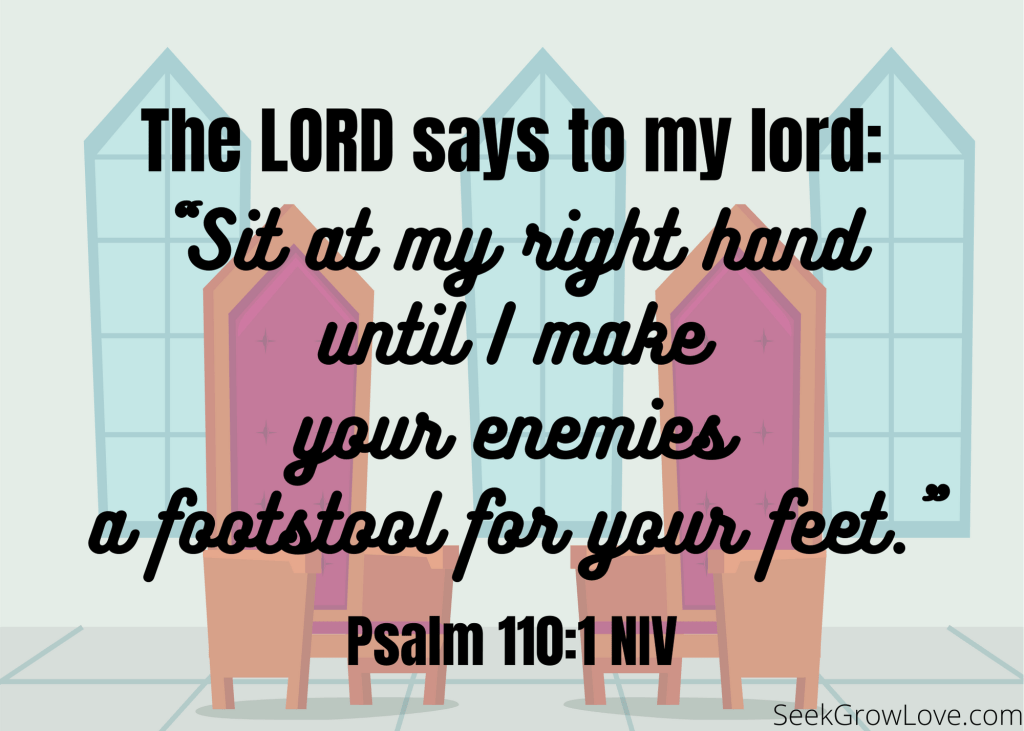
God promises that we will ultimately be victorious over evil if we walk in His ways and accept the gift of His Son. Psalm 110:1 gives us a clear picture of what God has planned for the future. This verse might seem repetitive at a glance, but as we look closer we can see that the first LORD is in all caps which means its referencing God while the second Lord that is not in all caps references the Messiah who we know as Jesus. By placing Jesus at His right hand, God is putting His son in a position of authority until the time comes for Jesus to rule over the nations after which will come the Kingdom of God. With all the craziness going on in our world, it’s refreshing to know that God has a plan for us to have victory over evil through Him.
Today I’d like to leave you with the lyrics from a praise and worship song we like to sing at Garden Park. Remember that no matter how dark it may seem, God has a plan and He will be victorious.
“See A Victory” by Elevation Worship
“The weapon may be formed, but it won’t prosper
When the darkness falls, it won’t prevail
‘Cause the God I serve knows only how to triumph
My God will never fail …
I’m gonna see a victory
I’m gonna see a victory
For the Battle belongs to you Lord.”
-Bill Dunn
Today’s Bible reading plan passages can be read or listened to at BibleGateway.com here – Ezekiel 17-18 and Psalm 108-110






 Seek Grow Love