
Old Testament: Jonah 4
Poetry: Psalm 73 (on repeat the rest of this week)
New Testament: Luke 12:13-21
In Jonah chapter 3, the great city Nineveh repented, and they turned towards God. Afterwards, God had mercy on the people and relented on the upcoming disaster that Jonah was warning them of.
For those who follow God, it should be easy to rejoice when God shows his mercy and love. However, in Jonah chapter 4 we see that Jonah was displeased with the mercy that was afforded to the people of Nineveh. Why was Jonah angry at this? This is possibly due to Nineveh being the capital of the nation of Assyria, an enemy of Israel. Perhaps being on opposite sides, Jonah wanted to see his enemies destroyed, or perhaps his own personal morality guided that the Ninevites deserved destruction. Perhaps the disaster never befalling Nineveh also delegitimized the words that he spoke to them, and made him feel less powerful. Either way, Jonah’s heart was not in the right place, and God saw to it that Jonah saw this too.
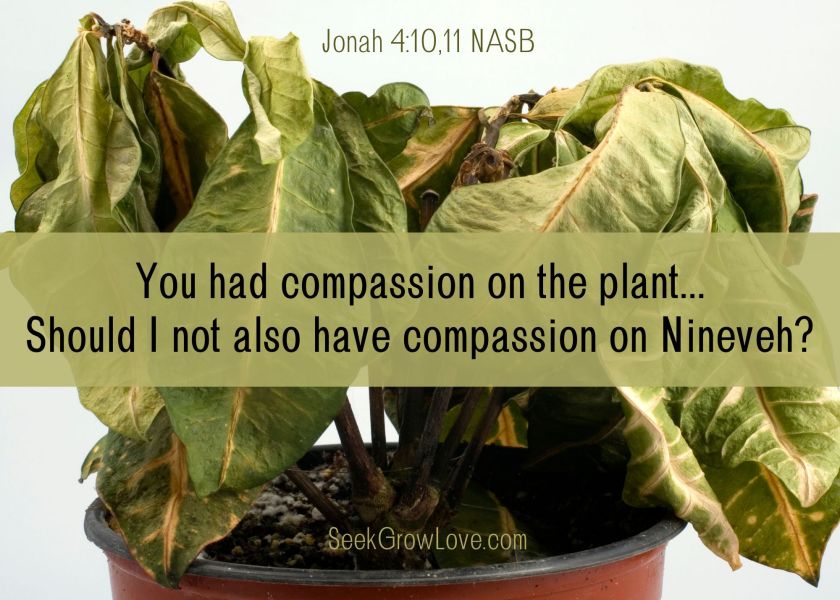
After Jonah complained to God, he rested. There, God allowed a plant to grow. Jonah found joy in this. Then, God caused the plant to die in the morning, and called in a great heat to overcome the area that Jonah was in. Again, Jonah cried out at the demise of the plant that he had.
God then likened this plant to Nineveh. It gave great joy to Jonah despite him not being the reason it grew, and it was only there overnight. So too Nineveh should also receive mercy even if recently they turned from their wicked ways.
Although only 11 verses long, Jonah 4 reveals a lot to us about who God is, and how we should interact with him. First off, God used the plant as a metaphor for Nineveh, much like how his son Jesus would use parables to teach spiritual lessons to people in ways that they may understand.
Secondly, God has love for people, even for those that are not his chosen people. Perhaps Jonah may have disagreed with this at the time, but regardless this goes on to show the legitimacy of the great commission given by Jesus in Matthew 28, and carried out through the rest of the New Testament. The love of God is for everyone.
Thirdly, we should always want what God wants. Even if we do not understand God, or if we do not agree with the way things may be going for us, we must adopt the viewpoint that aids so many people throughout the Bible: “not my will, but yours be done.” “Yours” referring to God, our father in heaven.
-Colby Leggitt
Reflection Questions
- Even when we feel that we are worthless, how can we remind ourselves of the greater purpose that God has called us to?
- Why was Jonah so upset that God relented to the disaster to befall Nineveh? How can we connect this to times in our lives when we are angry that things don’t go our way?
- What does God tell us about the worth of being angry (without very good reason)?
- Was God’s lesson on Jonah too harsh? Are such tribulations the kind of tough love that is needed sometimes for us to see things the way God wants us to?
 Seek Grow Love