
Lift Up Your Eyes

New Testament Reading:  Mark 9

Psalms Reading:  78

*Old Testament Reading:  Isaiah 39-40

Do you not know? Do you not hear?  Has it not been told you from the beginning?  Have you not understood from the foundations of the earth?   – Isaiah 40:21 (ESV)

Since we are covering a couple of chapters at a time in the Old Testament, there is a lot of information to consider every day.  Today, chapter 39 tells of a good man doing a bad thing.  King Hezekiah shows all his wealth to the king of Babylon.  King Hezekiah was trying to impress the envoys from Babylon.  He was enjoying the recognition, honor, flattery, and praise from men.  It seems that Hezekiah’s pride made him unable to see the destruction that could come from doing such a thing.  Isaiah tells him plainly in verses 6-7, Behold, the days are coming, when all that is in your house, and that which your fathers have stored up till this day, shall be carried to Babylon. Nothing shall be left, says the Lord. And some of your own sons, who will come from you, whom you will father, shall be taken away, and they shall be eunuchs in the palace of the king of Babylon.” 

Hezekiah started out as a godly king.  He was given a gift of an additional 15 years of life (see Isaiah 38).  Sadly, he did not use those extra years wisely.   Instead, he became proud and focused on himself.  Something to take from this chapter is that it is how we use our time that matters in the end. 

Beginning in chapter 40, the rest of Isaiah is largely a message of comfort.  Isaiah prophesies about John the Baptist, Jesus, and the reward he will bring.   Isaiah reminds us that God is our Creator and that His creation makes Him evident.  Verses 25-26a say, “To whom then will you compare me, that I should be like him? says the Holy One.  Lift up your eyes on high and see:  who created these?”  We need only “look up”; to consider there is a God who designed and created everything.  We are told he is mighty, strong in power, everlasting, and does not faint or grow weary. We need to know that about God.  This is also sound advice in general.  To “look up” is to take our eyes off of ourselves.  When we “look up” at God and what He created (this includes other people) we put ourselves in a position to see how God can use us. 

Then Isaiah turns the message a bit, from telling us how powerful God is to telling us that God will give us power and strength.  To whom does he offer these?  To those who “wait for the Lord” (verse 31).  I am not a scholar; I haven’t taken Hebrew or Greek.  I don’t usually get caught up in words, but in studying this passage, I found this word study very interesting.  The word wait in the English language is passive.  Apparently, the Hebrew language has about 25 words for wait.  The one used in Isaiah 40:31 is qavah (kaw-vaw).  Qavah means to wait actively with anticipation or to look eagerly for.  It is sometimes translated as hope.  It is impossible to wait on the Lord without hope. 

Amy Blanchard

Reflection Questions

  1. What does “to wait actively with anticipation” look like for you at this stage of your life?  What are you waiting (hoping) for?
  2. Lift up your eyes; look for God in everything around you.  What/Who do you see? 
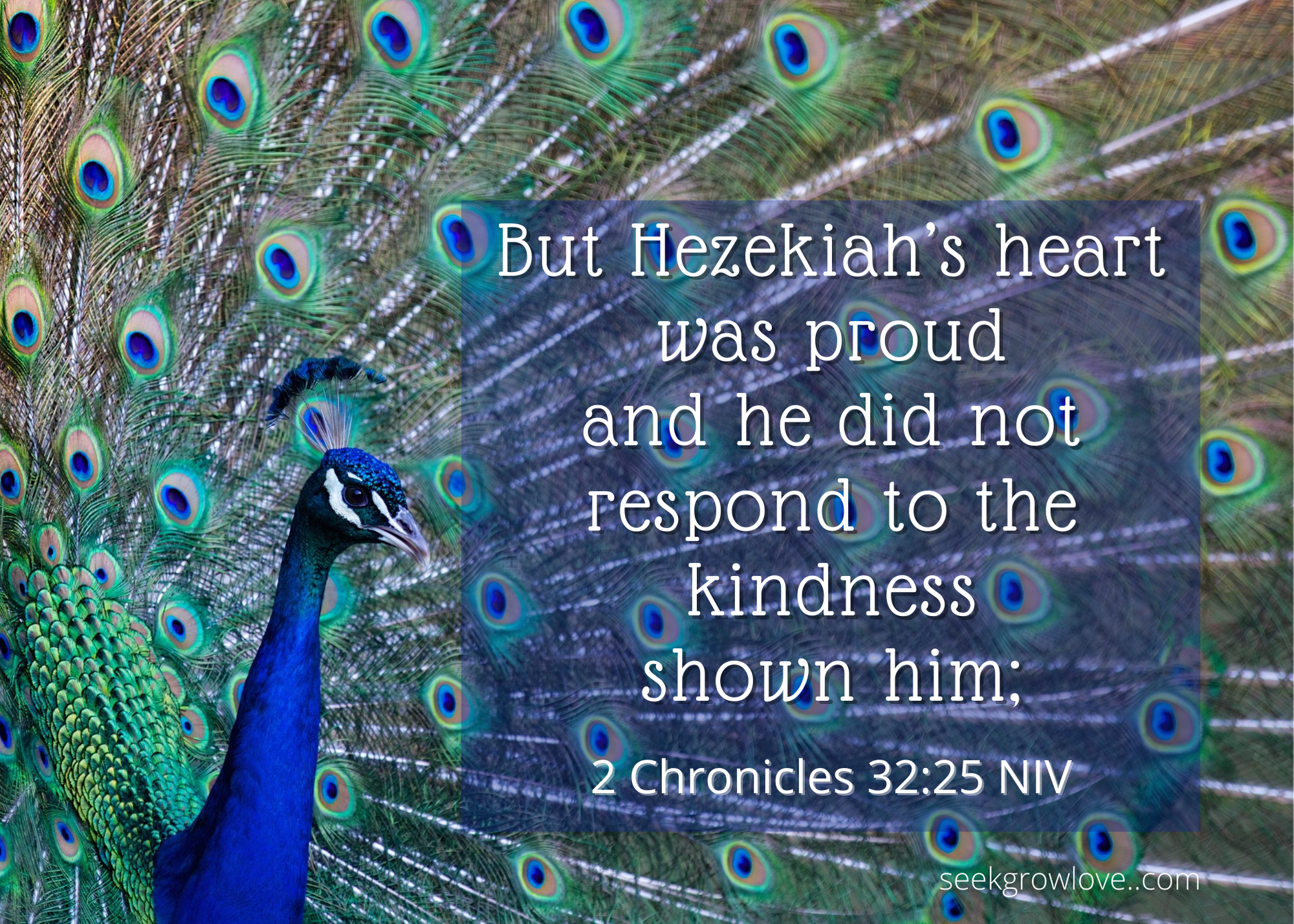
The Problem with Pride

2 Chronicles 32-33

2 Chronicles 32 25 NIV sgl

There are many lessons that we can learn from reading these chapters in the Bible. One of these lessons is that a proud heart can cause much trouble. For both Hezekiah and Manasseh this was an issue. Hezekiah did not want to credit the LORD, while Manasseh disregarded the LORD.

It is easy for us too to fall into this. There are times where we pray for guidance. However, once we receive the guidance we asked for, we neglect to go back to God and we just continue with our lives. We do not take the time to acknowledge the LORD’s hand in what was done and we do not do so until we feel we are again in need of him. It is easy for us to forget what he has done. The reality too, is that sometimes we like to think that we found the answers on our own. However, we would not have been capable of finding such answers without God. This situation is similar to Hezekiah when he allowed his heart to be proud and did not credit God with the successes of Jerusalem. He wanted to receive the glory that was owed to the LORD.

Other times, though, we may be able to better relate to Manasseh. During these times, we may be in outright rebellion toward God as Manasseh was. We want to do what we want. We may feel as though we do not need to listen to God because we are proud and think that we know best. We may say, “I know what I am doing.” That is until we receive a wake-up call and realize that we were not so wise in our thoughts and actions. We come to understand that we didn’t have a clue as to what we were doing. What a humbling experience this can be for our proud hearts!

This actually reminds me of a time when I was packing for a several month stent of studying abroad in Ireland. I had limited space, so I was trying to pack as lightly as possible. Because of this, I disregarded my mother’s advice to pack a small towel. I thought I was being smart. I will just get a towel when I get over there. “I know what I am doing”, I thought. This disregard for guidance offered to me by someone older and wiser than me resulted in me having to use a t-shirt as a towel for several days. Turns out that securing a towel in an unfamiliar country is not always so easy.

While this example is small in comparison, I think it shows how easily we can turn to ourselves rather than to others, and more specifically God. Even though the downfall of both Hezekiah and Manasseh were great, God forgave them when they repented. Because of the love our God has for us and the sacrifice of his son on the cross, we have the ability to be reconciled to him. That truly is something to be thankful for.

Hannah Deane


Today’s Bible reading can be read or listened to at https://www.biblegateway.com/passage/?search=2+Chronicles+32-33&version=NIV

Tomorrow’s reading will be Nahum 1-3 as we continue on the 2020 Chronological Bible Reading Plan

A King and A Tyrant

2 Kings 20-21

2 Kings 21 9 NIV sgl

These two short chapters make me very glad for the American political system. Before I talk about what makes our system so good, I need to talk about the system in place in the passage that we read. Chapter 20 marks the end of the reign of a good king, Hezekiah, who accomplished many good deeds in the name of God. He was an iconoclast, one who destroys religious images (as an aside, archaeological evidence confirms the iconoclasm of Hezekiah’s age, very cool). He also increased the size of the Judahite kingdom and made it into a power on par with that of the Assyrians and Babylonians. Of course, all of this was made possible by the God who went before them in battle. Of all the kings of Judah, Hezekiah can be counted among the best, and under the guidance of a king such as he, a monarchy isn’t such a bad deal.

But when your good king is replaced by a 12-year-old tyrant, things aren’t so good. Manasseh reversed all the progress that Hezekiah made toward ridding Israel of idols and images of foreign gods. Manasseh turned away from God and brought Judah down with him. This is the power of a king. If he is good, then he can accomplish great things! But if he is evil, then he can accomplish even worse things. Somehow, Manasseh survived for fifty-five years as the king of Judah. Being a murderous beast of a man can certainly turn people away from the idea of overthrowing you. Luckily for the people of Judah, his son Amon was a bit more of a weakling, giving his advisors the opportunity to assassinate him.

This is the problem with monarchies. Everyone loves a prosperous generation under a king who does good, but if you are unfortunate enough to have a bad king (and there were a lot of them in Judah and Israel’s history), then the only way to get back on the right track is to murder the guy. Luckily for the Judahites, the next in line to the throne was an 8-year-old boy who ended up becoming arguably the greatest king of Judah. I wish I could talk more about how impressive Josiah is, but our passage cuts off just before his reign begins.

To summarize: a good king is great, but a bad king can only end in bloodshed, in the form of his people’s lives or his own. God knew this when he told Samuel that establishing a kingship was a bad idea. But God let the people have what they wanted. John Locke, a 17th century political philosopher whose thoughts helped lay the groundwork for the American system, knew this and argued against it in his treatises. The American system is designed to move slow, to never be controlled by one person long enough to do lasting damage. In America, you don’t have to wait a generation just to see political reform. Maybe if you are terribly concerned with nominal tax rates and zoning laws, then you can be frustrated with the snail’s pace at which the American political system moves, but the great advantage that we have in America is the lack of despotism and regicide. This alone gives you great reason to be happy to be alive in 2020 and not in the 8th century B.C. Let us thank God that the founders of this country were men of God who believed that each person is endowed with the spark of the Divine which is the source of our authority over our own lives, thus freeing us from the whims of tyrants like Manasseh.

Nathaniel Johnson


Today’s Bible passage can be read or listened to at https://www.biblegateway.com/passage/?search=2+Kings+20-21&version=NIV

Tomorrow’s Bible reading will be 32-33 as we continue the 2020 Chronological Bible Reading Plan