Faith During Difficulties

1 Samuel 18-20
Psalm 11 & 59

Today’s reading, found in 1 Samuel chapters 18 through 20, highlights how far Saul has fallen from his successes of chapter 14.  (Remember from chapter 15, that Saul had deliberately disobeyed a direct command from God, and things have been going from bad to worse for him since.)

In 18:10-11, we read, “The very next day a tormenting spirit from God overwhelmed Saul, and he began to rave in his house like a madman.  David was playing the harp, as he did each day. But Saul had a spear in his hand, and he suddenly hurled it at David, intending to pin him to the wall.  But David escaped him twice.”

Once Saul decided to abandon God, God not only abandoned Saul, God tormented Saul.  This should be a lesson to us – never disobey God – there are always negative consequences.

Saul became jealous of David, after David had killed Goliath, because the women of Israel sang this song, “Saul has killed his thousands, and David his ten thousands.”  As a result of his jealousy, Saul tried to kill David with his spear in 18:11 and again in 19:10. Saul also tried to kill David by having the Philistines kill him in 18:17, 21, 25.   In 19:1, Saul urged his servants and his son Jonathan to assassinate David. In 19:15, Saul ordered his men to bring David (and his bed) to Saul to be killed, when Saul thought David was sick in bed.  In 19:20, 21 and 22 Saul unsuccessfully sent troops to get David three times.

In 20:30, Saul boiled with rage at his own son, Jonathan, who was friends with David, and in 20:33, Saul hurled his spear at Jonathan, intending to kill him.

So much for Saul, what about David?

If you were David, how would you react?  What would you do?

Remember that Samuel had anointed David in chapter 16, and declared that David would be the next king over Israel.  So what did David do? He wrote some songs about this. Let’s see what he said in those songs…

David wrote Psalm 59 when Saul sent his soldiers to watch David’s house in order to kill him.  This psalm starts out, “Rescue me from my enemies, O God. Protect me from those who have come to destroy me.  Rescue me from these criminals; save me from these murderers. They have set an ambush for me…”. This makes sense.  David was in trouble, so he cried out to God for help. David continues in verse 9, “You are my strength; I wait for you to rescue me, for you, O God, are my fortress.”

Then an astounding thing happens.  David starts praising God – in advance of God’s rescuing him.  Psalm 59 ends with, “But as for me, I will sing about your power.  Each morning, I will sing with joy about your unfailing love. For you have been my refuge, a place of safety when I am in distress.  O my strength, to you I sing praises, for you, O God, are my refuge, the God who shows me unfailing love.”

David, the man after God’s own heart was actually praising God when he was literally afraid for his life.  This shows his great faith that God will indeed rescue him. Maybe this is one of the reasons he was called a “man after God’s own heart.”

Psalm 11, the other chapter from today’s reading also shows David’s faith through difficulty.  It starts out, “I trust in the Lord for protection…”, and ends with “For the righteous Lord loves justice.  The virtuous will see his face.”

I believe David’s response is a good example for us.  When times are tough, it’s natural to cry out to God for help.  We need to move on from just asking for help, and follow David’s example to also have faith and praise God, even before the answer comes.  And in the process, we, too, may become people after God’s own heart.

–Steve Mattison

(originally posted April 12, 2020 for SeekGrowLove.com)

Reflection Questions

  1. Compare and contrast Saul and David based upon what we know from 1 Samuel.
  2. What do you see in your own life that is similar to Saul? And David?
  3. What does it look like to show faith in God during the difficulty?
  4. What difficulty (big or small) have you recently found yourself in, in which you can practice giving God praise even before the answer comes?
A Relationship

1 Samuel 15-17

Being raised as a pastor’s kid, I probably took for granted the accessibility of all things church related. Being a Christian was something that was easily practiced because of the environment I was constantly in. I asked Jesus to come into my heart when I was 5 years old. I was baptized the summer before my eighth grade. But it wasn’t until I went off to college that I really realized that my faith was my own responsibility. If I was going to have Christian friends, I needed to find them on my own. If I was going to attend a mid-week Bible study, I needed to find it on my own. If I was going to attend a Sunday morning service, I needed to find it on my own. Mom and Dad weren’t there to guide and direct me. If I wanted to continue to build up my faith, it was now up to me.

As we read through King Saul’s life, we see that he was hand selected and groomed to take on the role of leading Israel – everything was handed to him. And as a result, he never really owned the responsibility of the position he was put in. He never connected the dots of being the leader of God’s people and having a relationship with God himself.

This is particularly evident in 1 Samuel 15. Saul has carried out God’s instructions of taking up arms against the Amalekites. Once Israel wins the battle, they were supposed to destroy everything: man, woman, child, cattle, sheep, camels and donkeys. Nothing was to be spared. But…that’s not what Saul did. He kept the best of the spoils. He claims that he was going to use the prime plunder as a sacrifice.

Here’s how I know that Saul didn’t own his relationship with God: in verses 21 and 30 of chapter 15, Saul refers to the LORD as Samuel’s God.

…the best of what was devoted to God, in order to sacrifice them to the LORD your God at Gilgal.” (v 21)

…come back with me, so that I may worship the LORD your God.” (v 30)

Saul didn’t understand his disobedience because he hadn’t bothered to grow a relationship with the One who made him king of Israel.

More than anything God desires to have a relationship with us. He wants us to seek Him more than any other person or pursue any other passion. When we grow our relationship with Him, we come to know the things that please Him as well as the things that displease Him. As we grow our relationship with God, our hearts swell with love for Him, His word, and His people. And when our hearts are full of love, obedience comes naturally.

Bethany Ligon

(originally posted for SeekGrowLove April 11, 2020)

Reflection Questions

  1. Why is obeying Him important to God?
  2. Have you ever felt like God is just someone else’s God?
  3. How can you grow your relationship with God?

Waiting

1 Samuel 13-14

What do you do when you think God is taking too long to answer your prayer?

If you are King Saul, you tell the priest to “withdraw your hand” (1 Sam 13:19) – meaning that God is taking too much time responding to a prayer request. King Saul believed that he had some sort of advantage over the enemy and didn’t want that advantage to slip away. So he took matters into his own hands, assembled his men, and went into battle. The outcome wasn’t too good.

Have you ever prayed for something so long, that you become impatient waiting for God to give you directions and end up rushing the timeline just to pursue your own desires, wishes, or dreams? Any time we read a Bible study about an individual doing something for him/herself rather than waiting on God, it never ends well; it’s always a disaster.  Why do you think that is?

After some careful self-reflection, I think that I’ve got it figured out for myself: It’s because I like being in charge – to be independent – to not have to rely on someone else’s timing. And even as I type these words, I know it’s ludicrous because my decisions are based on a very limited perspective; whereas, God has a completely different view of my life. His reasons for delaying an answer to prayer, is all about the timing that will give him the most credit.

So the next time you are tempted to move on without God’s response to your prayers, just remember that Saul  ended up making some outlandish ultimatums and in so doing, ended up discrediting himself and losing God’s favor.

Stay persistent in your prayers. Do not give up. Keep waiting for an answer to your prayers. At the proper time, God will provide an answer or solution for your need. And in the meantime, always remember that God is by your side – he has not abandoned you.

Bethany Ligon

Reflection Questions

  1. From above: “Any time we read a Bible study about an individual doing something for him/herself rather than waiting on God, it never ends well; it’s always a disaster.  Why do you think that is?”
  2. And: “Have you ever prayed for something so long, that you become impatient waiting for God to give you directions and end up rushing the timeline just to pursue your own desires, wishes, or dreams?” What was the outcome?
  3. What are some reasons God works on His time schedule not ours?

Called, Changed, Qualified

1 Samuel 9-12

Have you ever found yourself in a position totally unprepared or unqualified? When I was in college for my bachelor’s degree, I took Cellular & Molecular Biology as part of my program to become a secondary science teacher. It just so happened that this was the same course that was required for pre-med students. Somehow, I ended up getting an invitation to join a study group with these pre-med students. After 5 minutes with these people, I realized that they were a completely different caliber of student – I was so out of my depth.

There have been other times in my life when my own inexperience and inadequacies seemed to cast a blinding glare onto the responsibilities that I had to carry out. Even now, after 23 years of experience in education, there are times when I have no clue on how to handle a given situation.

This is how I relate to Saul being approached by Samuel to become king of Israel. His response is that he’s a nobody, from the smallest tribe and his clan is the least of all. How is it that he has been selected to rule over an entire nation?

But isn’t that just like God to do something like that? God seems to select those who are the most unlikely to be successful. Why does He do this? What I have learned, is that it makes me more dependent on God and less likely to take the credit.

Being part of the FUEL leadership team for many years, I have seen time and time again when a situation developed that was bigger than our resources and everything ended up working out because we depended on God. Anyone out there remember the year that we stopped going to Taylor University and started going to Manchester University? Yeah, we weren’t sure if FUEL was going to happen that year. But with a lot of prayer (and hard work by the directors) we were able to gather again because God pointed us in the direction we needed to go. God provided us with exactly the right site, to work with the best conference staff, to continue to return for many years.

I recently read a phrase that I think is appropriate here: “God doesn’t call the qualified; God qualifies the called.” If you’re willing to be used by God, you will find yourself in circumstances that seem way out of your league. While you may not be so confident in your abilities, know that God is more than able to see you through. After all, it’s His reputation on the line and God never fails.

Bethany Ligon

(originally posted for SeekGrowLove on April 9. 2020)

Reflection Questions

  1. How did God prepare and qualify Saul? What do you think was included in God’s “heart change” for Saul (10:9) and the role of the Spirit of the Lord?
  2. From above: “God seems to select those who are the most unlikely to be successful. Why does He do this?”
  3. When have you felt unqualified for a job God sent you to? Did you do it? Did you have a “Samuel” who spoke God’s word to you? How did God change/prepare/qualify you for the job?
  4. How can you be a Samuel for someone else?

The Unfortunate Separation of Books

Old Testament: 1 Samuel 29-31

Poetry: Psalm 69

New Testament: Galatians 5:1-15

1 Samuel and 2 Samuel are, in your Bible and maybe in your mind, two different books. 

However, they are one story. We should not really end 1 Samuel without going on to 2 Samuel, the same way ending your movie marathon of the Lord of the Rings after just watching “The Fellowship” is lacking. 

1 Samuel ends with Saul and Jonathan and the other sons of Saul dead on Mount Gilboa, their bodies first desecrated and then given a proper burial by the men of Jabesh-gilead. 

But it is David’s response that is striking, and that comes in 2 Samuel. Forgive me for reading ahead, but look at what David does in 2 Samuel 1. 

He kills the man who claimed to kill Saul (even though we know Saul killed himself) because this man did not respect the Lord’s anointed. 

He laments, not only over Jonathan, but over Saul his enemy. 

His heart is broken because of this man who really and truly hated him. 

1 Samuel has been a journey, and I am glad you have allowed me to go on it with you over the last two weeks. Here has been my take-away:

Be David and do not be Saul. 

Saul did not start off wrong. He began as a shy, possibly humble, man who was given the gift of kingship. But instead of living up to that role, he first consistently and then later constantly rejected the will of God. He offered sacrifices on his own, he directly disobeyed the commands of God so the people would be impressed by his power. He lifted his hands against the Lord’s anointed constantly. When he couldn’t get an answer from God, he turned to demons. As a friend of mine said, Saul is the cautionary tale. 

David started off right. A humble young man who worked the field, he was also given kingship. He was found to be a man after God’s heart, who obeyed God. He made mistakes, but he sought God’s forgiveness. He sought to do God’s will, to bless those who blessed him, but to let God give justice to those who cursed him. He gave compassion to the Lord’s anointed, but fought against the enemies of God. At his best, he is a model king, a model disciple, and a model man. Even in his failings, he repents and turns towards God. 

My brothers and sisters, 

May you start off from this moment right. God can and will forgive you for everything in your past and start you off with the salvation offered through the death of Christ. By “putting on” Christ in baptism, you become a son or daughter of God, a child of the King of the Universe. You are given a type of kingship, and the power of God, the spirit of God, to do all that this kingship requires. You are training to reign with Christ in his Kingdom, and so you are to show love to all people, to show justice to sinners (telling them of God’s justice), to show compassion to all repentant (expressing God’s mercy), and to show honor to God’s anointed, the Lord Jesus Christ. 

Bless you as you become “Davids”, following the son of David. Amen

-Jake Ballard

Reflection Questions

  1. In what ways or times have you had a touch of Saul in you? What did it look like? What did God want to see instead? Have you confessed and repented?
  2. How do you treat God’s anointed?
  3. What does it take to become a David? What will you do today to make is so?

——————————

Jake Ballard is pastor at Timberland Bible Church. If you’d like to hear more from him, you can find Timberland on Facebook (https://www.facebook.com/TimberlandBibleChurch/ ) and on Instagram (https://instagram.com/timberlandbiblechurch?igshid=t52xoq9esc7e). The church streams the Worship Gathering every Sunday at 10:30. Besides studying and teaching God’s word, he is raising three beautiful children with the love of his life, plays board games and RPGs, and believes it was fine that Tom Bombadil was not in the LotR movies. If you’d like to reach out to talk Bible, talk faith, or talk about how the LotR movies might be an improvement on the books, look Jacob Ballard up on Facebook (https://www.facebook.com/jacob.ballard.336) or email him at jakea.ballard@yahoo.com
God bless you all!

Two Kings among the Sheep

Old Testament: 1 Samuel 15 & 16

Poetry: Psalm 68 (day 1 of 4)

New Testament: 2 Corinthians 12

We read it yesterday: “If you had obeyed…” 

Saul committed disobedience. But was the kingdom taken from Saul because of one act of disobedience? 

In 1 Samuel 15, God commands Saul, through Samuel, to kill and destroy everything of King Amalek. That is gruesome, but it is the command of God; you will kill all the people and destroy all their stuff. In warfare of the ancient world, after an enemy army was defeated you would take their survivors as slaves, their flocks as property, and their land as your own. To win a war was to become wealthy. But that is not the reason God desires the Israelites to go to war; they go to war because they are listening to the Lord, because he is creating a people for himself, not for their gain and profit. 

Saul disobeys God because he spares a man and the best animals. What our world, our culture might consider “mercy” is considered an act of disobedience. Samuel comes to Saul at Gilgal, and after the Lord told Saul to explicitly kill the sheep, the bleating carries across the hills of the region. After the Lord told Saul to explicitly kill the oxen, their lowing can be heard. Saul had set up a monument for himself (15:12) and even declares that he had completed the will of the Lord! Samuel has to clue him in that in declaring that he intended to sacrifice these animals, he was in fact disobeying God’s direct orders.  

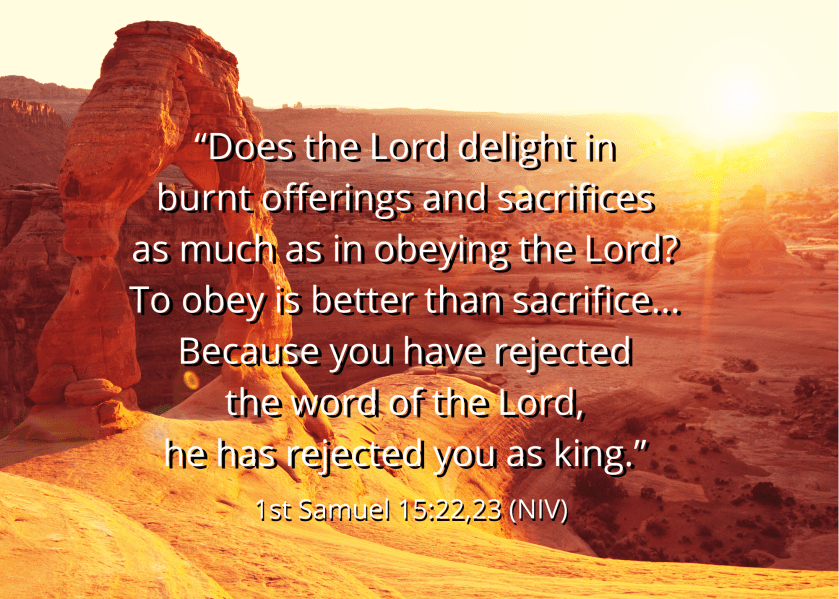
To obey is better than sacrifice. 

To heed is better than the fat of rams. 

The Lord regretted he had made Saul king over Israel. 

However, in the town of Bethlehem, a young boy, ruddy, beautiful, and handsome, also stands among sheep. A young boy who has been slinging stones at predators, not knowing he would need to fell giants. A young boy who is learning obedience, learning hearing and obeying the word of the Lord. A boy, a man, after God’s own heart. 

David. 

Imagine you are Samuel. The last time you smelled lanolin, you had a king crying at your feet, ripping your robes, and it breaks your heart. You had anointed this tall man while he was chasing donkeys, through the desert, but he never truly learned how to be king, how to follow the commands of God. And you grieve.

And now, the boy covered in the smell of sheep walks in through the front door and the Lord speaks to your spirit “Arise, anoint him; for this is he.”

With a sense of irony you realize that you have seen the Lord change the times and the ages. 

He took the kingdom of a king, and he gave the kingdom to another. 

Two Kings among the sheep…

-Jake Ballard

Reflection Questions

  1. Worship and Obedience: Because it is Sunday, there is just one difficult question for you. Today will be or was a day of worship. In Christ, our sacrifice is our heart and our praise to God. (Romans 12, Hebrews 13) However, have you been obedient to God? Have you done all that he has commanded? Are there any broken relationships that need to be mended? Are there any hurts for which you should ask for forgiveness? How can you be obedient to the prompting of the spirit, or to the commands of scripture? Or are you simply “worshipping” God, content that you are giving him something subpar, something less than the obedience he demands? 

Your Kingdom Forever

Old Testament: 1 Samuel 13 & 14

Poetry: Psalm 67

New Testament: 2 Corinthians 11

Saul fails as a King. 

Sorry for the lack of “spoiler warnings”. He doesn’t make it. 

What’s more sad and more of a shocker, is that he *could* have succeeded at being king. At building a dynasty for himself and his children. The language of 1 Samuel 13:13-14 is pretty clear. 

“You have done foolishly. You have not kept the command of the Lord your God, with which he commanded you. For then the Lord would have established your kingdom over Israel forever. But now your kingdom shall not continue. The Lord has sought out a man after his own heart, and the Lord has commanded him to be prince over his people, because you have not kept what the Lord commanded you.” (ESV)

The foolish action of Saul was… sacrifice. Worship. How can that be wrong? Because it was not in accord with the commands of God. Saul was not supposed to do the sacrifice; he was supposed to wait for Samuel. Saul’s impatience and his presumptuous attitude caused him to fall into sin, because he did not obey the word of the Lord. He was keeping the “outward” signs of the law (the sacrifice) but not the details (who, how, when). He wanted the armies to see the sacrifice, rather than keeping it the way God wanted. This impatience and presumption becomes worse later in the story (chapter 15). 

Saul is told that another is rising up in his kingdom. A man after God’s own heart, who would obey the word of the Lord. That is who will replace Saul. 

But notice the end of verse 13 : “For then (if you had kept his commands), the Lord would have established your kingdom over Israel forever.” I don’t think Samuel is stating his own personal opinion here nor do I think he is speaking falsely. God was willing to allow Saul to have a kingdom dynasty. He would have allowed him and his children to sit upon the throne… if Saul had obeyed. 

Far too often, we think all things are set in stone, that our days are done, that the story of our life is written. Before all time, before all actions, either God has claimed us or rejected us. 

In glorious praise and holy fear, that is not true. 

God would like to allow you to reign with Christ in God’s Kingdom. However, you have choices to make. Will you obey? Will you heed the word of the Lord? 

If you do, then all your sins can be forgiven. God will forgive, God will restore, God will empower. 

But, if you do not obey… “he would have established your kingdom”? More “he would have established you in his kingdom.”

You have choices to make. Rather a choice: will you obey the Word of the Lord.

-Jake Ballard

Reflection Questions

  1. The Law We Obey: 1 John 3:23 tells us the commandment that we are called to obey now. What is new about this commandment? What is ancient about this commandment? How can you live out the commandment today?
  2. The Perseverance We Have: In John 10:29, we are promised protection by the Father and that we, as sheep, are not going to be stolen away. How does this promise of protection relate to the story of Saul and the removal of his Kingdom? How does it relate to the choices we are called to make and the salvation we are called to have?
  3. Once Saved, Always Saved?: While some people find comfort in phrases like “there is nothing you did to earn your salvation, so there is nothing you could do to lose it,” is that phrase true? Can people who have “seen the light” reject the salvation of God? (Check out  Hebrews 6:4-6.) It seems obedient relationship with Christ through the power of the spirit is necessary for salvation! (1 John 5:2) Have you asked God to give you his spirit, so that you can obey the commands of Jesus?

By Choice, By Prophecy, By Lot

Old Testament: 1 Samuel 9 & 10

Poetry: Psalm 66

New Testament: 2 Corinthians 9

Before David, Saul becomes king of Israel. 

How does a person become king? 

Romulus, the “first king” of Rome, supposedly built Rome with his followers and then asked for the consent of the people who lived in the city. I guess being raised by wolves is helpful in courtly duties. 

Arthur Pendragon pulls a sword from a stone, whether his horse was simply two halves of a coconut or Merlin’s owl spoke. 

T’Challa took a heart-shaped herb and fought a Panther I think? I don’t quite remember that movie. 

“Charles the Third, by the Grace of God of the United Kingdom of Great Britain and Northern Ireland and of His other Realms and Territories, King, Head of the Commonwealth, Defender of the Faith”, boringly, inherited it from his mother. 

At least one of those kings is fake, the historicity of two others are greatly debated, and personally, I still have my doubts about Charles. 

How does someone become king?

In 1 Samuel 8:19-20, the people cried out for a king. 

In 1 Samuel 9, Saul is chosen by Samuel. 

In 1 Samuel 10:20-24, Saul is chosen by lot. 

In 1 Samuel 11:14-15, *Saul* is chosen by the people.

So, how did he become King? 

People’s choice award? 

Pulling the short straw?

One old guy’s decision?

Saul’s reign is not because the people demanded it, or because Saul got lucky at dice (or pot shards). God is involved in the process. In 1 Samuel 9:17 is was not Samuel but GOD who chose Saul. 

In every authority, in every government, this is true. “Let every person be subject to the governing authorities. For there is no authority except from God, and those that exist have been instituted by God.” (Rom. 13:1) It is clear that God does not approve of every leader and certainly not of their actions. God lets humans make their bad and destructive choices (including, in democracies, choosing bad leaders). Then he works with, and in spite of, those choices. God works to bring about glory for himself; he works toward the coming of the Messiah and his Kingdom. 

Saul was given an opportunity by God to be a person who would bring God’s plan into fruition. God took Saul from chasing donkeys to ruling a nation. God gave Saul every opportunity to be a ruler “after God’s own heart” and yet Saul chose to disobey. 

Kings, rulers, presidents, emperors are only ruling because God has given them the opportunity; the opportunity to obey or disobey, to listen to his voice and to his commands. The same choice he gives to each of us.

Remember, no matter who sits upon any throne, any seat, or behind any desk…

God is on his throne and in control.

-Jake Ballard

Reflection Questions

  1. Preempting “Godwin’s Law”: “What about Hitler?” “What about Mao?” “What about Pol Pot?” Yes those leaders were truly awful. Still, Paul wrote Roman’s to the people who were in the heart of one of the most powerful, most militaristic empires the world has ever known. Paul died by beheading in Rome, and yet he still was inspired by God to write Romans. What is the Christian response to wicked leaders? How much should we obey leaders who are acting against our values? (Maybe check Acts 5:27-32 to compare to Romans 13)
  2. The Lion from Benjamin?: From prophecy in Genesis (Gen. 49:10), it seems like a Benjaminite should never have been king. We see God chose Saul. Now a question for you to chew on for a long time, why Saul? David was a man after God’s own heart and a descendant of Judah. Was Saul always destined to failure? Why THIS choice? (There is not a clear cut reason in scripture, but having read through this chapter, what do you make of it?)

Inquiring of God – Too Late

1 Samuel 28-31 & Psalm 18

1 Samuel 28 15 NIV

In 1 Samuel 28, we read about the low point in Saul’s life.  The Philistine army had gathered their forces to attack, and Saul was terrified.  He wanted to know what to do, so he (finally) inquired of the Lord, but the Lord did not answer him.  He had spent much of his life ignoring God, now it was God’s turn to ignore Saul.

Saul was so desperate to know what to do that he decided to seek out a medium to contact Samuel (who was already dead by this point).  Saul knew this was wrong. In fact, in verse 3, we read that, “Saul had expelled the mediums and spiritists from the land.” And now he inquired of one.

Because Saul was head and shoulders taller than everyone else, presumably, the medium knew that her disguised client was really Saul. She suspected it was a trap.  Saul swore to her, “As surely as the Lord lives, you will not be punished for this.” Saul invoked God’s name to protect her – in total hypocrisy and defiance against God.

Samuel appeared and told Saul, among other things, “The Lord will hand over both Israel and you to the Philistines, and tomorrow you and your sons will be with me.”

Here are my thoughts on what happened:

1.  Through a direct reading of the passage, Samuel really truly did appear.  It was Samuel, not the medium doing some mambo-jumbo “channeling” sleight of hand.

2.  The medium was terrified by this, and didn’t at all expect this.  (Hence her screaming.) I think she was expecting some hocus pocus as usual, and Samuel really showed up.

3.  Samuel interacted directly with Saul, without “channeling” through the medium.

4.  Samuel spoke the truth, referring to comments he had made to Saul in chapter 15 about God tearing the kingdom out of his hand.

5.  I believe God raised Samuel temporarily from the dead specifically to condemn Saul.  I question whether Satan has that kind of power, or if he did, that he would have used it to tell Saul the truth.

6.  We know that Samuel was a righteous man, and Saul was a wicked man.  When Samuel told Saul that Saul and his sons would be joining Samuel the next day, we can infer that Samuel wasn’t in heaven, because Saul wouldn’t be going to heaven, and that Samuel wasn’t burning in hell, since he was righteous.  This re-affirms that Samuel was just dead in the ground, where Saul was going. (Daniel 12:2 reminds us where the dead are and what they are doing – asleep in the dust of the earth.)

In Chapter 31, we read that all of this came true the next day.  The Israelite army was conquered, Saul’s three sons were killed, and Saul committed suicide.

According to 1 Samuel 28:18, all of this happened because Saul “did not obey the Lord.”

This highlights again how important it is for us to obey the Lord.  We need to get into His word to understand what He requires. And then we need to just do it.


–Steve Mattison
Today’s Bible reading passages can be read or listened to at https://www.biblegateway.com/passage/?search=1+Samuel+28-31%2C+Psalm+18&version=NIV

Tomorrow’s reading will be Psalm 121, 123-125 & 128-130 as we continue the 2020 Chronological Bible Reading Plan

Becoming a People after God’s Own Heart

1 Samuel 18-20; Psalm 11 & 59

Psalm 11 1 7 NIV

Today’s reading, found in 1 Samuel chapters 18 through 20, highlights how far Saul has fallen from his successes of chapter 14.  (Remember from chapter 15, that Saul had deliberately disobeyed a direct command from God, and things have been going from bad to worse for him since.

In 18:10-11, we read, “The very next day a tormenting spirit from God overwhelmed Saul, and he began to rave in his house like a madman.  David was playing the harp, as he did each day. But Saul had a spear in his hand, and he suddenly hurled it at David, intending to pin him to the wall.  But David escaped him twice.”

Once Saul decided to abandon God, God not only abandoned Saul, God tormented Saul.  This should be a lesson to us – never disobey God – there are always negative consequences.

Saul became jealous of David, after David had killed Goliath, because the women of Israel sang this song, “Saul has killed his thousands, and David his ten thousands.”  As a result of his jealousy, Saul tried to kill David with his spear in 18:11 and again in 19:10. Saul also tried to kill David by having the Philistines kill him in 18:17, 21, 25.   In 19:1, Saul urged his servants and his son Jonathan to assassinate David. In 19:15, Saul ordered his men to bring David (and his bed) to Saul to be killed, when Saul thought David was sick in bed.  In 19:20, 21 and 22 Saul unsuccessfully sent troops to get David three times.

In 20:30, Saul boiled with rage at his own son, Jonathan, who was friends with David, and in 20:33, Saul hurled his spear at Jonathan, intending to kill him.

So much for Saul, what about David?

If you were David, how would you react?  What would you do?

Remember that Samuel had anointed David in chapter 16, and declared that David would be the next king over Israel.  So what did David do? He wrote some songs about this. Let’s see what he said in those songs…

David wrote Psalm 59 when Saul sent his soldiers to watch David’s house in order to kill him.  This psalm starts out, “Rescue me from my enemies, O God. Protect me from those who have come to destroy me.  Rescue me from these criminals; save me from these murderers. They have set an ambush for me…”. This makes sense.  David was in trouble, so he cried out to God for help. David continues in verse 9, “You are my strength; I wait for you to rescue me, for you, O God, are my fortress.”

Then an astounding thing happens.  David starts praising God – in advance of God’s rescuing him.  Psalm 59 ends with, “But as for me, I will sing about your power.  Each morning, I will sing with joy about your unfailing love. For you have been my refuge, a place of safety when I am in distress.  O my strength, to you I sing praises, for you, O God, are my refuge, the God who shows me unfailing love.”

David, the man after God’s own heart was actually praising God when he was literally afraid for his life.  This shows his great faith that God will indeed rescue him. Maybe this is one of the reasons he was called a “man after God’s own heart.”

Psalm 11, the other chapter from today’s reading also shows David’s faith through difficulty.  It starts out, “I trust in the Lord for protection…”, and ends with “For the righteous Lord loves justice.  The virtuous will see his face.”

I believe David’s response is a good example for us.  When times are tough, it’s natural to cry out to God for help.  We need to move on from just asking for help, and follow David’s example to also have faith and praise God, even before the answer comes.  And in the process, we, too, may become people after God’s own heart.

–Steve Mattison
And, of course – it’s a great day to celebrate a risen Savior (as is everyday) so enjoy some time reading from the gospels as well.  Matthew 28, Mark 16, Luke 24, and/or John 20-21 provide some exciting reading for the day.  He is Risen!
Tomorrow’s reading will be 1st Samuel 21-24 as we continue our journey into God’s Word on the 2020 Chronological Bible Reading Plan