“An Object of Extreme Devotion”

Jeremiah 35-37

The Israelites were still heading in the wrong direction. Jeremiah 35:15 reads, “Again and again I sent all my servants the prophets to you. They said, ‘Each of you must turn from your wicked ways and reform your actions; do not follow other gods to serve them. Then you will live in the land I have given to you and your ancestors.’ But you have not paid attention or listened to me.”

Is there an area of our lives where we need to pay closer attention and listen to God more? Sometimes the sins of the Israelites can seem so unrelatable at first glance. They engaged in idol worship? We might safely conclude,  “None of that going on here, but how foolish of the Israelites!” Then I think about modern day idol worship. Does it look like overconsumption of social media, doom scrolling, adoring celebrities, etc.? Sometimes our idol can be right in the palm of our hands. Do we have a fit of panic when we are getting ready to go somewhere and we can’t find our phones? Merriam Webster’s dictionary defines an idol as “an object of extreme devotion.” Do we have idols we need to clear out of our lives so that God becomes our number one priority? God makes it very clear we are to have no other gods before Him. 

I worked at a Catholic school for a number of years and the faculty and staff worked hard to come up with a school motto that embodied the school’s mission. One of the teachers exclaimed, “God calls, we answer!” and everyone unanimously agreed. That simple, succinct, yet oh so powerful statement really resonated with me and it dovetails nicely with the last sentence in 35:17:

“Therefore this is what the Lord God Almighty, the God of Israel, says: ‘Listen! I am going to bring on Judah and on everyone living in Jerusalem every disaster I pronounced against them. I spoke to them, but they did not listen; I called to them, but they did not answer.’”

When God calls, we want to be sure to answer, but first we must make sure we are truly listening and not letting the superficial cares or distractions of life drown out His voice. Perhaps it’s time to put Psalm 46:10 into practice:

He says, “Be still, and know that I am God;

    I will be exalted among the nations,

    I will be exalted in the earth.”

-Kristy Cisneros

Reflection Questions

  1. Do we have idols (“objects of extreme devotion”) we need to clear out of our lives so that God becomes our number one priority?
  2. What distractions keep you from listening to God’s voice? How can you tune in better to the voice of God?
  3. When you hear God calling – how will you answer?

Voice of Truth

Old Testament: Jeremiah 17 & 18

Poetry: Proverbs 12 and today’s Devotion on Psalm 12

New Testament: 1 Peter 4

One of my favorite Christian songs of all time is “Voice of Truth” by Casting Crowns. In this song, the band talks about choosing to listen to the voice of Jesus out of all the different voices calling out to them. Although those voices keep laughing at us, reminding us of all the times we’ve failed before, and saying that we will never be enough, Jesus says something different. Jesus tells us that we are strong with his God, that we are forgiven, and that we don’t need to be afraid. Everything that happens to us is only for his glory and the glory of his God, and we just need to listen to what he says.

Psalm 12 talks about two different voices that are shouting at King David: the wicked who flatter themselves and destroy God’s people, and the pure voice of the one true God that is like silver. King David stands in the middle and must make a choice: will he listen to voices of wicked, powerful forces that tear him down, or the voice of God that promises to preserve and keep him forever (verse 7)? King David makes the right call and follows after God’s voice, resulting in him being saved from those forces surrounding him (verse 5).

We also have a choice to make: what voice is shouting loudest at you? There are many voices around you that will claim that you are not good enough, are a failure, are ugly, or worthless. Every single person has these voices surrounding them, sometimes coming from mean people or from ourselves. However, our God through Jesus tells us that we are precious, worthy, and loved. There is nothing that will be able to separate us from God’s love in Jesus Christ (Romans 8:38-39), if we will just listen and trust in that great voice over the others. We can have rest, assurance, peace, and joy if we listen to the voice saying, “You’re my son/daughter: I love YOU”.

Brothers and sisters, you are more loved than you can imagine. Although you have people saying horrible things about you, and may be saying horrible things to yourself, you are a child of the one true God: you have value, purpose, and a family. Please find hope and encouragement today in knowing that this Voice is greater than all the rest and speaks the truth.

-Talon Paul

Reflection Questions

  1. What lies about yourself have you heard, and sometimes believed, from others or from yourself? Why are they wrong? Why are they harmful?
  2. What does God say about you and His love? What is Jesus’ role in sharing God’s love and truth?
  3. How can you listen LESS to the lies and MORE to the truth?
  4. How can you help carry God’s words of truth and worth to those who are listening to lies?

Discerning

When and Where God Just Wants You to Stand

*Old Testament: Esther 5-7

Poetry: Psalm 28

New Testament: John 8

Esther’s boldness is often written about… If I perish, I perish.

Kind of melodramatic.

The real story here, although not presented with as much flourish, is Esther’s discernment. When Mordecai tells her what she needs to do, she doesn’t just swoon the ‘if I perish’ line and exit stage left to appeal to the king. She asks for time to pray and fast herself, and asks for others to join her.

Go, gather all the Jews to be found in Susa, and hold a fast on my behalf, and do not eat or drink for three days, night or day. I and my young women will also fast as you do. Then I will go to the king…   4:16

After this, Esther still doesn’t march into the king’s presence and boldly present her ask. What she does is be intentional with each and every action and word. She chooses what to wear, and she puts herself in the right place. And she stands there.

Esther put on her royal robes and stood in the inner court of the king’s palace.  5:1

Even after the king receives her and asks for her request, all but assuring her that the answer will be yes, she continues to act with discernment.

And the king said to her, “What is it, Queen Esther? What is your request? It shall be given you, even to the half of my kingdom.” And Esther said, “If it please the king, let the king and Haman come today to a feast that I have prepared for the king.”   5:3-4

At the feast, the king repeats his promise to give her what she desires, but still she doesn’t ask. We can’t really explain why she does what she does, but what can explain it is that she is being led by a wise and knowing God because she has taken the time to listen to him.

And as they were drinking wine after the feast, the king said to Esther, “What is your wish? It shall be granted you. And what is your request? Even to the half of my kingdom, it shall be fulfilled.” Then Esther answered, “My wish and my request is: If I have found favor in the sight of the king, and if it please the king to grant my wish and fulfill my request, let the king and Haman come to the feast that I will prepare for them, and tomorrow I will do as the king has said.”   5:6-8

And then this happens…

On that night the king could not sleep.  6:1

A-ha! His sleepless night led to him doing a little light reading which opened a door for God to speak directly into him. God didn’t put Esther in this place so she could convince the king, he put her there simply to ask. And she did, the next day…

And on the second day, as they were drinking wine after the feast, the king again said to Esther, “What is your wish, Queen Esther? It shall be granted you. And what is your request? Even to the half of my kingdom, it shall be fulfilled.”Then Queen Esther answered, “If I have found favor in your sight, O king, and if it please the king, let my life be granted me for my wish, and my people for my request. For we have been sold, I and my people, to be destroyed, to be killed, and to be annihilated. If we had been sold merely as slaves, men and women, I would have been silent, for our affliction is not to be compared with the loss to the king.” Then King Ahasuerus said to Queen Esther, “Who is he, and where is he, who has dared to do this?” And Esther said, “A foe and enemy! This wicked Haman!”   7:1-6

Far too often, I think we inflate just how much God needs us. He truly does the heavy lifting far more effectively than we can. Our job is to learn to tune in to when it’s time to speak and when it’s time to put on the royal robes and just stand.

How often do we think we’re helping God, or are certain that we’re on the path to do the most good (both positive intentions, by the way) but we’re not doing an awful lot of praying or fasting before we move, speak, or bulldoze ahead?

Maybe God’s thinking, ‘It’s great that you’re willing to perish, but all I really need you to do is just stand there today.’

-Susan Landry

Reflection Questions

  1. Have you tried praying and fasting before making a large decision or bold action? If so, did you find it beneficial? Whether you have done it before or not, what might God want you to spend time praying and fasting about?
  2. Can you think of a time you may have been to0 quick to act – not acting within God’s perfect timing?
  3. When have you seen examples of God’s perfect timing?

Paul Before Felix

Acts 24

May 12

Once again Paul is calmly stating the facts against his false accusers.  He stresses “there will be a resurrection of both the righteous and the wicked” (v.15).  Felix likes to listen to Paul, probably hoping for a bribe.  He’s a willing audience until Paul starts stepping on his toes.  When the subjects of righteousness, self-control and the coming judgment come up, Felix suddenly has better things to do.

Take care not to listen to God just when it’s convenient.  Or stop fellowship if someone steps on your toes.  Proverbs 27:17 tells us “As iron sharpens iron, so one person sharpens another.”   God wants us in fellowship for a reason.

-Annette Osborn

Questions for Reflection and Discussion

  1. Have you ever been in a “bad situation” (before your accusers or in custody for two years or something else) that was an opportunity to share about Jesus and a coming resurrection for the righteous and wicked? (Hint: the answer is yes) Did you seize the opportunity? How could you see the opportunity and be bold to do so next time?
  2. Are you easily offended or avoid further contact when your toes are stepped on? What is a healthy attitude to take?

When God says Go

When God Says Stop

Acts 9

April 27

Acts 9:17 – Then Ananias went to the house and entered it. Placing his hands on Saul, he said, “Brother Saul, the Lord – Jesus, who appeared to you on the road as you were coming here – has sent me so that you may see again and be filled with the Holy Spirit.”

A few days ago, I shared thoughts on becoming sensitive to the Holy Spirit, instead of clinging tight to traditions of the Law.

And yesterday, I shared my thoughts on evangelizing. 

In Acts chapter nine we have an example of a new believer being asked to do what some might describe as a dangerous mission – go visit the Jewish leader who is known to breath out murderous threats against followers of Jesus. 

May I be honest? If I had been Ananias, I would have been second guessing this new gospel message and all that God was asking me to do. I may have even been tempted to just flat out disobey and tell God “no”. 

Thank goodness Ananias chose to believe God and responded in obedience. Thank goodness Ananias trusted in God’s faithfulness, even when it didn’t make any sense. Thank goodness Ananias is an example we can turn to when we are also asked to do things that take us way out of our comfort zone. 

Ananias is called a disciple – so it’s not too much of a stretch to think that he was a devoted man of prayer and scripture study. Ananias was most likely in a spiritual posture to notice when the Lord was speaking to him. He wasn’t so wrapped up in his daily routines that he didn’t know when the Lord called to him in a vision. 

On the other hand, Saul, one who was devoted to the Law, had to be struck with blindness in order for the Lord to get his attention. 

The dichotomy of how the Lord spoke to these two men is striking, but both were startling. One was approached in a vision, the other lost his vision. One was told “go”, the other was told “stop”. One had to overcome doubt and act in faith, the other had to be humbled and overcome pride. 

This story of Saul’s conversion and Ananias’ part in it, shows us that God will use whatever method necessary to get us to stop and listen in order to make an impact for His Kingdom. 

-Bethany Ligon

Questions for Reflection and Discussion

  1. Have you ever done something for God that was a reach out of your comfort zone? What was the result? Would you do it again? Would you do something even more daring – for God?
  2. When was a time God probably wanted you to GO? When was a time God probably wanted you to STOP? Ask God if He is currently calling you to GO or to STOP. Then do it.

Selective Listening – or Worse?

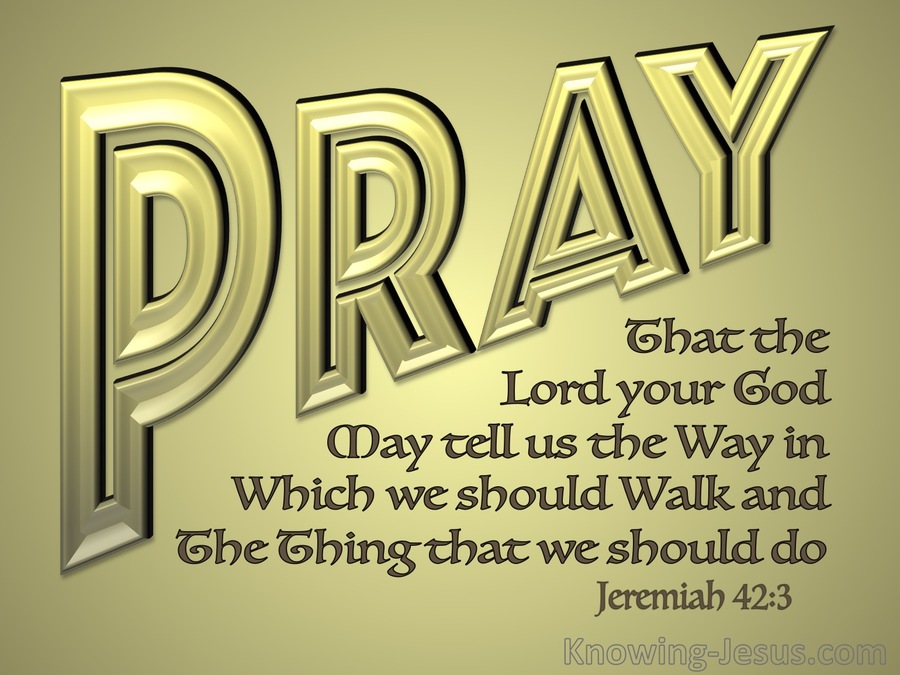
Jeremiah 42-43

Jeremiah 42-3 Pray That The Lord May Shoe Us The Way gold

Sunday, March 12


I’ve witnessed an oft-recognized-but-rarely-diagnosed illness called “selective listening.” I’ve charted an epidemic of the disease mostly among strong-willed toddlers, but it expands among all ages, genders, and cultures (even to Dads and, dare I admit it, Moms too). This “selective listening” regularly manifests as an inability to hear or acknowledge commands or requests given loudly a few inches away, followed by an ability the next minute to overhear a whispered conversation about dessert behind closed doors three rooms away.


Have you ever demonstrated selective listening? Or, even worse, have you listened and heard clearly, but deliberately chose to go the other direction? Often, selective listening becomes so selective that it leads to disobedience – we only let ourselves hear or believe that which aligns with our desires, and then we follow our desires even if they lead us away from God’s truth.


In this passage, the people went to Jeremiah for some advice. What should they do – should they stay in Judah or go to Egypt? Jeremiah consulted with God, who revealed to him that the people should stay in Judah. Jeremiah told the people about his revelation from God, but did they listen to this very advice (for which they had asked, mind you)? NO! They decided to head to Egypt and took Jeremiah with them. (We’ll explore the repercussions of this action over the next few days!)


I’m reminded of many Bible characters who had “selective listening” – or shall I say, outright disobedience – of which one of the most prominent examples was Jonah. God told him to go to Nineveh, but Jonah boarded a ship in the exact opposite direction! He soon learned that he could not hide from God, though! (You can get that whole story in the Old Testament book of Jonah).


Pray with me about any areas of our lives that we need to be more open to listening to God and obeying him, even if it is contrary to what we want to do. Ask God to change our hearts to make us desire to listen to Him and obey His will. May we be people who DO the word of God, not just HEAR it (James 1:22).

-Rachel Cain


Rachel Cain is a follower of Jesus, wife to Dan, and stay-at-home homeschooling mommy to three precious Blessings. She enjoys reading (children’s books by day and non-fiction by night), eating ice cream, hiking, and writing devotionals about what God has been teaching her. 


(Photo Credit: http://images.knowing-jesus.com/i/jeremiah-42-3-pray-that-the-lord-may-shoe-us-the-way-gold)