
Afraid of the Truth

1 Samuel 1-2Psalm 45Acts 24

-Devotion by Kristy Cisneros (SC)

Verses 24 and 25 in today’s reading in Acts immediately captured my attention, 

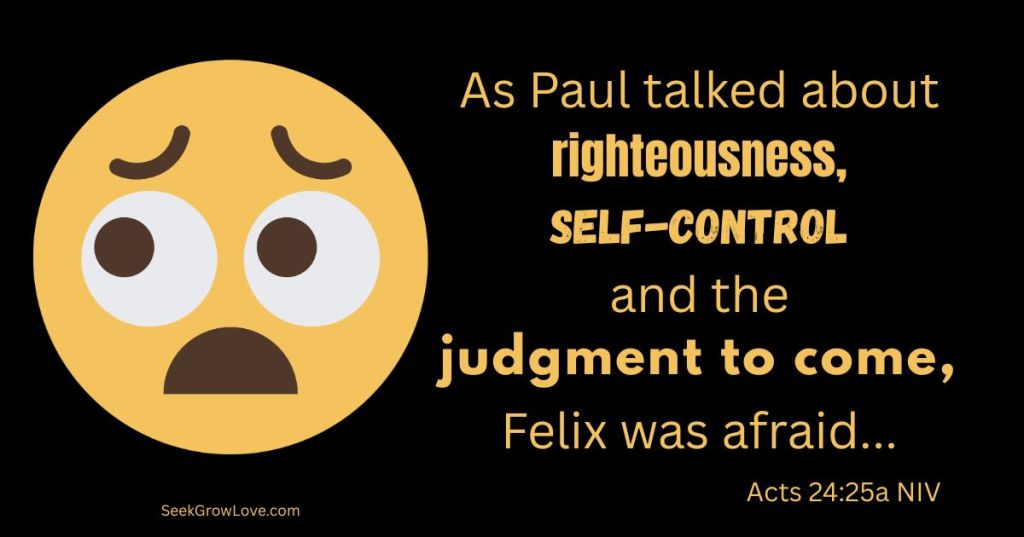
“Several days later Felix came with his wife Drusilla, who was Jewish. He sent for Paul and listened to him as he spoke about faith in Christ Jesus.  As Paul talked about righteousness, self-control and the judgment to come, Felix was afraid and said, “That’s enough for now! You may leave. When I find it convenient, I will send for you.” (NIV). 

My takeaway from these verses is that Felix must have recognized the gospel message as the truth, but didn’t want to act on it. Instead, he wanted to pretend like he had never heard it. Reading these verses immediately brought to mind Hebrews 10:31:  “It is a dreadful thing to fall into the hands of the living God.” (NIV) Earlier in chapter 10 of Hebrews in verse 26 and 27, we read of the fate of those who know the truth but don’t allow it to change them, “If we deliberately keep on sinning after we have received the knowledge of the truth, no sacrifice for sins is left, 27 but only a fearful expectation of judgment and of raging fire that will consume the enemies of God.” To be confronted with the truth and then deliberately choose to ignore it doesn’t make us immune from God’s judgment. Hebrews 10:39: “ But we do not belong to those who shrink back and are destroyed, but to those who have faith and are saved.” (NIV) May we have a bold faith like Paul rather than one that shrinks back like Felix’s. 

Reflection Questions

  1. Why might Felix have been afraid of the truth he heard from Paul – about righteousness, self-control and the judgment to come? Even with fear, what might have been a better response than his, “That’s enough for now! You may leave. When I find it convenient, I will send for you”?
  2. Is there truth that you are too afraid to face? How do you respond to that fear? Even with fear, what might be a better response?
  3. Are there some things God might want us to be fearful of? If so, what and why, for what purpose? Are there some things God does not want us to be fearful of? If so, what and why, for what purpose?

Prayer

Dear God, You are the mighty and wise Creator of heaven and earth and all truth. I pray that You show me what is true – about You, Your Son, Your Word, myself, this world and the one to come. I desire a deeper and deeper faith in You that is bold in believing, sharing and acting upon Your truth. Guide me today in seeing and making the most of every opportunity you set before me, as a Paul and not a Felix. In the name of Your Son, who came and will come again, I pray.

Paul Before Felix

Acts 24

May 12

Once again Paul is calmly stating the facts against his false accusers.  He stresses “there will be a resurrection of both the righteous and the wicked” (v.15).  Felix likes to listen to Paul, probably hoping for a bribe.  He’s a willing audience until Paul starts stepping on his toes.  When the subjects of righteousness, self-control and the coming judgment come up, Felix suddenly has better things to do.

Take care not to listen to God just when it’s convenient.  Or stop fellowship if someone steps on your toes.  Proverbs 27:17 tells us “As iron sharpens iron, so one person sharpens another.”   God wants us in fellowship for a reason.

-Annette Osborn

Questions for Reflection and Discussion

  1. Have you ever been in a “bad situation” (before your accusers or in custody for two years or something else) that was an opportunity to share about Jesus and a coming resurrection for the righteous and wicked? (Hint: the answer is yes) Did you seize the opportunity? How could you see the opportunity and be bold to do so next time?
  2. Are you easily offended or avoid further contact when your toes are stepped on? What is a healthy attitude to take?

Paul Faces Felix

image (1)
Acts 24
When the Roman Empire conquered the Holy Land in the middle of the first century BC, it established its own rulers to ensure peace and cooperation throughout the region. The Jews have had a long history of revolting against their rulers (especially when they weren’t monotheists), so it makes sense that one of the main jobs of the regional Roman rulers was to keep Zealots (Jews who vocally, and sometimes violently, opposed Roman rule in their homeland) from causing too much trouble. Whenever any of these Zealots caused an uprising in a Jewish city, there were major consequences–sometimes death.
 So when in chapter 24, the attorney for the Jewish elders accused Paul of being a trouble maker who stirred up riots among the Jews, he was saying that Paul was not such a great guy and should perhaps be killed. He also claimed that Paul desecrated the temple–a capital offense. These religious leaders wanted Paul taken out.
As Paul stood to defend himself before Felix, the first of several Roman rulers who would hear his case, he was up against some serious allegations. But Paul was unfazed. He had just been assured by his Master that his journey would not end here. Paul spoke boldly in both the defense of his character and his faith. I think Paul would have done this even without that assurance because of where he had his focus. Paul’s eyes were fixed firmly on his savior and the future hope of the resurrection. This allowed Paul to operate without fear of death or retribution–to be at peace.
You may not live in a society where you must defend yourself or your faith in front of corrupt rulers. But perhaps someday you will face charges because of your beliefs. If that time ever comes, you, like Paul, can have a peace that passes understanding. Trust in God, rely on His promises, focus on His Son and the hope of the resurrection, and pray.
-Joel Fletcher