
Read this BEFORE you Get Rich!

Old Testament: 2 Chronicles 29 & 30

Poetry: Psalm 10

*New Testament: 1 Timothy 6

            In 2022 a record was set as Americans lost more than 60 billion dollars in casinos and online betting.  American’s spend about 100 billion dollars a year buying lottery tickets.  I read a news article today that said as much as 200 Billion dollars in Covid relief money was stolen by fraud during the Covid paycheck relief program.  Over the next few months and years there will be trials as those who have been arrested and charged with fraud will have to face the consequences of their actions. 

What is the motivation for people to get rich by any means, including gambling, stealing and other types of fraud.  Does having more money make you happier?  A number of studies have been conducted in recent years to determine if there is a correlation between how much money one makes and their level of happiness.  One 2010 study by economist Daniel Kahneman found that after a certain amount of having basic financial needs met, having more money doesn’t improve your level of happiness.  The amount he found at the time was $75,000.  A more recent study found that making more money can have a slight affect on happiness, but really not enough to make a significant difference.  That researcher, Matthew Killingsworth from the Wharton Business School found that up to a certain amount your happiness might increase, but that your life is much better spent focusing your attention on other things to really improve your sense of well-being. He says: “people probably overemphasize money when they think about how well their life is going.”

The reward of short term happiness one might feel for having more money by winning the lottery, hitting the jackpot, or ripping off the Government by fraud, or even by wearing yourself out at work or working multiple side jobs to make more money isn’t worth the negative consequences of those behaviors. The negative outcomes more than offset any happiness gains one might have by having more money.

I love how psychologists, economists and other highly educated people are finally getting around to proving what God’s word has been saying for thousands of years.

In today’s reading in Timothy Paul warns: “But godliness with contentment is great gain. For we brought nothing into the world, and we can take nothing out of it. But if we have food and clothing, we will be content with that. Those who want to get rich fall into temptation and a trap and into many foolish and harmful desires that plunge people into ruin and destruction. For the love of money is a root of all kinds of evil. Some people, eager for money, have wandered from the faith and pierced themselves with many griefs. (1 Timothy 6:6-10)

Paul contrasts the benefits of godliness with contentment with basic food and clothing vs. the risks and consequences of those who desire to get rich due to their love of money.  Love of money and pursuit of riches are a trap that are destructive to people’s lives.  The love of money leads to all kinds of evil behavior and is a cause of some believers wandering away from their faith in God.

This week we’ve talked about different things that cause us to abandon faith in God including fear in the case of Jehoshaphat or pride in the case of Uzziah.  Here Paul warns that plain old greed can lead you away from faith in Jesus Christ.

What is the solution.  Learn to be content.  This corresponds with what John the Baptizer said in Luke 3:14 when soldiers came to him: “Soldiers asked, ‘What about us? What should we do?’ He answered, ‘Don’t cheat or harass anyone, and be satisfied with your pay.’”

Jesus was pretty smart and gave some great wisdom about money in Matthew 6:24-33

“No one can serve two masters. Either you will hate the one and love the other, or you will be devoted to the one and despise the other. You cannot serve both God and money.”

“Therefore I tell you, do not worry about your life, what you will eat or drink; or about your body, what you will wear. Is not life more than food, and the body more than clothes? Look at the birds of the air; they do not sow or reap or store away in barns, and yet your heavenly Father feeds them. Are you not much more valuable than they? Can any one of you by worrying add a single hour to your life?”

 “And why do you worry about clothes? See how the flowers of the field grow. They do not labor or spin. Yet I tell you that not even Solomon in all his splendor was dressed like one of these. If that is how God clothes the grass of the field, which is here today and tomorrow is thrown into the fire, will he not much more clothe you—you of little faith? So do not worry, saying, ‘What shall we eat?’ or ‘What shall we drink?’ or ‘What shall we wear?’ For the pagans run after all these things, and your heavenly Father knows that you need them. But seek first his kingdom and his righteousness, and all these things will be given to you as well.”

            I know that many who are reading this today are young people, perhaps in college or just beginning careers.  It’s natural to want to make enough money to meet your basic living needs- for food, shelter, clothing, healthcare and to give to help those in need.  Proverbs 30:8-9 offers this simple but wise prayer:

“give me neither poverty nor riches;

    feed me with the food that is needful for me,

  lest I be full and deny you

    and say, “Who is the Lord?”

or lest I be poor and steal

    and profane the name of my God.”

Lord, provide me with my basic needs so that I won’t be tempted to steal food to stay alive, but also please don’t give me too much so that I might be tempted to forget you.  In our striving for the happiness that we think wealth will gain for us, we may so badly wreck our priorities that it completely derails our faith.  If we value money too much, we might not be tempted to steal, but we may be tempted to steal from God by choosing to work on Sundays instead of going to Church.  Or working so hard the other 6 days a week that Sunday is our only day to sleep in or do work around the house and so we can’t make time for God or Church.

A life spent chasing after riches will likely leave you spiritually poor.  So budget your time and your priorities wisely and don’t make financial wealth the primary driver of your happiness and meaning.

-Jeff Fletcher

Reflection Questions

  1. How much money do you think it would take to make you happy?
  2. How can the love of money tempt you to wander away from your commitment to Jesus Christ?
  3. What should Christians’ attitude be about gambling?  The Bible doesn’t explicitly condemn gambling, but can gambling be participated in without greed/love of money?  How would you answer that question to someone who asked you if it is okay for Christians to gamble?

Detestable Prayers

Proverbs 28

As Marcia mentioned in yesterday’s devotion, many of us were at Midwest Family Camp last week, where the theme was “Stand Firm”.  In a nutshell, if we don’t have a relationship with the Lord, it is critical that we repent and come into a relationship with Him. If we already have a relationship with the Lord, we need to strengthen that relationship, and stand firm in the faith – no matter what.

In today’s reading in Proverbs 28, there are a few verses that jumped out at me which reinforced that message.  The first is found in Proverbs 28: 9, “If anyone turns a deaf ear to the law, even his prayers are detestable.”  This proverb tells us that if we’re not doing everything to live the life God called us to live, if we’re not following his rules, then He won’t listen to our prayers.  Since many of our prayers are about asking for God’s help with various things, if we selfishly want Him to answer our prayers, then we need to obey His rules, and live for Him.  As we grow in relationship with Him, we come to long for an even deeper relationship with the Lord. Then we learn that prayer is powerful, and we don’t waste it just asking for superfluous things.

Proverbs 28:13 goes on to say, “He who conceals his sins does not prosper, but whoever confesses and renounces them finds mercy.”  This is saying if we pretend to be Christians, we won’t prosper (you can’t fool God).  But if we confess and renounce our sins, and turn completely to God, we will receive God’s mercy.  I don’t know about you, but I would much rather have His mercy than to have Him holding me back from prospering.

As we continue to read through this chapter, we get to verse 20, which says, “A faithful man will be richly blessed, but one eager to get rich will not go unpunished.”  I’ll take a detour here and comment on the health and wealth teachings we often hear from people who don’t know better.  The theory goes sort of like this… “if someone follows God, God will bless every aspect of their life.  They will be rich, healthy, and blessed.”  Many people who call themselves Christians subscribe to this false belief.  Jesus told us in John 16:33, “…In this world, you will have trouble.  But take heart, I have overcome the world.”  We have to remember this life isn’t our reward.  This life is the test to see what reward we will receive when Jesus returns.  If we are faithful to the Lord now, we will enjoy peace with God now, and eternal life when Jesus returns.  If we are just trying to get rich, we are actually worshiping money, not God — our reward is in this life, and we will forfeit eternal life.  

1 Tim 6:9-11 says, “People who want to get rich fall into temptation and a trap and many foolish and harmful desires that plunge men into ruin and destruction.  For the love of money is a root of all kinds of evil.  Some people eager for money have wandered from the faith and have pierced themselves with many griefs.  But you, man of God, flee from all this, and pursue righteousness, godliness, faith, love, endurance, and gentleness.”

Instead of trying to get rich, we need to follow the advice given in Proverbs 28:27, “He who gives to the poor will lack nothing, but he who closes his eyes to them receives many curses.”  Again, I think the idea is that if I’m greedy, wanting to keep all my money for myself, I’m not trying to please God, I’m just greedy for money, and God will curse me for not following Him.  But if I’m generous with the things God has given me by giving them to the poor — this mimics God’s generosity to me.  When I am imitating God, God loves that.  In fact we’re commanded in Ephesians 5:1, “Be imitators of God, therefore, as dearly loved children.”

So the bottom line is this.  We need to do everything we can to reconcile ourselves to God.  We need to confess and renounce our sins, obey His laws, be faithful, and be generous.  All these things are required to live in close relationship with God.  And if we live in a close relationship with God, we will have peace with God in this life, and an amazing reward in the life to come.  In Rev 21:4, we’re told, “He [God] will wipe every tear from their eyes.  There will be no more death or mourning or crying or pain…”   Rev 21:7 goes on to say, “He who overcomes will inherit all this, and I will be his God and he will be my son.”

How well are you imitating Dad?

Stand Firm.

–Steve Mattison

Today’s Bible reading passages can be read or listened to at BibleGateway here – 1 Chronicles 23-24 and Proverbs 28

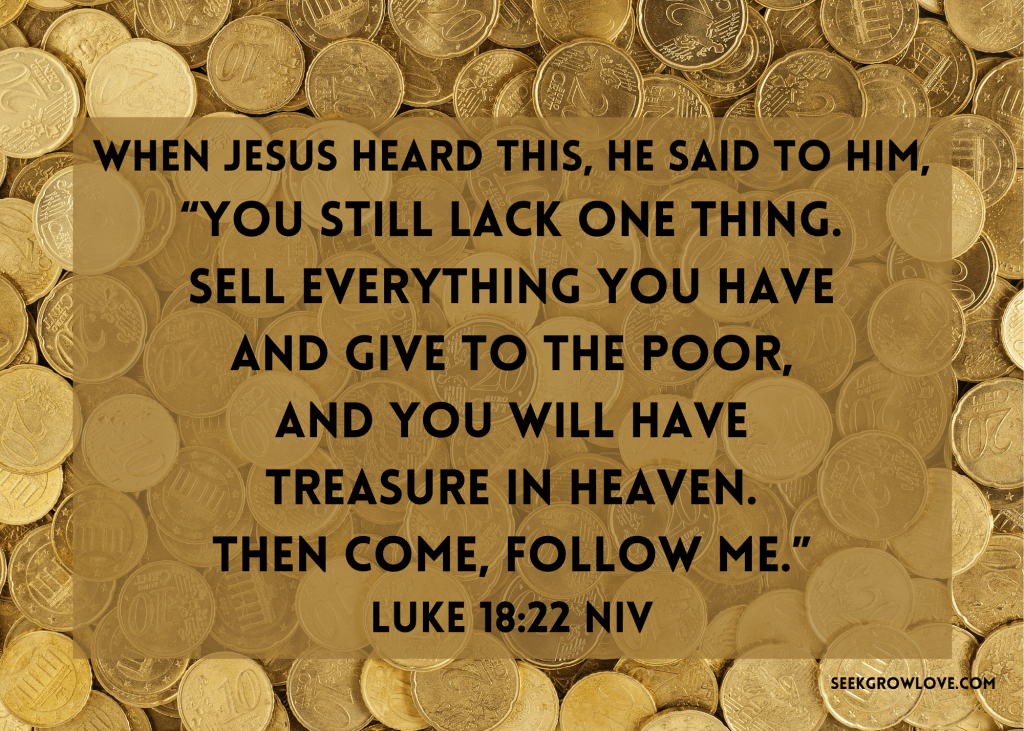
Possessions or Jesus?

Text: Luke 18.15-19.48

At the time this devotion is being written, the release of the new iPhone 12 will be announced tomorrow. Many people, as usual, will drool over this fresh piece of technology and feel compelled to get it even though they probably don’t need it. And my oh my how this is true with so many other material items in our life. We don’t really need them but feel as though we do. This is the world we live in as 21st century Americans. However, though having material possessions IS NOT BAD, as disciples of Jesus we MUST be aware of the ever lurking sin of greed and ungodly consumption. 

In today’s text we read about two rich men who respond to Jesus in complete opposite ways. The two rich men are the Young Rich Ruler and Zacchaeus. The reality is both of these men represent two groups of people. One group who says they want to follow Jesus but do not want to give up their supreme desire for possessions/wealth and the other group are those who equally love money and wealth but repent of it and replace the greatest desire of their life (wealth) with Jesus. 

In the account of the rich young ruler, Jesus plainly tells us it is impossible for a rich man to enter the kingdom of God. Worldly riches and treasures and possessions mean absolutely nothing to the sovereign creator of the universe. It is ok to have money, it is absolutely not ok to love money (and what you get with it) more than God. The former is God’s gift to us, the latter is idolatry. Love the giver not the gift. 

In the account of Zacchaeus we learn that it is never too late to repent of our sin (in this case greed) and come to Jesus and receive salvation. Zacchaeus was likely a career tax collector who made a living stealing from his own Jewish people. He shows us the way to repent from greed. He gives away many of his possessions and repays four times what he stole from people. Zacchaeus’ heart changed therefore his actions and lifestyle changed. True repentance is always evidenced in life change. 

Who are you? Do you say you love Jesus but really wealth and consumerism has your heart? Or do you recognize greed has no place in the life of a believer. Our greatest treasure is Christ not the Iphone 12. 

Other passages on greed and wealth:

.Luke 8.14

.Luke 12.16-21

.Luke 16.19-31

.Proverbs 11.4

.Proverbs 11.28

.Matthew 6.19-21

-Jacob Rohrer

P.S. The next 2 weeks of devotions will be authored by me. All my scriptural citations will come from the New American Standard Bible (NASB).

Today’s Bible reading passage can be read or listened to at BibleGateway here – Luke 18.15-19.48

Tomorrow we will read Mark 11 & John 12.

What Do You Owe?

Proverbs 6

Proverbs 6 23 NIV

This chapter can be broken into two sections.  The first section is about how we deal with situations where we owe something to someone.  Some of you may be thinking that you don’t owe anything to anyone, and you have not offered a security for what someone else owes, so this doesn’t apply to you.  That is good, but remember it is unlikely you will go through life without owing anything, so be prepared.

So, how do we deal with owing someone?  Verses 3 and 4 say:

So do this, my son, to free yourself,
since you have fallen into your neighbor’s hands:
Go—to the point of exhaustion—
and give your neighbor no rest!
Allow no sleep to your eyes,
no slumber to your eyelids.


We need to work hard to free ourselves.  We need to repay what we owe as quickly as possible.  We also need to repay this through honest measures.  Verses 16-19 talk about this:


There are six things the Lord hates,
seven that are detestable to him:
17         haughty eyes,
a lying tongue,
hands that shed innocent blood,
18         a heart that devises wicked schemes,
feet that are quick to rush into evil,
19         a false witness who pours out lies
and a person who stirs up conflict in the community.

These verses by themselves are good wisdom, but don’t seem to have anything to do with owing someone.  However, in the context of working hard to repay what we owe, it could be tempting to scheme, or cheat our way out of what we owe.  Doing this would cause us to do at least one of the things God hates.  So, when we owe anything, we need to take responsibility for it , and work hard and honestly to pay it back as quickly as possible.

The chapter then transitions to talking about adultery.  This seems to be an abrupt transition to me, and I thought about that for a while.  Then, I thought of the 10 commandments, and specifically Exodus 20:17:

“You shall not covet your neighbor’s house; you shall not covet your neighbor’s wife or his male servant or his female servant or his ox or his donkey or anything that belongs to your neighbor.”

So, both parts of this really come back to wanting what we don’t have.  We borrow to get what we don’t have, and adultery comes from wanting what we don’t have.

Acting on either of these will cause us trouble, but the problems caused by adultery will be much greater.  Verses 30-33 show this:

People do not despise a thief if he steals
to satisfy his hunger when he is starving.
31 Yet if he is caught, he must pay sevenfold,
though it costs him all the wealth of his house.
32 But a man who commits adultery has no sense;
whoever does so destroys himself.
33 Blows and disgrace are his lot,
and his shame will never be wiped away.


I think the chapter really shows the perils of not being content with what we have.   We can be content with everything we have in live because God is always with us as stated in Hebrews 13:5:

Make sure that your character is free from the love of money, being content with what you have; for He Himself has said, “I will never desert you, nor will I ever forsake you,”


Andrew Hamilton

1 Timothy 6

Sat Devo

“Instruct them to do what is good, to be rich in good works, to be generous, willing to share, storing up for themselves a good reserve for the age to come, so that they may take hold of life that is real.” ~ 1 Timothy 6:18-19

What is the purpose of life? What really matters in life? These age-old questions have numerous answers, but Paul tries to point us to the true answer in 1 Timothy 6. In this chapter, we see two different kinds of people: those who love money and those who love God. In Paul’s words, those two things can’t exist together. Paul says, “But those who want to be rich fall into temptation, a trap, and many foolish and harmful desires, which plunge people into ruin and destruction. For the love of money is a root of all kinds of evil, and by craving it, some have wandered away from the faith and pierced themselves with many pains” (1 Timothy 6:9-10). Paul doesn’t necessarily call money evil in this passage, but he definitely states that loving money, or making it an idol in your life, will lead you down a dark path. In fact, Paul urges Timothy in the next verse (v. 11) to run from these things and to pursue, instead, “righteousness, godliness, faith, love, endurance, and gentleness.” It would seem from these verses that the love of money and God are mutually exclusive. Jesus confirms this when he says in Matt. 6:24, “No one can be a slave of two masters, since he will hate one and love the other, or be devoted to one and despise the other. You cannot be slaves of God and of money.” 

Our culture today encourages us to make ourselves slaves of money. Our lives are dictated by pursuing jobs that will provide enough money to pay our bills and other living expenses until we can get the next paycheck. If we have the chance to work more to get money to buy some more nice things for ourselves, many of us will jump on the opportunity. And, that lifestyle is applauded by those around us. But, we have to always ask ourselves when get sucked into a cycle of living: is this godly or worldly? According to 1 Timothy 6, our purpose in life shouldn’t be to become rich and get all of the material goods that wealth entails. 

So what should our purpose be? Paul answers that in 1 Timothy 6:17-19: 

“Instruct those who are rich in the present age not to be arrogant or to set their hope on the uncertainty of wealth, but on God, who richly provides us with all things to enjoy. Instruct them to do what is good, to be rich in good works, to be generous, willing to share, storing up for themselves a good reserve for the age to come, so that they may take hold of a life that is real.” 

When we set our hope on God, it changes what we think is important. Instead of pursuing a life of riches on earth, we begin to “collect for [our]selves treasures in heaven, where neither moth nor rust destroys, and where thieves don’t break in and steal. For where [our] treasure is, there [our] heart[s] will be also” (Matt. 6:20-21).

~ Cayce Fletcher