In today’s passage in Galatians, 5:23, we read of the rest of the fruits of the spirit: gentleness, self-control; against such things there is no law. (NASB 1995) The spirit of self-control is a quality that would have served David well in today’s passage in 2 Samuel 11. What can we learn from the story of David? Sin can have a domino effect. One sin can easily lead to another. David’s first sin was probably just looking at Bathsheba longingly while she was bathing. Jesus tells us that for a married person to even look upon someone else with lust is equivalent to adultery. Ideally, David should have looked away immediately once he realized she was not clothed. We can probably safely assume his self-control did not kick in at that moment to prompt him to quickly avert his gaze, which then led to feelings of lust multiplying in him. Then, as the story goes on, we see David actively pursuing her, impregnating her and then frantically trying to figure out how to clean up his mess. David’s struggle with temptation is obviously not unique. We only have to look around to see we have many temptations competing for our attention. Pornography is more accessible than it has ever been and has been named as a major public health crisis due to the impact on individuals and their marriages and families.
Abiding in the living vine is our best defense against the onslaught of temptation that we face on a daily basis. Self-control is not easy to come by naturally because temptations are considered to be temptations because they are powerful and tap into our carnal desires and stimulate our senses. Whether it’s overindulging in alcohol or food, taking drugs that aren’t prescribed to us or abusing prescription drugs, sexual sin, etc., temptation comes in many forms. Thankfully we don’t have to rely on our own strength to resist them. Abiding in Christ helps us to cultivate that fruit of the spirit that includes self-control. Of course, like any plant, a vine must be tended to. We cannot ignore it and expect it to thrive. It is a choice that must be made daily, sometimes hourly, at times even minute by minute, to abide in Christ.
-Kristy Cisneros
Reflection Questions
Besides in this chapter, where else have you seen sin’s domino effect in action?
What temptation grabs your attention and pulls you away from where you should be? Where does it lead to next?
What does it look like when your temptation wins over your lack of self-control? What does it look like when your self-control wins over temptation? How do you feel in each instance? How are others affected in each case? What do you imagine God is thinking or feeling in each scenario?
What specific actions can you take this week to abide in Christ more and more? What will it cost you? What will the benefits be?
The story of David and Bathsheba is probably familiar to most of us. King David, described elsewhere as a “man after God’s own heart”, had a little too much time on his hands while his army was away fighting. One evening, he got up from his bed and walked around on the roof of his palace; and from his roof, he saw a beautiful woman taking a bath. I’m reminded of 1 Corinthians 10:12, “So, if you think you are standing firm, be careful that you don’t fall!”
You might be tempted to stop right there and ask what this beautiful woman was doing taking a bath in public. Wasn’t she inviting unwanted attention? Presumably, she was in her own fenced backyard, and nobody could see her unless someone was on the roof of the palace next door – and who would be walking around on a roof? Regardless, she isn’t the real topic of the story, David is.
The fact remains that David took a long look at her. David lusted after her. David violated one of the 10 commandments: “Don’t covet your neighbor’s wife…”. Lust is a trap, especially for men – even for a “man after God’s own heart”. David should have stopped right there, confessed, and asked God for forgiveness. Instead, he asked one of his servants who she was. He was definitely showing too much interest.
Once he found out that she was the wife of Uriah, one of his bodyguards, and the granddaughter of Ahithophel, his chief advisor, he certainly should have walked away. But she was gorgeous, so instead, he invited her over and slept with her. David violated another of the 10 commandments: “Don’t commit adultery” – and the punishment for this one was supposed to be death.
When David found out that Bathsheba was pregnant, he recalled her husband from the battle so he could go home – to try to hide the fact that David was the father. But Uriah didn’t cooperate; he didn’t go home. Ultimately, David then schemed to have Uriah put on the front line of the battle, and have everyone else withdraw, so Uriah was killed. And so he violated another of the 10 commandments: “Don’t kill”.
David seemed to successfully hide all of this until after the son was born. But God sent Nathan, the prophet, to confront David. Nathan told David that God was going to discipline David, according to his sins.
David wrote Psalm 51 after Nathan confronted him about his adultery with Bathsheba. In this psalm, we find in verse 1, “Have mercy on me, O God, according to your unfailing love; according to your great compassion, blot out my transgressions.” In verses 11-12, “Do not cast me from your presence or take your Holy Spirit from me. Restore to me the joy of your Salvation…” David’s heart was broken, he confessed, and was reconciled to God.
The discipline came a little later. During Absalom’s rebellion, Absalom slept with 10 of David’s concubines in public; David’s daughter Tamar was raped by her half brother Amnon; four of David’s sons died: this baby, Amnon, Absolam, and Adonijah; and David had problems for the rest of his life. God forgave David’s sins, but David still had to live with the consequences of his sins.
God’s discipline isn’t punishment handed out by an angry God bent on vengeance, it’s difficulty allowed by a loving Father who wants to see his children develop godly character. Otherwise, it would be too easy to just accept and live with sin, and God loves us too much to let that happen without a fight.
This brings us to our application for us today.
Do you consider yourself to be Godly? If so, “If you think you are standing firm, be careful that you don’t fall!” If you don’t consider yourself to be Godly, what do you think your long-term future (eternity) looks like? Isn’t today the best time to solve that problem?
Look at the progression in David’s life. A glance, lust, adultery, then murder. Are there places in your own life where you are at that “glance” stage? The “lust” stage? Further down the path (to destruction)? Wherever you find yourself, don’t continue down the path of sin. Turn around.
Was David’s wild fling worth it? Absolutely not! Is the pleasure of your sins worth it? It never is! I’m reminded of Hebrews 11:25-26, where we’re told that Moses “chose to be mistreated along with the people of God rather than to enjoy the pleasures of sin for a short time… because he was looking ahead to his reward.” Are you strong enough to forgo “the pleasures of sin for a short time” and instead look ahead to your reward? If not, ask God to help you.
And when you do sin, don’t just try to hide it. Remember 1 John 1:9, where God promises, “If we confess our sins, he [God] is faithful and just and will forgive us our sins and purify us from all unrighteousness.” It was only after David’s confession that he was reconciled with God. The same is true for us.
You may be tempted in similar ways as David, or you may be tempted in other ways, but you will be tempted. 1 Corinthians 10:13 reminds us, “No temptation has seized you except what is common to man. And God is faithful; He will not let you be tempted beyond what you can bear. But when you are tempted, He will also provide a way out so that you can stand up under it.”
-Steve Mattison
Questions for Reflection and Discussion
In your own experience, have you ever observed (or are currently in) the downward spiral of sin where one sin leads to another? Where would have been the best place to stop? How? How do you turn around now – look at David’s example (Psalm 51 is a beautiful place to start).
To avoid the painful and long lasting consequences of sin in your own life how can you build your resolve to forego the “pleasures of sin” which last a short time? What can you do now to help yourself stand strong when you are tempted? What can you do when you are right in the the middle of a strong temptation? How can you help others stand firm against their temptations?
Like David, sometimes we need our sin pointed out to us before we reach a point of confession. Read 2 Samuel 12. Have you ever needed a Nathan to help you see your own sin? Pray to see your own sin clearly. Then confess it. Have you thanked those who have helped you see your sin. Then, as David said in Psalm 51 – with a pure heart he could, “Then…teach transgressors your ways, so that sinners will turn back to you.”
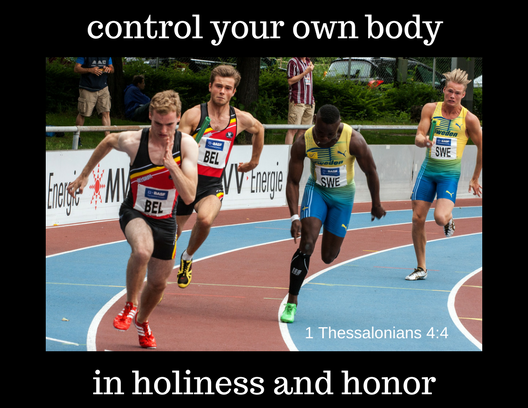
1Th. 4:4 that each one of you know how to control your own body in holiness and honor, 5 not with lustful passion, like the Gentiles who do not know God;
We wrote yesterday that the most important thing in making moral decisions is to know what God has said. The second most important is to exercise self-control. The first has an external source — what has God said? The second is internal — What does it mean to have self control?
Not everyone agrees with me, but I believe that in life, after being true to God, we must be true to self. That’s more important than anything else. That doesn’t mean, “if it feels good, do it.” the mantra of my generation, but rather, what is best for me as a one of God’s creation. Paul writes about moral decisions in these terms in 1 Corinthians:
1Cor. 10:23 “All things are lawful,” but not all things are beneficial. “All things are lawful,” but not all things build up.
This world says that we can do anything. Can we stop and ask, “What is actually good for me?”
I have worked with many people who have practiced the world’s view of sexuality, i.e., “I can do anything I want to do.” I truly love people who have been caught up in sexual sin, still see them as people for whom Jesus died, but I cannot say that their life choices have been good for them. Their choices have made them miserable, sometimes have even shortened their lives.
Making good moral decisions includes respecting ourselves and not hurting ourselves through bad choices.



 Seek Grow Love