
Micah 1-7

What does the Lord require of you_

Micah was a minor prophet who simply conveyed the truths of God to the people of Israel of his day and in just 7 chapters he spoke volumes! What I love most about his message was that he spoke of God’s judgement as well as God’s mercy.

His task at hand must have been very daunting to speak in a day of a divided nation (Israel and Judah) about their sins and the judgement of destruction it would bring on them. 

Chapter 1 speaks of their Idolatry and looting. (Vs. 6&7)  Chapter 2 refers to the schemes of the wicked oppressors and their evil plots and injustice to others. (1-3) Chapter 3 brings out that the leaders were corrupt and many were “paying off” false prophets to tell the people what they wanted them to hear. (Vs. 5)

Can we relate to a nation like this?

But in the midst of this we are told in chapters 4 and 5 of the Peaceful reign to come in “Latter Days”. Chapter 5:2-5 tells us of the baby to be born in Bethlehem and that this One (Jesus) will be our peace.   

How refreshing is that?

In Chapter 6 God speaks of all He has done for His people. His words apply to us today as well. He requires our faith and obedience to Him over our sacrifices. We are told that we cannot justify our own sins by living wicked and then offer burned sacrifices to obtain salvation. (Giving up your first born is mentioned.) Thank goodness Jesus is now our atonement and our way to salvation! (Vs. 6&7)

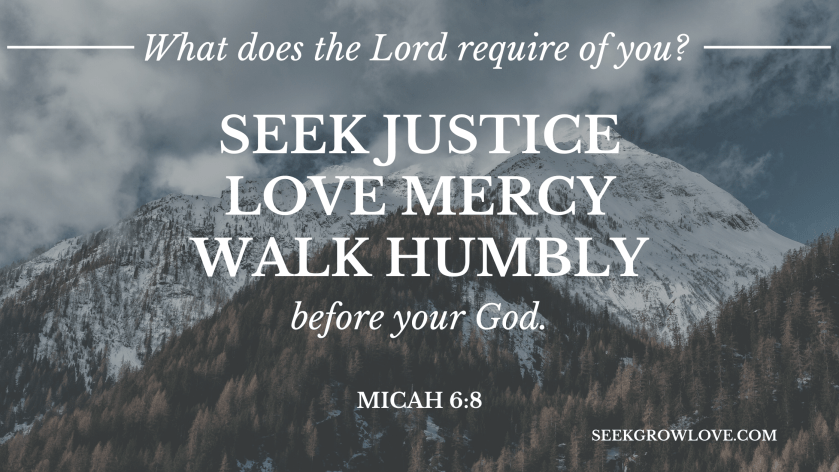
The answer to what God requires of us is found in the verse I would like to highlight today… act justly, love mercy and walk humbly with Our God (Vs.6:8).  Do we show love, kindness and walk with Him?

The acknowledgement of the Prophet himself is what we find in chapter 7. He reflects on the mercies of God and how God is our Salvation and Light. He is quick to forgive, if we truly repent, and we are redeemed by His unfailing love and compassion. He will be faithful to His Remnant. 

Thank goodness Micah bravely spoke truth in such a difficult day and time. The beautiful words we have from his message, along with Isaiah, Hosea and Amos’ as well, as they stood up for the ways of God despite the downward spiral of their society still speaks to us today.

Micah leaves us with the reminder that there is a final day of judgement coming for all the earth so we must stay faithful no matter what we are facing even in our uncertain present day. That false prophecy is ringing in our ears every day and we must ingrain ourselves in the truths of God’s word and stand up to a society where many are turning away from God. Jesus is with us in the midst of this and we are to follow him and look expectantly for his return. Our God is faithful and will remember those who have remained true to Him just as He did all those before us and all to come. Most of all God expects us to ACT JUSTLY, LOVE MERCY AND WALK HUMBLY WITH HIM. May the peace of Christ be with you today.      

~ Donna L. Smith          


Today’s Bible passage can be read or listened to on Bible Gateway.

Tomorrow, we continue reading the history of Israel in 2 Chronicles 28 & 2 Kings 16-17 – as we continue the 2020 Chronological Bible Reading Plan


It’s Always Been About the Condition of the Heart

Micah 5-7

micah-6_8

Tuesday, April 18

The latter half of Micah includes passages about judgement, God’s frustration with the people of Israel, and a prophetic utterance about the future king of Israel coming from a tiny blip-of-a-town, Bethlehem. Among these three chapters, we will look at Micah 6.6-8. Despite a common misconception that the Old Testament is concerned solely about external obedience to Torah (the Jewish law) and that it says nothing about the heart issue, our passage speaks directly about the heart.

Starting in verse six Micah asks a rhetorical question, ‘What should I bring to God”? Should it be burnt offerings? How about yearling calves? What about a thousand rams! The answer is none of these. We can find a similar message in Hosea 6.6. Micah tells the Israelites plainly “He [God] has told you, O man, what is good” (Micah 6.8). What is good in the sight of God are not sacrifices and mere external obedience but exacting justice, loving kindness, and walking or obeying God humbly, all of which are impossible to do without a transformation of the heart. The remedy to the corrupted leadership in Israel we looked at yesterday is found in here in verse eight. Israelites, return to God with all your heart-fully devoted to him, upholding justice, loving kindness, and obeying God, this is good in the sight of Yahweh!

You and I can read this passage and think ‘silly Israelites of course God doesn’t want your sacrifices, he wants your heart’! However, just because we’re removed from the historical context, doesn’t mean we don’t struggle with the same problems. For example, some of you reading this may keep up with the ‘look’ of a Christian, yet have let your heart linger far from him. You attend church, youth group, and camps. You instagram your Bible readings and caption verses on your selfies. These are not wrong or bad, however, if this is the extent of your Christian faith, God is longing for something much deeper and significant. He wants your heart. Have you surrendered in your heart completely to the will of God and what he desires for you? In the words of Micah, do you uphold justice? Do you love kindness and see people as God sees them? And lastly, do you humbly obey and walk with God? We all can return to God in some area of our lives and give our heart back to him.

-Jacob Rohrer

(photo credit: http://www.godswordimages.com/wallpaper/gentleness/micah-6-8/)

The Responsibility of Godly Leadership

Micah 1-4

micah 1

Monday, April 17

            Micah, in line with his fellow minor and major prophets, has been given a message of judgment and warning. Micah is prophesying to the northern tribe of Israel. After king Solomon died, his son Rehoboam took over the nation of Israel but due to his poor leadership the nation split into two tribes. The northern tribe-Israel, and southern tribe-Judah. Micah’s audience is Israel-the northern tribe in the eighth century BCE.

Chapter three sheds light onto why judgment and wrath will come upon Israel if she does not change her ways. The rulers and leaders of Israel have led in a manner that is not in line with God and his standards and statutes. Instead of loving justice and hating evil, the present leadership have been accused of “hating good and loving evil” (Mic. 3.2). God had placed certain officers to lead his people, and the people in these positions were failing. Chapter three continues to say that leaders pronounced a judgment not based on truth but on bribery, the prophets would prophesy for money and speak falsely concerning God. Corruption was through the whole leadership and the victims of the corruption were the common people themselves.

In our world it’s not uncommon to see leaders fail and look out for their own interests before the interests of the people they’re leading. If you and I can be outraged with failed leadership how much more is God displeased and upset with his leadership when it fails? Whether we serve in an official leadership position at a church or Christian organization, or you’re a student leader at your school or church, you are a leader to someone. The best way to lead is to do it God’s way: pursue his heart and truth, practice servant leadership, stand up for justice, obey, and don’t be a coward with God’s truth. Leadership is something God gives and so it’s something he can take away if those whom he has called are not being faithful with it. We can see from Micah that God takes seriously a failure to obey God when leading. Are you being faithful with a leadership position God has placed you in?

-Jacob Rohrer