Shocking Stories from Sunday School

Old Testament: 1 Samuel 17 & 18

Poetry: Psalm 68 (day 2 of 4)

New Testament: 2 Corinthians 13

What are the stories you remember from Sunday School lessons? What videos did you watch or what murals were painted on the wall?

Jonah.

Noah. 

Zacchaeus. 

If you take away the cartoon animals, the talking vegetables (as much as I love them), and the flannelgraph, and describe the story as experienced by the people in the moment, they become traumatizing. Horrifying. Or, at the very least, shocking. 

A man devoured by a great water beast that digests him for three days. 

The world is covered in a flood that wipes out all life, causing them to drown as torrential rain falls from blackened skies and geysers shoot from the ground in every direction. 

You have been living your whole life obeying God’s law and waiting for the coming of his Messiah, and instead of him coming to your home, he chooses to spend his time with the short, traitorous Zacchaeus and his rag-tag group of ne’er-do-wells. 

Traumatizing. Horrifying. Shocking. 

The story of Goliath is similar. It’s not about a piece of broccoli with gourd brothers who sings to an asparagus and a giant pickle; it is about a young man who is ready to kill an enemy because he dares defy the army of the living God. 

The story is not funny or fun; it is awe-inspiring. 

David looks into the eyes of his enemy and says “This day the Lord will deliver you up into my hands, and I will strike you down and remove your head from you.” (17:46)

What strikes me is this: we should be careful before we sanitize the Bible. 

The Bible is not a list of propositions to believe, they are stories about the past of a nation and their encounter with the living God. 

Bible stories, moreover, are not nice, or clean, or simple. 

Characters are rarely one dimensional. 

Good characters do bad things and bad characters can do good things. 

Rarely do those good or bad things fit nicely into our models of morality; David was a man of bloodshed and war and a man after God’s heart. And Jesus said “love your enemies.” That’s not clean or simple.

The Bible, this amazing library of sixty-six books that teach us about the God of the universe and his amazing interaction with people who are looking for him, is not a book that is *given* to children. Jesus does love the little children of the world, but the stories of scripture are meant to be read, understood, questioned, and applied by mature, wise disciples of Jesus. 

The Bible is a big book, and the stories of the Bible grow as we grow.

We shouldn’t lose sight of what we learned in Sunday School; but the stories of the Bible go far beyond Sunday School, and can impact all aspects of our lives. 

-Jake Ballard

Reflection Questions

  1. Sunday School Stories: As you read the stories of David and Saul, how often are you thinking of the “sanitized” versions from Sunday School? Of course, we shouldn’t tell toddlers about the slaughter of the Philistines, but the story of Goliath is grim; God isn’t pleased with Goliath or the Philistines. Should we shy away from the judgement of God because it makes us uncomfortable?
  2. Encountering God: When you are being honest with yourself, do you want the Bible to be simple, clean, or nice? Do you *want* the Bible simplified, or do you *want* the Bible to be the complicated, holy, challenging collection of books that it is? 
  3. A final thought: The Bible can be understood by someone who knows nothing about it. However, someone who knows nothing about the Bible also wouldn’t have WRONG ideas when reading it for the first time. Are we OK admitting that we might be bringing wrong ideas to the text when we read?
The “Dones”

Old Testament: 2 Chronicles 31-33

Poetry: Psalm 11

New Testament: 2 Timothy 1-2

It’s Friday.  Have you stuck with me so far?  We’ve tackled some challenging subjects this week.  Most of the subjects have had to do with things that lead us away from God- from fear to pride to greed.  So many things have the potential to turn our hearts away from God.  It can be disheartening at times.

We talked earlier this week about the fastest growing religious group in America, the nones- those who say they have no religious affiliation or faith.  Today, I want to address another group, the Dones.  The Dones are people who have been highly committed believers, perhaps very active in Churches and ministries who have gotten to a place in their lives where they are just done.  Maybe they are a pastor or Church leader who has poured out their life and energy into helping others and then experienced resistance or mistreatment, or other forms of suffering and they simply said “I’m done” and walked away from their ministry or their church.

I know.  If you are a committed leader in the church and you get frustrated by people who treat you badly, it’s tempting to give up and say I’m done.  These people aren’t necessarily abandoning their faith in God to pursue a sinful lifestyle of adultery, drunkenness or debauchery.  They simply quit gathering with other believers in worship.  They might pray and read their Bibles in the comfort of their living room or back porch, but they aren’t in the fray with their sleeves rolled up active in ministry any more.  They are frustrated, depleted, disillusioned and disheartened and they are done with ministry or church or religion.

A couple of today’s texts address this.  Psalm 11 addresses the challenge of disillusionment in the people of God.  It asks the question: “When the foundations are being destroyed, what can the righteous do?”  Some Christians have worked hard to help build the Church, make disciples and take a stand against sin and unrighteousness in the world, but as we look at what’s happening, the world seems to be winning and the Church is losing ground.  We are seeing some of the foundations of basic morality crumble – basic issues of what is right and wrong, what it means to be a human person as a male or female created in the image of God, the meaning of the covenant or marriage and family – all of these basic elements of faith and life are being contested and undermined.  The very foundations of society are being undermined right before our eyes.  It’s easy to become disheartened and give up.

Psalm 11 says: “How then can you say to me, ‘Flee like a bird to your mountain.’”  In other words, the temptation in the face of all of these attacks against the Church and God and morality and our ministry could be to simply fly away like a bird to the safety of the mountain, far from the battle.  Go stick your head in the sand.  Give up. Become apathetic about religion or God or the Church and ride the clock out.  Or throw yourself headlong into achieving worldly pleasure or success (see yesterday’s devotion on money and happiness.)

Psalm 11 gives this following reminder when the temptation arises to fly away.

“In the Lord I take refuge.”  Our refuge is in God, not in running away to safety away from the battle.  Remember our reminder from earlier this week when God sent his prophet to Jehoshaphat- “The Battle belongs to the Lord”  Let us take refuge in God, but let us not run away from the battle.

“The Lord is in his holy temple; the Lord is on his heavenly throne.”  Trust that God is still there.  God hasn’t gone anywhere.  God hasn’t abandoned us and flown away, he’s there, he’s watching, he’s engaged and he’s working his plan through us, through the church, through the proclamation of the gospel.  We can keep doing what we are called to do because we know that God is still on the throne.

“For the Lord is righteous, he loves justice; the upright will see his face.”  God cares about what is right and just and good and that day will come when we will be at rest and peace.  In the mean time, we may experience our share of suffering while we serve God.  But we trust that the day is coming when we will see God’s face and receive our full blessing.

And just a word from the reading in 2 Timothy.  Paul uses the word suffering many times in this reading.  Paul knew a thing or two about suffering.  Much that he wrote came while he was sitting in a prison cell somewhere suffering because of his faith in Jesus Christ.   For Paul, suffering was not something to be avoided at all costs but the price of doing business as a disciple of Jesus.  Paul wore his suffering as a badge of honor.  He considered it a privilege to be able to suffer while serving Jesus in ministry.  I admit that I haven’t quite hit that level of faith yet.  I’m not a fan of suffering and I don’t like it when my ministry efforts are met with resistance or failure.  I don’t like seeing people that I tell about Jesus reject Jesus or see formally faithful FUEL attenders or church members join the ranks of Nones and Dones.  But I do recognize that Jesus warned us that being his disciple in this sinful world has costs and challenges and can be painful.   After nearly 40 years of ministry, I have a few scars of my own.  But I’m not ready to fly away and join the ranks of the Nones and Dones.  I share Paul’s faith: “That is why I am suffering as I am. Yet this is no cause for shame, because I know whom I have believed, and am convinced that he is able to guard what I have entrusted to him until that day.” (2 Timothy 1:12)  I hope that you know him too and are convinced.  Keep yourself in the faith.

-Jeff Fletcher

Reflection Questions

  1.  Do you know any Nones or Dones?  Have you tried asking them to join you as part of an active faith community?  If not, will you?
  2. Have you ever been tempted to join the ranks of the Dones?  What has kept you from flying away?
  3. Are you in danger of becoming a Done?  What steps do you need to take to stay fully committed and connected to a body of believers?

Will it Be Okay?

Jeremiah 14-17

Jeremiah 14 19 b NIV sgl

I’ve been a pastor for 35 years.  As a pastor I’m often present for the happiest moments of people’s lives – when they get married, when they have a baby and want to have that baby blessed, when they give their life to Jesus Christ and are baptized, and when they celebrate great milestones like graduations, 50th wedding anniversaries and other joys.  I am privileged to “rejoice with those who rejoice.”

At the same time, I am also there during some of life’s most painful moments- when a loved one has died after a long illness, or suddenly in a tragic accident, when someone has just been told by their spouse that they want a divorce, or when their child has been arrested for possession of illegal narcotics.  I am there to weep with those who weep.

When people are going through the most painful or difficult challenges of their lives- when they are waiting for a loved one in major surgery, or for the test results to come back, I try to help them and provide a voice of calm assurance.  “It’s going to be okay.”  And of course, I want it to be okay.  But to be honest, sometimes it’s NOT okay.  Sometimes people don’t make it through surgery.  Sometimes couples don’t reconcile and marriages aren’t saved.  Sometimes test results come back and it’s bad.  Sometimes prodigal children don’t come back home, or back to Church or back to God.

Let’s be honest, 2020 sucks!  Covid-19 has killed a lot of people and has a lot of people scared.  A lot of people are out of work and the economy has tanked because of it.  A lot of people are scared to go anywhere including church.  For a time many states told people they weren’t allowed to go to church – what’s up with that?  And in the midst of that we’ve also had racial protests (or sometimes riots), murder hornets, great white shark attacks and now for more fun – its hurricane season.  Some people joke about, “What’s this month’s plague going to be?” but it’s getting to the point where it’s no joke.  Something’s going on.

The caring pastor part of me wants to take you by the hand and say “it’s going to be alright.  We’ll get through this.”  But can I be honest for a minute?  I don’t know that for sure.  For all I know Covid-19 could get a lot worse.  Or the vaccine they make to cure it could turn us all into vampires.  (Just kidding, I just watched the movie I Am Legend where the cure for cancer turned almost everyone into vampires.)  You get my point, I can’t guarantee that in a few weeks or months it’s all going to get better… it might not.

Can I be more honest?  God may be really angry right now.  “Oh, now Pastor Jeff we don’t believe in an angry God anymore- that Angry God of the 18th and 19th century has been replaced by a much more liberal and chill God, haven’t you heard?”  Well, I hate to break it to you but there’s only one God.  The God we worship today is the same God who was around in 600 BC when Jeremiah was walking around on the earth.  It’s the same God who got so angry with Israel for years of unfaithfulness that he sent a drought.  Yep, no water.  He’s the same God who said I’m going to call your neighbors to come and go fishing and hunting… for you, Judah.  It’s the same God who told Jeremiah that all the prophets who were out there telling everyone “It’s all going to be all right, we’re gonna get through this together” were spreading “fake news.”  They were false prophets telling people it was all going to be okay, when clearly God was not done smiting His very disobedient nation.

Make no mistake about it.  America has changed a LOT in the last 50 years.  It’s changed a lot in the last 10 years… or even 5 years.  Things that for a long time everyone agreed were bad, wrong, sinful have been declared ok.  Things that God used to say were important, like getting married BEFORE you have sex, and being faithful to your spouse after you get married, those kinds of things aren’t so important now.  Protecting the lives of the unborn, those aren’t so important either.  In Psalm 139 David says that God is the one who, “knit me together in my mother’s womb” but now it’s okay if the woman chooses to murder that unborn baby.  (“Pastor, you don’t sound very nice anymore, I don’t think I like where this is going?”)

I’m telling you the truth because I love you.  Don’t just listen to me, go back and read the actual verses in Jeremiah 14-17.  God was angry.  God told Jeremiah to tell the people “don’t even bother to pray to me for help right now, because I’m not helping you.”

Now, don’t get me wrong.  I believe that God is love and that everything God does is because of His great love for us.  That’s why he sent His Son to rescue us from our sinful ways.   God wants to rescue us from our sinful ways.  What we are doing collectively is WRONG.  It is hurting us.

I read an interesting article recently.  So called progressive elites, those liberal professors who say that traditional morality is bad or outdated, those who say that people should be free to do whatever they want.  Yeah, those people, the highly educated, the elites, the 1%.  They aren’t the ones having babies out of wedlock and whose children are being shot by gangs or dying from opioid addiction.  Those people who are “successful liberal elites” actually get married, then have children, work hard, live in good neighborhoods and do the kinds of things that actually lead to successful lives.  The people who suffer from living in a society that has tried to do away with God and with Biblical morality are actually the poor, the uneducated, those without power and privilege.   What we need to be telling people is the truth.  If you want to thrive and live a flourishing life you should do things the way God says to do it.  Adopt God’s values and live by them.  Turn away from evil.  That’s how you thrive.

Now, after telling Jeremiah that he won’t answer their prayers and things are about to get really bad for them, God does offer this hope.  After all the punishment is over, after the exile has passed, after you have repented and you’ve changed and are willing to start doing things the right way, I will take you back home and restore you and everything will eventually be okay.

So yes, ultimately, everything will be okay.  Someday God will restore this earth to its original state of perfection.  But first, God’s got to do some major housecleaning.  God loves you just the way you are, but he loves you too much to leave you that way.  God wants to make you to be like Jesus.  Follow Him. Turn away from your sinful ways – do not follow this world into judgment, follow Jesus into the Kingdom of God.

Pastor Jeff Fletcher


Today’s Bible passage, Jeremiah 14-17, can be read or listened to at https://www.biblegateway.com/passage/?search=Jeremiah+14-17&version=NIV

Tomorrow’s reading will be Jeremiah 18-22 as we continue seeking God and His Ways on our 2020 Chronological Bible Reading Plan

God’s Deliverance Begins – Again

Exodus 1-3

Exodus 2 3 NIV

I had fun with today’s reading; I laughed out loud numerous times. I’m going to try to recreate some of the internal dialogue that was playing out in my head as I read it. Enjoy.


“We need to be shrewd with these Israelites. What should we do? I have a brilliant idea! Let’s enslave them.” – The new Pharaoh, probably.

Shrewd: having or showing sharp powers of judgment; astute.

I’m not sure the new king really knows what shrewd means. I suppose he was astute in his observation that the Israelites are more powerful than he, yet he is not displaying great judgement in putting shackles on the people who got to their current position thanks to a very shrewd man named Joseph. As Egypt will soon find out, God is great at providing the Israelites with shrewd men who are capable of delivering them at just the right time.


“Murder all the baby boys. Do it for king and country, why else? What’s that? It’s immoral to kill babies? Why would you possibly think that?” – Also the new Pharaoh, probably.

The midwives are smart enough to lie to the king and tell him that they aren’t responsible for the lives of these children (as if a person could be considered “responsible” for someone else continuing to live). They claim that the women giving birth are just so skilled at it that they do not need the assistance of a midwife. That is quite a longshot. When is the last time you heard of someone giving birth to a child without the assistance of a professional? Yet the king is dull enough to buy it. He sincerely believes that these women have no concept of morality other than to obey the edicts of their government. The midwives feared God over their government and followed the commands of morality and God instead of the king.


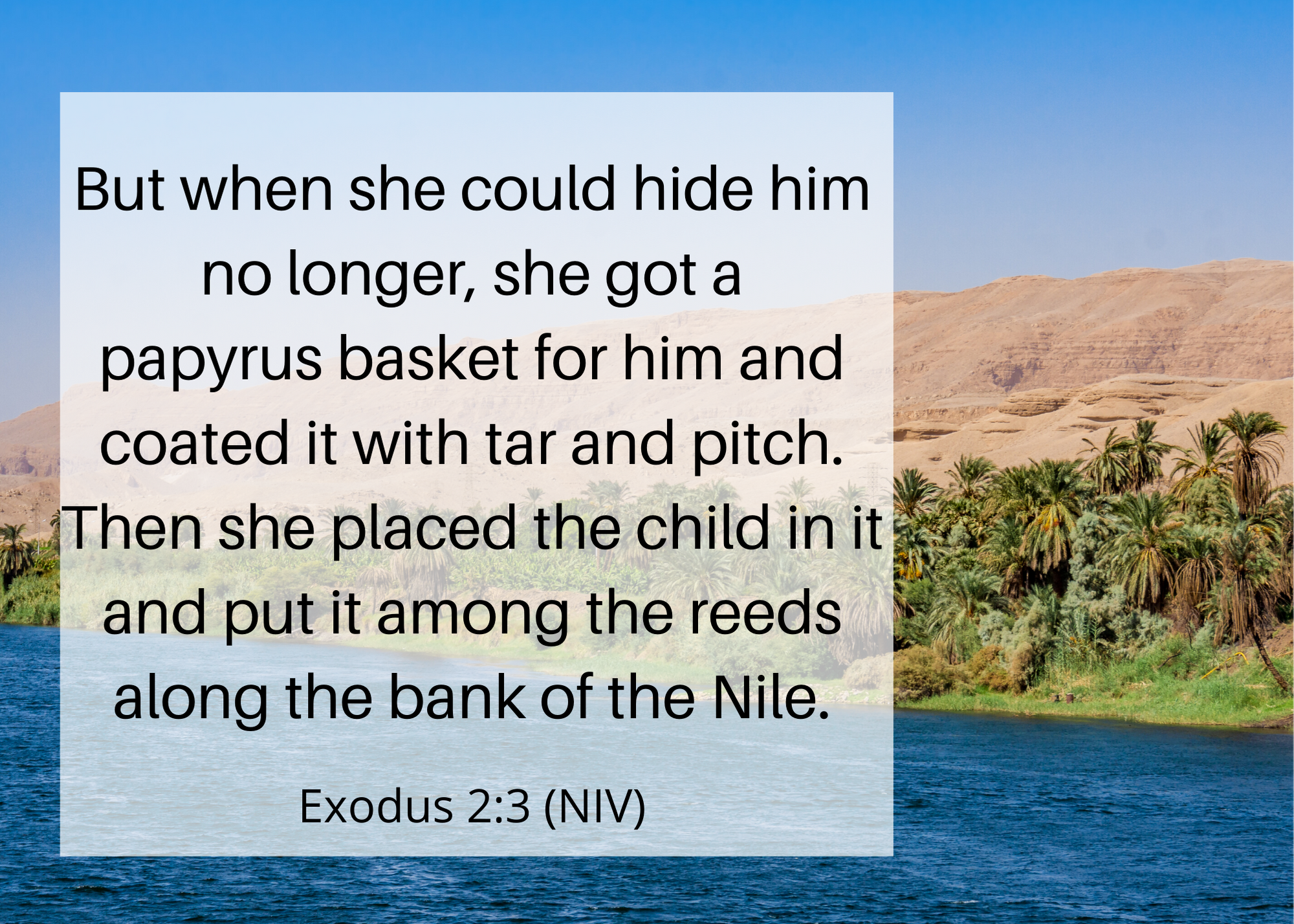
The mother of Moses saves him because she thinks he is beautiful. When is the last time a mother did not think their baby was beautiful? Every mother in this time must have been like her, attempting to hide their baby boys after seeing how beautiful they were. After all, the king made it the family’s duty to kill their own children. Moses’ mother was shrewd. She put him in a basket and set him out in the Nile, intending for him to survive. This sounds insane knowing what lurks in the Nile. She created the basket so that he would be protected, it was waterproofed with pitch. She placed it among the reeds so that it wouldn’t wash away. Finally, she had Miriam, Moses’ sister watch over the basket from a distance. His mother was certainly crafty. I believe she knew exactly what would happen next, otherwise she would not have done it. When Moses is found, his own mother is hired to raise him. That is the work of divine providence and the craftiness of Moses’ mother.


As a side note, the midrash states that Miriam had a significant role in leading Israel alongside Moses and Aaron after the Exodus. https://jwa.org/encyclopedia/article/miriam-midrash-and-aggadah


The bloodlust of Levi comes out in Moses when he kills the Egyptian.


The burning bush seems unique at this point in the story. In the past, God had interacted with people by sending messengers. Abraham speaks with God before the destruction of Sodom and Gomorrah. Jacob wrestles with God. Now we have Moses talking to God in a bush. It is a little different but this begins to be the pattern from here on out. We soon get the pillar of fire and cloud (which appears over the tent whenever Moses speaks with God), and the mountain covered in cloud when Moses receives the law. Later God identifies himself in a new way. He gives himself a name “I AM WHO I AM” or “I AM THAT I AM” which is the translation of the Hebrew YHWH. Up until this point, He has always identified Himself as “The God of your fathers, Abraham, Isaac and Jacob.” This encounter seems to be a turning point in the human story. From now on, a large group of people is going to interact with God in a personal way, they will address Him by name and they will be in close contact with Him.


Nathaniel Johnson


Today’s Bible reading can be read or listened to at https://www.biblegateway.com/passage/?search=Exodus+1-3&version=NIV


Tomorrow’s reading will be Exodus 4-6 as we continue the 2020 Chronological Bible Reading Plan

Where’s the Truth?

John 17 17


Building off of what a very wise woman shared yesterday in this same FUEL Bible Reading blog, I would also like to focus on the truth of the Bible.

This is what I appreciate most about God’s word. We can trust that it is true.

Culture, morals and laws are always changing. Things that were once taboo, largely in part because of God’s word, are now celebrated. How can we know if those things should be accepted morally or not? God’s word.

Many scientists believe that the entire universe exists only because of an accident, billions of years ago, and that each one of us is a result of billions of small built-up accidents over the last several hundred million years. In other words, there is no purpose or thought behind our existence. How sad is that sentiment? How can we know how we were created and if we truly have a purpose? God’s word.

There are many today that say that once you are dead, that is the end of your existence, and thus, we have no hope for a better future. And there are any numbers of world-ending scenarios that exist as well. But how can we know what our future truly holds? God’s word.

Truth, in the secular world, is always changing, always “evolving.” What is “truth” for one person may not be “truth” for another. That should clearly reveal that at least one person’s “truth” is not truth at all. We obviously need to all have a standard of truth when it comes to such things as morality, our origin and purpose, and our future hope. Thanks be to God that He was so wise as to have others write down and keep for all time the truths of His word.

How can we know that scripture is true? Proverbs 119:160 says that all of God’s words are true. Jesus confirms that God’s word is true in John 17:17. And we can know that Jesus does indeed exist and that God’s word is indeed truth because it has stood up under historical scrutiny, it has correctly predicted hundreds of specific prophecies, and as Hebrews 4:12 says, “…sharper than any double-edged sword, [God’s word] penetrates even to dividing soul and spirit, joints and marrow…”

As yesterday’s devotion pointed out, we need to constantly be in God’s word so that we KNOW the truth that it contains. This is both for our benefit, and for others that we can then share that truth with, as God’s word instructs us. I encourage you to begin and end each day in God’s word, so as to not be swayed by the untruths of this current age.

-Greg Landry


Today, we are pleased to have Greg Landry writing on the importance of God’s Word.  Greg and his wife Susan (who wrote yesterday) are active in many ministries.  Greg has a great passion for researching and teaching on the lies of evolution.  His website, https://onegodsixdays.com/, offers readers many opportunities to become better informed on this important topic, which has sadly become a great stumbling block for many young Christians.  Susan has a great blog (https://thesparrowshome.com/) with a good variety of content for faith, family, food, games and homeschool. She has also started a website called http://onelegacy.net/ where she works to provide resources for Biblical Unitarian homeschoolers, families and churches working to actively instill a Godly worldview in their children.  Greg and Susan are a delight as they love and apply God’s Word in their own lives – and help grow that love in others.

Guard Your Heart – Prov. 4

Hello, and welcome to Thursday!

I hope your week is going well, and I’m so glad you’ve decided to stop by and read this today.

This week we have been reading the first chapters of Proverbs, one chapter each day this week. Today we will be reading chapter 4. Throughout this week I have been talking a lot about wisdom and some of its different facets. I’ve also talked about its importance in our lives as Christians. Today I will again, be talking about wisdom. I will be focusing on how and why we should hold on to wisdom and treasure it.

heart guard The first part talks again about how wisdom is taught by parents and passed down from generation to generation. Wisdom and knowledge are gifts given to us by those who have lived or existed before us. Chapter 4:4 “Then he taught me, ‘Take hold of my words with all your heart; keep my commands, and you will live.'” This is the reason we are taught by our elders; so that we may live. This is why we are taught by religious leaders, and our parents, so that we may live.

I really want to focus on the last few verses of chapter 4, which say, “Above all else, guard your heart, for everything you do flows from it. Keep your mouth free of perversity; keep corrupt talk far from your lips. Let your eyes look straight ahead; fix your gaze directly before you. Give careful thought to the paths for your feet and be steadfast in all your ways. Do not turn to the right or the left; keep your foot from evil.” Proverbs 4:23-27.

You need to guard your heart because your heart should be the center of who you are, and who you represent. Your heart is very important, and everything you are, everything you share with other people, and how you share God’s love, comes from your heart, guard it fiercely. Keep your mouth free of perversity. Be careful with the words that you say, and remember that you represent our creator. Do not perpetuate lies that people tell you, do not get caught up in drama with friends or at school, or work, or at home, because all of them distract from what you are called to be. Look straight ahead- stay on the narrow path. Do not stray from God, call out to him if you feel yourself straying, he wants a relationship with you, and he wants you to let him be a part of your life.

Wisdom is more than just advice given to us by our parents. It is how we discern right from wrong, it is how we know when to ask God into our lives, (which is all the time). We know how to help people, and we know when we need to guard our hearts. Wisdom is a gift, but it is also a tool to help us in our faith walk.

Thank you for reading with us today, and hopefully, you will join us tomorrow.

God Bless,

– Jana Swanson