
*Leviticus 10-11
Psalm 10
Matthew 23
Devotion by Jeremy Martin (TN)
There are a number of cautionary tales in the bible. Whenever I see a few specific characters, I mentally always add “The cautionary tale of….” and that character’s name to remind me that while every single one of us has a purpose, sometimes that purpose is just to be an example to others of what not to do. The cautionary tale of Queen Vashti is one of my favorites (See the book of Esther), about privilege and responsibility. Today’s reading is one of those, “The cautionary tale of Nadab and Abihu”, and it’s always intrigued me as well, primarily because I’ve always wondered what “strange fire” was.
First, a little background. Aaron and his descendants were designated (by God, see Leviticus 8 for details on their ordaining) to be the priests of Israel, the men who would stand before God and offer propitiation for the sins of the nation. Aaron had 4 sons by his wife Elisheba (Ex 6:23), and Nadab and Abihu were the two oldest. Aaron was the “High Priest”, and had some specific duties that only he was supposed to carry out, and his sons were all priests. All of his descendants are priests as well, but it should be noted that Nadab and Abihu did not have any children so their younger brothers stepped up to fill their role after the events in today’s reading (Eleazar and Ithamar, as noted in Num 4:4 and later in Lev 10).
Keep in mind also that these newly appointed priests were just freshly put in the position, back in Lev 8. We then have to go back a chapter from today’s reading to get the pattern of what a normal ritual should look like, going back and reading from Lev 9:1-23 for the particulars, and culminating in Lev 9:24 when “Then fire came out from before Yahweh and consumed the portions of fat on the altar. And all the people saw it and shouted out and fell on their faces.” (LSB) . I think I’d fall on my face too, it’s a pretty amazing scene. It’s also pretty important to note that Aaron as the high priest was the one who was supposed to offer the sacrifices for the nation, as noted in Lev 9:6-10 and Ex 30:7-8.
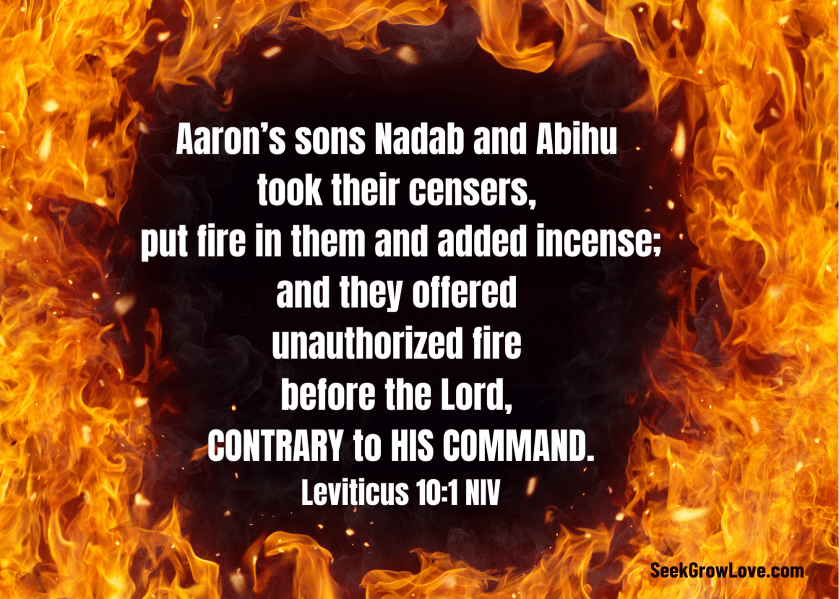
So, seemingly immediately after the miraculous fire coming out from before Yahweh and all of the people falling on their face, enter Nadab and Abihu, who “took their respective firepans and put fire in them. Then they placed incense on it and offered strange fire before Yahweh, which He had not commanded.” (Lev 10:1, LSB).. Then, as before, “fire came out from before Yahweh” but instead of burning up the offering, it burned up Nadab and Abihu.
So what is strange fire? I’ve honestly always wondered. Carefully dissecting today’s reading, there were probably a couple factors in their unfortunate demise. First off, it was presumptuous of Nadab and Abihu to offer the incense before God, since that was the job of the High Priest. Secondly, they used their own fire on the incense (Lev 10:1) instead of the “fire which came forth from Yahweh”. The word that we translate as “strange” fire could also be equally accurately translated as “profane” fire, by the way. This seems like a pretty cavalier attitude from a couple guys who just spent an entire week (Lev 8) preparing spiritually to enter the priesthood. Then Moses says to Aaron “It is what Yahweh spoke, saying, by those who come near Me I will be treated as holy, and before all the people I will be glorified.” (Lev 10:3, LSB).
While this was a bit presumptuous on Nadab and Abihu’s part, read on in Lev 10:8-11: “Yahweh then spoke…saying, “do not drink wine or strong drink…when you come into the tent of meeting, so that you will not die…so as to separate between the holy and the profane…” (LSB). It doesn’t seem likely that this was a random statement given the circumstances, but more likely a bit of preventative education from God for future priests. This seems to indicate that maybe they were impaired with alcohol as well, which might help to explain the (extremely poor) decision to offer “strange fire” on their own. There was more than one thing going on, it looks like.
What’s strangest to me in this story is that just prior to these events, both Nadab and Abihu were present with the 70 elders when God appeared to them in Ex 24:3-8. These are men that should have had an extremely healthy respect for the most high God. These are men that should have known with every fiber of their being that the Lord God Almighty is Qodesh (Holy, Set Apart, Seperated), and had seen with their own eyes the awesome and fearful power of the living God. These are men that were likely in line to be High Priests themselves, but because they did not separate in their minds and actions between the holy and the profane, the clean and the unclean, they died in a fire. They should have known better.
When we approach our God, we need to make sure that we are not offering strange fire. We should be sober (1 Pet 1:13) and focused. We need to separate in our mind between the clean and the unclean, the holy and the profane, before we approach the altar. We need to purify ourselves. Consider for a moment a tiny ant, and your relationship with it comparatively. Our role before our Creator is infinitesmally smaller than that, comparatively. When we pray, when we seek God, we need to understand that this is the most important and critical moment in our existence, every time, and not a casual conversation: we are approaching the Lord God Almighty, the Creator of heaven and earth, the master of all life who sustains us with His breath (Job 34:14-15) and we should tremble. Approaching the Lord God Most High is not something that is to be taken casually or lightly, but with awe and reverence.
Since God has sent us his Christ, we no longer need to make ritual sacrifices, the sacrifice has been made once and for all. The sacrifices that we need to make, the sacrifices that our God desires from us are righteousness (which can also be translated as “equity”), and obedience (1 Sam 15:22). We need to reflect the amazing and awesome character of our God, and love Him with our whole heart, as well as loving the rest of His creation as much as we do ourselves (Mark 12:29-31), just like He has loved us. Jer 29:13 says “You will seek me and find me when you search for me with all your heart.” (LSB). If you go seeking inappropriately and offering strange fire, be very aware that instead of finding God, God might find you. Don’t become a cautionary tale.
REFLECTION QUESTIONS
- Lots of times when we pray, we basically just present God with our “to do” list. Do you pause for a few moments and consider the level of interaction between a single tiny human and the omnipotent Creator of all things in the universe before you pray? Every time?
- When you open your Bible to read it, do you pause for a few moments to wonder at the amazing grace and love of the Lord God most high who has given you His words as a guide, tiny human?
- Do you seek fully to know your God with the attitude of an unworthy servant seeking their hardest to please their master? All the time, or just on church days?
- Consider for just a moment, every day, what am amazing God we have. It should melt your heart. He sent His own son as a sin offering, to cut a covenant with us. What are you going to do to show God how much you love Him back, today?
PRAYER
Father God, my Master and my Creator, forgive me, heal me, and teach me. I am an unworthy servant. You are wonderful and beautiful, and greater than all. Help me to be a servant who pleases his master. I was not worth the price You paid for me, have mercy on me Lord God. Help me to love as You love. Grant me your spirit, and teach me wisdom so that I can please you. Thank you heavenly Father, in Jesus’ name, Amen.


 Seek Grow Love