Can anyone guess what Piglet from Winnie the Pooh, the Lion from The Wizard of Oz, and Gideon from the Bible all have in common? Think as you scroll for the answer…
.
.
.
.
.
.
.
.
.
They are all famous for being fearful. What a fantastic claim to fame.
(…But honestly, that trio of cowards reminds me a lot of myself. How about you?)
In Judges 6, we find that the Israelites turned away from God again (no surprise there!) and were being severely oppressed by the Midianites. Their behavior kind of reminds me of school bullies times a thousand – school bullies steal your lunch; Midianites crushed their crops. School bullies force you to hide in lockers; Midianites drove the Israelites off their land to hide in caves. Starving, homeless, and desperate, the Israelites again cried out to God for someone to save them. So, God sent his angel to the most unlikely warrior: Gideon, the self-proclaimed least member of the weakest family in his clan.
The chapter opens to the scene of Gideon hiding in a winepress while threshing the wheat (to keep it away from the Midianite bullies, of course). Ironically, the first words the angel of the LORD said to Gideon were, “The LORD is with you, Mighty Warrior!”
I’m sure Gideon looked around to see if the angel was talking to someone else. Gideon, a mighty warrior? Gideon was full of questions, concerns, and doubts, asking for verification that he understood correctly that God had called him to defeat the Midianites. His first assignment was to tear down the idols (which Gideon did under the cover of night, of course, because he was afraid). Through sign after sign after tiring sign, God reassured Gideon that He really had called him to conquer Midian. Finally Gideon gained the courage to attack when he overheard a conversation among Midianites about their premonition that Gideon was going to conquer them. So Gideon’s miniscule militia, armed with (oddly enough) trumpets, jars, and torches, conquered the Midianites. There is a bit more conflict and idolatry in chapter 8, but overall, God’s people experienced 40 years of peace.
Gideon was not afraid to question God and ask for reassurance. God knows what we are feeling, and He wants us to bring our questions before Him. God was faithful and patient with his servant, encouraging Gideon with inexplicable reminders of His plan. “But you, O Lord, are a God merciful and gracious, slow to anger and abounding in steadfast love and faithfulness.” Psalm 86:15
I doubt that anyone would have labeled Gideon a warrior at the beginning of this story; he was a most unlikely hero. But that’s one of the beautiful things about our God: He has a way of ordaining the underdogs to do His most important work and calling them for it even before they look the part. God saw Gideon not for the milksop he was, but for the mighty warrior he would be with God’s power. God sees the potential in us, too, and he loves to use us through our weaknesses to demonstrate his power (I Corinthians 1:26-31). As the angel in this story advised, just “go in the strength that you have” (Judges 6:14).
-Rachel Cain
Reflections:
What are some ways that God has worked through your weaknesses for His glory?
Bring your doubts and questions before God, and ask Him to reveal Himself to you. He wants you to seek Him!
Be encouraged to seek God even in your doubts by listening to this song.
Whenever I think of girl power, I envision caricatures of Deborah and Jael posing Rosie-the-Riveter-style in front of a tent, bloody peg in fist. Though this Bible story is a bit morbid, it is also bold and counter-cultural evidence of the power of God and his desire to use everyone for His glory.
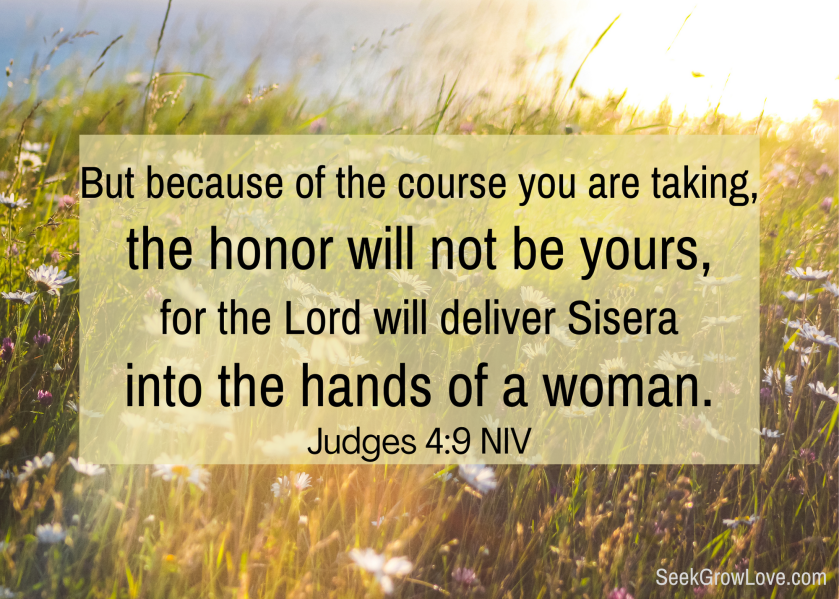
After Ehud died, the Israelites turned away from God, and they were oppressed by Jabin, the king of Canaan, for 20 years. Deborah became the Israelite leader during a time period in which not many women held high positions; she was not only a female judge in the same way other men in this book, like Othniel and Ehud, were judges/leaders, but she was also a prophetess and a judicial expert. God gave Deborah a message for military general Barak, guaranteeing him a victory against Sisera, the Canaanite army commander. Barak refused to go without Deborah, which could be a tribute to his faith in Deborah, a testimony to his lack of faith in God, and/or a confirmation of his general cowardice. Whichever it may be, Deborah agreed to go with the army, warning Barak that the victory for this battle in the historical record would forever be credited to a woman.
Barak’s army managed to fatally defeat every one of Sisera’s troops – except Sisera himself, who fled on foot to the home of Heber and Jael of the Kenite tribe (which was supposedly a neutral party, friendly to both Israelites and Canaanites). Jael greeted Sisera with exceptionally devious hospitality: when Sisera asked for water, she instead gave him a skin of comforting milk to help him rest well. Once Sisera was fast asleep, she sneaked in as stealthily as a prowling cat and drove a tent peg through his head into the ground, thus practically emancipating the Israelite people from King Jabin.
But really though, shouldn’t Jael have just stayed in her lane? Why would she rock the boat when her tribe was at peace with both sides? I mean, it was probably common knowledge that the Canaanites were oppressing the Israelites, but since she was neither, it didn’t really affect her, right? Why should she do anything to help one side or hurt the other?
Perhaps Jael had heard rumors of the power of the Israelites’ God and didn’t want to be on their bad side. Or maybe she just had a sense that the Israelite/Canaanite relationship wasn’t right, and if she were in the position of the Israelites, she would hope that someone would come to the rescue, too.
We aren’t privy to Jael’s thoughts, but when Sisera sought refuge in her abode, Jael was thrust into a rather precarious position that forced her to choose sides. She was granted a unique opportunity to impact great change, an opportunity that literally fell into her tent. The stakes were high (pun intended)! So Jael chose to be brave, even though it could have repercussions for her family and tribe once Jabin got wind of her actions. She had witnessed injustice and chose not to turn a blind eye when it was within her power to do something. Jael deceptively entertained the tyrannical army leader in order to gain an advantage and help the Israelites.
Would I be like Jael, always ready to stand for what’s right even if I’m standing alone, even if it would cost me something? Or would I just mind my own beeswax and not get involved in things that don’t directly concern me, even though others are being hurt? As Christians in a first-world country, often we would rather spend energy complaining about minor inconveniences like Starbucks messing up our overpriced coffee than about serious issues that are going on in the world. Did you know that there are still people in the world suffering from starvation, lack of clean water or medical care, poverty further worsened by illiteracy, and political unrest that makes even simple daily living dangerous? Did you know that today there are more slaves than ever before? We envision all of that as happening across the ocean, but so much of it is right here under our noses. I live about 20 minutes from the intersection of two significant US highways, rendering it a major drug- and sex-trafficking hub. So much of this slavery and injustice is happening in our own backyards, and we all have a duty to do something about it. (I’m speaking to myself here too; I’ve been considering how I can get involved in the local movement to help this trafficking injustice.) We as collective Christians have neglected this duty to be involved in the world around us and contribute to change. It is so easy for us to stay in our comfy little church bubbles. But think back to the gospels for a minute… who did Jesus criticize the most – the biggest sinners or the religious leaders? Pharisees. Sadducees. The “most religious” people who ultimately cared more about their image than the One in Whose image they were created. Being Christians doesn’t give us permission to “look up at God” and away from the needs; it gives us all the more reason to see the world through “Jesus goggles” and intervene in practical ways (which James calls us to do). We can’t do everything, but we can do something.
In Deborah’s song of praise after this victory that led to 40 years of peace for her people, she sang a line that I have adopted as a personal mantra: “March on, my soul, with courage!” (Judges 5:21). Another term for courage and determination is moxie. Deborah and Jael were definitely women of moxie! I long to become a person of righteous moxie who fights the battles God calls me to fight, always depending on His strength.
“Deborah, the mother of Israel, and Jael, most blessed of tent-dwelling women. Did they ever even meet? Would they have been friends? This is beside the point, but still, I wonder. Living in a world where it seems like no one with any differences can get along, I wonder how two women, from such different worlds, ever came together to accomplish the same goal…. God uses the unlikely, the unexpected, and sometimes even the unsavory to deliver us and to crush the heads of his enemies. While his means of rescue may change, his promises remain permanent. So whether it’s by means of tent pegs through the head of an oppressor or nails through the hands of his son, we see yet again that we serve a God who never ceases to defeat his enemies so that his people, just like the sun, may rise in his might (Judg. 5:31).” (source)
-Rachel Cain
Reflections:
Listen to this song about being brave for God and consider how He might be calling you to be brave for Him.
Would you, like Jael, have risked everything to stand up to an oppressor? What are some situations today in which God might be calling you to be brave and stand up for someone else?
Look for opportunities to get involved with local organizations to help with needs in your area and with the work of our international missions organization, Lord’s Harvest International, at lhicog.com.
Pray for God to help you muster up moxie to initiate change with the injustices in the world.
The study of genetics is fascinating. I remember being rather annoyed by punnett square assignments in my sophomore Biology class, but as an expectant parent it was fun to guess the likelihood of our children bearing unique characteristics of my husband and myself (…and it is ironic that four children from the same DNA can be so drastically different!). One of our four children looks like my mini-me, while the other three possess more of my husband’s physical traits. Though two children seem to be a mix of our personalities, one child definitely inherited my introverted and cautious personality while another one is every bit as ornery as I hear his father was at that age. Unfortunately, I did not provide our children with the recessive gene needed to match my husband’s red hair, and I don’t think he’ll ever forgive me for it. Ha!
While some traits can be considered rare, one with which we are all probably familiar is the concept of dominant hand usage. Today, about 90% of the population demonstrates right-hand dominance, while 9% prefer to use their left hand and 1% are ambidextrous. This likely-inherited recessive trait of left handedness allowed our protagonist in today’s Bible reading to execute a most epic assassination to free the Israelites from oppression.
Yesterday, we read Joshua’s monologue in which he recited a battle cry for his people to remember the Lord and continually choose to follow Him; today, we read about how, after Joshua died, the next generation didn’t know about God and started worshipping the gods of their neighbors. Even after all the miracles that God had performed for his people, the collective generation dropped the ball big time and failed to teach their children about God. So… God got their attention by turning them over to their enemies.
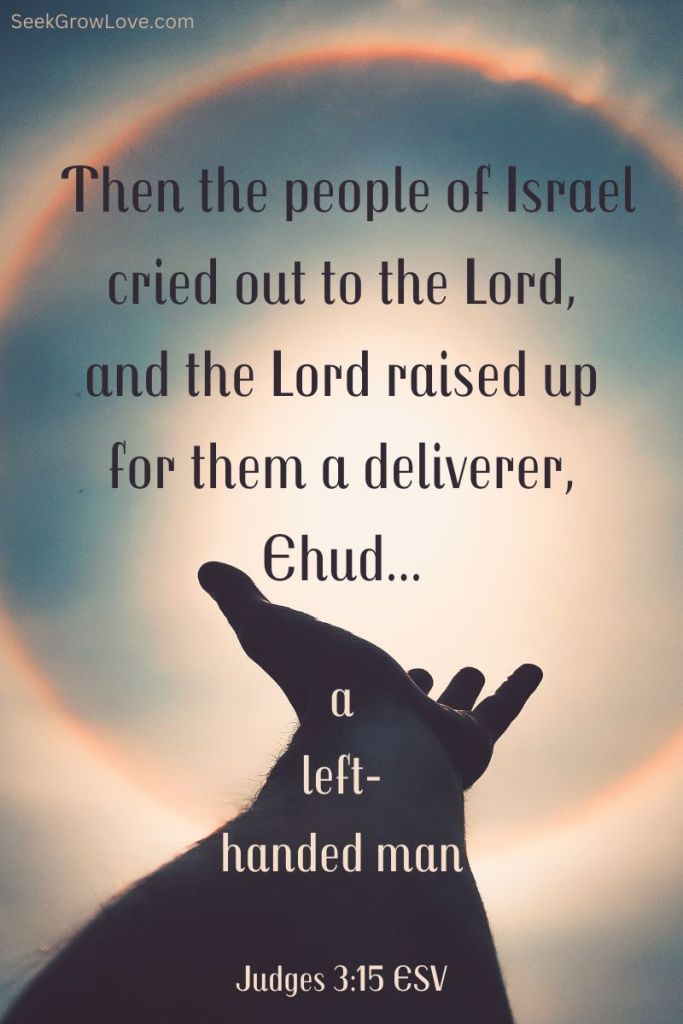
The Lord selected leaders (“judges”) to help guide the people in His ways, but the Israelites ignored the judges and continued worshipping gods, doing evil even more so after each judge died. So, the Lord gave the people over to their enemies. In Judges 3:14, we find the Israelites being ruled by Eglon, the Moabite king, for almost two decades. The people finally called out to the Lord to save them, and He sent them Ehud as their leader/judge.
The following verse specifically notes that Ehud was left-handed; God had a unique purpose for Ehud’s special trait. Ehud hand-delivered the Israelites’ tribute to the king, which was more or less a tax that the people had to pay as subjugates. In the days before metal detectors, the king’s security would check a visitor’s left side for weapons, since right handed people would sheathe a sword on their left side for ease of draw. Because Ehud was left handed, he would have hidden his sword on his right side, allowing him to pass inspection as an assumedly unarmed visitor. As he delivered the tribute to King Eglon, Ehud told the king that he had a secret message to share. The king, falling right into his trap, dismissed all the guards. Ehud seized his opportunity. Leaning in with a “secret message from God,” Ehud drew his clandestine sword and plunged it, hilt and all, into the belly of the obese ruler. (You can read all the gory details in the text.) Then Ehud locked the doors and escaped through the porch. The king’s attendants assumed that the king was “relieving himself,” so they “waited to the point of embarrassment” (a very long time!) before they finally unlocked the room to discover their gullible king dead on the floor. Their polite delay provided Ehud a nice buffer of time in which to abscond. Then the tables turned as the Israelites conquered Moab and enjoyed eighty years of peace.
The left handed trait might have been viewed as a peculiar weakness, but God used Ehud’s uniqueness to accomplish something great for His people!
-Rachel Cain
Reflections:
Do you have any traits that you thought were a flaw, but that God used for His glory?
The guy who made this “tableau” was simply trying to understand all world religions, starting with the Bible; similar to the way someone might analyze the words of a politician to see if they should vote for him or her. What I found fascinating is that if you focus on 1-2 Samuel, the word “Samuel” is used 126 times. The guy the books are named after only shows up that many times, and only a little bit after he dies. I also don’t mean he is *mentioned* after he dies, I mean he literally *shows up*. However, besides “Lord” there is one word used more than any other:
David. 484 times. “Lord” is only used 517.
Over the next two weeks, we are going to focus on the story of the kingdom of Israel and the earliest part of the story of their kings.
But today, as you read about Elkanah, Hannah, Peninnah, these baby-mamas and their baby-drama, it is important to set the scene for the next few books. The life of Samuel, born to Hannah and raised in the temple, was a time of transition. The people of Israel have been led for hundreds of years (something between 350-410 years) by judges. Judges were men and women who were divinely empowered to rule the people of Israel after they cried out to the Lord. And they ruled well. But the problem, as the Israelites will come to see it, is that Israel is not like the other nations. They wanted a king upon the earth, so that they could look like everyone else. But, in doing so, they rejected God, who was to be the only king who would reign over them.
So, through Samuel, God institutes the first kings of Israel. While this is not the path God wanted for his people (as we shall see), God, ever good and ever wise, allowed his people to make this choice and then used their choice, their rebellion, their sin, to be a way that he would show his glory. He took the people of Israel turning their back on him and worked it into his plan to bring about the Messiah. The judges ruled through empowerment, but the kings ruled through birthright. God indicated that the Messiah would be the child of King David. You have just finished reading Ruth, and God used this Moabitess in order to bring about the Great King of Israel, even the man after God’s own heart. God is in the business of using things we would never think to use in order to bring about greater things than we could ever imagine; he is an artist that strikes the canvas with a color that at first doesn’t look right, but with the right blending, the right technique, and the right eye, turns what seems to be a mistake into a work of art.
We have two weeks to cover 1 Samuel, the Kingdom of Israel, and King David.
Let’s begin.
Comparing Judges and Kings: While it’s true that God did not want his people to have a King (because they were rejecting God’s Kingship), the book of judges itself does not paint the kingship in a bad light. Read Judges 17:6, 18:1, 19:1, and 21:25. Why does the author use the specific refrain we read in those verses? What is the king implied to bring?
Faith History: Jesus’s family tree includes the neglected Tamar, the harlot Rahab, the Moabite Ruth, the survivor of assault Bathsheba, and the many murderers, liars, cheats and swindlers that make up everyone’s family tree. What stories about your history can you bring to the foot of the cross because it doesn’t define you? God does not care where you came from, only the faith you have today.
Personal History: While it should not cause us to misbehave on purpose, it is an encouraging thought that God can take even our mistakes and use them for our good. What are parts of your life that you would like to forget? Parts that when you tell your story you leave out? The power and goodness of our God and the love and grace of Jesus means that even those parts can become cause for joy about what God has done in spite of our evil, or the wickedness or brokenness of the world.



 Seek Grow Love