Our Week of Unity

IMG_0272 (1)

I’ve enjoyed writing this week’s devotions and sharing with you Paul’s words on unity. Today I want to recap what we’ve learned and encourage you to start living out these ideas in your own life.


I began this week talking about the conflict-ridden times we are living in and the fact that the Church is not immune to divisiveness. The church has struggled with unity since its inception, but this isn’t how it should be. Paul wanted unity for the church in Philippi—he said this would make his joy complete. Unity is also what is needed in every church today. This is why we should pursue it.


On Monday, I said that to be unified we must be striving towards the same idea—to be of same mind. And the idea around which we should be unified is living out the Gospel. This should be our singular purpose in life and everything else should pale in comparison to it.


The next day we moved to Paul’s advice on the way towards unity. Humility, the lowering of one’s self and self-interests, is how he says we should go about achieving unity. Our agendas should be subject to God’s. Paul pointed to Christ as the prime example of living in humility and subjecting oneself to God’s will. We must follow Christ’s pattern of humility if we are to have unity in our churches.


On Wednesday, we learned about four enemies of unity and why they’re so destructive to churches. The first is pride, which promotes self-interest instead of the Gospel. The second is gossip, which divides people by pointing out others shortcomings without trying to help them. The third enemy is complaining. When we complain, we are saying that we think something is wrong, but we don’t care enough about the body to address the issue in the proper way. The fourth enemy to unity we see is argument, but not just simple disagreement. Arguments that are fueled by a desire to be proved right and arguments that are filled with bitterness instead of love drive churches apart. All four of these enemies are real dangers that we should fight against with love and humility.


On Thursday I spoke about our union with Christ and how essential it is to church unity. Union with Christ has two aspects: knowing him and being like him. In knowing him we must truly understand what he did, why he did it, and what that means for us. In being like him, we must strive to live as he lived, in subjection to the will of God and in the service of others. Christ is the head of the body; if we want unity in the body, we must be united with him.


Yesterday I spoke about Paul’s final advice for the Philippians on unity and four principles we can take from it. The first is of reconciliation. When two or more people in the church are divided, the church should work together to bring everyone back into unity. The second principle is about exercising gentleness. Just as Jesus was gentle when caring for those who were weak and needed special attention, the Church today needs that same gentleness in its ministry. The next principle is that we should live our lives worry free from the troubles that plague this age and that, when we do face struggles, we should bring them to God in prayer. The final principle we see is that we should fill our minds with things that are good instead of the rot that is a hallmark of this world. These four principles will go a long way towards promoting unity in our churches.


I hope you’ve enjoyed reading these devotions this week, along with the words of Paul to the Philippians. But we are not called to simply be hearers (or readers) of the word—we must also be doers. The words of Paul to the Philippians are challenging, but the results from following them would be life changing and paradigm shifting for the Church. If we want to see unity in the Church, we must start by applying these ideas in our own lives as individuals—living in humility, having the Gospel be our primary focus, and not gossiping, complaining, or arguing.


– Joel Fletcher

Four Enemies of Unity

Philippians 2:12-30

IMG-0276

Yesterday we learned about Paul’s advice for moving towards unity—having an attitude of humility. Today, I’d like to discuss some attitudes and actions that can hinder unity. These four enemies of unity that I will mention are just some of the obstacles that get in the way of the Church achieving unity. 

Enemy 1: Pride

Pride is the opposite of humility. In humility, we put ourselves in the service of others; in pride, we use others to serve our own purpose. It is an easy trap to fall into; pride catches those who do well and convinces them that this gives them cause to boast in themselves. It inflates their ego—giving them a reason to look down on others and view their own ideals as the be-all-end-all. When even just one person in a church body is infected by pride, it can have terrible consequences for church unity. This why Paul cautioned against boasting in one’s self and works:

“For it is by grace you have been saved, through faith—and this is not from yourselves, it is the gift of God—not by works, so that no one can boast. For we are God’s handiwork, created in Christ Jesus to do good works, which God prepared in advance for us to do.” (Ephesians 2:8-10, NIV)

Enemy 2: Gossip

There is no redeemable quality in gossip—it is a destroyer of friendships and communities. Gossip is broadcasting the shortcoming of others with no attempt to help them get better. It is a mechanism used to make the one gossiping feel better about themselves. Where gossip is present, unity cannot exist. The one being gossiped about is treated like an outsider and is pushed away from the community. Gossip is a unity killer.

“Do not let any unwholesome talk come out of your mouths, but only what is helpful for building others up according to their needs, that it may benefit those who listen.” (Ephesians 4:29, NIV)

Enemy 3: Complaining/Grumbling 

When we complain or grumble about something we don’t like, this is typically a sign we are struggling with pride and not embracing humility. If something is actually wrong, grumbling under your breath about it is not the way to go. Never will a good solution be found when it is brought to the attention of leaders through complaining. If we feel something is not being done the way it should be, we should humbly voice our concern to those in leadership after much prayer and meditation. Complainers don’t promote unity—those who genuinely want what is best for the church need to find the right way to address changes. 

Enemy 4: Arguing 

By arguing, I don’t mean mere disagreement, but an incessant need to be proved right (which also comes from pride). When a person goes around trying to convince everyone that their own views on various issues are right and then get angry when they’re not agreed with, it is not beneficial. We must always be striving to find the truth, but we must never do so in a matter that is unloving. Our discussions should be edifying and result in a more unified body; not filled with bitterness and anger which causes strife.  

“Do everything without grumbling or arguing, so that you may become blameless and pure, ‘children of God without fault in a warped and crooked generation.’ Then you will shine among them like stars in the sky as you hold firmly to the word of life. And then I will be able to boast on the day of Christ that I did not run or labor in vain. But even if I am being poured out like a drink offering on the sacrifice and service coming from your faith, I am glad and rejoice with all of you. So you too should be glad and rejoice with me.” (Philippians 2:14-28, NIV)

Each one of these enemies come about naturally from our human nature. We must fight against them just as we do with other sins. We must instead embrace humility, love, peace, and encouragement in order to promote unity and avoid these divisive enemies. 

If you struggle with any of these, start pushing them out of your life today. 

– Joel Fletcher

What to Do with Doubt

Mark 9:14-32 (Monday)

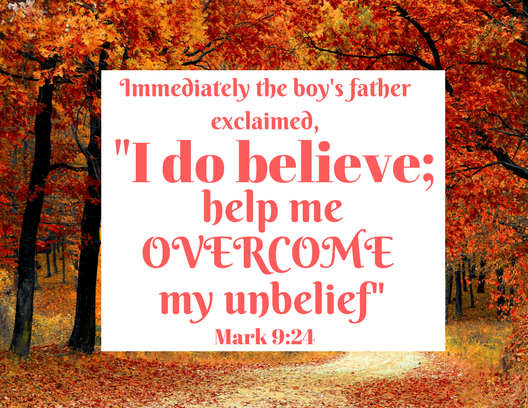
Mark 9 24

None of Scripture was intended to be read.  Although that may seem strange to us today, the ability to read was incredibly rare.  For today, it’d be like having a doctorate.  There are a number of professor’s out there, but you don’t run into them every day.  Reading just wasn’t something most people needed to be able to do to get through their day.  The agricultural and craftsman lifestyles didn’t need to keep many notes themselves.  As a result, the writings, when they were used, were usually read aloud in a collective setting – and this is key.  Because Scripture is meant to be heard – not read!  All those with EARS, let them HEAR.

Because of this, there weren’t any of the nifty little headings that we find in our Bibles today.  It was just one long story without breaks or chapters.  So, the nice breaks that we often get around stories didn’t exist except for the past few hundred years.  For today’s reading, both of these things are really important.

These two vignettes in Mark 9:14-32 (the healing of the child and the misunderstanding of the disciples) come back to back and would have been heard that way by Mark’s original audience.  So, what I’d like you to do is try it.  Take just a second to read these verses out loud. If you’re somewhere public, just try whispering if you want.  But read it out loud and see what sticks out to you.  I’ll wait here and I’ll do it too…

[waiting]

So, how was it?  Awkward? Weird?  Probably a little.  But when I did it something new really stood out to me about this passage.  In the first story, a man comes to Jesus asking for healing for his son. Jesus responds ‘oh you faithless people…how much longer do I have to put up with you.  Bring me the boy.’  The father, distraught over Jesus’ seemingly kinda cruel response, cries out – ‘I want to believe! Please help my unbelief!’  He wants to save his son and will do whatever it takes to save him.

The next story is between Jesus and his disciples.  He’s teaching them about what’s going to happen to him when he reaches Jerusalem.  But they don’t get it.  They don’t have belief/faith, just like the dad in the previous story.  However, instead of putting aside their pride and asking for Jesus to help their unbelief (lack of understanding), they stay silent.

Here, in these few verses, a man from “this faithless generation” reaches out, pleads, and finds Jesus meeting him in his unbelief while the ones who are part of Jesus’ own inner-circle remain unmoved in their faithlessness.  And this at a time when Jesus’s time with them was literally drawing short.

The problem with this is never unbelief.  The problem is how we respond to it.  We won’t have all the answers.  We will doubt and question.  Jesus doesn’t lament our struggle – it is one that he himself walked through (for he shared in all things but without sin).  Embrace the places where you are unsure.  Lean into the spots where the struggle is the most real and you are shaken like the son in the story.  Push forward and call out for a help, a grace that will fill us in our uncertainty and bring healing.

-Graysen Pack

Three Deep Breaths

PROVERBS 29

Proverbs 29-11

When reading Proverbs 29, I caught onto a theme of how to handle anger and frustration.  Verse 8 says that the wise turn away anger.  Verse 11 reads that the wise bring calm whereas the fool vents his rage.  Verse 20 instructs us not to speak in haste, verse 22 tells us that angry and hot-tempered people stir up conflict and commit many sins, and verse 23 warns against pride, which is often a precursor to anger and argument.

We all encounter trying situations.  We all have tense moments in which we want to scream into a pillow or go for a run or do whatever helps us to cool off.  Proverbs 29 instructs us to keep a cool head and turn away from anger.  I remember a scene from a movie or television show (although for the life of me, I can’t remember the source) in which a character is stressing out.  Another character instructs her to take 3 deep breaths, saying that in the time it takes to complete those 3 breaths, she will stop herself from doing or saying anything she may later regret.

At some point or another, we all get angry.  In these times, it is important to know how God instructs us to handle ourselves.  I had a classmate in college who would pray for the class before every exam.  She always ended her prayers by asking the Lord to keep us calm, cool, and collected during the stress of the exam.  Three deep breaths.  Calm, cool, and collected.  When on the verge of having an outburst, remember to be the wise man and bring calm.  Be wise and turn away anger.  Don’t speak in haste.  Lean on the Lord and His teachings, even in tense moments.  Three deep breaths allows for enough time to reflect back on these verses.

-Megan Bryant

Seek Not to Please Myself

John 6-7

john-6-35

Saturday, May 27

As I started reading John 6 & 7 a few key quotes from Jesus recorded in the end of John 5 were still ringing in my ears:

“For I seek NOT to please myself but him who sent me.” (John 5:30)

“I do not accept praise from men…How can you believe if you accept praise from one another, yet make no effort to obtain the praise that comes from the only God.” (John 5:41, 44)

Here Jesus Christ, the Son of God and Son of Man, was saying quite clearly and repetitively – it’s not about me.  He did not seek to please himself or earn the praises of men – his goal was only and always to please God and hear the praises of his Heavenly Father.

Chapter 6 begins with this same Jesus feeding the famished five thousand with five small barley loaves and two small fish – and ending up with twelve baskets of left-overs.  As the one primarily responsible for feeding my family of 5 three times a day, I have always been greatly impressed with this miracle!  And, he follows it up with walking on the water!  There is no doubt that this Jesus has just earned some serious bragging rights.

Instead, he turns it into a teachable moment and offers himself as the bread of life – the bread and body that must be broken for others to live.  This is what he offers to the world not because he is the one who dreamed it up, and not because he was looking forward to it, and not because he desired it – but because he knew he came, “Not to do MY (Jesus’) will but to do the will of him who sent me.” (John 6:38).

In Chapter 7 he continues, “My teaching is not my own.  It comes from him who sent me.” (7:16) and “I am not here on my own, but he who sent me is true.” (7:28).   While some wanted to kill him, others wanted to make him king.  And yet – none of that really mattered to Jesus.  He was teaching God’s Word and living – and later dying – God’s Will.  His one-track mind and life was centered on what his Daddy desired and had planned from the beginning of the world.

Two things seem clear.

First, Jesus was definitely NOT claiming to be God, nor did he desire to be considered as God in any way.  His repeated use of, “not me/mine…but He/His” were pointing out the differences – two beings, even though their purposes would be the same – at Jesus’ choosing.  Today, would I hold any credibility if I stated, “I do not seek to please myself, but only what I want?”  Or, if I said, “My teaching is not my own but it comes from me”, would people listen to me for long?  Over and over again, Jesus is drawing some pretty clear lines between His Father God and himself.  Two beings, united in purpose – because that is what Jesus chose – to follow His Father and not himself.

Second, how must I change my focus, my goals and my everyday life so that I, along with Jesus, can confidently say, “Not my will, but His be done,” “My teaching is not my own, but God’s.”  “I seek not to please myself, but my Heavenly Father.”  No doubt the Son of God set an example for us to follow.  It is a path that requires laying aside all selfishness and pride, as well as false teaching.    It is not an easy road.  But when we live our life to please God our Father, just as Jesus did, we won’t be disappointed in the end!

-Marcia Railton


(Photo Credit: https://dailyverses.net/john/6/35)

A Shift in Tone

Ezekiel 27-28

ezekiel 27-28 amber

Monday, March 27

Thanks to Rachel Cain’s devotion on Lamentations recently, we know that to lament means to mourn. Here, God tells Ezekiel to mourn Tyre.  To me, this looks like a shift in what we saw yesterday.  In our reading yesterday, God told the rebellious people not to mourn.  Here, God is calling for a season of mourning.


At the beginning, we see that Tyre was a great nation.  Some of the vivid imagery is displayed in the visual above.  Tyre is compared to great ship.  The ship is made of the finest wood and cloth; Tyre was a wealthy city who traded with many.


However, in 27:26, we see another tonal shift.  The east winds will come and break this beautiful, seemingly perfect ship into pieces.  Although I am by no means a Bible scholar, it seems like a fair assumption to say the east winds represent Babylon.  Tyre will be destroyed by Babylon, just like the nations foretold in Chapter 25.


We see this theme continuing in Chapter 28.  God tells Ezekiel in reference to Tyre, “Because you think you are wise, as wise as a god, I am going to bring foreigners against you, the most ruthless of nations” (28:6).  Here, it is evident that pride is once again an obstacle for Tyre.  Their pride blocks their vision of the True God; whether explicitly stated or not, through the actions of Tyre.


Application to our lives: Although we may not explicitly state we are a god, do we sometimes un-purposefully act as though we are? Do we act as if we are entitled to a life of abundance?  Do we let our pride obstruct the divine glory of God?  I know that I can act this way sometimes.  When I feel these emotions creeping up on me, I remind myself of my identify I have in Christ, not my identity I have built up in treasures on earth such as pride and wealth.  I think of the disciples and how they left everything to follow Jesus.  This seems to be a theme I keep coming back to in Ezekiel.

-Amber McClain


God’s DETEST List

Proverbs 14-16

10636599685_7baa6c27da_n

Wednesday, January 25

A phrase that is repeated numerous times in the Proverbs is “The Lord detests…”  It’s not just, “God doesn’t really like it very much when we ….”.   No, The Lord DETESTS!  I for one want to be far, far, far away from God’s DETEST List.  Sounds like we need some more information to know what to avoid.

— 15:8 – The Lord DETESTS the sacrifice of the wicked, but the prayer of the upright pleases him.
— 15:9 – The Lord DETESTS the way of the wicked, but he loves those who pursue righteousness.
— 15:26 – The Lord DETESTS the thoughts of the wicked, but those of the pure are pleasing to him.
— 16:5 – The Lord DETESTS all the proud of heart.  Be sure of this: They will not go unpunished.

My heart sinks.   Wasn’t it just yesterday I said my PRIDE leads me to believe I am usually right.  Perhaps I am inching closer to that Detest List than I would like to admit.  And, the dangers don’t end there – there are numerous other “The Lord DETESTS” throughout the Proverbs: haughty eyes, lying tongue, hands that shed blood, a scheming heart, feet rushing to evil, a false witness, a man stirring up dissension (6:16-19), perverse hearts (11:20), acquitting the guilty and condemning the innocent (17:15), and dishonest scales (20:23).  We are so comfortable with the warm and fuzzy “God of Love”, that we sometimes prefer to forget about the Lord DETESTS list.  So, while we are spending some time evaluating our mouth this week, let’s also examine our heart and deeds and attitudes and thoughts.  May we not become like the Pharisees, so proud of our “righteousness” that we lose sight of God and His many-faceted and always right –  love AND judgment.
Dear God – Help me to see myself clearly, as You see me.   Help me to grow in my understanding of You and what You desire of me.   Help me steer clear of ALL that is on your DETEST list and seek to please you always.

And, speaking of pleasing God . . . here’s just a sampling of some more great lessons from these 3 chapters of Proverbs . . .

On our Attitude

  • “A heart at peace gives life to the body, but envy rots the bones.” (14:30)
  • “All the days of the oppressed are wretched, but the cheerful heart has a continual feast.  Better a little with the fear of the Lord than great wealth with turmoil.” (15:15,16)

Contentment with what you have and what comes your way.  It is well with my soul – even if I don’t have what others do or what I thought I wanted.  Enjoy the feast before you – whatever it may be.

On Patience vs. Temper  –

  • “Better a patient man than a warrior, a man who controls his temper than one who takes a city” (16:32)
  • “A hot-tempered man stirs up dissension, but a patient man calms a quarrel” (15:18)
  • “A patient man has great understanding, but a quick-tempered man displays folly” (14:29)
  • “A gentle answer turns away wrath, but a harsh word stirs up anger” (15:1)

Watching our mouth is so much easier when we learn to think before speaking.  Slow down, simmer down – it will save you, and others, a lot of grief.

On Helping the Needy –

  • “He who despises his neighbor sins, but blessed is he who is kind to the needy.” (14:21)
  • “He who oppresses the poor shows contempt for their Maker, but whoever is kind to the needy honors God.” (14:31)

How can you honor God this week with an act of kindness to the needy?
God Bless You as You Seek Him,

Marcia Railton


(Photo credit: photo by Bob Smerecki, found at https://www.flickr.com/photos/snapnpiks0304/10636599685)