
It Changes Everything

Old Testament: Amos 5 & 6

Poetry: Psalm 130

New Testament: Matthew 16

In our reading today, we see these verses:

If you, Lord, kept a record of sins,
    Lord, who could stand?
But with you there is forgiveness,
    so that we can, with reverence, serve you. – Psalm 130

This was written back in the pre-Jesus times.  Yet even then, the writer speaks of forgiveness of our sins.  How much more is that available to us with the blood of Jesus to wash those sins away?  We can be so thankful that the LORD does not keep a record of our sins.  If He did, we could not stand.

Has someone ever done something to you that you hold onto and struggle letting go of?  Now I do think there can be wisdom in remembering things that are dangerous – say, you play a game of pool with your then-boyfriend, and he hits you with a cue stick in the face on accident.  Then maybe, when you play pool with your now-husband, you are a little extra careful to make sure you don’t get too close when he is lining up a shot. 

That’s a joking example, but there are times when serious hurt may be done, and we can learn from those instances so they don’t get repeated.  But learning from things and keeping a record of sins to hold against people is very different.  As you are reading Psalms 130 today, ask yourself, is there someone that you need to forgive or something you need to let go of?

Our New Testament chapter for today is Matthew 16 which is where Peter makes the big confession – identifies the truth – that Jesus is the Messiah, the Son of God.  If we too confess this, we can take part in the forgiveness of sins.

The Psalm continues on –

I wait for the Lord, my whole being waits,
    and in his word I put my hope.
I wait for the Lord
    more than watchmen wait for the morning,
    more than watchmen wait for the morning.

I don’t feel that I do a great job of waiting for the LORD with my whole being.  It isn’t in the forefront of my mind.  It is easy to live life with the focus not being on God with so many different things available to distract us.  How would my life look different if that was my main focus? 

We talked in a youth group class this year about how the good news should radically alter our lives.  It should infuse every aspect of it.  That thought came up again in a book I was reading related to parenting.  The gospel changes everything.  If God is my main focus, and I let the salvation that Jesus has made possible alter every part of my life, that includes how I interact with my children.  Parenting is what stood out to me in that, but that might not be where it hits you – maybe for you, you are struck that the gospel should change how you go to school, interact with your friends, work at your job, etc. 

If you want a song reminder of this Psalm, visit https://open.spotify.com/track/6A6GlReEZA0eG48K9yKK0J to hear a song written by Aaron Winner called “Wait For the Morning.”

~Stephanie Fletcher

Reflection Questions

  1. Is there someone that you need to forgive or something you need to let go of?
  2. How would my life look different if waiting on the Lord was my main focus? 
Grace That is Greater

Old Testament: 2 Kings 7 & 8

Poetry: Psalm 130

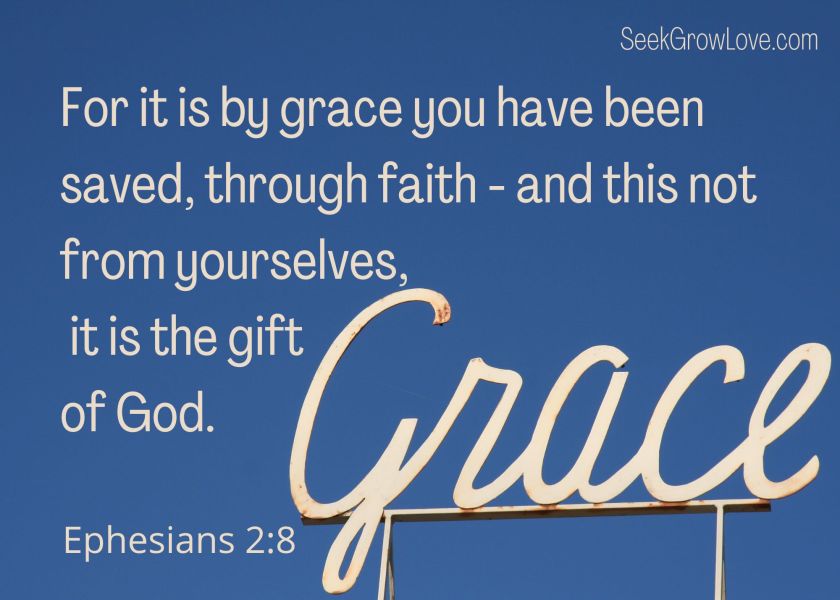
New Testament: Ephesians 2

“Out of the depths I cry to you, Lord; Lord, hear my voice. Let your ears be attentive to my cry for mercy.” Psalm 130:1-2

At the beginning of Ephesians 2, Paul terms the forces at work that draw us away and towards gratifying ourselves as the “Kingdom of the Air.” We hear the wind blowing from this kingdom as we see the work of countless groups that have formed today that are in direct opposition to God.  While these groups follow different threads, they each perpetuate this idea that gratifying your desire is a higher form of living and leads to a more fulfilled life.  This type of living isn’t enlightened; it is carnal.  The “air” is hot and it stinks, so it’s no wonder that this advice leads to a lake of burning sulfur. Yet at some point, we all were residents here.  However, with the waters of baptism, Christ moves us, sending an Uber (not a U-haul because our junk stays behind) and we have made our way out.

“If you, Lord, kept a record of sins, Lord, who could stand? But with you there is forgiveness, so that we can, with reverence, serve you.” – Psalm 130:3,4 

 “For it is by grace you have been saved, through faith—and this is not from yourselves, it is the gift of God— not by works, so that no one can boast. For we are God’s handiwork, created in Christ Jesus to do good works, which God prepared in advance for us to do.” – Ephesians 2:8-10

God doesn’t see our rap sheet, whether it extends feet or miles. He doesn’t care if we visited sin on the weekend, or if we had set up a mansion in the city center of a false kingdom.  Those who declare Jesus as the Lord of their life are covered in marvelous grace that hides the stain of sin.  This is not a one time deal, but a perpetual gift that will always outweigh our folly.  Grace isn’t earned through righteous acts, but it is the free gift of God received when we acknowledge the trespass, transgression, and unrighteousness.  We put to death the selfishness, and we become alive in Christ, ready to take on the mission which has been prepared by a loving Father. 

“Israel, put your hope in the Lord for with the Lord is unfailing love and with him is full redemption.” – Psalm 130:7

Moreover, we are called to show grace to others. While we don’t live in the past, we should remind ourselves of where we once lived.  We do so, not as a comparison, but to remind ourselves that we desperately need the grace of God, and additionally, have benefited from the grace extended by those who follow Him.  Jesus addresses the issue of grace in the Parable of the Unforgiving Servant, as a response to Peter’s inquiry about how many times we should offer forgiveness (Matt 18:21-35).  We cannot out love God.  We cannot out forgive God.  We cannot out grace God.  Like our Heavenly Father, let the stories we tell not be about the trespass, but let it be about the grace that is greater than sin.

“In him the whole building is joined together and rises to become a holy temple in the Lord. And in him you too are being built together to become a dwelling in which God lives by his Spirit.” Ephesians 2:21-22

-Aaron Winner

Reflection Questions

  1. Make a little comparison chart – Old Life of Sin vs. New Life in Christ. Use Ephesians 2 and your own personal experience. What does each look like? Characteristics of each? Ruler of each? Future of each?
  2. If you haven’t personally experienced new life in Christ yet, what is holding you back?
  3. What does God’s gift of grace mean to you? Today, how will you thank God for this gift? How will you show God’s grace to another?

NO Pit TOO Deep

Look UP!

Psalm 130

Friday, July 15, 2022 

                The comedic author Erma Bombeck once wrote a book entitled: “If life is a bowl of cherries, what am I doing in the pits.”  It’s a funny play on words using “the pits” as the antithesis of the good life.  The “pits” she’s talking about are not really cherry pits, those things you spit out after you have eaten the deliciously sweet cherry, but the pits of despair.  Webster’s Dictionary defines  “the pits”: “something that is very bad or unpleasant. You caught the flu on your birthday? That’s the pits! This rainy weather is the absolute pits.”

                You’re in the pits when things are going horribly wrong, or when you are feeling low.  You feel low when you are depressed, like there is something heavy weighing down on you.

                Psalm 130 is known as a penitential psalm (Psalm 6, 32, 38, 51, 102, 130, 143).  It starts out very low, “Out of the depths I cry to you, LORD”.  This person is in deep despair because they are weighed down by feelings of guilt.  They have done something terribly wrong and they are weighed down with the heaviness of regret.

                In the Bible there are stories of people who are down in the pits of despair who cry out to God.  When Joseph was taken by his brothers and thrown into a dry cistern down in the earth, he was in the pit.  When Jonah was swallowed by the whale (or great fish), he was in the pit.  When Daniel was thrown into the den of lions he was in the pit.  But each of these people when they were in the pit cried out to God.  And that’s what this Psalm writer does from the depths, they cry to God.  They cry for mercy.

                They acknowledge that it is only by God’s mercy that they are able to get out of that pit.  If God kept a perpetual record of our sins that we had to carry around with us all of our lives none of us could stand under the weight.  Imagine trying to swim holding a 100 lb barbell in your hands… you would sink to the bottom in an instant. 

                Psalm 130 is also one of the songs of ascents.  This selection of Psalm from Psalm 120-134 were sung by worshippers journeying to the temple in Jerusalem to worship God by offering sacrifices.  They would sing the songs of ascents as they climbed up Mt. Zion.  They would sing them as they walked up the steps to the temple bringing with them their sin offering, their guilt offering and other reminders of their need for God’s mercy and forgiveness.

                Notice as the Psalm begins they are “in the depths crying for mercy” lamenting that no one can stand in God’s presence as long as God remembers their sins.  But feel them rising up as they get closer to the top of the mountain, closer to Jerusalem, closer to the temple, closer to God.  There is the hope of forgiveness.  There is this longing for God, they are waiting with their whole being for God, they are putting their hope in God.  As they look up and draw closer to God they are literally coming up from out of the pits, out of the depths of misery and despair into God’s mercy and forgiveness into the arms of God’s unfailing love and full redemption.  They are being bought from slavery to sin and given freedom in God.

                So many people today, like this Psalmist, are in the pits.  The rates of depression are incredibly high.  A study in 2020 showed that 37 million Americans take anti-depressant medication (the numbers undoubtedly have gone up in the 2 years since then due to Covid lockdowns).  Over 100,000 people died in 2021 from opioid/fentanyl overdoses.  People take these pain killers not for physical pain but to try to relieve existential pain and despair.  Suicide rates are rising because people find themselves in the pits and can’t find a way out. 

                Psalm 130 says to them and to us…. Look up, there is a way out.  God is the way out of that pit of despair.  God rescued Joseph from the pit and  he became the most powerful man in all of Egypt and saved his whole family from starvation.  God rescued Jonah from the pit of the whale and Jonah preached salvation to the entire city of Nineveh and they were restored to God.  God closed the mouths of the lions and Daniel was rescued by God from the pit of lions.  Even Jesus was in the pit of despair on the cross from which he cried out, “My God, my God, why have you forsaken me?” as he took the total weight of the sin of the world on his shoulders.  God rolled back the stone and rescued Jesus from the pit of the tomb and brought him out to everlasting life.

                There is no pit too deep for God to bring you out of if you will cry out to him, look up and move toward him.  Ascend from the depths of despair to God’s mercy and forgiveness and true life through faith in Jesus Christ.

-Jeff Fletcher

Reflection Questions:

1.        When was a time that you were in the pits?  How did God help you out of that pit?

2.       If you’ve experienced God’s saving hand in the pit, who can you share that hope with to help them out of the pit?