

Live in Unity

Ephesians 1 

1

Churches split. Friendships break. Families fracture. Some people seem to be water and others oil. We are surrounded by division. Fortunately for us, Jesus’ mission is to unite everything in heaven and on earth.

He made known to us the mystery of his will according to his good pleasure, which he purposed in Christ, to be put into effect when the times reach their fulfillment—to bring unity to all things in heaven and on earth under Christ.  –Ephesians 1:9-10

Unfortunately for us, Jesus’ undertaking won’t be complete until he comes back to earth to establish his Father’s Kingdom. In the meantime, however, he invites us to join him on this mission. It’s a great honor to play a part in Jesus’ task, but it’s hard to know where to begin in such a broken world. When it seems like there’s not enough Elmer’s glue to hold the world together, here are some key ways to preserve unity:

See people how God sees people. I think nearly every problem in the world would disappear if we saw people from God’s perspective. If we viewed each person as intentionally and brilliantly designed by our Creator for a unique purpose, division would have no foothold. Pray that God would change the way you see people and you’ll see a change in your relationships.

Dwell on unity. Do you have a friend that you agree with 99% of the time, but the 1% has created a rift? I once had a heated debate with a friend, Luke, on the right way to eat a Little Debbie’s Nutty Bar. After 30 minutes of quarreling, it was clear neither of us were going to budge. While most issues threatening relationships are bigger than a Nutty Bar, it is still silly to dwell on them all the time. Whether you differ on a specific doctrine, a political view, or a football team allegiance, spend more time focusing on your similarities than differences. As Christians, we are more alike than different.

Seek reconciliation. We’ve all said and done things that we regret, but our true character is revealed in how we handle the hurt. Humbly admit when you are wrong, give grace when you’ve been hurt, and diligently deal with the cracks in your relationships. There is no weakness in forgiveness.

Consider the cost of division.  Unity is costly in terms of effort, but the results of division cost much more. I’ve seen the nasty effects of broken friendships, strained family relations, and hurting churches. Remember that a rope is stronger than a single string. We were made to do life together—in unity.


-Mackenzie McClain
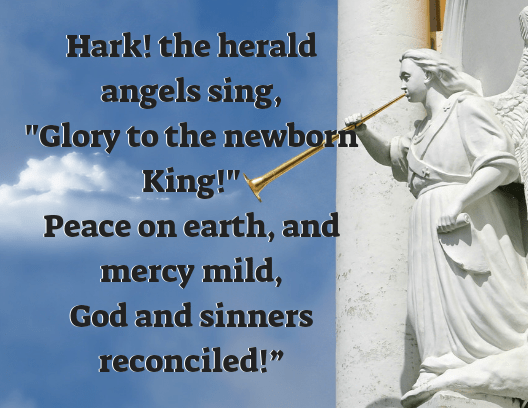
“Hark! The Herald Angels Sing”


Hark! the herald angels sing

Hark! the herald angels sing,
“Glory to the newborn King!”
Peace on earth, and mercy mild,
God and sinners reconciled!”
Joyful, all ye nations, rise,
Join the triumph of the skies;
With th’ angelic host proclaim,
“Christ is born in Bethlehem.”
Hark! the herald angels sing,
“Glory to the newborn King!”

Hail! the heav’n born Prince of Peace!
Hail! the Son of Righteousness!
Light and life to all he brings,
Risen with healing in his wings
Let us then with angels sing,

“Glory to the newborn King!

Peace on earth and mercy mild;

God and sinners reconciled!”
Hark! the herald angels sing,
“Glory to the newborn King!”

As is common at Christmastime, “Hark the Herald Angels Sing” proclaims peace on earth.  In Isaiah’s prophecy about the coming of the Messiah he states that Jesus will be called the Prince of Peace (Isaiah 9:6).  Jesus certainly came to bring peace.  The most important way that he brings peace, is that he enables us to have peace with God, as is referenced in the hymn when it says, “God and sinners reconciled.”  We have all sinned, and as such we are enemies with God (Romans 5:10).  Enemies cannot become friends until their differences are dealt with.  For reconciliation to occur there is often a price that first has to be paid.  In the case of our sinning against God, the price that needs to be paid is death.  “For the wages of sin is death” (Romans 6:23).  When Jesus died on the cross he paid the price for us to have a relationship of peace with God.  “Therefore, since we have been justified through faith, we have peace with God through our Lord Jesus Christ” (Romans 5:1).

Jesus also gives us peace in the midst of difficult and painful situations.  Hours before Jesus was crucified he promised to give his disciples peace.  On what should have been one of Jesus’ worst nights, on a night he might have been consumed with his own anxiety and despair, he tells his disciples he wants them to have peace.  “Peace I leave with you; my peace I give you. I do not give to you as the world gives. Do not let your hearts be troubled and do not be afraid” (John 14:27).  The peace Jesus is offering is not the world’s peace, which is usually just based on good circumstances.  On the contrary, we are told to expect trial and pain, but that Jesus’ peace can prevail.   Jesus says, “I have told you these things, so that in me you may have peace. In this world you will have trouble. But take heart! I have overcome the world” (John 16:33).

We have no reason to fear the present or the future.  We can rest assured that God is in control of every situation.  When we are faced with difficult conditions do not give into worry, but rather turn to God in prayer, asking for our requests, and thanking Him for all that He has already done.  Then rest in peace, knowing that He loves us and is in control. “Do not be anxious about anything, but in every situation, by prayer and petition, with thanksgiving, present your requests to God. And the peace of God, which transcends all understanding, will guard your hearts and your minds in Christ Jesus” (Philippians 4:6-7).

-Jill McClain


Paul’s Final Exhortation for Unity

Philippians 4

IMG_0280

Yesterday we took a break from our discussion on unity in the body to talk about our union with Christ—the head of the body. Today we’re back to the theme of unity in the Church and looking at Philippians 4, where Paul offers the Philippians some final exhortations for unity. From Paul’s advice to the church at Philippi in this passage, we can see four principles that, if applied, will help promote unity in our own churches.


The first principle we see here is reconciliation. In verse 2 Paul calls attention to an apparent disagreement that was causing strife among two of the woman in the church. He urged them to “be of the same mind in the Lord.” These women had been workers, alongside Paul, for the Gospel and this disagreement between them was hindering their ministry. Personal differences should never get in the way of our commitment to the Gospel. When disagreements arise, the church should work together towards reconciliation so that it can get back to its primary focus.


The second principle we can take from this passage is to live gently. Paul says in verse 5 (NRSV) to “Let your gentleness be known to everyone.” Gentleness is one of the Fruit of the Spirit, but one that I think is often overlooked. This comes from a misunderstanding of what gentleness is all about. Many people equate gentleness to weakness, but it is actually a sign of strength. A weak person is one who lacks strength but a gentle person is one who appears weak for the benefit of others. Gentleness allows us to care for those who are weak and need special attention. Jesus was gentle—this aided him greatly in his ministry to sick and inflicted. If we want to have inclusive churches that minister to the needs of those who are weak, we must promote gentleness.


Living worry free is another principle Paul pushes in this passage that can aide our goal of church unity. In verses 6 and 7 (NRSV) he says “Do not worry about anything, but in everything by prayer and supplication with thanksgiving let your requests be made known to God. And the peace of God, which surpasses all understanding, will guard your hearts and your minds in Christ Jesus.” Worry and anxiety are enemies of the Gospel. Worry is a prison; the Gospel is freedom. Worry keeps us focused on the evils of the age we live in—all the bad things that come about from our sinful nature. It takes our minds off the hope we have in the future Kingdom of God, where everything will be made right and worry rendered obsolete. When bad things do happen in our lives, we shouldn’t spend time thinking about how much worse they could get or why it is happening to us. We should instead bring our concerns before a God who can offer us peace that we won’t find anywhere else, and that can get us through this evil age until we dwell with him in His kingdom. A church at peace and without worry is one that is focused on the future and making a difference in the present.


The final unity principle Paul offers in Philippians 4 is filling our minds with that which is good. In verse (NRSV) he says, “Finally, beloved, whatever is true, whatever is honorable, whatever is just, whatever is pure, whatever is pleasing, whatever is commendable, if there is any excellence and if there is anything worthy of praise, think about these things.” There are a lot of things in this world that try to grab our attention and many of them are not beneficial. Our minds our shaped by what we take in, just as our bodies are by the food we eat. This is why what we think about is so important. If we want to get good out, we must put good in. If we want to be unified in our purpose, we must be unified in our thinking, and that thinking should be on things that are true, honorable, just, pure, pleasing, commendable, and excellent.


While they are not always easy to follow, these four principles will go a long way towards promoting unity within the Church.


– Joel Fletcher

Reconciliation

Hosea 1-4

hosea 2

Sunday, April 9

Weird names.  Sketchy goings-on.  Terms like “sacred raisin cakes”.  The book of Hosea is kind of like that weird relative you avoid, but then find out that they actually have some interesting things to say.

Hosea offers us some of the most beautiful and heart-wrenching images of God’s love for us in all of Scripture.

Have you ever watched a movie where someone gets cheated on?  Maybe you even know someone in real life that has experienced this.  A husband or wife finds out that the one who promised to love them, to never leave them, has found someone new.

“I made a mistake,” they may say.  “You’re not the one for me, I’ve found my soul mate and I’m leaving.”

As hurtful as that is, can you imagine how much more hurtful for a wife to tell her husband that she loves him, but spends her weekends sleeping with not one, but many, other men.  It’s beyond comprehension that any marriage could survive that, or that any husband would put up with it.

But that’s exactly what God says He does.  And can you guess the part we play in this story?  It’s not the faithful husband, I can tell you that!

Hosea shows us that God tries many things to get His unfaithful spouse (us) back when we walk away.  Do you see him doing any of these things in your life?

Verses 2: 6-7 show us that sometimes God blocks our paths when we start to go astray:

Therefore I will block her path with thornbushes;
    I will wall her in so that she cannot find her way.
She will chase after her lovers but not catch them;
    she will look for them but not find them.
Then she will say,
    ‘I will go back to my husband as at first,
    for then I was better off than now.’

Sometimes God ‘allures’ us.  He brings flowers, and lavishes gifts and affection on us.  Wooing us to choose Him again (2:14).

Therefore I am now going to allure her;
    I will lead her into the wilderness
    and speak tenderly to her.

Can you feel God’s shoulders slumping, His head dropping, as the hurt of being cast aside washes over Him when he says (2:8),

She has not acknowledged that I was the one
    who gave her the grain, the new wine and oil,
who lavished on her the silver and gold—
    which they used for Baal.

Ultimately, God shares the dream of every abandoned spouse…reconciliation.  “One day,” the scorned wife thinks, “One day he’ll come back to me and be mine again.  One day he’ll wake up and see what he’s given up…”

God says (2:23):

I will plant her for myself in the land;
    I will show my love to the one I called ‘Not my loved one.’
I will say to those called ‘Not my people,’ ‘You are my people’;
    and they will say, ‘You are my God.’”

For myself.  God wants you for himself.

Friend, you don’t ever need to wonder if God loves you.

-Susan Landry

Susan is a teacher turned homeschooling mom turned blogger.  She is married to her favorite person and they live in balmy Minnesota with their two sons and their dog, Scout (who is the sweetest and most desperately infatuated mama’s boy on earth).  Her favorite Psalm is Psalm 84; and her favorite passage of Scripture overall is Job 23:8-10 (because it reminds us that even when we can’t see God…He sees us).  She knows that she is blessed far more than she deserves, and seeks to follow Jesus’ example of spreading grace and truth.