Alliances with Unbelievers

Old Testament: 2 Chronicles 17-19

Poetry: Psalm 6

New Testament: 1 Timothy 2

“Should you help the wicked and love those who hate the Lord?”  This is a pretty challenging question that comes straight from today’s reading from 2 Chronicles 19:2 NIV.  One of the questions that comes to mind for me is “help the wicked do what?”  The second question is, “Why shouldn’t I love those who hate the LORD?”  After all,  Didn’t Jesus tell us that we are supposed to love everyone, including our enemies? (Matthew 5:44) Shouldn’t godly people treat others with love, even unbelievers, even those who have rejected God? 

One of my ministry settings is as a hospital chaplain.  Recently I visited a patient who informed me as soon as I walked into their room that they were an atheist, but that they still wanted to talk to me, they were going through an emotional crisis and they needed help.  This was a person that didn’t simply hate the LORD but actually denies the existence of God.  As a Chaplain, as a pastor, and as a Christian should I have NOT helped the patient?  Should I have NOT loved the patient since they do not love God?  I’ll tell you the rest of the story at the end. Let’s look at the context of this quote in today’s reading and see what God reveals to us about himself.

The story is about Jehoshaphat (isn’t that a great name).  It literally means YHWH has judged.  At the time of today’s reading in 2 Chronicles 17-19 Jehoshaphat was the king of Judah.  Judah and Israel were at one time one nation comprised of 12 tribes that descended from Abraham, Isaac, and Jacob.  Israel was a strong and united nation during the reigns of kings David and Solomon, but after Solomon died the nation of Israel was divided by a civil war.  The Northern Kingdom of Israel, and the Southern Kingdom of Judah separated with Judah’s capital in Jerusalem where the temple of God was.  Jehoshaphat was the king of Judah and ruled from Jerusalem.  He was an heir of King David and was generally a good and faithful ruler who avoided the worship of idols.  Ahab was the King of Israel and he did not remain faithful to YHWH, the God of Israel, and led his people into the worship of idols which was strictly forbidden by God.

A common practice at the time for smaller nations was to enter into alliances with other nations against their enemies.  God had made it clear to his people that he did not want them entering into political alliances with nations that practiced idol worship.  In today’s reading, it says that Jehoshaphat entered into an alliance by marriage with Ahab and Israel.  This was a violation of God’s commands and led to all kinds of trouble for Jehoshaphat and the Kingdom of Judah.  Now that they were in an alliance Ahab wanted Jehoshaphat to go to war with him against their enemies.  The problem was that God was not in favor of this because of Ahab’s unfaithfulness.  Jehoshaphat was wise enough to ask one of the prophets to seek God on the question.  Of course, Jehoshaphat should have known the answer- God did not want him to enter into an alliance with Ahab to begin with, he certainly wouldn’t want Jehoshaphat to fight in battle alongside Ahab, a battle which Ahab was destined to lose and where he would be killed.

After Ahab was indeed killed in battle as the prophet warned, Jehoshaphat returned to his palace where another prophet of God, Jehu, came to him and asked our opening question-“Should you help the wicked and love those who hate the Lord?”  The answer here was clearly “no, you should not enter into a political alliance with a king and a nation that have rejected God and his teaching.  No, you should not give your son to be married to the idolatrous king’s daughter as the law clearly taught that God’s covenant people should not marry with idolatrous people who do not believe in God.

The prophet was not saying that God’s people should never help a non-believer or should never act in loving ways to people outside of the faith community.  The law taught that we should love our neighbor (Leviticus 19:18).  What the prophet was saying is you should never enter into a formal alliance with one who has rejected God and the teachings of God.  The Apostle Paul would express this to followers of Jesus in 2 Corinthians 6:14 “Do not be yoked together with unbelievers. For what do righteousness and wickedness have in common?”  One obvious example of this would be marriage.  If you are a Christian you should not enter into a committed relationship with one who has denied or rejected Jesus Christ as savior or God as our Father.  Believers should not marry unbelievers.  If you’re driving down the road and you see your non-believing neighbor with a flat tire, you can stop and help her change her tire, but you can’t marry her.  You might do a favor or otherwise show kindness and love to unbelievers, but it would be potentially very spiritually dangerous to enter into a business alliance with one who has rejected God and godly values.

Jehoshaphat was basically a good man and a good king, but he got into trouble when he violated the clear teaching of God’s law by entering into a political alliance by having his son marry the idolatrous, god-rejecting king Ahab’s daughter.  It might be the savvy and politically expedient thing to do, but it was spiritually deadly.

If you are committed to following God and God’s values, you can and should show love and kindness to everyone, including believers, but don’t join them or make commitments that will compromise your values and dedication to Jesus Christ.

Now for the rest of the story.  The atheist and I talked for an hour.  When I left they said, “I think I might want you to preach at my funeral.”  A week later they came back to the hospital and asked the nurse to have me come and visit. We talked for another hour.  Before I left they said, “I’m not so convinced that God doesn’t exist, is it okay if I visit your church?”  We can and should show kindness and grace and caring love to everyone, including unbelievers, just don’t enter into committed relationships with them, until they give their lives to Jesus too.

-Jeff Fletcher

Reflection Questions

  1.  Beyond dating and marriage, what are some other potentially damaging ways a Christian today might bring themself spiritual harm by entering into an alliance with one who has rejected God?  How might this impact educational or career decisions?  Investment decisions? What political candidates we support?
  2. How would Jesus want you to love your non-Christian neighbor without entering into a dangerous commitment to one who does not share your values?
  3. As Christians, we are called to pray for and obey our governments unless they demand that we violate our commitment to God, how is that different from supporting a political candidate who clearly has rejected God’s teaching either by what they profess or how they live?

Bio- This week’s devotions are written by pastor Jeff Fletcher.  Pastor Jeff has been a participant at Fuel for over 40 years.  He is a pastor and hospital chaplain in the Shenandoah Valley of Virginia and is a doctoral candidate for Integrative Mental Health at Vanderbilt Divinity School in Nashville.   He is married to Karen, father of eleven, and grandpa/papa to 15.  He likes reading, watching baseball, and making delicious pulled pork in the smoker.
Did as They Saw Fit

Old Testament: Judges IntrO Below

Poetry: Psalm 106

New Testament: Luke 6

— Introduction to the Book of Judges —

We don’t know who wrote the Book of Judges, but we do know it records the events immediately after those recorded in the Book of Joshua.  The book of Judges is named after the judges that ruled the land of Israel after Joshua’s death.

Although there are several exciting stories of God’s deliverance recorded in the book, reading the book of Judges can be depressing.  This is because it records the downward spiral of Israel and its relationship with God.  The loop looked sort of like this:

  • Israel would follow God for a while.  
  • Then they would turn away from God and worship idols.  
  • God would punish them by sending invaders to torment Israel.  
  • The Israelites would cry out to God for deliverance.  
  • God would raise up a Judge to deliver them.  
  • Israel would then follow God for a while.  (loop)

One thing that makes reading Judges so frustrating is that with each iteration of the cycle, the Israelites fell further from God.  And their punishments got worse.

Judges 21:25 tells us the root cause of all of these problems, where it says, “In those days Israel had no king; everyone did as they saw fit.”

People did whatever they wanted, instead of following God’s commands.

As you read the book of Judges, I challenge you to compare and contrast your own life with the experiences of the Israelites and see what practical lessons you can apply to your own life.

-Steve Mattison

– – Devotion – –

Imagine waking up one morning in a world where there are no laws. No local police, no elected officials and no military force defending civilians’ rights. Instead, everyone just does what is right in their own eyes. Ok, that is a little terrifying. Yet, the book of Judges tells us twice, “In those days Israel had no king; everyone did as they saw fit.” (Judges 17:6 and 21:25) As we will discover, the Israelites are soon allowing disobedience and selfishness to rule. The covenant with God was broken and they begin to rule themselves. It can be difficult to read the accounts of the people and their judges because they do not seem to have a moral compass. We must remember this is a narrative telling us what they did, not approving of their actions. Human beings NEED the LORD to teach us what we should and should not do. People are excellent at justifying and rationalizing our wrong doing, but thankfully God is there to help us. As Proverbs 21:2 states “A person may think their own ways are right, but the Lord weighs the heart”.

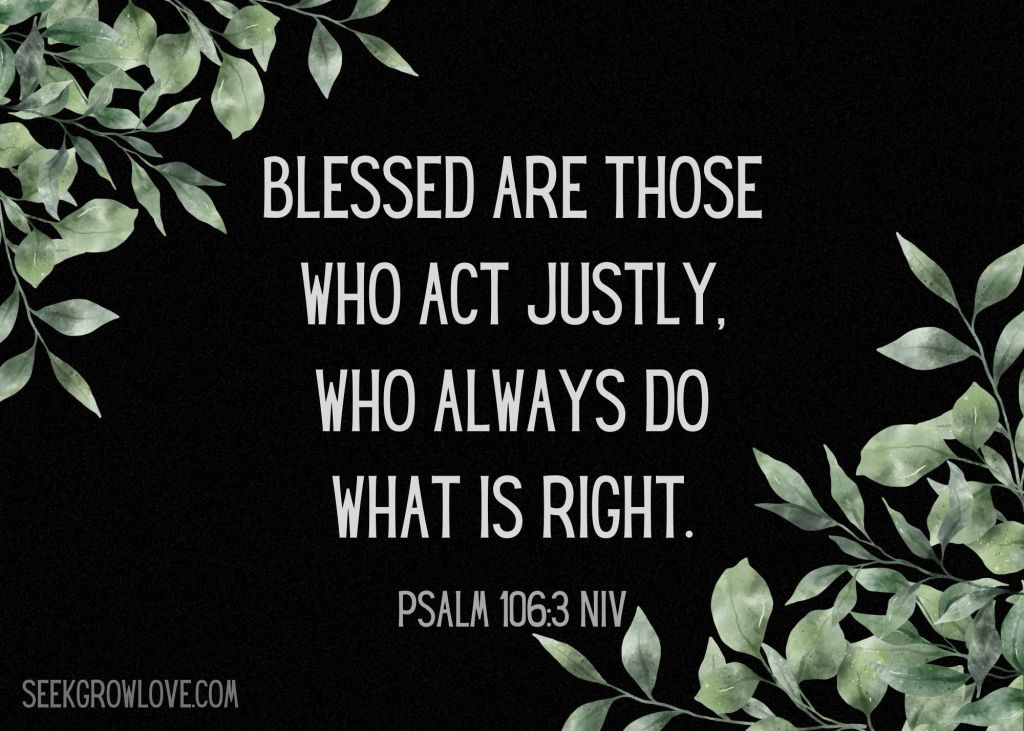
How far did Israel fall during this time period? Psalm 106 states that they shed the innocent blood of their sons and daughters for idol sacrifice to false gods. “They defiled themselves by what they did; by their deeds they prostituted themselves.” (v.39) This Psalm contrasts how good, loving, and mighty the LORD is against the people that reject Him. If we want to be blessed, we must act justly, and do what is right (v.3).

The LORD loves us as a perfect Father. He wants us to be in a close, loving relationship with Him so He has given us the scriptures. Through them we have explanations of good actions and forbidden, sinful actions. Through the scriptures, we have scores of examples of those that chose to follow the LORD. Most of all the scriptures explain who the LORD is. His amazing plan for His creation and an incredible future for His children. It is so important for us to understand and do what the LORD commands us to do.

Thankfully the scriptures also include the instructions of Jesus Christ, God’s Son. His teaching shows us that we can do what is right by putting his words into practice. We can be like the faithful builder that dug down deep and put the foundation on rock. The storms of life can’t tear our faith down because it is well built. (Luke 6:46-49)

-Rebecca Dauksas

Reflection Questions

  1. How important is it to you to do what is right? How do you most often decide what is right and what is wrong?
  2. How important is it to God for you to do what is right? How does He tell us what is right and what is wrong?
  3. What is the result when everyone does as they see fit?
  4. What do we learn about God in today’s Bible reading? What do we learn about His Son in Luke?

Is God Faithful, or Not?

Old Testament Reading: Exodus 21 & 22
Psalms Reading: Psalm 39
* New Testament Reading: Romans 9

Romans 8 ended with the promise that nothing can separate us from the love of God.  But then in the next chapter, we find Paul saying, in Romans 9:2-4, “I have great sorrow and unceasing anguish in my heart.  For I could wish that I myself were cursed and cut off from Christ for the sake of my brothers… the people of Israel.”

You may be thinking, “Wait a minute, is God faithful, or not?  Didn’t he choose the Israelites as His chosen people originally?  Apparently, that didn’t work out so well, so then God threw them away, and now Christians are His chosen people.  Will God get tired of us too, and throw us away too?”

I’m glad you asked.  Let’s look at that.

God chose the Israelites.  They were His people. God gave the Israelites the law, the temple worship, and the promises, the patriarchs, and the human ancestry of Jesus.   God extended tremendous grace to them.   God was (and is) faithful.  But despite that, many turned their back on God.  Romans 9:6 says, “It is not as though God’s word had failed.  For not all who are descended from Israel are Israel.”  The problem was with the Israelites.  They weren’t faithful to God.  Even though they had the right ancestor (Abraham), they didn’t have the right heart.

Romans 9:27-28 later says, “Though the number of the Israelites be like the sand by the sea, only the remnant will be saved.  For the Lord will carry out his sentence on earth with speed and finality.”

This should be a warning to us.  God told us in Romans 8 that nothing external can separate us from the love of God.  But we are free to walk away from Him if we choose.  Even though God extended tremendous grace to Israel, many rejected God, and only a remnant will be saved.  God has now extended tremendous grace to us Gentiles through Christ.  Unfortunately, I fear the same will be true of those of us who call ourselves Christians.

Romans 9:30-32 then stresses again the importance of righteousness by faith, “What shall we say then?  That the Gentiles, who did not pursue righteousness, have obtained it, a righteousness that is by faith; but Israel, who pursued a law of righteousness, has not attained it.  Why not?  Because they pursued it not by faith but as if it were by works…”

To recap, God is merciful, gracious, and faithful.  He showered His love on the Israelites, but many rejected him.  And many who didn’t reject Him tried to please God by just following a bunch of rules.  I picture their attitude as something like this:  “I’m going to do what God demands, but it doesn’t mean I have to like it.”  God then rejected those who rejected Him and those who tried to earn their way into his favor.

God has showered his love on us through Jesus, and has invited us to be adopted as His children.  How will you respond?  Will you reject Him?  Will you try to earn His favor by following a bunch of rules?  Or will you develop a loving relationship with Him and live by faith?  Only one of these choices will result in eternal life.  Which will you choose?

-Steve Mattison

Reflection Questions

  1. In this chapter on God’s Sovereign Choice how many times does Paul quote the Old Testament? Why do you think Paul does so?
  2. Are there times you have questioned if God is faithful? Do you find anything in Romans 9 that would have helped you (or did help you) through these times? How can you help someone else who is questioning?
  3. What do we learn about God and His character and roles and desires in our reading of His words today?

A Father and His Child

Hosea 11

Friday, November 4, 2022

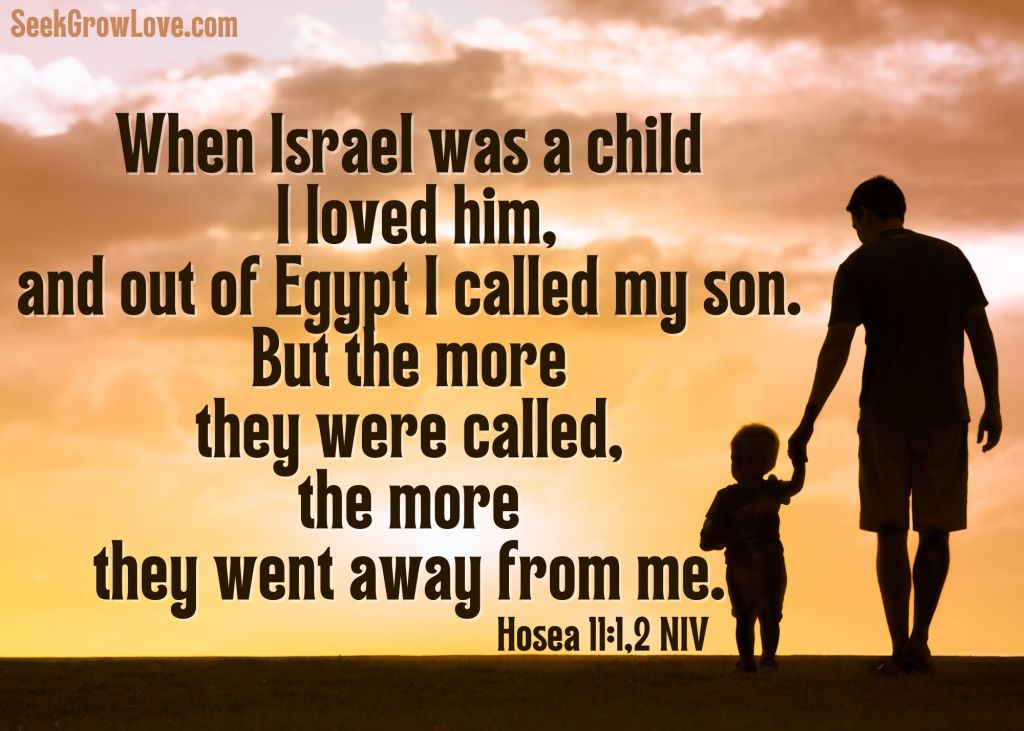
I was touched by the beautiful imagery of the LORD calling to Israel as a child. Teaching him to walk and taking him into His arms. Here the LORD is also leading with kindness and bonded to His people in love. And I can just imagine a compassionate care taker releasing an animal from its burden-taking off the bridle and bit to allow the animal to freely eat and drink. The love and compassion of God are so evident in these passages. But Israel’s obstinance is also evident. These collections of poetry are calling out again to the people. Turn to God, do what is right and be saved. God desires for people to come to Him to be healed, forgiven and saved, but as we have seen over and over, the people continued to reject Him.

We are told what the result is, “Because there is no faithfulness or kindness or knowledge of God in the land. There is swearing, deception, murder, stealing and adultery. They employ violence, so that bloodshed follows bloodshed. Therefore, the land mourns, and everyone who lives in it languishes (4:1-3a)”. It is disturbing that this scripture could be describing parts of our own country today. But the poetic words of the prophet Hosea still speak through this book. Telling us about the LORD’S perfect character and His justice. We still hear a main theme of not rejecting, but accepting and remaining faithful to our God. How horrible to become stubborn and self-willed against the Only True Living God. That is a place that we never want to occupy. Unfortunately, I know that we could name some individuals who have turned away and have chosen lives that are in complete opposition to God. But we want to be those that faithfully hold to God. Hosea 14 describes it this way, “Whoever is wise, let him understand these things; Whoever is discerning, let him know them. For the ways of the Lord are right, and the righteous will walk in them, but transgressors will stumble in them (v.9)”. Hosea explains that someday the sons of Israel will return and seek the LORD their God; they will come trembling to the LORD and to His goodness. It is incredible that we can know, walk with, and most of all be in a loving relationship with Him right now.

-Rebecca Dauksas

Reflection Questions

  1. How is your nation like Israel? How are they different from Israel? How are you like Israel? How are you different from Israel?
  2. How would you describe God as a parent?
  3. How will you respond as His child? When have you been rebelled against Him? What is His desire for You?

Freedom

2 Chronicles  7-8

Today we celebrate the many freedoms that we have in our country. We are so blessed to live in a country that allows us to worship God and so freely profess our belief in Christ. The scriptures explain that through Christ Jesus the law of the Spirit who gives life has set you free. We are also free from the law of sin and death. (Rom. 8)

From the beginning, God has given human beings freedom in the form of free will. He allows us to choose. We can choose to follow Him and His Son or we can reject them because we want to go our own way. It is so clear to see this choice when it is placed before the people in the scriptures. Their own evil desires will result in sin and death or they can follow God as He leads them and others to life. Life that is described as abundant and everlasting.

Solomon had been making some great choices for God. He was honoring Him. God’s temple was being dedicated and Solomon was using his influence for good. As always when people draw near to God, He draws near to them. God assures them that He is there with fire from heaven and His glory filling the temple. The people praise the LORD by saying, “He is good; His love endures forever.” After this the LORD even appears to Solomon. God presents a choice that Solomon has to personally make. Solomon can walk before the LORD faithfully following everything that God commanded or reject God by doing his own thing.

Unfortunately, as Solomon’s life unfolds, he begins breaking the laws that he was given. One by one he breaks the few laws that he was asked to follow as the king. He continues following some of God’s laws while ignoring others. His heart was led astray, just as the LORD told him it would be.

Solomon had wealth, fame, power, and wisdom, but none of that mattered because he allowed people and things to replace his love for God. Let’s examine our own hearts today and freely give them completely to our God. We know that “He is good; His love endures forever.”

-Rebecca Dauksas

Today’s Bible reading passages can be read or listened to at BibleGateway here – 2 Chronicles 7-8 and Romans 3

The Choice is Yours

Revelation 16

Revelation 16 7 NIV

Yesterday, angels were sent out with plagues and bowls were prepared for pouring. Today, we get to see the dramatic moments when the bowls are poured. Each plague is horrific, especially when we recognize the wholeworld is experiencing each plague. Everyone, from everywhere, will be affected by these plagues.
(As a quick aside, that means all people who have chosen to turn their backs on God. Remember these plagues and bowls are the wrath of God upon those who chose to reject Him [see Rev. 15]. God has promised that we will not taste his wrath but his salvation, as we chose to follow him. [1 Thess. 5:9])
First, Sores cover those who worship the beast. Then, the sea becomes blood and all life dies. Rivers and streams turn to blood, so blood is the water over the whole earth. Then the sun begins to burn people, followed by the Kingdom of the Beast being plunged into darkness. Penultimately, Euphrates is dried up.
The reason we will stop at six is because I think the important part for John, what SHOULD shock his readers then and now, are the parts where he talks about the reaction to the plagues, what the people chose to do because of the plagues.
In verse 9, we see the sad and shocking reaction of those who are being effected by the plagues. Even as they have experienced the plagues and they know the plagues are coming from God, they choose to blaspheme His name and do not repent or give Him glory. Those who suffer the plagues are continuously, with full knowledge, rejecting the God of heaven after the plagues and bowls. They are not accidentally rejecting Him, or acting in ignorance. They are choosing to reject the God they KNOW is sending these plagues. They reject Him after the fourth bowl (9), and the fifth bowl (11). After the sixth bowl, demons round up the people of the world in their final rejection of God. The seventh bowl, poured out at the Mountain of Megiddo (Har Megiddo or Armageddon), is upon all those who have blasphemed God and continued to blaspheme Him.
Earlier I said it is sad and shocking that this is the reaction of those who choose not to follow God. But the truth we must see is that God is giving everyone a choice. He shows us that even with clear evidence that YHWH is the God of heaven and Earth, some will still refuse to repent and follow Him. The question for the original recipients of Revelation, and for you and I, is this : are we among those who refuse to repent and acknowledge God, or do we give Him the glory he deserves, and choose to do his will?
The choice is yours.
Jake Ballard