
A Mystery

1 Samuel 27-28
Psalm 51
Romans 9

-Devotion by Sarah Johnson (MN)

Some people are a big fan of mysteries.  I am not one of those people.  When getting a new fiction book, I start by reading the last paragraph of the last chapter just so I know what to expect (trust me, I know it’s weird…).  So you can imagine there are many things within our faith that are a challenge for me to grapple with as “mysteries of God”.  Romans 9 is a great example of one of those things that requires me to acknowledge that I simply do not, cannot, and most definitely should not know everything there is to know about our Creator.

Paul starts this chapter off by attempting to describe how deeply he loves his Jewish community and desperately wants them to understand Jesus, so much so that he wishes he himself could simply be cursed and cut off for the sake of his people (v. 3).  This is similar to how Moses offers himself to be blotted out of God’s book when he watches his people worshipping a golden calf (Exodus 30:32).  In both of these instances, these men have a deep love for their people, and yet their love alone is just not enough to change their salvation.  There was only one who was capable of holding that type of power in substitution, the man Jesus Christ.  Paul references many Old Testament passages that point to a coming Messiah and how salvation may be brought to the Gentiles in this letter – he knows exactly what doubts his fellow Jewish believers may have, and tries to proactively present his case, as he often does in his writing.

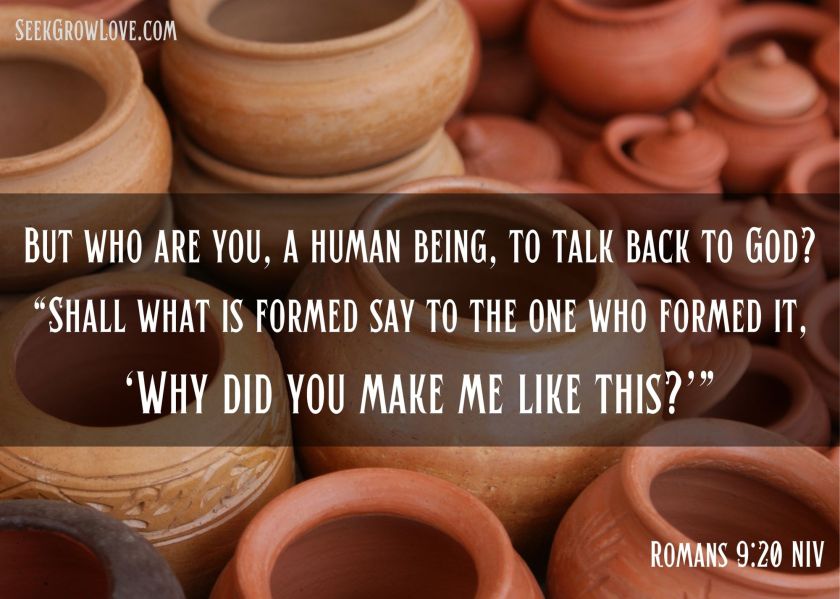
And then we start getting into that mystery part of things… God is sovereign, the Ruler over all, the one who decides who he extends mercy to, and who he hardens (v. 18).  Well that’s just not fair, is it??  I want to justify these verses in my own mind to make them “nicer” – somehow I want to twist these words, rationalize them, make them more presentable, and far less mysterious.  But in doing so, I remove God from His rightful place of sovereignty in my mind.   I am absolutely the type of person Paul references in verse 19 – “one of you will say to me: Then why does God still blame us? For who is able to resist His will?”.  I am nothing more than a mere clump of clay, pretending as if I have any right to tell the potter what to make of me.  

In his study of Romans book, author Jared C. Willson writes this on my very thoughts above: “If we dictate to God what he must be like, then we are not in fact worshiping God – we are worshiping an idol, for it is a god of our own making.”  When I try to over-simplify or “clean up” these mysterious moments of God, I am no longer genuinely focused on Him.  I am focusing on the more presentable parts of the gospel, when in reality, we must wrestle with ALL parts, praying for wisdom and understanding as we navigate the mystery.

I will not pretend to know why God does what He does.  I will not pretend to understand why some people just won’t grasp the gospel.  I will not pretend I can figure out the mysteries of God.  So while it may be confusing, and at times slightly disheartening or even frustrating, I will also choose to find comfort in the fact that it does not depend on human desire, or effort, but on God’s mercy alone (v.16).  What a beautiful mystery!

Reflection Questions

  1. Have there been moments in your faith walk when you attempted to dictate to God what He must be like?  Looking back now, are you able to see what you missed in doing so?
  2. The last few verses of this chapter describe Jesus as a stumbling stone.  How might believers stumble over the truth of Jesus?

Prayer

What an honor it is to speak to You Lord God, the Maker of Heaven and Earth and me. Help me see You for who You are – a God too big and great and right for my comprehension. And help me see me for who You made me to be, and do what You want me to do.

Is God Faithful, or Not?

Old Testament Reading: Exodus 21 & 22
Psalms Reading: Psalm 39
* New Testament Reading: Romans 9

Romans 8 ended with the promise that nothing can separate us from the love of God.  But then in the next chapter, we find Paul saying, in Romans 9:2-4, “I have great sorrow and unceasing anguish in my heart.  For I could wish that I myself were cursed and cut off from Christ for the sake of my brothers… the people of Israel.”

You may be thinking, “Wait a minute, is God faithful, or not?  Didn’t he choose the Israelites as His chosen people originally?  Apparently, that didn’t work out so well, so then God threw them away, and now Christians are His chosen people.  Will God get tired of us too, and throw us away too?”

I’m glad you asked.  Let’s look at that.

God chose the Israelites.  They were His people. God gave the Israelites the law, the temple worship, and the promises, the patriarchs, and the human ancestry of Jesus.   God extended tremendous grace to them.   God was (and is) faithful.  But despite that, many turned their back on God.  Romans 9:6 says, “It is not as though God’s word had failed.  For not all who are descended from Israel are Israel.”  The problem was with the Israelites.  They weren’t faithful to God.  Even though they had the right ancestor (Abraham), they didn’t have the right heart.

Romans 9:27-28 later says, “Though the number of the Israelites be like the sand by the sea, only the remnant will be saved.  For the Lord will carry out his sentence on earth with speed and finality.”

This should be a warning to us.  God told us in Romans 8 that nothing external can separate us from the love of God.  But we are free to walk away from Him if we choose.  Even though God extended tremendous grace to Israel, many rejected God, and only a remnant will be saved.  God has now extended tremendous grace to us Gentiles through Christ.  Unfortunately, I fear the same will be true of those of us who call ourselves Christians.

Romans 9:30-32 then stresses again the importance of righteousness by faith, “What shall we say then?  That the Gentiles, who did not pursue righteousness, have obtained it, a righteousness that is by faith; but Israel, who pursued a law of righteousness, has not attained it.  Why not?  Because they pursued it not by faith but as if it were by works…”

To recap, God is merciful, gracious, and faithful.  He showered His love on the Israelites, but many rejected him.  And many who didn’t reject Him tried to please God by just following a bunch of rules.  I picture their attitude as something like this:  “I’m going to do what God demands, but it doesn’t mean I have to like it.”  God then rejected those who rejected Him and those who tried to earn their way into his favor.

God has showered his love on us through Jesus, and has invited us to be adopted as His children.  How will you respond?  Will you reject Him?  Will you try to earn His favor by following a bunch of rules?  Or will you develop a loving relationship with Him and live by faith?  Only one of these choices will result in eternal life.  Which will you choose?

-Steve Mattison

Reflection Questions

  1. In this chapter on God’s Sovereign Choice how many times does Paul quote the Old Testament? Why do you think Paul does so?
  2. Are there times you have questioned if God is faithful? Do you find anything in Romans 9 that would have helped you (or did help you) through these times? How can you help someone else who is questioning?
  3. What do we learn about God and His character and roles and desires in our reading of His words today?

Why Did You Make Me Like This?

Romans 9

May 25

Sweet adolescence.  A time of a personal experiment, finding one’s self, and coming of age. It is a scary season filled with growing feet, growing hair, and new body odors.  During these years we’ll try out more looks, hairstyles, and ideas than the rest of our lives combined.  For many of us, there is some perceived physical flaw, (acne and weight were mine) we try to hide or minimize because we don’t want to stick out or become the source of ridicule (and maybe this is still true today of some of us who are older, too). Why did I have to be made like this?  Why couldn’t my heavenly Father shape me to be more like them over there?

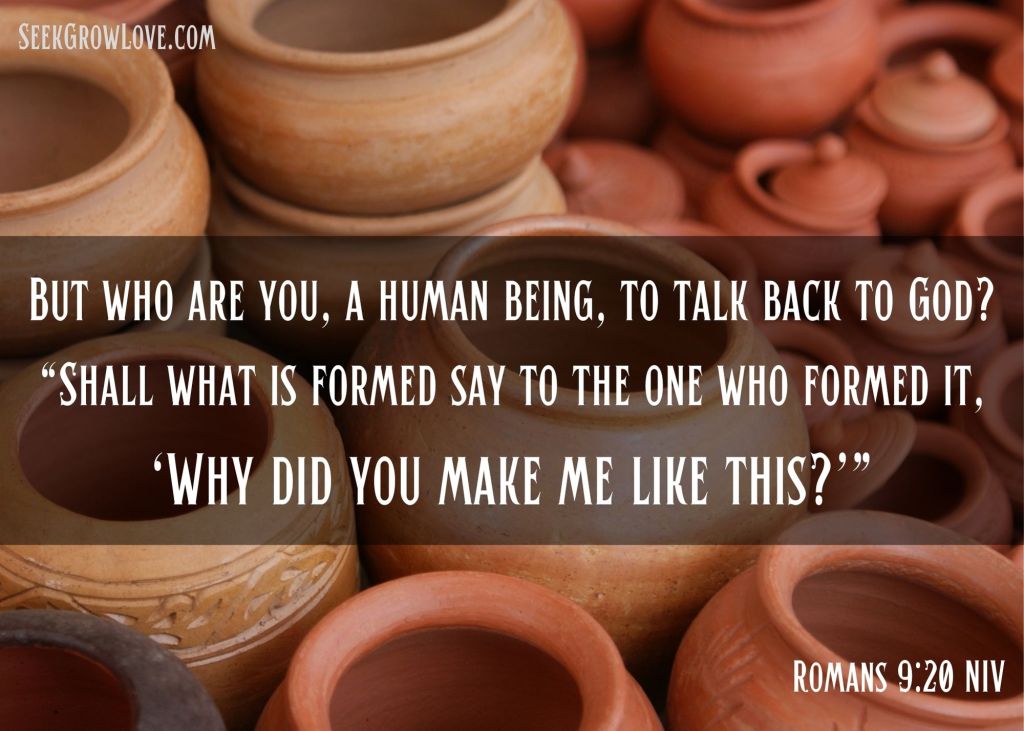
One of you will say to me: “Then why does God still blame us?  For who is able to resist his will?” But who are you, a human being, to talk back to God?  “Shall what is formed say to the one who formed it, ‘Why did you make me like this?’ Romans 9:19-20

Romans 9 seems to indicate that God has foreseen our identity and placed us to “be” in our present circumstance.  We’re all made out of the same clay, but we each have a different role.  He knows our hearts, and He will use each of us to his advantage.  We don’t even need to be “good.” God foreknew Esua’s flagrant disregard to his birthright and used it to continue his line through Jacob.  God used the hardened heart of Pharaoh to bring about the freedom of the Hebrews for Egyptian captivity.  He used King Cyrus to send the Jews home to rebuild their temple and wall.  The lack of relationship to the Heavenly Father doesn’t remove you from being a character in his story.  God made each of them like this and they fulfilled His purpose.

But let’s provide some contrast.  God used Esther, Joseph, and Solomon in almost identical manners to those listed above.  So, did God predestine the fate of the “good” and the “bad”?  Give some ungodly inclinations so they could move in the direction of wrongdoing, and give others no opportunity to fail at following Him?  Well, I’m not a theologian, but I feel the Bible is consistent about the free choice of man to choose and follow God at any point, including His son, Jesus Christ, who faces his own trials and temptations.  We may have perceived traits, inclinations, chips, chunks, or some other appraisal of malformation in our clay, which again, beg the question, “Why did I have to be made like this?” Well, whether it is the normal stuff or the special stuff (v.21), God has made you to be used for times such as this, according to His plan..

In other words, it is not the children by physical descent who are God’s children, but it is the children of the promise who are regarded as Abraham’s offering. Roman 9:8

Because there is no longer a single line of inheritance, Jewish heritage, he is calling all the pottery of different shapes and sizes to follow Him.  Our titled-question I cannot answer. That is the Heavenly Father prerogative and determination. What I can tell you is to spend less time questioning God about the chunky bits, the cracks, the struggles He has placed within you and before you. We have been formed exactly in a way to shine the fullness of God.  To find Him, not ourselves.  To look like Jesus, not everyone else.  For us, His work and craftsmanship, to trust in the Potter’s identity alone.

-Aaron Winner

Questions for Reflection and Discussion

  1. If you could ask Paul to further explain one of his points in Romans 9 what would you ask and why? What might he reply?
  2. What do you love about God’s plan? What do you wonder about God’s plan?
  3. What is the joy in being the clay not the potter?