Sowing and Reaping

OLD TESTAMENT: Ezekiel 27-28

*POETRY: Psalm 126

NEW TESTAMENT: John 2:12-25

          As a child one song I enjoyed singing in church was called Bringing In The Sheaves.

1 Sowing in the morning, sowing seeds of kindness,

Sowing in the noontide and the dewy eve;

Waiting for the harvest, and the time of reaping,

We shall come rejoicing, bringing in the sheaves.

Refrain:

Bringing in the sheaves,

Bringing in the sheaves,

We shall come rejoicing, bringing in the sheaves;

Bringing in the sheaves,

Bringing in the sheaves,

We shall come rejoicing, bringing in the sheaves.

2 Sowing in the sunshine, sowing in the shadows,

Fearing neither clouds nor winter’s chilling breeze;

By and by the harvest, and the labor ended,

We shall come rejoicing, bringing in the sheaves. [Refrain]

3 Going forth with weeping, sowing for the Master,

Though the loss sustained our spirit often grieves;

When our weeping’s over, He will bid us welcome,

We shall come rejoicing, bringing in the sheaves. [Refrain]

As a little child I really had no Idea what the song meant.  What were sheaves?  Why did people go out sowing with weeping.  What made them so sad? Why were people rejoicing while bringing them in?

Fortunately, Psalm 126 answers a lot of those questions.

Psalm 126

A song of ascents.

When the Lord restored the fortunes of Zion,
    we were like those who dreamed.
Our mouths were filled with laughter,
    our tongues with songs of joy.
Then it was said among the nations,
    “The Lord has done great things for them.”
The Lord has done great things for us,
    and we are filled with joy.

Restore our fortunes Lord,
    like streams in the Negev.
Those who sow with tears
    will reap with songs of joy.
Those who go out weeping,
    carrying seed to sow,
will return with songs of joy,
    carrying sheaves with them.


The first half of the Psalm is a Song of Rejoicing.  It likely refers to the time when Israel returned from their time in Exile.  King Cyrus of Persia released the exiles in Israel and allowed them to return to Israel where they could live in freedom and rebuild the city of Jerusalem and the Temple.  It was a time of rejoicing.  It was a time of rejoicing, laughter, songs of joy.  The surrounding nations could see how God did great things for them.  Sadly over time Israel faced a whole new set of trials.  So God’s people pray that once again God would step in and bless his people and restore their fortunes.

There was a time of drought that led to famine.  The people were sad from their misfortune so they went out in faith with bags of seed to plant.  It was an act of faith that God would supply abundant rain so that their seed would grow and be harvested so that they would carry back bundles… sheaves or grain.  There would be laughter and shouts of joy in happy gratitude for God’s blessings.

Today, we go through times of great rejoicing at the blessings.  November is a special time of celebrating God’s abundant blessings and rejoicing in God’s gifts.  It can also be a time when we go through pain and loss.  There’s a passage in Job that says “The Lord gives and the Lord takes away, blessed be the name of the Lord.” (Job 1:21)  Some times we go out weeping and, in hope plant seeds believing that God will give blessings.

Is today a day that you are going out weeping with seeds to sow, or is today a day that you come back rejoicing  at what God has provided, carrying those seeds of blessing? 

Trust that God will give blessings if we faithfully sow, even with tears.

Pastor Jeff Fletcher

Reflection Questions

  1. Is today a day that you are going out weeping with seeds to sow, or is today a day that you come back rejoicing  at what God has provided, carrying those seeds of blessing? 
  2. What seasons of sowing in tears have you had? What seasons of rejoicing in reaping have you had? Where have you seen God’s faithfulness?
With Great Joy

Nehemiah 11-13 & Psalm 126

Now that the wall’s been built, the city secured, and they’ve read from the Book of the Law to relearn God’s ways, it’s time to dwell in Jerusalem and the

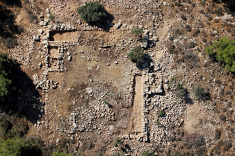
cities.  The leaders were designated to live in Jerusalem and the people cast lots to see which one out of every 10 would dwell in Jerusalem.  The rest would dwell in cities surrounding Jerusalem.  I lived in Israel 25 years and for most of the time we lived in a little village 10 miles west of Jerusalem.  It’s a mountainy and rocky area forested with some trees.  Most villages and Jerusalem were built around a water source, perhaps some type of spring.  Pictured is a photo of ruins of a Nehemiah period fortress in the hills of Judah near Jerusalem. (This photo courtesy of Israel Department of Antiquities.)

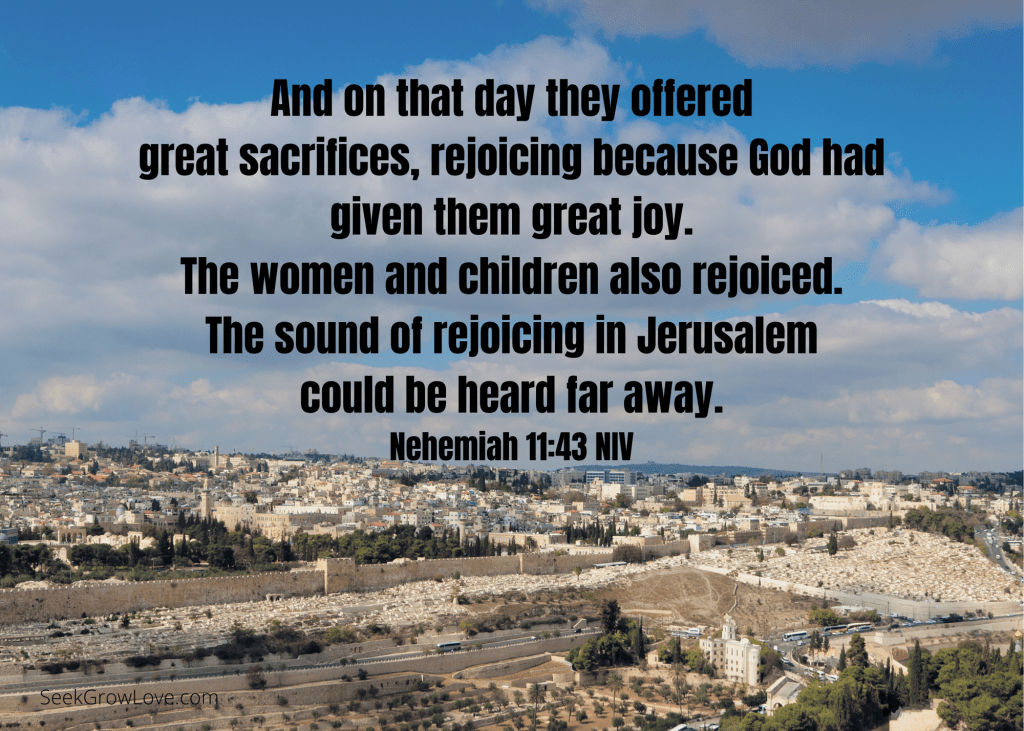
            It was a time of rejoicing.  Singers had built themselves villages all around Jerusalem (12:29). Also, two large Thanksgiving choirs with specific names and place locations are listed.  It’s amazing the record we still have today of the detailed descriptions of their locations. Also, great sacrifices were offered for God had made them rejoice with great joy.  The joy of Jerusalem could be heard from afar.  It’s amazing on the quiet of a shabbat or holiday when places are closed the noise that can be heard from a greater distance.  Psalm 126 says with singing they returned from captivity.  There must have been a joy to be back in the land of Israel again after being exiled. Though they “sow in tears, they’ll reap in joy.” At our oldest daughter’s wedding I told this to people as I wept, that I sowed in tears (such hard work raising kids overseas) and now I was reaping and weeping in joy, not out of sorrow but gladness that we made it to that day!! 😊


        Nehemiah returned after some time to Jerusalem and like a good parent had three firm corrections to make.  First, Eliashib, the priest, allowed Tobiah (Ammonite official) to have a large storeroom for himself, where articles and supplies for the Levites, singers, gatekeepers, were to be kept.  Thus, he threw out Tobiah’s things and cleansed the storeroom for proper use.  Then he asked God to remember him. (13:14) Secondly, he contended with the people for buying and selling on Shabbat and commanded the gates be shut and not open until after the Shabbat.  In current the state of Israel, every Friday afternoon stores, including all the malls shut down all over the country and remain closed until after sundown on Shabbat (Saturday), once two stars are visible.  Some weeks with holidays, the malls are closed for THREE full days!… Nehemiah prayed that God remember him. (13:22) Lastly, he contended with some of them, cursed them, struck some of them, and pulled out their hair, and made them swear not to give their children to foreigners!  That’s quite aggressive and zealous. Imagine the uproar he’d receive from all kinds of people and media today for those actions! But he prayed and asked God remember him for good. (13:29,30)

-Stephanie Schlegel

Today’s Bible passage can be read or listened to at BibleGateway here – Nehemiah 11-13 & Psalm 126

Tomorrow’s reading will be our last book of the Old Testament – Malachi – as we continue on our 2020 Reading Plan. God has great things in store! Come follow along!

The Parable of the Lost Ring

Luke 15

Luke 15_10

It was the beginning of a Louisiana winter when I lost my wedding ring just a couple years into my marriage.  It was a beautiful white gold ring with an inscription of our anniversary on the inside of the band.  It was a perfect reminder of my covenant in every way; however, its faults were it was a little loose when my hands were cold, and of course, it had me for an owner.  My friends and I were readying to play a football game on a Sunday afternoon and I was warming up by tossing the ball with a friend.  In a bit of foreshadowing for the events of the day, my ring slipped off as I caught the ball.  I picked it up off the ground, remarked how cold it was that afternoon, thought about placing my ring inside my pocket but thought it might fall out if it was there.  I put the ring back on my finger, only to lose it at some point in the next couple of hours of our pick-up game.

As we finished playing, my heart immediately sank when I realized it was gone.  I felt a cold sweat build on my forehead, my gut churned, and I held back tears, disappointed that I had lost something so precious.  My friends helped me look for almost an hour without success.  In the muddy, mushy, marshy Louisiana ground, I could see the imprints of our shoes and feet, I could see heaps of crawdad holes, but none of us saw the silvery reflection of my ring buried within the mire and muck.

In Luke Chapter 15, Jesus tells a series of three parables with a similar subject of a possession that has gone missing. In “The Parable of the Lost Sheep”, the master realizes that one of his flock is missing, and leaves behind 99 others to search for the lost one.  In the “Parable of the Lost Coin”, a woman takes account (to tie to our theme from yesterday) to realize she has misplaced a day’s earnings and does the equivalent of turning up couch cushion, investigating under the bed, and sweeping every nook and cranny to uncover it.  In “The Parable of the Lost Son” a father turns his son loose with an inheritance, but is actively looking for his return.  In addition to the same topic, each story ends in a similar resolution: what has been lost has become found and there is great rejoicing.

For me, there are two great takeaways as I ponder the collective meaning of these parables.  The first: to be lost, you have already belonged.  It is true that we each must find the Master in order to be saved, but He is the one who never stops searching.  Our Lord desires that not even a single sheep goes astray and is left without the safety of the shepherd (2 Peter 3:9).  Additionally, my thoughts turn to the Book of Life.  In Revelation 3, we are presented an image that our names are not written into the Book at the transition from “lost” to “saved”, but have already received a place there and are blotted out at the end of a life that is not found in Christ.  We are always His, but like the lost son, we make the decision to be found.

The second takeaway is the wonderful rejoicing that occurs when we turn our lives over and are indeed found.  There is a literal fiesta in the firmament to celebrate our Savior’s joy that we are alive again. No longer do we share the fleeting moments of a mortal life with our Father, but have the hope of an eternity of His presence, living with Him in His kingdom, our intended inheritance instead of passing pleasures. We, too, should echo the heavens and revel in each return.

Unfortunately, the resolution to my own parable of the ring isn’t as joyous as our Jesus’.  I searched for the ring for weeks, beseeched friends I know with metal detectors, offered rewards, but none of these measures ensured the retrieval of my wedding band.  I resigned my search, and my ring is forever lost in the loose Louisiana earth.  Maybe, as I like to imagine, it is the crowning jewel at the bottom at some crawdad family’s hole. With this being said, I can’t help but be thankful that my God has called me his treasure and that he never stops searching for me.  He finds me in my wandering, revealing and moving His will and His way through His words, waiting for my silhouette to again darken the horizon when I have gone astray – a Father who never fails finding those who desire to be found in Him.

-Aaron Winner