
Trusting, Seeking & Standing Firm

OLD TESTAMENT: Habakkuk 2

POETRY: Psalm 119:153-160

NEW TESTAMENT: Revelation 13

Habakkuk 2:2-4 (LEB):

“And Yahweh answered me and said:

‘Write the vision and make it plain on tablets,

so that he may run who reads it.

For still the vision awaits its appointed time;

it hastens to the end—it will not lie.

If it seems slow, wait for it;

it will surely come; it will not delay.

Behold, his soul is puffed up; it is not upright within him,

but the righteous shall live by his faith.'”

Psalm 119:153-160 (LEB):

“Look on my affliction and deliver me,

for I do not forget your law.

Plead my cause and redeem me;

give me life according to your word.

Salvation is far from the wicked,

for they do not seek your statutes.

Great is your mercy, O Yahweh;

give me life according to your rules.

Many are my persecutors and my enemies,

yet I do not swerve from your testimonies.

I look at the faithless with disgust,

because they do not keep your commands.

Consider how I love your precepts;

give me life according to your steadfast love.

The sum of your word is truth,

and every one of your righteous rules endures forever.”

Revelation 13:7-8 (LEB):

“And it was permitted to make war on the saints and to conquer them.

And authority was given it over every tribe and people and language and nation.

And all who dwell on the earth will worship it, everyone whose name has not been written from the foundation of the world in the book of life of the Lamb who was slain.”

In Habakkuk 2, God instructs the prophet to write down the vision He has revealed. This vision, while it may seem slow in coming, is assured and will ultimately be fulfilled. God encourages Habakkuk to remain faithful and patient, for the righteous shall live by faith.

In our own lives, we often find ourselves in seasons of waiting, questioning God’s timing and plans. Like Habakkuk, we may feel that the answers we seek are delayed. Yet, God’s assurance reminds us that His promises are sure, and we are called to trust in His character and faithfulness. This passage challenges us to embrace a faith that endures, especially in uncertain times.

Psalm 119 continues the theme of seeking God in times of trouble. The psalmist cries out for deliverance, expressing his deep reliance on God’s law and commandments. He recognizes that while he faces persecution and opposition, he is determined to hold fast to God’s truths.

The psalmist’s plea, “Look on my affliction and deliver me,” reflects a heart that is anchored in God’s mercy and truth. He understands that salvation is found in God alone, and he chooses to love and meditate on God’s precepts, despite the trials he endures. This teaches us the importance of grounding ourselves in God’s word and seeking His help in our struggles. We can draw strength from the truth that God’s steadfast love is the source of life and hope amidst adversity.

Revelation 13 presents a sobering reality: the world may rise against believers, and authority may be given to oppose the saints. This passage speaks to the challenges and tribulations that Christians may face as they navigate a world often in conflict with God’s kingdom. However, it also reassures us that not everyone will follow the ways of the beast; those whose names are written in the book of life will stand firm in faith.

In the face of persecution and temptation to conform to worldly standards, we are reminded that our allegiance lies with Christ, who has triumphed over sin and death. This call to remain steadfast is a powerful encouragement to persevere in our faith, knowing that our ultimate victory is secured through the Lamb who was slain.

-Jeff Ransom

Reflection Questions:

In what areas of your life are you waiting on God’s promises? How can you cultivate patience and trust during this time?

Reflect on the importance of grounding yourself in God’s word. How can you actively seek His truth and guidance in your daily life?

How does the reality of opposition in Revelation encourage you to live out your faith boldly? What steps can you take to stand firm in your beliefs?

Consider the psalmist’s expression of love for God’s precepts. What practices can you incorporate to deepen your love for God’s word in your life?
Where Does Your Allegiance Lie?

Revelation 13

Monday, November 28, 2022

Multiple times throughout the book of Revelation Jesus is referred to as faithful and trustworthy. In chapter 12 we are introduced to a deceptive dragon and in 13 his beast minions that also deceive. 

We are all given a choice. To follow what is faithful and true or what is deceptive and false. 

When painted so clearly it seems silly that some would actually choose the latter. Unfortunately, if you look around, we see Christians dabble in the ways of the world. They straddle the fence of what is right and wrong. 

Those who straddle will be deceived. Right and wrong becomes muddied. Black and white becomes gray. They will slowly drift further from what is faithful and true and more in line with the way of the world. 

Vs. 8 describes those who fall into that trap:

“And all the people who belong to this world worshiped the beast. They are the ones whose names were not written in the Book of Life that belongs to the Lamb who was slaughtered before the world was made.”

‭‭Revelation‬ ‭13:8‬ 

A few verses later is the mark of the beast. A time when a clear choice will have to be made. Will you be branded and continue to live a worldly life that takes your name out of the book of life? Or will you maintain your allegiance to Christ even if it means severe persecution, being cut off from buying goods and even possible death? 

That day may come in our lifetime; it may not. You do not have to wait until then to make your choice. 

Like Joshua (Joshua 24) – choose for today whom you will serve – as for me, I will serve the Lord. 

Where does your allegiance lie? 

Choose today! Choose to follow what is faithful and true and stay vigilant to not be deceived. 

-John Wincapaw

Reflection Questions

  1. Can you think of a time when you were deceived by Satan or by “the world”? What could you do differently to not be deceived next time?
  2. Because of the evil, deception and difficult times John writes that God’s people will need what 3 characteristics (see Revelation 13:10 and 18). What grade would you give yourself in each of these areas? What can you do to strengthen yourself in each area?
  3. How has Jesus shown himself to be faithful and true?

With God or Against God

Revelation 13

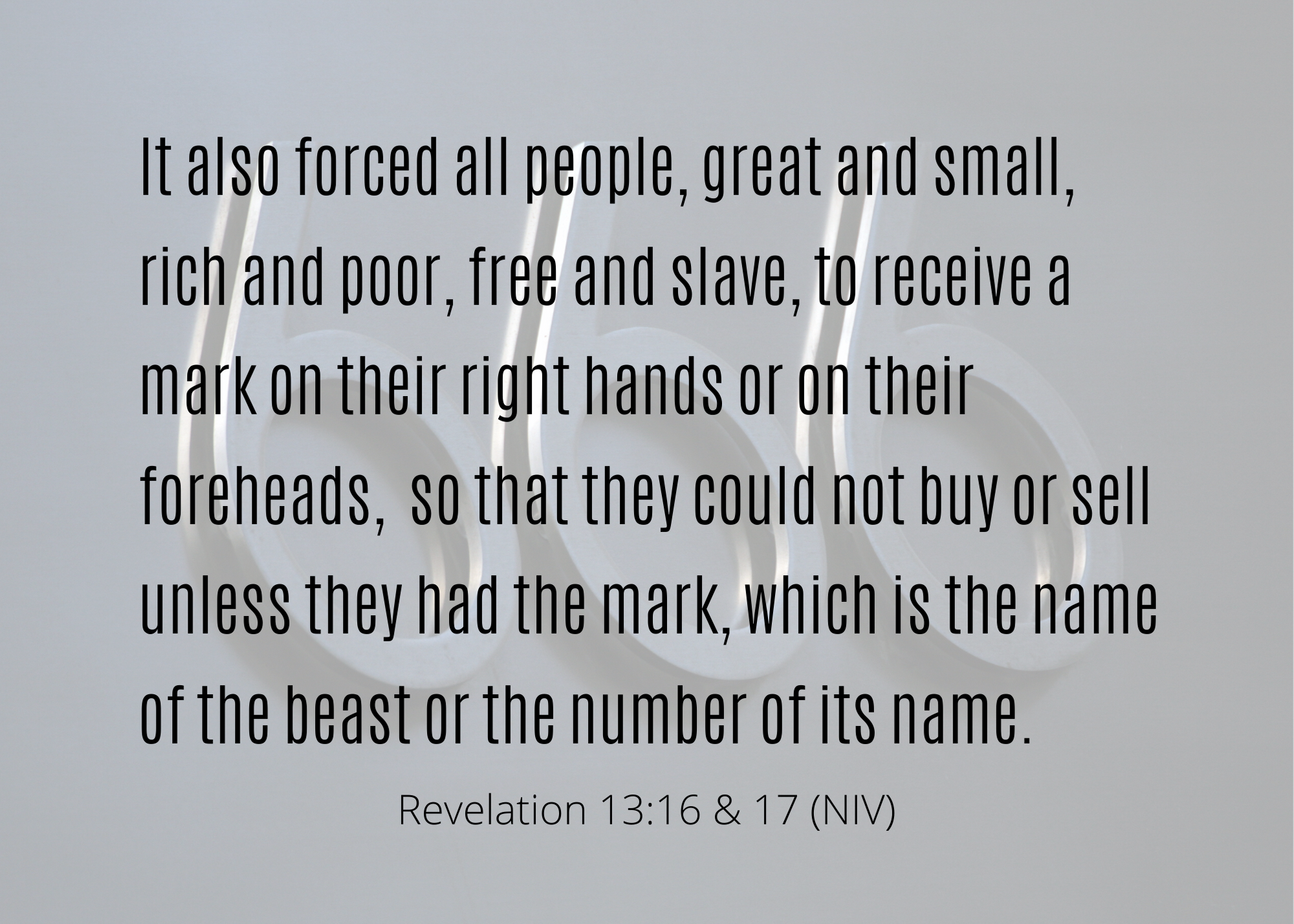
Revelation 13 16 17 NIV

666! This number has been special in the minds of believers and nonbelievers alike for thousands of years. What exactly is this number meant to represent? What is the “mark of the beast”? Is the government going to try and put a microchip in my hand? What should I do?


There is much speculation about what the number 666 means, and it all comes from this chapter in Revelation; chapter thirteen. However, before we go wandering off to try and apply this number to our situation in 21st century America, it is important to try and understand what John is trying to communicate to his audience in 1st century Asia Minor. This is an important practice for reading any passage of the Bible, and I encourage you to do your research before applying it to yourself.


John sees a vision of a terrifying beast that has ten horns and seven heads, and was like a leopard, with feet like a bear, and a mouth of a lion. It is likely that John is drawing these images from the Old Testament prophet Daniel, specifically Daniel chapter 7, where the prophet describes four great empires with beast-like imagery. Since Daniel described empires/nations with this imagery, it is likely that John also has a specific empire in mind with his description of this beast. Since we’ve already been told that this beast is responsible for killing the two Witnesses (11:7), John likely has in mind the nation of Rome, who was ruling at the time of his writing and was notorious for killing Christians during the empire’s reign.


John then sees a second beast, which is responsible for making the people worship the first beast. In the first century Roman world that John is writing in, there was a religious movement called “the imperial cult”, that was the fastest growing religion of the time. This religious movement encouraged, and sometimes forced, people to worship the Roman emperors as “gods”. If you do a little historical study on the imperial cult, you may be surprised at how much the whole New Testament addresses this issue.


This second beast forces the people to put a “mark” on their hand or forehead, demanding their allegiance to the first beast. If you don’t have this “mark”, you will be unable to do many things. This number is the number of “a man”, which is 666. This is in stark contrast to the “mark” (or seal) that God had already placed on his own people in 7:3. In other words, you are either with God or against Him.


While I don’t believe we have to worry about microchips in our world today, since that wasn’t the point John was making, we do have a responsibility of giving our allegiance to God in every decision we make. Think about each decision you make today. Is this decision honoring to God, or is it bringing glory to something else? Have you “marked” yourself with God’s grace, or are you seeking something else?


Talon Paul