Delight in the Lord

xr:d:DAF9a3RP5Z8:7,j:6617333126820609679,t:24022111

Old Testament: Leviticus 6 & 7

Poetry: Psalm 37

New Testament: Acts 7

Almost the entirety of Act 7 is Stephen’s response to the charges brought against him from our previous reading. Stephen gives a beautiful sermon, outlining the history of the Israelite people. His sermon shows how time after time, the Israelites were unfaithful and persecuted the prophets. He asks the leaders of the high council when they will stop resisting the truth. Stephen forms a sound argument with the tools of a great orator utilizing ethos, logos and pathos. However, I want to just focus on one small line today.

Stephen retells the story of when Moses went to Mount Sinai and the Isrealites rebelled. He says the Israelites, “made an idol shaped like a calf, and they sacrificed and celebrated over this thing they had made.” (Acts 7:41 NLT). Celebrated this thing they had made. That caught my attention.

How often do we get carried away with our own success? How often do we put value in material things? How often do we forget Christ’s words to seek first the Kingdom of God? (Matt 6:33). We live in an age where knowledge, entertainment, and relationships are literally at our fingertips. Not to sound like a broken record, but it is so easy to get wrapped up in our own lives, the things we can make, things we can buy. God needs to be made a priority in our lives. He is someone we need to communicate with daily, thank and praise. Otherwise, we run the risk of celebrating over the things we have made and turning those things into idols.

These things may not be physical. They also may not always be bad or wrong. Sometimes the thing we are trying to make is a dream or notion of something. Maybe a job promotion, an engagement, a family. It’s when these desires become our only focus a problem occurs. The Greek term used in Stephen’s statement is the word euphrainó which literally means to “cheer, make merry.” Our happiness should not be placed solely in these things.

The Israelites made the golden calf when Moses went to talk to God at Mount Sinai. Moses was their leader and connection to God. Suddenly, to the Israelites, God felt distant. It is then they began to see what joy they could offer themselves and celebrate with their own idols. Sometimes, God may feel distant. At times we may face periods of loneliness, sadness, even anger. When this happens, we MUST heed the words in Psalms 37:4 “Take delight in the LORD.”

The rest of that verse in Psalms offers us a promise: “Take delight in the LORD, and he will give you your heart’s desires.” I am not saying God always answers prayers for those who put their true delight in following Him. He does not. I know many godly people who have given their lives in faithfulness to Him and still face difficulty and unanswered prayers. However, I do sincerely believe when we start to delight in the LORD, when we celebrate Him, something in our hearts begins to change. We still have dreams and goals, but our heart’s desire becomes wanting a true connection with God, a deep relationship with our creator, the one who gave us those very dreams we have.

Several times in my life I have felt defeated, lost, and alone. I have had to grieve lost dreams, goals, relationships. I’ve had to mourn a life I imagined for myself. The lyrics to Phil Stacey’s song “You’re Not Shaken” describes this feeling of helplessness perfectly: “When every little thing that I have dreamed would be/ Just slips away like water through my hand.” That’s what brokenness can feel like at times. Like reaching out your hand and trying to cling to something that isn’t there. In these moments it’s imperative we take our delight in the LORD. Slowly, He will fix our gaze on something better than what we had lost. Even when that thing we lost was good.

Here’s a link to a playlist of some of my favorite songs when dealing with loss and grief: https://open.spotify.com/playlist/3QAs1OUWTnwSbRClTaV51T

-Emilee Ross

Reflection Questions

  1. What in your life have you made (or are trying hard to make), but in the process you have celebrated it so much, and raised its priority above seeking God’s Kingdom, that it has gained idol status?
  2. When have you felt God was distant?
  3. What does it look like for you to “Take delight in the Lord”? Is this a priority to you? How could you do it more often or more deeply?
Giving Responsibility

xr:d:DAF9U4VOudE:10,j:1267056673937771116,t:24022012

Old Testament: Leviticus 4 & 5

Poetry: Psalm 37

New Testament: Acts 6

Today, we’re going to take a break from Psalms 37 and focus on our passage in Acts. Though a short chapter, two very important events take place in chapter 6. To set the stage, here’s a quick mini review of Acts so far.

Acts 1 – Jesus leaves the apostles and Matthias is chosen to replace Judas of Iscariot.
Acts 2- Holy Spirit comes, pentecost.
Acts 3 – Peter heals a beggar and preaches in the temple.

Acts 4 – Leading priests and elders get mad. Peter, John, and believers began to worry about oppression but pray for courage and continue preaching. Believers begin to unite in one heart and mind, caring for each other by acting as generous givers.

Acts 5 – Ananias and Sapphira lie about being generous givers and are struck dead. The apostles heal many people. More officials get mad at apostles and arrest them. An angel of the Lord sets them free and they continue preaching.

In Acts 6 we see the church has grown and the apostles feel overwhelmed with responsibility. So, like all great leaders, the apostles delegate. Seven men are chosen to be in charge of caring for widows, food distribution, and other administrative duties. This enables the apostles, those who had lived with Jesus and witnessed his resurrection, to continue their preaching and teaching.

I love this story because it shows how all people are useful within the church. Not everyone is meant to be a preacher. Not everyone has a surplus of money to donate to the church. Not one role is more important than the other. This is where we start to see the church operating as a body.

As a little girl I was always in awe of my Aunt Christy. I got to really see her at work when she took over directing Minnesota State Youth Camp. My first camp job was making sure my cousin, her toddler son, “stayed out of the lake” as his parents put it. During that time of babysitting my cousin, I saw a lot of the behind the scenes work Christy did. I was impressed. There is a lot more that goes into running a camp than one might think. I told her how she was so good at her job and she laughed in humility. Then she told me something I’ve never forgotten. She said the secret to being a good leader is finding the things other people are good at and putting them in charge of those things. In Acts 6 that is exactly what happens for the early church.

Sometimes I think we are too harsh on ourselves. We compare ourselves to others and guilt ourselves for not serving like them. The thing is we all have different roles to play. We need not feel bad about our role. It takes all sorts of people to run a church efficiently. We are given this example in Acts 6.

The second important event in Acts 6 is Stephen’s arrest. His arrest leads to his death in Acts 7. This is significant as it is the first recorded execution of someone preaching the Gospel in Jesus’ name. Present at Stephen’s execution is the first time we see the man Saul who would later become Paul the Apostle. Before he is stoned to death, Stephen delivers a beautiful sermon. One line in particular stood out to me but we will look at that tomorrow. For now, I encourage you to find ways to serve within your church community, using your unique God-given gifts.

-Emilee Ross

Reflection Questions

  1. What God-given gifts have you been given?
  2. How can you use those to serve within your church community?
  3. Is there a job you have been doing for the church that might be good to share with someone else?
  4. What benefits are there to giving responsibilities to others?

Stiff-Necked Stubborn People

Acts 7

April 25

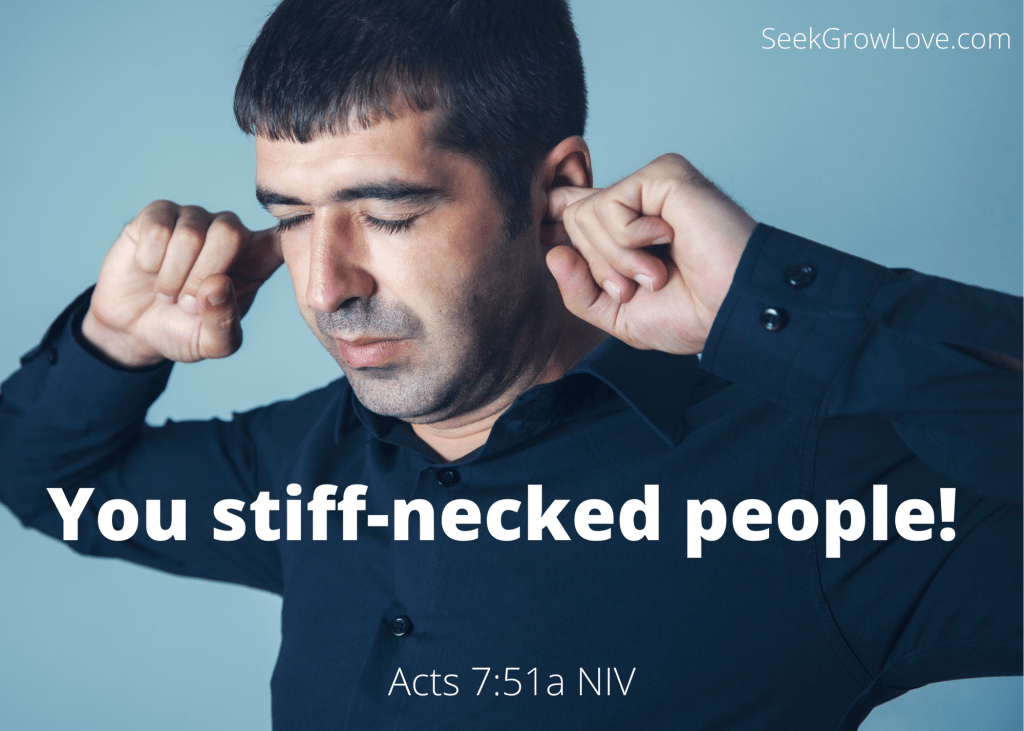
Acts 7:51 – You stiff-necked people, with uncircumcised hearts and ears! You are just like your fathers: You always resist the Holy Spirit! (NIV)

Stiff-necked…bull-headed…stubborn…headstrong…obstinate…when we use these kinds of words to describe someone’s mindset, it’s never a compliment. 

For a brief moment, let’s put ourselves in the sandals of the Jewish leaders that Stephen is speaking to in Acts 7. They had the strongest of convictions. They truly believed that what they stood for, what they expected others to conform to, was to follow the Law given to Moses, rather than to submit to the teachings of Jesus. 

As believers we are also called to hold fast. To stand firm. To believe and not doubt. So what’s the problem?

The Jewish leaders were putting their faith in a system, rather than the Spirit of God. They believed that by following all the rules set forth in the Law, that they would be saved. Stephen is trying to convince them that instead, they need to submit to the Holy Spirit in order to be saved. 

Changing the way that you think about something, especially about a conviction you have, is not easy to do. But that’s exactly why we need to rely on God’s power instead of our own wills. The Holy Spirit is a gift given to us to soften our hearts; to transform our minds, to reveal truth. If we can be more committed to being sensitive to the messages God places in our inner beings, than we are dedicated to a system of rules and regulations, we can finally live the lives that God calls us to experience.     

It’s time to put aside your own system of beliefs. The abundant life starts with seeking God with all your heart.

-Bethany Ligon

Questions for Reflection and Discussion

  1. How would you describe the difference between being stubborn and standing firm?
  2. Can you think of a time when your convictions made you stiff-necked, and you missed (or nearly missed) an opportunity to be led by the Holy Spirit? If you can’t think of a specific time, what might it look like?
  3. What do we learn about Stephen in Acts 7? What do we learn about God in Acts 7? How can what we read in this chapter change our mindset and actions this week?

See What You Can Do

1 Samuel 25-26 and Acts 7

In 1 Samuel 25 we are introduced to Abigail. If you haven’t yet – go read her story now. Abigail – intelligent and beautiful, a safe place for the servant to come speak truth, she “lost no time”/”quickly” – woman of decisive action, generous gift-giver, humble and contrite, willing to accept blame (even when it more rightly belonged to her husband instead), thinking ahead to future ramifications, eloquent, known and praised for good judgment, discerning and a peacemaker. Not promoting peace by just keeping her mouth closed or looking the other way, but from speaking up and standing up for what is right and just.

I can learn a lot from Abigail, as well as from her servant. The servant who warned Abigail of her husband’s foolish treatment of David confided in her and said, “Now think it over and see what you can do, because disaster is hanging over our master and his household” (1 Samuel 25:17). Think it over – and see what you can do. Wise words of advice from the servant. I too often overthink myself into non-action. I get stuck in the ‘think it over’ stage. I might feel I have discerned a situation well and see the foolishness, wickedness or injustice but become paralyzed by what to do about it by overanalyzing or fear of getting personally involved. Or, just as unhelpful – I can come up with lots of solutions of what other people could or should do to fix the problem. But not Abigail. She thought it over and saw what she could do and “lost no time” in getting it done. Twice it says she “quickly” mounted or dismounted her donkey. She is wasting no time hem hawing around. There is action to be taken – and she will do it.

However, even though Abigail acts decisively and quickly – she also avoids erring on the side of rash, reckless behavior she might regret later. When she returns home to a drunk husband she doesn’t engage him then but waits til morning to tell him of all that had transpired. She still takes the time to wisely interpret a situation and choose the best time, not necessarily the first chance, to intervene and speak.

And, God takes care of the rest. I imagine it was scary for Abigail to approach David and then confront her husband – not knowing how either of them would react or what it would mean for her future. When we are called to act we usually don’t know what the results will be – either short or long-term. But we can know that God is faithful in providing for His children who have stepped out in faith to right wrong and peacefully pursue justice.

But wait – how did God provide for faithful Stephen in Acts? Like Abigail, Stephen was also a courageous, eloquent person of action and wisdom who boldly served his master and spoke for his king, Jesus, in the face of wicked opposition. He saw that disaster was hanging over all those who had rejected Jesus and he had considered what he could do – speak in Jesus’ name. And he did it faithfully, regardless of the outcome. A life cut short and the agony of being stoned to death doesn’t seem like much of a reward for bravely doing the right thing. But, when you read the description of Stephen there is an amazing amount of peace. He is not in fear or second-guessing his words or actions. He is full of the Holy Spirit and he is allowed a glimpse into heaven and sees, “the glory of God, and Jesus standing at the right hand of God.” (Acts 7:55). Even at his last moment before “falling asleep”, he is at peace with his Lord Jesus and even with his adversaries.

We don’t need to know the immediate outcome before courageously taking action and speaking up for what is right. Disaster is indeed hanging over so much of the world today. It is time for God’s children to think it over and consider what each one can do. And then take action, quickly mount your donkey, open your mouth, speak His words. You can be confident – you might not know the outcome, but God’s got His children.

-Marcia Railton

Today’s Bible reading passages can be read or listened to at BibleGateway here – 1 Samuel 25-26 and Acts 7

David and Stephen

1 Samuel 23-24 and Acts 6

Today’s Old Testament reading includes strong, powerful David sparing King Saul’s life in a cave when he could have easily taken revenge and killed the king, clearing the way for his own rule and prosperity. Strong, bold, but full of mercy and God-fearing appreciation for those God had placed in power.

Today’s New Testament reading tells of Stephen, “a man full of God’s grace and power, did great wonders and miraculous signs among the people” (Acts 6:8). But, not everyone was a fan. Just as David and Jesus had run into opposition, now it was Stephen’s turn. Jealousy, arguing, false witnesses ensued. Stephen remained steadfast. I love the descriptions of this man. Those who argued against Stephen, “could not stand up against his wisdom or the Spirit by whom he spoke.” (Acts 6:10) and even the Sanhedrin saw that, “his face was like the face of an angel” (Acts 6:15). We will read more of Stephen’s story tomorrow.

Motherhood is on my mind today. The characteristics displayed in today’s reading of both David and Stephen are characteristics I want to help develop in my children. Strong, bold, full of grace and wisdom and the Spirit of God, also able to face opposition and remain steadfast and godly.

We do not hear anything about Stephan’s family or mother. We know very little of David’s mother – though in yesterday’s reading we learned that he cared for and provided for the safety of his mother and father when Saul was seeking to kill David (1 Samuel 22:3). Just like the Disney princesses (and princes), they seem to have grown and developed with no maternal influence mentioned. But, we know, for better or worse every child ever born has had a mother. It is perhaps a good reminder to me that God doesn’t NEED me to grow my children into the Davids or Stephens or Hannahs or Marys he wants them to be. But, what a privilege to get that opportunity to do my best in His Spirit to develop those characteristics in my children. And, I am so thankful for the mother who did that for me.

-Marcia Railton

Today’s Bible reading passages can be read or listened to at BibleGateway here – 1 Samuel 23-24 and Acts 6

Are You Opposing God – 0R – Facing Opposition for Him

acts 6 9a 10

Acts 6b and 7

Yesterday, we left off with the 7 qualified individuals being chosen to take a load off of the apostles. One is given more attention than the rest. We see that because the power that was once seen in Christ, started to be seen in the disciples and now has moved on to other believers. Stephen is said to be full of grace and power and he started performing wonders and signs among the people.
Again we see the religious leaders take offense and try to squash any threat to their power and authority. As they stood up to dispute Stephen they quickly realized they could not outsmart or outwit him. So, as with Jesus, when they were unable to come up with a way to take him out on merit they made something up. They lied – and created a plan with multiple witnesses aligned with a fictional story to take out their problem.
All of chapter 7 is Stephen giving a summary of a year’s worth of children’s Sunday school material. He gives the details of Abraham, Isaac, Jacob, Joseph and Moses. He shows how God was at work throughout time and the constant opposition that faced Him, and then Stephen throws these man into that group. Stephen calls them uncircumcised in the heart and ears. He then points out that again God has been at work and when the story is retold – they would be the bad guys that opposed God and further the ones that killed the promised righteous one!
And like Jesus – he was put to death. They raised up stones to kill him and also like Jesus he asks for their forgiveness. Wow – to stand in the face of opposition and talk with conviction. He didn’t back down when it got difficult.
Our Christian walk at times has become too easy. As Stephen’s speech indicated; all throughout history, whenever someone made a stand for God, they eventually faced opposition. If we are not facing opposition, maybe people do not know where we stand. In John 16:33, Jesus tells us we will face  trials, trouble, opposition, suffering, sorrows, tribulations (depending on your translation). Not a maybe or some will – instead a certainty that we will all face.  As we make a stand for what is right we prepare for opposition knowing we can have peace while dealing with it because the verse doesn’t end there. It continues to say “Take heart, for I have overcome the world”.
What I pull most from the first few chapters of Acts is this: God has given His spirit, His power, so that we will go out into the world with BOLDNESS proclaiming the truth with love.
-John Wincapaw

Better Than Nothing

acts 7 53

Read Acts 7 then watch this!

https://www.youtube.com/watch?v=oArDFU_IESQ


If you grew up watching Disney movies, then you most likely have heard Thumper’s most famous tagline. It’s easy to remember and fun to say while trying to mimic Thumper’s voice. “If you can’t say something nice, then don’t say nothing at all.”

This line is misleading. It gives the impression that the only things we should say should be nice. (Or at least considered nice.) It is wise to use caution when saying less than nice things; however, they are still necessary for the edification of the church. If Jesus spoke nicely about everything where would we be? He probably would not have done everything he did, He might not have died and been raised if he was nice to everyone.

Speaking truth is not always easy or fun. It is often the most difficult thing to do. In Acts chapter 7 Stephen is speaking things against the temple council and their actions with handling Jesus. Stephen tells them they care more about what their ancestors have to say than God. He also calls them out on worshiping the temple and not God.

If that wasn’t enough Stephen says this “You men who are stiff-necked and uncircumcised in heart and ears are always resisting the Holy Spirit; you are doing just as your fathers did.” Did you catch it? He called them stubborn and heartless! Ouch, that’s not very nice. What would Thumper’s father say about that one?

Here is my take away, sometimes the truths we need to say aren’t always nice or well received but are needed to break down walls, so the holy spirit is able to change others and ourselves. That change we experience from the truth being told is way Better Than Nothing.

Here is my second takeaway, TACT is important. That is why I like to follow up with a compliment after the truth has been said.

Thanks, everyone for reading this week.  I hope to see you at FUEL!

Jesse Allen