
Fools and Folly

Old Testament: Jeremiah 46-48
Poetry: Proverbs 26
New Testament: Jude


In writing these devotions, I’ve been hoping to bring up my favorite villain of all time, Dr. Heinz Doofenshmirtz, of Phineas and Ferb fame (which is the best animated series of all time and the only argument against that fact I will entertain is Veggie Tales). Most villains are cruel and cunning, and I just can’t relate to that. Dr. D doesn’t really aspire to be cruel, he just wants to control people in the Tri-State area. After being a mom and nurse, I understand wanting to control people to save them from bad choices..but I digress. The thing I like the most is that for a villain, Dr. D is completely harmless and hilarious. Sometimes his plans are foiled by his nemesis, the hero, Perry the Platypus, but most of the time Dr. D is his own worst enemy. His own folly is the means to his destruction, usually because he builds in a self-destruct button in
all of his inventions designed to take over the Tri-State area. Dr. D is definitely a character whom I would consider a fool, super funny, but a fool nonetheless.


In all of the readings today: OT, Proverbs, and NT, we are told of all sorts of foolish people. In Jeremiah 46-48, God is spelling out exactly what is going to happen to the people/cities who chose to disobey Him. Disturbing reading to say the least. I think the thing that is most disturbing is that these people are purposely foolish. They were warned by Jeremiah repeatedly to return to God, but they would not.


In Proverbs 26, we are given a list of the things foolish people do. Verse 27 has happened to Dr. D. in several episodes of Phineas and Ferb. Verse 11 is a favorite of kids who like to be gross, but points out something fools are famous for: repeating their stupid actions. My favorite quote from Dr. D is what he says after his plans are waylaid: “Well, live and learn.” I quote this all the time. But Dr. D never seems to learn, he makes the same mistakes time and again. He indeed is foolish.


In Jude, we read the letter written to those who have very eagerly decided to follow Jesus Christ, Jude’s brother. Jude writes this letter both to encourage these people but also to warn them about the most dangerous fools of all, those who call themselves Christians but purposely teach falsehood. Just as in 2 Timothy 4:3, fools were claiming to be teaching the word but were in truth teaching what people wanted to hear. Sadly, my brothers and sisters, this is not a problem of the past. I fear we are seeing an even greater number of so-called churches allowing people to teach a gospel of “your truth.” Just this evening as I was mulling the scriptures I had read, I came across a “Not the Bee” article that discussed a preacher or “pastrix” as she calls herself, telling her congregates that God lied to Eve and it’s a good thing Eve ate of the apple so
women would have the agency to make choices over their bodies. And you know where she is going with that line of thinking. This is exactly what Jude was talking about. This is not harmless foolishness. This is the foolishness that leads to death, both in this lifetime and the age to come.


As dangerous as these fools are, we are given the equipment to recognize false teachings and rebuff them. Take up the full armor of God (Ephesians 6: 10-18), Hide the word of God in your heart ( Psalms 119:11), and study, study, study (2 Timothy 2:15)!

-Maria Knowlton

Reflection Questions

  1. What foolish things have you done more than once? How’s that vomit tasting? GROSS!!!! But I couldn’t resist. Do you foresee yourself doing it yet again? How might you be able to train yourself to NOT do it again?
  2. What foolish false teaching are you aware of today? How can you tell it is false? Why do you think others are believing and following after it?
  3. Why do you think the people of Jeremiah’s day were so set on doing life their way when God was so clear about what the consequences would be? Are there any differences today?

You Are Here

Numbers 33-34

Numbers 33 53 NIV

I like “You Are Here Signs” and I am always pulling up navigation on maps. In a mall or an amusement park, I can quickly see where I am going and how to get back to the place where I parked. The Lord offers us spiritual navigation as well. In James we are told to do what the word says. It states, “whoever looks intently into the perfect law that gives freedom, and continues in it—not forgetting what they have heard, but doing it—they will be blessed in what they do.” We are to look intently into the scriptures (study) and do (apply) what we discover. We are offered blessing from this. So why do we miss out? I am afraid that we are sometimes like the Israelites were. But thankfully we have this account of their lives to be an example to us. We don’t want to imitate this generation of people whose hearts went astray and did not know God’s ways (Psalm 95:10).

In Numbers 33, Moses recorded the Israelites’ journeys at the command of the LORD. You can even find online maps that visually show their journey and wandering.  This 40-year journey could have been traveled in days. It was approximately the distance I currently am from Chattanooga, TN. According to maps, only a 70-hour walk. Moses recorded where they had physically been and God provides direction on what they are to do next. They are to take possession of the land, drive out the inhabitants and settle in it. The next generation was being offered the opportunity to receive the land. The boundaries are established and the leaders are put in place to assign the land (Numbers 34).

The Israelites face the choice of allowing the Canaanite societies steeped in abominable practices like child sacrifice and cult prostitution to remain or to begin a nation that faithfully looks to God and practices His commands.

In our lives today, we are faced with the choice to let society give us our moral standards or to connect so closely with God that He is directing our moral standards. When we fully trust and love our God we can know that He is leading our lives. He shows us where we are and He encourages us to keep moving toward our inheritance of the kingdom of God.

“Listen, my beloved brethren: did not God choose the poor of this world to be rich in faith and heirs of the kingdom which He promised to those who love Him?” James 2:5


Rebecca Dauksas


Today’s Bible passage can be read or listened to at https://www.biblegateway.com/passage/?search=Numbers+33-34&version=NIV

Tomorrow’s reading will be Numbers 35-36 as we continue the 2020 Chronological Bible Reading Plan


Paul Speaks Freely

image (3)

Acts 26

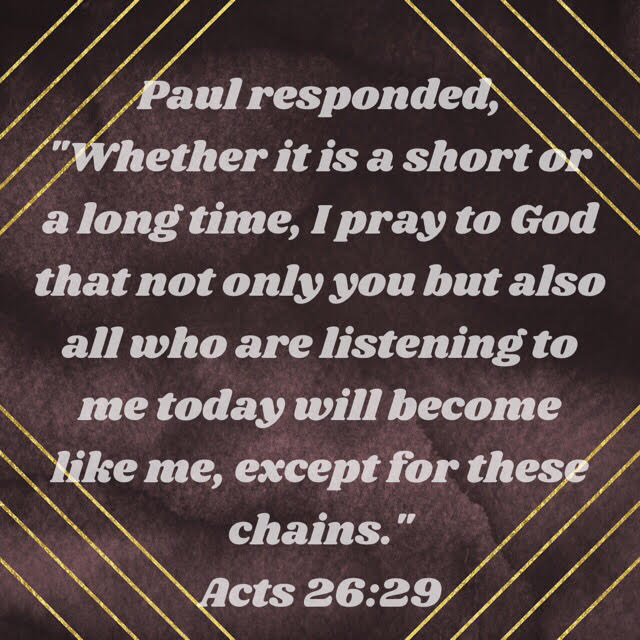
Because of his appeal to Caesar in chapter 25, Paul was guaranteed his next trial would take place in Rome. So when Paul stood before King Agrippa and other dignitaries, he wasn’t required to defend himself or give testimony. Having said that, Paul wasn’t going to pass up an opportunity to witness about the works God had performed in his life–this was one of his life’s missions. So Paul, being able to speak freely, gave his most passionate testimony yet.
There are three things we should learn about apologetics (defending the Christian faith) from Paul’s final defense before he headed to Rome.

1. Know Your Stuff.

Although Festus called Paul crazy, he recognized him as a man of great understanding. Going back to his days as a Pharisee, Paul demonstrated his great zeal for truth and reason. He didn’t lose this enthusiasm when he became a follower of Jesus, he refocused it. Paul knew the Hebrew sacred writings better than anyone and was a master at reconciling the long-held truths of Scripture with his new-found recognition of Jesus as Messiah. Paul was also well learned in the other philosophies and religions of the day. This is most clearly seen in his visit to Mars Hill.
If we are going to be able to defend our faith, we must be knowledgable of both the ideas of Scripture and those contrary to them.

2. Live Above Reproach.

One of the most common critiques leveled against Christianity today is that its adherents are hypocrites. Nothing ruins credibility more effectively than saying one thing then doing the opposite. The Jews had quite a difficult time trying to get charges against Paul to stick. As has been mentioned before, Paul strived to live life with a clear conscience. So in order to discredit and disgrace Paul, the religious leaders had to contrive charges against him.
To be an effective witness and apologist for the Christian faith, we must also strive to live with a clear conscience.

3. Be Positive.

Another issue some have with Christians is that they can be too harsh when talking about their faith. Street preachers and picketers are tuned out and labeled as unfriendly fanatics (or worse) by passersby. Sadly, they are the only representatives of Christ some people every meet.
When Jesus was harsh it was with those who should known better (the religious elite). When Paul was trying to convince unbelievers of the wonderful nature of the Good News, he would do so in a positive way–highlighting things like the resurrection, the power of God, and the mercy He extends to sinners.
The truth is that there are certain tenets of Christianity that non-believers don’t like. When witnessing we should focus on the recognized positives of the faith that appeal to most people–mercy, justice, eternal life, etc. Once people start understanding things like the nature of God and morality, then we can start discussing the perceived negative doctrines of Christianity.
Paul was knowledgeable, had a clear conscience, and was positive when defending his faith and promoting the Good News. The power of the Gospel message is amazing and life-changing. If we want to further its reach and be better able to defend it, we must follow these three principles from Paul.
-Joel Fletcher