Sharing the Gospel

1 Samuel 5-6Psalm 46Acts 26

-Devotion by Kristy Cisneros (SC)

Today’s reading in 1 Samuel 5-6 is so thought-provoking. I can’t help but wonder, how could these people be directly confronted with the power of God and not be convinced to follow Him as the one true God and to forsake all other gods? They literally witnessed firsthand the terrifying wrath of God Almighty as they were plagued with tumors and their “god” Dagon was reduced to a beheaded and dismembered statue. In our modern times, it is truly mind-boggling to me that anyone can see the beauty and splendor of earth (the variety of flowers, trees, natural landscapes, etc.) and our amazing bodies (immune system, regeneration, etc.) and conclude it happened by mere explosive chance. It reminds me that we can’t take it personally when people don’t accept the gospel message in spite of our best efforts. We have to be faithful that God knows hearts and He can find a way to reach them if their hearts are open. Today’s reading in Acts 26 is such a great testimony to that concept. Paul testifies to King Agrippa about his actions toward Christians while he was a Pharisee:

9 In fact, I myself was convinced that it was necessary to do many things in opposition to the name of Jesus of Nazareth. 10 I actually did this in Jerusalem, and I locked up many of the saints in prison, since I had received authority for that from the chief priests. When they were put to death, I was in agreement against them. 11 In all the synagogues I often punished them and tried to make them blaspheme. Since I was terribly enraged at them, I pursued them even to foreign cities. (CSBA)

God knew Paul’s heart and he used Jesus Christ to reach Paul. Paul had to literally be struck blind before he could finally “see” the light. We are wisely advised in Matthew 10:14 regarding what to do when others reject the gospel message we share:

14 And if anyone will not receive you or listen to your words, shake off the dust from your feet when you leave that house or town.

It’s also important to remember that we could be planting a seed that might bear fruit down the road because God will see to it that it comes to fruition based on that person’s heart. 1 Corinthians 3:6-9 reminds us of this important point:

6 I planted, Apollos watered, but God gave the growth. 7 So neither he who plants nor he who waters is anything, but only God who gives the growth. 8 He who plants and he who waters are one, and each will receive his wages according to his labor. 9 For we are God’s fellow workers. You are God’s field, God’s building. (ESV)

In the meantime, we must not give up as advised in Galatians 6:9:

9 Let us not become weary in doing good, for at the proper time we will reap a harvest if we do not give up. (ESV)

When I signed up for today’s devotion, I did so specifically because Psalm 46 is one of my absolute favorite passages in the Bible; therefore, I can’t end this devotion without tying in this beloved chapter. This passage is a great reminder that when we encounter trouble in this world (including resistance to the gospel message), we can be comforted by verse 1 that “God is our refuge and strength, a very present help in trouble.” (ESV) Be obedient and share the gospel message, and then give it to God.

9 The Lord of hosts is with us; the God of Jacob is our fortress . (ESV)

Reflection Questions

  1. What were some of Paul’s experiences in sharing the gospel message?
  2. What have your experiences been in sharing the gospel message? Do you let the fear of, or past negative reactions keep you from trying?
  3. What can you learn from Paul?
  4. What makes God and His Son so worthy of sharing with others? What happens when we don’t?

Prayer

Dear Heavenly Father, You are the One True God – worthy of all praise and worship and worthy of our dedication to sharing the good news. I confess the times I have not taken advantage of all the opportunities You place before me to share what a great, worthy God You are. Help me be who You want me to be. Help me learn from Paul and boldly, with a heart of compassion and urgency, share with others who You are and what You and Your Son have done and will do. Thank You for opening and changing hearts and being the help I need today.

Paul Preaching Jesus

Theme Week: Review of Paul – Acts 26

Old Testament: Ecclesiastes Intro (below)

Poetry: Psalm 49

            In the Movie, Forrest Gump, the titular character, Forrest Gump, met three different Presidents in the Oval office.  First, he met President Kennedy while a member of the All-American football team. He later met President Johnson to receive the Medal of Honor. Finally, he met President Nixon to receive an award for player of the year while on the national Table Tennis team.  Of course this was all fiction, but wouldn’t it be kind of cool to actually be invited to meet the president?

            As we review Paul this week, today we read in Acts 26 that Paul was given a chance to meet, not the president, but the King.  Paul appears before King Agrippa.  The back story is interesting and you can read about it in Acts 21-26.  Here’s the Cliff Notes version:  Paul came back to Jerusalem after his third missionary tour, he was accompanied by several people including some Gentile believers in Jesus.  Paul went to the Temple to offer a sacrifice of purification (he was still Jewish and did not want to be offensive to his fellow Jews).  The Jews who opposed Paul for being a Christian used this event as a chance to try to get rid of Paul and falsely accused him of bringing a Gentile into the temple.  Paul was arrested and given multiple trials in several different locations.  This gave him a chance to keep giving his testimony and preaching Jesus Christ in all kinds of high places including before the Jewish ruling court, the Roman Governor, the King of Israel and Paul hoped to ultimately be sent to Rome where he could preach the good news of Jesus Christ to Caesar. 

In today’s reading Paul is on trial before King Agrippa, but he’s using this as an opportunity to proclaim the Gospel to the King.  It’s no small irony that in trying to silence Paul and prevent him from preaching Jesus Christ, his enemies actually gave him a huge platform to preach Jesus Christ.

This reading is helpful in that it shows us an example of how Paul preached Jesus Christ.  He begins by drawing a point of connection between himself and his audience.  He begins by talking about those points that he and King Agrippa both have in common.  He shows respect to Agrippa.  I think this is so important, especially in today’s world where people are so divided and confrontational.  The person of God who seeks to share Christ should treat others with respect.  The only difference between you and an unbeliever is faith.  You may be the first one who is proclaiming Jesus Christ to another.  Don’t demean or put down your audience.  Show them respect.  Honor what truth they already have, even if it isn’t all the truth that you have.  Try to find areas where you can connect with them.  Attempt to build a bridge and not a wall.

Paul talks about his credentials as a faithful Jew who followed the Torah all his life.  He claims his past and who he was, and then he shares how God has brought something new into his life through faith in Jesus Christ.

-Jeff Fletcher

Reflection Questions

  1. What key points can be learned from Paul about how to preach Jesus Christ? Of those you list which is an area you you could use some experience or refinement?
  2. How well do you show respect to unbelievers? Why is it important? What happens when we don’t?
  3. How are your bridge-building skills? Think of a specific unbeliever you would like to have a conversation with about Jesus. How can you show them respect? What do you have in common already? What pieces of truth might they have that you can acknowledge? Why do they need Jesus? Why do they need you to tell them?
  4. Where has God placed you to share about His Son?

Ecclesiastes Introduction

Solomon (the teacher), the son of David wrote the book of Ecclesiastes to probe the meaning of life.  Solomon attempted to find fulfillment in every pleasure he could imagine – only to find that everything was meaningless.  He then pursued accomplishments, and found that they were meaningless as well.  In fact, without God, everything is utterly meaningless.

Most of the book is pretty depressing until we get to chapter 12, where Solomon finally revealed his insights in verses 13 and 14, “Now all has been heard; here is the conclusion of the matter:  Fear God and keep his commandments, for this is the whole duty of man.   For God will bring every deed into judgment, including every hidden thing, whether it is good or evil.

-Steve Mattison

Our Hope in God’s Promises

Acts 26

May 14

Once again, Paul has a chance to give his testimony.  He is respectful.  He boldly states “it is because of my hope in what God has promised our fathers that I am on trial today.” v.6

God promised the Israelites blessings. 

Genesis 12:3 -I will bless those who bless you, and whoever curses you I will curse; and all peoples on earth will be blessed through you

God promised the Israelites redemption. – A savior messiah who would be the once and forever sacrifice for sin.    

Deuteronomy 18:15 – The Lord your God will raise up for you a prophet like me from among you, from your fellow Israelites. You must listen to him.   

Romans 3:23-25 “for all have sinned and fall short of the glory of God, and all are justified freely by his grace through the redemption that came by Christ Jesus. God presented Christ as a sacrifice of atonement, through the shedding of his blood—to be received by faith. He did this to demonstrate his righteousness, because in his forbearance he had left the sins committed beforehand unpunished.”  

Psalm 16:10  – Because of this, all men have the hope of eternal life. 

Titus 2:14- who gave himself for us to redeem us from all wickedness and to purify for himself a people that are his very own, eager to do what is good.

Paul stayed focused.  And so must we.

God promised the Israelites land. 

Deuteronomy 34:4 – the Lord said to him, “This is the land I promised on oath to Abraham, Isaac and Jacob when I said, ‘I will give it to your descendants.’ 

Blessings, redemption, eternal inheritance in the kingdom on earth.  These promises are ours as well.

-Annette Osborn

Questions for Reflection and Discussion

  1. Reading Paul’s testimony in Acts 26, what are you most impressed by?
  2. What promises of God give you great hope?
  3. How can you share that hope with others?

Paul Speaks Freely

image (3)

Acts 26

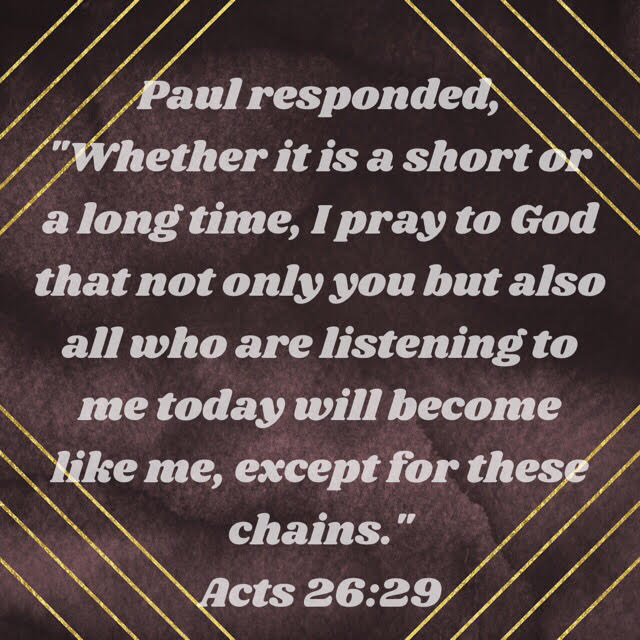
Because of his appeal to Caesar in chapter 25, Paul was guaranteed his next trial would take place in Rome. So when Paul stood before King Agrippa and other dignitaries, he wasn’t required to defend himself or give testimony. Having said that, Paul wasn’t going to pass up an opportunity to witness about the works God had performed in his life–this was one of his life’s missions. So Paul, being able to speak freely, gave his most passionate testimony yet.
There are three things we should learn about apologetics (defending the Christian faith) from Paul’s final defense before he headed to Rome.

1. Know Your Stuff.

Although Festus called Paul crazy, he recognized him as a man of great understanding. Going back to his days as a Pharisee, Paul demonstrated his great zeal for truth and reason. He didn’t lose this enthusiasm when he became a follower of Jesus, he refocused it. Paul knew the Hebrew sacred writings better than anyone and was a master at reconciling the long-held truths of Scripture with his new-found recognition of Jesus as Messiah. Paul was also well learned in the other philosophies and religions of the day. This is most clearly seen in his visit to Mars Hill.
If we are going to be able to defend our faith, we must be knowledgable of both the ideas of Scripture and those contrary to them.

2. Live Above Reproach.

One of the most common critiques leveled against Christianity today is that its adherents are hypocrites. Nothing ruins credibility more effectively than saying one thing then doing the opposite. The Jews had quite a difficult time trying to get charges against Paul to stick. As has been mentioned before, Paul strived to live life with a clear conscience. So in order to discredit and disgrace Paul, the religious leaders had to contrive charges against him.
To be an effective witness and apologist for the Christian faith, we must also strive to live with a clear conscience.

3. Be Positive.

Another issue some have with Christians is that they can be too harsh when talking about their faith. Street preachers and picketers are tuned out and labeled as unfriendly fanatics (or worse) by passersby. Sadly, they are the only representatives of Christ some people every meet.
When Jesus was harsh it was with those who should known better (the religious elite). When Paul was trying to convince unbelievers of the wonderful nature of the Good News, he would do so in a positive way–highlighting things like the resurrection, the power of God, and the mercy He extends to sinners.
The truth is that there are certain tenets of Christianity that non-believers don’t like. When witnessing we should focus on the recognized positives of the faith that appeal to most people–mercy, justice, eternal life, etc. Once people start understanding things like the nature of God and morality, then we can start discussing the perceived negative doctrines of Christianity.
Paul was knowledgeable, had a clear conscience, and was positive when defending his faith and promoting the Good News. The power of the Gospel message is amazing and life-changing. If we want to further its reach and be better able to defend it, we must follow these three principles from Paul.
-Joel Fletcher