
Trust, Gratitude and Humble Prayer

Luke 17:11-18:14

Devotion by Jerry Wierwille (New York)

As Jesus continues his journey toward Jerusalem, he encounters people from all walks of life—outcasts, disciples, religious leaders, and ordinary men and women. In Luke 17:11–18:14, there are various stories and teachings involving miracles and parables where Jesus calls people to deeper trust, genuine gratitude, and humble prayer.

Trust and Thankfulness

This section of Scripture opens with Jesus traveling along the border between Samaria and Galilee. Ten men with serious skin diseases (traditionally translated as “lepers”), who were shunned by society and desperately wanted mercy, call out to him from a distance, saying, “Jesus, Master, have mercy on us” (Luke 17:13). Jesus responds not with an immediate healing, but with a command: “Go and show yourselves to the priests.” As they obeyed, they were cleansed. But while all ten were physically healed, one man (the Samaritan) displayed gratitude which brought him a deeper wholeness—spiritual as well as physical. Jesus tells him, “Your trust has made you whole” (Luke 17:19). The passage reveals that faith and thankfulness are both vital to experiencing the fullness of God’s blessing.

One helpful insight here is that trust often requires action before we see results. The lepers had to begin their journey to the priests while still unhealed. Their obedience was an expression of trust, and as they went, God’s power healed them. Trust, even as small as a mustard seed, has the power to move what seems immovable (cf. Luke 17:6).

Reflect: Where is God inviting you to trust him more, even before you see the outcome? How might cultivating a heart of gratitude open the door to God’s work in your life?

Persistence in Prayer

Jesus then tells the parable of The Persistent Widow (Luke 18:1-8), encouraging his followers to “always pray, and not become discouraged.” The widow’s relentless pursuit of justice before an indifferent judge is contrasted with God’s attentive care for his people. If even an unjust judge can be moved by persistence, how much more will God respond to the cries of his beloved children when they persistently come to Him in prayer?

The parable is about the necessity of persistent prayer and unwavering hope, even when answers seem delayed. Jesus asks, “When the Son of Man comes, will he find trust on the earth?” (Luke 18:8). Our perseverance in prayer is an act of trust and also a testimony to our trust in God’s character.

Reflect: In what prayers do you need to be more persistent? What discouragements in your life can you bring honestly before God, trusting that he hears and cares?

Humility Before God

Finally, Jesus tells the parable of The Pharisee And The Tax Collector (Luke 18:9–14). The Pharisee stands confidently, listing his religious achievements and looking down on others. The tax collector, by contrast, stands at a distance, unable even to lift his eyes, but nonetheless, he prays: “God, be merciful to me, a sinner.” Jesus declares that it is the humble tax collector who goes home “righteous,” not the devout Pharisee. The reason Jesus gives is that “everyone who exalts himself will be humbled, but whoever humbles himself will be exalted.”

This parable reveals that one must be humble when coming before God. Humility, openness, and a childlike posture are essential for receiving the kingdom of God (Luke 18:17). Our standing before God is not based on our prowess, devoutness, or accomplishments, but on our honest need for his mercy, because there is nothing we can do to deserve it.

Reflect: In what ways do you find yourself comparing your spiritual life to others? How can you approach God with greater humility and openness in your heart?

Encouragement

As you read these stories and teachings of Jesus, may you be inspired to trust in God more deeply, return thanks for His goodness and blessing, persist in prayer, and humble yourself before Him.

Jerry works on the REV Bible (revbible.com) as the chair of the REV Translation Committee and the lead NT translator. He also has a podcast on the Book of Proverbs called “Words of Wisdom” (stfi.org/podcasts/words-of-wisdom-podcast) that people can find on Spotify, Apple, Pandora, etc.
Unworthy Servants and Thanksgiving

Theme Week – THANKS: Luke 17

Old Testament: Ezekiel 39 & 40

Poetry: Psalm 108

By Luke 17, Jesus has set his face to go to Jerusalem (Luke 9:51), and every step he takes is taking him one step closer to his ultimate act in this world : his death for sin upon a cross. 

With that in mind, he knows the days of ministry are limited. On the way to Jerusalem, he entered a village, and he sees ten lepers (people who suffer from various skin diseases) who are unable to participate in community life due to laws in the Torah. In a culture like Judea in the time of Rome, family, community and tribe were not just important; they were what gave life connection, purpose, meaning. To get a skin disease which banished you from community was akin to a living death. These suffering people look to Jesus the one who can heal them, as their “Master”. 

Interestingly, the last words Jesus said before speaking to these men, in Luke’s narrative, were of masters and servants. Specifically, masters do have authority over their servants or slaves. They have the authority to command them to work and rest only when the master’s wishes are fulfilled. To post-chattel-slavery-American ears, we recoil in horror about how masters might have treated their slaves. But Jesus’ point isn’t about the actual institution of slavery but about how his disciples should consider their own responsibility when following him : “When you have done all that you were commanded, say, “We are unworthy servants; we have only done what was our duty.”” Jesus wants his disciples (that’s us) to recognize that the God who owns all things owns us, and the savior who saves all people saved us. Therefore, God and Christ deserve all things, and when we give them our all, we are not going above and beyond the call of duty, we are giving God and Christ exactly what they deserve. 

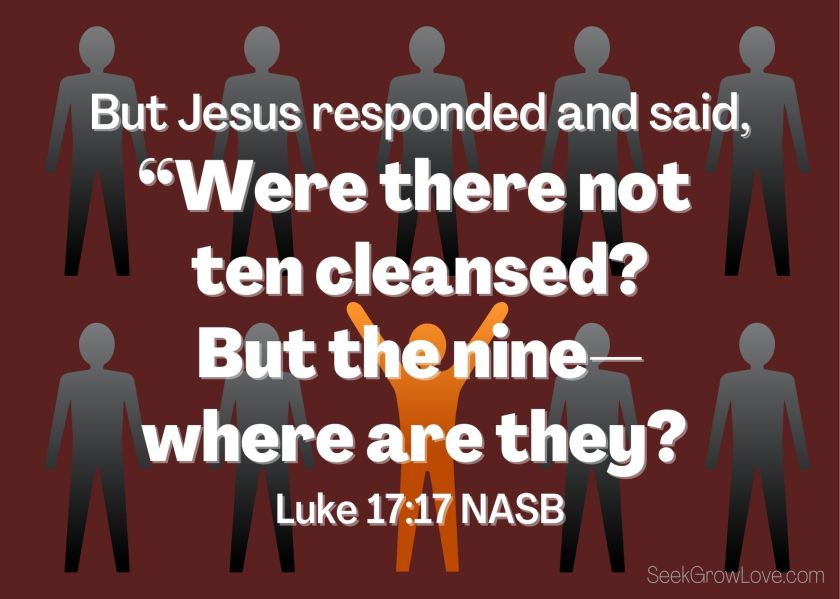
Jesus tells the lepers to go and show themselves to the priest. This is a reference to a priest being able to see if they are “clean” in order to fulfill Torah and allow the unclean to return to community. Note: he does not heal them. He says “go” and “as they went they were cleansed.” It was in the going, it was in the action, the trusting, the faith that they were cleansed, made whole, restored. 

But one stopped. 

One turned around. 

One praised God in a loud voice. 

One fell at the feet of the Master Jesus. 

One gave thanks. 

Jesus seems to expect the other nine, inquires into there whereabouts, but looks with grace at this Samaritan leper-no-more, and says “your faith has made you well.”

Giving thanks is not an element of the Christian faith that moves us from normal to turbo-charged-Christianity

Giving thanks is a vital part of understanding that God, who owns all things, has given us all things. (Rom. 8:32) Giving thanks is a vital part of understanding that Christ, our Master and Savior, gave himself to save us upon the cross, and by his wounds we are healed. (Isa. 53:5-6) Giving thanks is a vital part of the Christian faith, because God and Christ deserve all things, and to give them thanks and to shout loudly the praise of God and fall at the feet of Christ is the most common, natural, expected response to those who have been saved by grace through faith. 

When we give thanks, we are not being amazing, super Christians, wonderful and worthy of praise ourselves. 

When you give thanks and give it all to God, then say, “We are unworthy servants; we have only done our duty.”

-Jake Ballard

Reflection Questions

  1. When we consider our position as Christians, we are slaves, bought from one master (sin, death, the devil) to serve another (God through Christ). Do you bristle at the thought of being a slave or a servant? We are being adopted, heirs of God and coheirs with Christ (Rom. 8:17), but one image doesn’t completely negate the other. Why do you and I feel uncomfortable with being own by the God who already owns everything?
  2. “Your faith has made you well.” I find it interesting that Jesus, who seemed to be very necessary in the completion of the miracle, implies that the man was cleansed by his own faith, as if Jesus didn’t have anything to do with it. Why is this phrase used here and in other miracles? Is Jesus implying that he was not needed or is this humility? How should we understand this phrase to a man who was healed “as he went”?
  3. When was the last time you gave God thanks for everything in your life that you could remember? Try it this week. Everyday, after devotions, spend 5, 10, 15 minutes in prayer, thanking God for everything good in your life, in your family, in the world. Let this week be a week of giving thanks, and still realize that this is our appropriate response to the God who gives every good and perfect gift. (James 1:17)