
Did as They Saw Fit

Old Testament: Judges IntrO Below

Poetry: Psalm 106

New Testament: Luke 6

— Introduction to the Book of Judges —

We don’t know who wrote the Book of Judges, but we do know it records the events immediately after those recorded in the Book of Joshua.  The book of Judges is named after the judges that ruled the land of Israel after Joshua’s death.

Although there are several exciting stories of God’s deliverance recorded in the book, reading the book of Judges can be depressing.  This is because it records the downward spiral of Israel and its relationship with God.  The loop looked sort of like this:

  • Israel would follow God for a while.  
  • Then they would turn away from God and worship idols.  
  • God would punish them by sending invaders to torment Israel.  
  • The Israelites would cry out to God for deliverance.  
  • God would raise up a Judge to deliver them.  
  • Israel would then follow God for a while.  (loop)

One thing that makes reading Judges so frustrating is that with each iteration of the cycle, the Israelites fell further from God.  And their punishments got worse.

Judges 21:25 tells us the root cause of all of these problems, where it says, “In those days Israel had no king; everyone did as they saw fit.”

People did whatever they wanted, instead of following God’s commands.

As you read the book of Judges, I challenge you to compare and contrast your own life with the experiences of the Israelites and see what practical lessons you can apply to your own life.

-Steve Mattison

– – Devotion – –

Imagine waking up one morning in a world where there are no laws. No local police, no elected officials and no military force defending civilians’ rights. Instead, everyone just does what is right in their own eyes. Ok, that is a little terrifying. Yet, the book of Judges tells us twice, “In those days Israel had no king; everyone did as they saw fit.” (Judges 17:6 and 21:25) As we will discover, the Israelites are soon allowing disobedience and selfishness to rule. The covenant with God was broken and they begin to rule themselves. It can be difficult to read the accounts of the people and their judges because they do not seem to have a moral compass. We must remember this is a narrative telling us what they did, not approving of their actions. Human beings NEED the LORD to teach us what we should and should not do. People are excellent at justifying and rationalizing our wrong doing, but thankfully God is there to help us. As Proverbs 21:2 states “A person may think their own ways are right, but the Lord weighs the heart”.

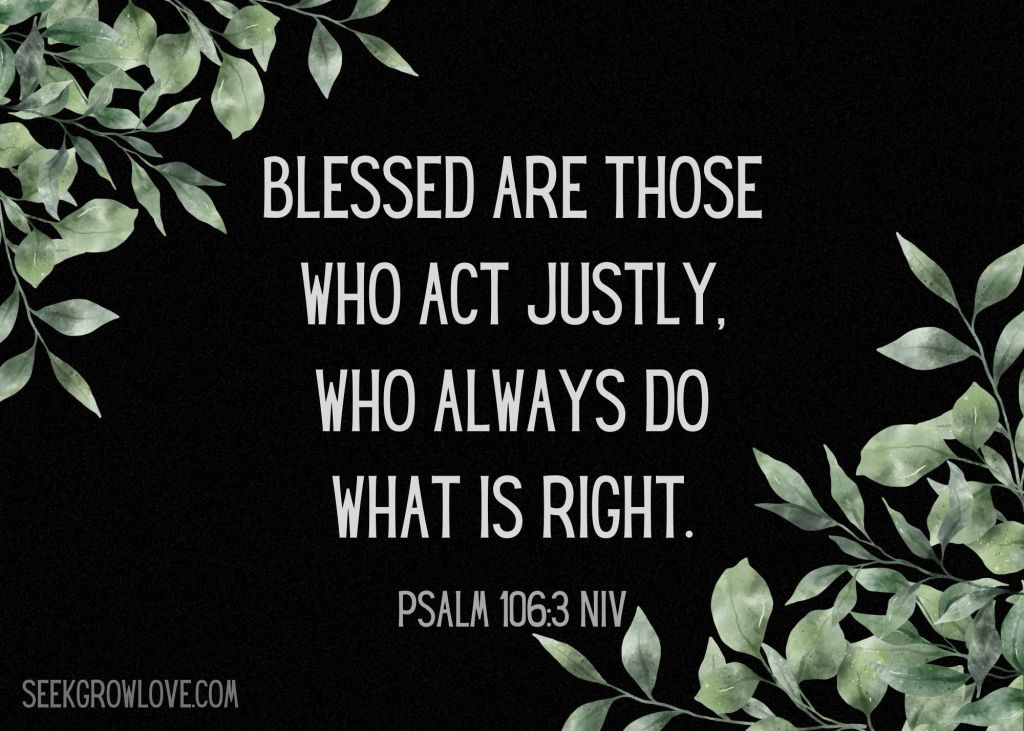
How far did Israel fall during this time period? Psalm 106 states that they shed the innocent blood of their sons and daughters for idol sacrifice to false gods. “They defiled themselves by what they did; by their deeds they prostituted themselves.” (v.39) This Psalm contrasts how good, loving, and mighty the LORD is against the people that reject Him. If we want to be blessed, we must act justly, and do what is right (v.3).

The LORD loves us as a perfect Father. He wants us to be in a close, loving relationship with Him so He has given us the scriptures. Through them we have explanations of good actions and forbidden, sinful actions. Through the scriptures, we have scores of examples of those that chose to follow the LORD. Most of all the scriptures explain who the LORD is. His amazing plan for His creation and an incredible future for His children. It is so important for us to understand and do what the LORD commands us to do.

Thankfully the scriptures also include the instructions of Jesus Christ, God’s Son. His teaching shows us that we can do what is right by putting his words into practice. We can be like the faithful builder that dug down deep and put the foundation on rock. The storms of life can’t tear our faith down because it is well built. (Luke 6:46-49)

-Rebecca Dauksas

Reflection Questions

  1. How important is it to you to do what is right? How do you most often decide what is right and what is wrong?
  2. How important is it to God for you to do what is right? How does He tell us what is right and what is wrong?
  3. What is the result when everyone does as they see fit?
  4. What do we learn about God in today’s Bible reading? What do we learn about His Son in Luke?

Who are You Imitating?

Matthew 5-7

Today’s reading comes from Matthew 5-7.  You may know this as “The Sermon on the Mount”, and this may be among the most well known passages in the Bible.  The Jews Jesus was teaching knew the Old Testament laws really well.  Jesus took this opportunity to focus on what God really requires – he focused on matters of the heart, not just following the letter of the law.

For example, the old law said, “Do not murder, and anyone who murders will be subject to judgment.”  Jesus took it further and taught, “But I tell you that anyone who is angry with his brother will be subject to judgment.”  This is a difficult teaching, but wait – there’s more.  

Then, in Matt 5:42-45, Jesus tells us, “You have heard that it was said, ‘Love your neighbor and hate your enemy.’  But I tell you: Love your enemies and pray for those who persecute you, that you may be sons of your Father in heaven.  He causes his sun to rise on the evil and the good, and sends rain on the righteous and the unrighteous.” – This is even harder to follow.

In this passage, Jesus is telling us more of the reason behind his new rules.  God loves even those who hate him, and he does them good – in spite of their hatred for Him.  And we should imitate this characteristic of God.  Jesus takes this even further in verse 48, where he said, “Be perfect, therefore, as your heavenly Father is perfect.”  – Ok, now this isn’t possible to obey without some serious help from God.

In the Lord’s prayer, Jesus said, “Forgive us our debts as we also have forgiven our debtors.”  Basically, this is asking God to forgive me only to the extent I forgive others.  Jesus then told us plainly in Matt 6: 14-15, “For if you forgive men when they sin against you, your heavenly Father will also forgive you.  But if you do not forgive men their sins, your Father will not forgive your sins.”  – This is a pretty good reason to forgive others! – But still not easy to do.

Then, Jesus tells us in Matt 7: 1-2, “Do not judge, or you too will be judged.  For in the same way you judge others, you will be judged, and with the measure you use, it will be measured to you.”  – Did you catch that?  I will be judged in the same way I judge others.  This is a pretty good reason for me to not condemn others!  This goes back to the old saying, “Hate the sin, but love the sinner.”

As I read these passages, a couple things jump out to me.  First, I need to imitate God as much as possible. Unfortunately, I’m not very good at doing this, so I need to beg for His forgiveness.  Fortunately, He is loving and extends grace.  From His example, I recognize I need to be loving, and extend grace too.

Second, once I recognize I am a worthless sinner, saved only by the grace of God, it’s suddenly easier for me to be less eager to condemn others.  Then, if I can see them through God’s eyes – as other sinners in need of grace – that makes it even easier for me to extend grace to others.  And that grace may take the form of forgiving them, or of not judging them, or even turning the other cheek if they hit me.  On our own, this isn’t possible, but we can do these things with God’s help.  Ultimately, we can (again with God’s help) come to the point of loving or enemies, and blessing those who persecute us.

Jesus closes this section talking about the wise builder (who built on a rock) and the foolish builder (who built on sand).  The wise man was likened to someone who listened to Jesus’ teaching, and put it into practice – building his life on the rock.  The foolish man was likened to someone who listened to Jesus’ teaching, and didn’t put it into practice – building his life without a foundation.  In both instances, storms come.  But only the house built on the rock survived.  By analogy, only the life founded on Jesus’ teachings will not be destroyed.

So again, we find that today’s reading has implications for us today, and for eternity.  And just knowing these truths isn’t enough, we must put them into practice.  Please join me in taking this seriously.  Apply this to your life.  Ask God’s help living up to these requirements that are impossible to accomplish on our own.  Become an imitator of God.  The reward is eternal.

–Steve Mattison

Today’s Bible reading can be read or listened to at BibleGateway here – Matthew 5-7.

Tomorrow’s reading will be Matthew 8:1-13 and Luke 7 as we continue on our Bible reading plan. SeekGrowLove.