
Genesis 49 & 50
*Proverbs 25
Matthew 11
Proverbs is such a fun book -chock full of wisdom about so many subjects and issues, including laziness, generosity, enemies, friends, instruction/counsel/rebuke, rich and poor, pride and humility, anger, self-control, words (that’s a big one that comes up over and over again), and quarrelsome, contentious women!
Wait, what are you talking about Solomon?
I love the feel of the Proverbs. Solomon could have just written it like an instruction book:
Women – Don’t be quarrelsome, people don’t like that.
Men – Don’t marry a quarrelsome women, it would become annoying.
But instead, he gives us some delightful analogies in these Proverbs to remember and learn from. If you’ve been reading along in Proverbs, you might remember coming across some of these, including one in today’s Proverbs 25:
Proverbs 19:13 …And the contentions of a wife are a continual dripping.
Proverbs 21:9 Better to dwell in a corner of a housetop, Than in a house shared with a contentious woman.
Proverbs 21:19 Better to dwell in the wilderness, Than with a contentious and angry woman.
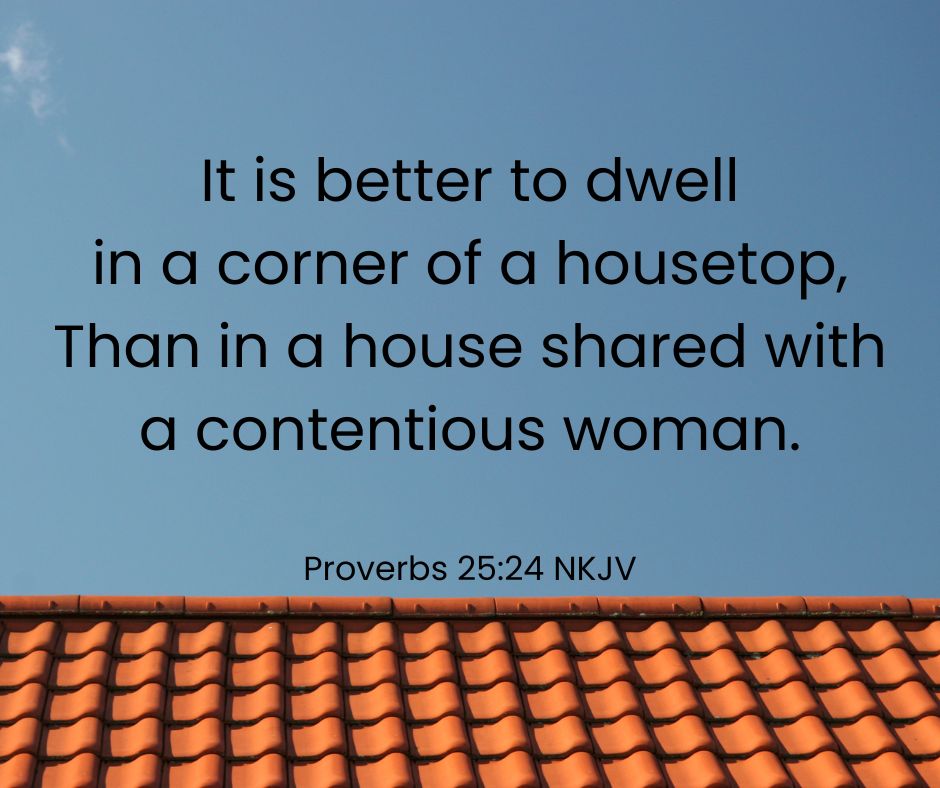
Proverbs 25:24 It is better to dwell in a corner of a housetop, Than in a house shared with a contentious woman. (Because sometimes saying it once isn’t enough.)
Proverbs 27:15 A continual dripping on a very rainy day And a contentious woman are alike;
I know it can be pretty easy to slip into the constant dripping category. We women have opinions and sometimes we are pretty sure our way is the right way. “I wouldn’t have taken this way to the store.” “That kitchen gadget doesn’t go there when you empty the clean dishwasher.” “Eating that isn’t good for you.” Before we know it, our helpful advice is actually not so helpful.
I want instead to be the excellent, prudent, virtuous, gift from the Lord wife!
Proverbs 12:4 An excellent wife is the crown of her husband, But she who causes shame is like rottenness in his bones.
Proverbs 18:22 He who finds a wife finds a good thing, And obtains favor from the Lord.
Proverbs 19:14 Houses and riches are an inheritance from fathers, But a prudent wife is from the Lord.
Proverbs 31:10 Who can find a virtuous wife? For her worth is far above rubies.
Whether you are married or not, man or woman, it is of great value to pay close attention to the words coming out of your own mouth. Instead of being critical, be supportive. Instead of condemnation, try appreciation. Instead of needing to be right (most often about something that does not matter at all), be kind. Instead of sharing your opinion all the time, be quiet and listen.
Solomon had some wise advice for us all regarding our words, too. Here’s just two of my favorites.
Proverbs 16:24 Pleasant words are like a honeycomb, Sweetness to the soul and health to the bones.
Proverbs 10:19 In the multitude of words sin is not lacking, But he who restrains his lips is wise.
Reflection Questions
- Do a quick look up of the word “word” in Proverbs. What do you find that would be helpful to remember? Where will you put it to remember it? What other word(s) would you like to look up in Proverbs to see Solomon’s advice?
- Our other readings today have some more helpful examples, both positive and negative, for the use of our words. What do you see in Genesis 50:19-21 and in Matthew 11:18-19? How can we keep from having a critical spirit (and mouth) that finds fault with others? How can we offer true forgiveness even when we have been wronged?
- What have you said recently that would have been best left unsaid, or said a different way? When in that situation again, what do you want to do?
Prayer
Dear God, I thank you for the wisdom You gave Solomon that has been saved and preserved and is still so valuable for me today. Help me to seek Your wisdom and apply it daily in my life and in my words and in my attitudes and relationships with others, including those who are closest to me. I confess that some days I might sound like the constant dripping. Help me honestly see and hear myself and make corrections, so my words are pleasant and bring life.


 Seek Grow Love