
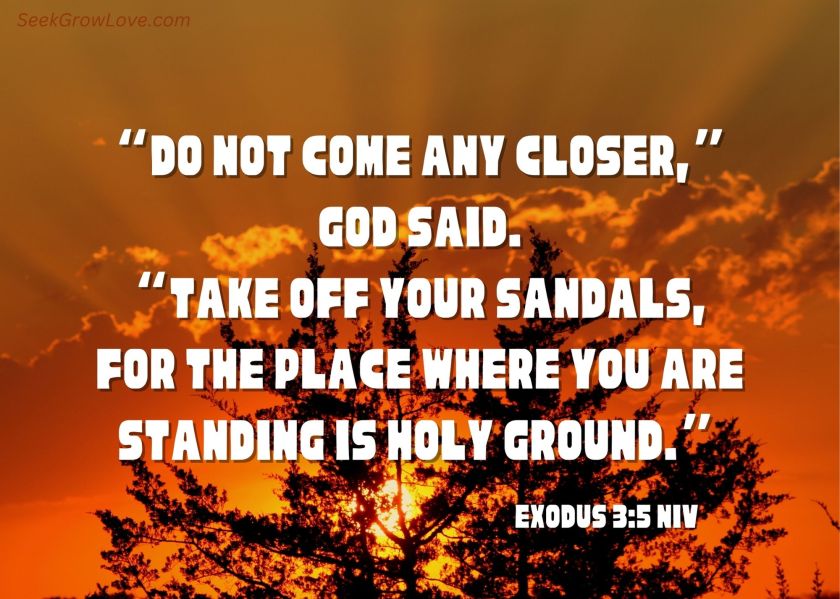
*Exodus 3-4
Proverbs 27
Matthew 12
Devotion by Jeremy Martin (TN)
When we start Exodus 3, the Israelites have been demoted from a position of honor to a position of slavery (Ex 1). Moses was born into these turbulent times and through a series of miracles survived and was promoted to a position of authority, and then fled when he was near 40 and remained in exile for 40 more years (Exodus 2, Acts 7: 23-30). This puts Moses at the spry young age of about 80 years old when the story of the burning bush kicks off in Exodus 3. This is one of the most important stories and chapters in the entirety of scripture for a couple different reasons: firstly, for the first time the concept of “shaliah” is indisputably revealed to us in scripture, and secondly God reveals himself to a human (Moses) by name for the first time in recorded history. There are a few chapters in Genesis where the concept of Shaliah can be strongly inferred, but this is the first time I’m aware of that it’s plainly revealed.
If you are not familiar with this concept, understand it is absolutely critical to understanding scripture. You are apt to get a number of scriptures wrong if you don’t view them from the perspective of it’s original authors, that is to say, the ancient Jewish people. This is what wikipedia states about the Law of Shaliah (it is a legal term):
( Quoting Wikipedia) “In Jewish law, a shaliaḥ (in Hebrew : שָלִיחַ or pl.שְלִיחִים , sheliḥim (pl) or sheliah, literally “emissary” or “messenger”) is a legal agent. In practice, “the shaliaḥ for a person is as this person himself.” Accordingly, a shaliaḥ performs an act of legal significance for the benefit of the sender, as opposed to him or herself. “
This concept is shown to us clearly in scripture by comparing and contrasting Ex 3:2 to Ex 3:4. “And the angel of Yahweh appeared to him in a blazing fire…And Yahweh saw that he turned aside to look, so God called to him from the midst of the bush…” (LSB translation). In essence, the messenger that God sends (be it angel, donkey, or human) speaks with the full authority of God, as if they are God. So when “the word of The LORD” comes to the prophets and they speak, they are speaking with the full authority of the Most High God. When God placed His name in the angel leading the Israelites in Ex 23:20-21, He explained to them that this angel spoke with His authority. When the donkey spoke to Balaam, through the “angel of Yahweh”, it states clearly that “Yahweh spoke” (Number 22:22-28). The one speaking was not the donkey, not the angel, but The LORD (YHVH) Himself (through His agent). This is why it’s so critical to understand Shaliah, because the one who is sent by God speaks with the full authority of God. This does not make the messenger mysteriously transform into God, but God lets us know that this messenger is speaking with the full authority of God so we’d better listen up.
This concept is repeated constantly throughout scripture but a lack of understanding of this concept, along with the introduction of a number of popular Greek philosophies later on, have caused numerous misinterpretations of scripture and much confusion amongst believers. That concept carries over into the New Testament as well. Jesus states in the book of John about 42 times that God sent him: he is not only the Messiah prophesied, but the man chosen to be the Shaliah of God. The title “Christ” in Greek means “The Anointed One”, and we see from the OT that you are anointed by God from among men, so every time you see “Jesus Christ” in scripture, it is an affirmation that Jesus of Nazareth was the prophesied messiah, the anointed one, the man chosen by God to be his Shaliah. Christ is a title, not a name, and it affirms Jesus’ humanity every time it is spoken while at the same time affirming that he speaks with the authority of God.
Exodus 3 is one of my favorite chapters in the bible. In it, God clearly reveals himself through his agent (Shaliah, we just talked about that) by name to a human being, for the first time recorded in history. This is both awesome and humbling: that the creator of all things would reach back out to we who bear His image in another attempt to draw us closer to Him speaks to the never ending mercy and lovingkindness of our heavenly Father. While there is some debate as to the proper pronunciation of the most sacred name (YHVH: is it Jehovah, or Yahovah, or Yaweh….?), the fact remains that He chose to reveal his identity to us, and that is wonderfully beautiful. Some people say that every breath that we breathe, in and then out, whispers the name of God. Try it, and visualize the name. That is also wonderfully beautiful, and seems to me like an amazing “made by” stamp like you might see on the bottom of a fine piece of pottery, but in our very breath. Praise God!
Personally “The LORD” really bothers me. Most of your Bibles will say something in the preface notes to the gist of “…and honoring tradition, all references to YHVH (the actual transliterated name of God) have been translated as “The LORD””. This is a horrible mistranslation, as has led to a whole lot of terrible confusion and mistaken identity later. Let me be very clear: GOD HAS A NAME. He reveals it to us, and gives us a command, in Ex 3:15: “And God furthermore said to Moses, Thus shall you say to the sons of Israel, ‘Yahweh, the God of your fathers, the God of Abraham, the God of Isaac, and the God of Jacob, has sent me to you.’ This is my name forever, and this is My memorial-name from generation to generation.” (LSB translation). Did you know that in the Old Testament, the actual name of God is used almost 7,000 times? Why have we stopped using it when we pray or worship? Think about it.
Reflection Questions:
- If you had seen the burning bush, would you have turned aside to go investigate or would you be too busy with work/school/life?
- How many times in a week do you think that God is trying to get your attention to tell you something important? Of those times, how many times do you stop and listen?
- Do you call on God by name when you pray or worship? Why, or why not?
- When you breathe in and out, and listen closely, do you hear the name of God?
Prayer
Blessed be the Lord God Yahovah, creator of the the heavens and the earth, who has made all things and us with them, who causes the sun to go down and the sun to rise, and all things to be made anew every day. Lord God, renew me today, help me to listen when you are trying to get my attention. Open my eyes so I can see you, and my ears so I can hear you. I thank you in your son Jesus’ name, Amen.
Side Note: A brief mention of 1 of the 2 verses in the Old Testament that baffled me a bit: Ex 4:24 has always confused me. If God had wanted to kill something, it would die, period. In my Bible currently, I have a handwritten note by Ex 4:24 that says “possible confusion among the host?”. I think this is one of 2 verses in the Old Testament that tend to point out that in some very rare instances, and in some minor matters, there may be some level of miscommunication amongst the Shelihim (legal agents of God; the story of Balaam is the other). This is absolutely inconceivable if it were the most high God performing the actions directly, but becomes understandable if beings lower than God are acting on their own perceptions but with God’s authority, particularly if there are multiple agents in play simultaneously. Just a theory.


 Seek Grow Love