-Devotion by Jeremy Martin (IN)
Hebrews 1 is one of those chapters that’s often used by our brothers and sisters with a more “complex” understanding of God as a proof text, and we’ll look at it closely today and with love in our hearts acknowledge the few instances that could seem to point to a more difficult reading, while also examining the majority of the verses that tend to point toward a more simple reading, verse by verse. I was once told by a man I love as a father that “To take any verse by itself as a basis for one’s theology is a mistake. The entirety of scripture should be weighed and measured and the most likely reasonable interpretation based on all scriptures should be the preferred understanding.” With that in mind, and keeping also in mind that we are all human and fall short of the glory and wisdom of God, let’s proceed. I’ll be using the ESV translation primarily, since it’s a pretty mainstream “standard” version that lots of folks use.
Hebrews 1:1- Long ago, at many times and in many ways, God spoke to our fathers by the prophets, There’s really nothing difficult in interpretation here, but I did want to point out the constantly recurring scriptural theme and concept of God interacting with His creation through “agents” or “shaliah”: the prophets, in this instance.
Heb 1:2- but in these last days he has spoken to us by his Son, whom he appointed the heir of all things, through whom also he created the world. We now see that same concept of agency (or shaliah) applied to Jesus (in the same exact sense as the prophets) for God to speak to us, the son whom God “appointed heir of all things”. This is a double point for our specific understanding, because Jesus is being used as an agent (by God) to speak to men, and God has appointed him “heir of all things” (ie, Jesus received that position because God gave it to him). The “through whom also he created the world” is a bit problematic on first reading, but I’d like to point out that the actual word for “world” is “aeonas“, which is more applicable to an “age” or “time”. This word is used 102-128 times in scripture (depending on the manuscripts used) and about half of that time in your bible it’s translated as “age”. The actual strongs translation is: From the same as aei; properly, an age; by extension, perpetuity; by implication, the world; specially a Messianic period. It really depends on your translational bias, so while we can acknowledge in fairness that this could be a difficult text, it seems more likely when considering the entirety of the verse to indicate the simpler understanding that God created this current “age” through Christ.
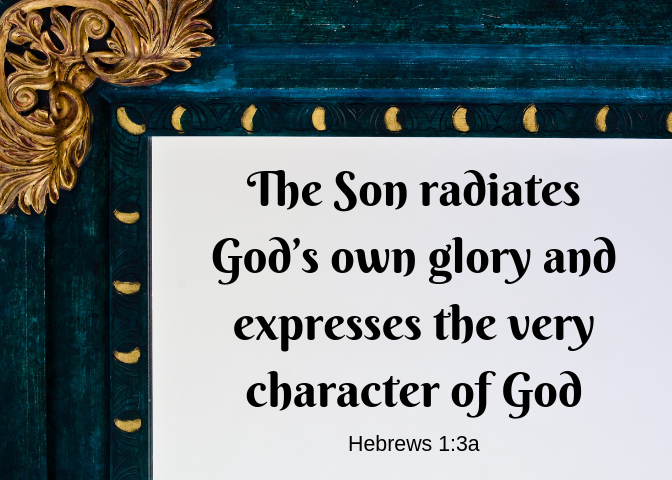
Heb 1:3 He is the radiance of the glory of God and the exact imprint of his nature, and he upholds the universe by the word of his power. After making purification for sins, he sat down at the right hand of the Majesty on high, (ESV)
This is the verse that “more complex” interpreting folks lean into and go “aha! There it is!”, but I’d suggest that the translational bias slip is showing again. The word for radiance here is “apaugasma” (A light flashing forth (from)) which implies a reflection of light rather than an origin. The “exact imprint” is translated from the word “charakter” (From the same as charax; a graver, i.e. engraving, the figure stamped, i.e. An exact copy or representation) and could be (and is) also translated as reflection or image in different versions. It should be noted that being the image of something precludes you actually being that something generally, but let’s look at a few other mainstream translations and compare:
(NASB) And He is the radiance of His glory and the exact representation of His nature, and upholds all things by the word of His power. When He had made purification of sins, He sat down at the right hand of the Majesty on high
(NET) The Son is the radiance of his glory and the representation of his essence, and he sustains all things by his powerful word, and so when he had accomplished cleansing for sins, he sat down at the right hand of the Majesty on high.
The elephant in the room, of course (for our more “complex” interpretation folks) is: if Jesus sat down at the right hand of the Majesty on high (God), and if you believe that Jesus is literally God (and not God’s agent), then is God currently literally sitting beside Himself? That’s confusing, and would on the face of it contradict Deut 6:4 and Mark 12:29-31. I personally opt for a simpler reading, and think the NET translation did a better holistic job of translating into english (this time).
Heb 1:4 -Heb 1:7 are pretty non-controversial, so for the sake of brevity I’ll skip a commentary.
Heb 1:8 But of the Son he says, “Your throne, O God, is forever and ever, the scepter of uprightness is the scepter of your kingdom.
Right now, our more “complex” interpretation brothers are going: “Aha! There! It clearly says “but of the Son” and then “Your throne, “O God”!”, THERE IT IS!”. Granted, that could be a difficult text, by itself, particularly if you are thinking like a modern day English speaking person and assume that the bible was written originally in English (it was not). Dig a little in the original languages, and you’ll see there’s a very good reason there are multiple translations in English. I would propose that to the ancient Jewish mind, any throne or kingdom that God establishes is God’s throne or kingdom, regardless of whom God chooses to rule it. It’s understood (and stated) that the authority to rule is granted by God, and the one who is sent by God acts with the authority of His name and on His behalf (shaliah). This simpler and culturally accurate reading seems like a much better reading particularly when you combine it with the following verse below:
Heb 1:9 You have loved righteousness and hated wickedness; therefore God, your God, has anointed you with the oil of gladness beyond your companions.”
Because the Most High God, by definition, doesn’t have a God. He is the “Most High God” (it’s in the name). Jesus did have a God (John 20:17). We see further that “God has anointed you”…do you recall what “Christ” means? It’s simply, “The Anointed”: anointed by God, your God. God is the anointer, Jesus is the anointee. God is the ultimate authority and power, and He has appointed (see v2) the Christ as the heir of all things. It’s a much simpler and less confusing reading.
Heb 1:10 And, “You, Lord, laid the foundation of the earth in the beginning, and the heavens are the work of your hands;
The “and” here above indicates a transition in subject, we’re now speaking of God again, the creator of heaven and earth, as the following verses also seem to indicate.
Heb 1:11-11:14 are also pretty straightforward, so for the sake of brevity again, I’ll skip a commentary. So looking back over the fullness of Heb 1, I personally don’t find anything with such a difficult reading that I feel the need to alter my beliefs. Any texts that I’ve heard used as proof texts to espouse a different doctrine have variant readings that seem simpler and to make more sense, taken holistically. Please keep in mind, I’m just a human being so I absolutely accept that I could be mistaken. I sit under the authority of scripture and not over it, but digging into these scriptures and examining them closely I feel about 90% confident that I have made a correct interpretation in this instance. I think it’s important to deeply search the scriptures and to be honest with yourself with what you find.
Before we leave today, I’d be remiss if I didn’t at least give a polite nod to our Esther reading, because Esther 1-2 is what I’ve mentally labelled in my mind “The Cautionary Tale of Queen Vashti” as an example of how not to act. We have been given great blessings and favor undeservedly by our God, let’s make sure we don’t get demoted due to our own arrogance and self importance, and removed from our position (Like Queen Vashti was).
REFLECTION QUESTION
When you read scriptures, do you rush through it quickly or dig deep and compare translations and alternate meanings or complexities? Why?
PRAYER
Father God, thank you for giving us Your word. Please grant us the wisdom to understand what You have spoken, and the sense to listen. In Jesus name, amen.