
Old Testament: Deuteronomy 2
Poetry: Job 26
New Testament: Mark 11
As we just celebrated the triumphal entry it got me thinking about 1 aspect of Palm Sunday. The hosannas that the people yelled out to Jesus. What does that mean?
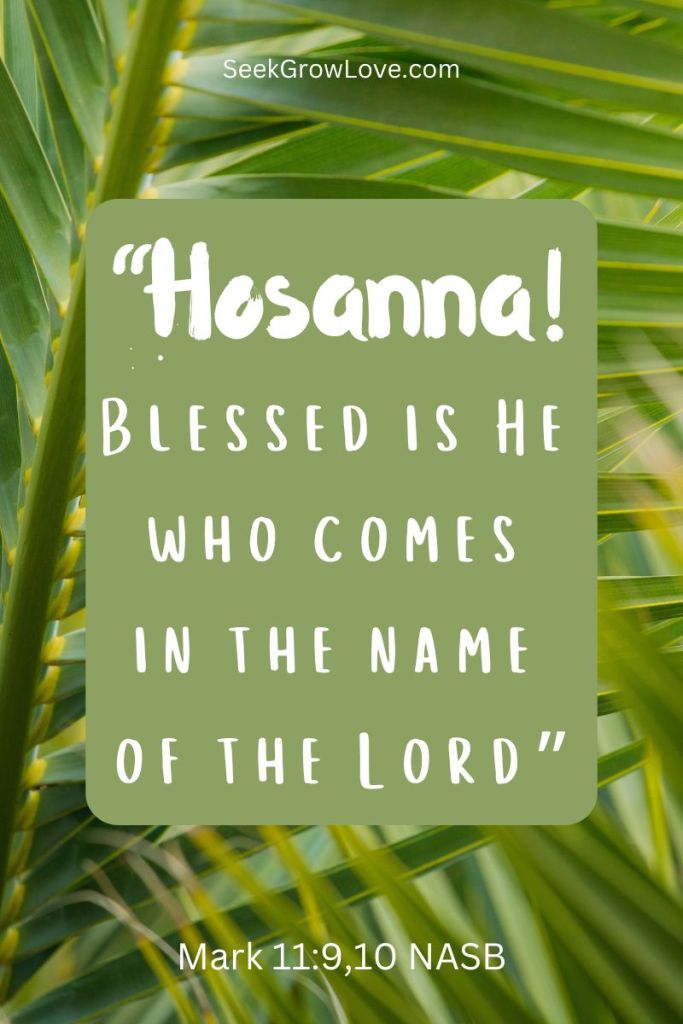
Hosanna is a word used in some songs of praise, especially on Palm Sunday. It is of Hebrew origin: “Hosanna to the Son of David! Blessed is he who comes in the name of the Lord! Hosanna in the highest heaven!” (Mark 11).
Hosanna is often thought of as a declaration of praise, similar to hallelujah, but it is actually a plea for salvation. The Hebrew root words are found in Psalm 118:25, which says, “Save us, we pray, O LORD!”. The Hebrew words yasha (“deliver, save”) and anna (“beg, beseech”) combine to form the word that, in English, is “hosanna.” Hosanna means “I beg you to save!” or “please deliver us!”
So, as Jesus rode the donkey into Jerusalem, the crowds were perfectly right to shout “Hosanna!” They were acknowledging Jesus as their Messiah, as shown in their address “Son of David.” Theirs was a cry for salvation and a recognition that Jesus is able to save.
When is the last time that you have yelled out to Jesus to save you? It’s an important question, and one that needs to be on our lips all the time.
There is nothing more satisfying in all the world than to be followers of a king like Jesus. Picture him riding toward Jerusalem, the rebellious city. A multitude praising him: “Hosanna, blessed, is the king who comes in the name of the Lord.” He knows the praise is shallow. In a few days it will fade away. But does he rebuke them? No. He defends them against the criticism of the Pharisees: “‘Teacher, rebuke your disciples!’ . . . ‘I tell you, if these were silent, the very stones would cry out.'” He knew his days were numbered. He knew their cries were not completely sincere.
The praise the people gave was not because they recognized Him as their Savior from sin. They welcomed Him out of their desire for a messianic deliverer, someone who would lead them in a revolt against Rome. These are the ones who hailed Him as King with their many hosannas, recognizing Him as the Son of David who came in the name of the Lord. But when He failed their expectations, when He refused to lead them in a massive revolt against Rome, the crowds quickly turned on Him.
Within just a few days, their hosannas would change to Crucify Him.
Those who hailed Him as a hero would soon reject and abandon Him.
The story of the triumphal entry is one of contrasts, and those contrasts contain applications to us. It is the story of the King who came as a:
servant on a donkey, not on a white horse.
not in royal robes, but on the clothes of the poor and humble.
Jesus Christ comes not to conquer by force but by love, grace, mercy, and His own sacrifice for His people.
His is not a kingdom of armies and splendor but of lowliness and servanthood.
He doesn’t conquer nations but hearts and minds. His message is one of peace with God.
If Jesus has made a triumphal entry into our hearts, He reigns there in peace and love. As His followers, we exhibit those same qualities, and the world sees the true King living and reigning in triumph in us.
If he lives in us today, we sing Hosanna. With a true and right heart. We don’t crucify him again and again with our sin.
We cry out to save us, not we can save ourselves. What do you cry out to Jesus for? Is it sincere? Is it true? Ask God to give you a sincere heart, so that your worship to God through Jesus is a saving worship.
-Andy Cisneros
Reflection Questions
- What can you learn from the King who came on a donkey?
- Where else in Scripture do you find humility honored? Are you more known for your humility or pride?
- In what ways, at what times, have you tried saving yourself? When have you cried out for Jesus to save you?
 Seek Grow Love