In today’s passage in Galatians, 5:23, we read of the rest of the fruits of the spirit: gentleness, self-control; against such things there is no law. (NASB 1995) The spirit of self-control is a quality that would have served David well in today’s passage in 2 Samuel 11. What can we learn from the story of David? Sin can have a domino effect. One sin can easily lead to another. David’s first sin was probably just looking at Bathsheba longingly while she was bathing. Jesus tells us that for a married person to even look upon someone else with lust is equivalent to adultery. Ideally, David should have looked away immediately once he realized she was not clothed. We can probably safely assume his self-control did not kick in at that moment to prompt him to quickly avert his gaze, which then led to feelings of lust multiplying in him. Then, as the story goes on, we see David actively pursuing her, impregnating her and then frantically trying to figure out how to clean up his mess. David’s struggle with temptation is obviously not unique. We only have to look around to see we have many temptations competing for our attention. Pornography is more accessible than it has ever been and has been named as a major public health crisis due to the impact on individuals and their marriages and families.
Abiding in the living vine is our best defense against the onslaught of temptation that we face on a daily basis. Self-control is not easy to come by naturally because temptations are considered to be temptations because they are powerful and tap into our carnal desires and stimulate our senses. Whether it’s overindulging in alcohol or food, taking drugs that aren’t prescribed to us or abusing prescription drugs, sexual sin, etc., temptation comes in many forms. Thankfully we don’t have to rely on our own strength to resist them. Abiding in Christ helps us to cultivate that fruit of the spirit that includes self-control. Of course, like any plant, a vine must be tended to. We cannot ignore it and expect it to thrive. It is a choice that must be made daily, sometimes hourly, at times even minute by minute, to abide in Christ.
-Kristy Cisneros
Reflection Questions
Besides in this chapter, where else have you seen sin’s domino effect in action?
What temptation grabs your attention and pulls you away from where you should be? Where does it lead to next?
What does it look like when your temptation wins over your lack of self-control? What does it look like when your self-control wins over temptation? How do you feel in each instance? How are others affected in each case? What do you imagine God is thinking or feeling in each scenario?
What specific actions can you take this week to abide in Christ more and more? What will it cost you? What will the benefits be?
We previously read the Seek.Grow.Love year’s readings with the objective of focusing on what we could discover and celebrate about God’s character. Today’s reading in Psalm 72 paints a beautiful picture of the kingdom and highlights wonderful attributes of God’s amazing character. We read in verses 4 and 12-14 about His heart for the afflicted, the crushed and the needy.
Give the king Your judgments, O God,
And Your righteousness to the king’s son.
4
May he vindicate the afflicted of the people,
Save the children of the needy
And crush the oppressor.
12
For he will deliver the needy when he cries for help,
The afflicted also, and him who has no helper.
13
He will have compassion on the poor and needy,
And the lives of the needy he will save.
14
He will rescue their life from oppression and violence,
And their blood will be precious in his sight;
I am always blown away that we are blessed enough to have a Heavenly Father with such compassion and unconditional love for us. Let that sink in for a minute. This passage actually made me think of a few other passages. One was from the story of Ruth and Naomi and we read how they were able to glean the fields per the provision of God’s law. Those harvesting the land were not to clear the grounds of the crops that had fallen or clear all the way to the edges so that the needy could glean the field.
We can read about this law in Leviticus 19:9 “‘When you reap the harvest of your land, do not reap to the very edges of your field or gather the gleanings of your harvest. 10 Do not go over your vineyard a second time or pick up the grapes that have fallen. Leave them for the poor and the foreigner. I am the Lord your God.
Here are a couple of other passages that came to mind:
James 1:27 Religion that God our Father accepts as pure and faultless is this: to look after orphans and widows in their distress and to keep oneself from being polluted by the world.
Isaiah 1:17: learn to do good; seek justice, correct oppression; bring justice to the fatherless, plead the widow’s cause.
If reading these passages doesn’t give you pause, it really should. Take a moment to really think about God’s heart and what that means for you. Take time to deeply celebrate and appreciate who He is! May we seek to imitate His character by looking after the needy, the fatherless and the widow.
-Kristy Cisneros
ReFLection Questions
Where have you seen evidence of God’s amazing character?
How would you describe God’s heart?
How can you pass on God’s compassion and helping hand to others?
Can the fruits of the Spirit of love, kindness and goodness be seen in you?
This phrase shows up twice in chapter eight of 2 Samuel. The repetition of this phrase tells me that it must be an especially important message that God wants us to hear. Reading this sentence calls to mind the passage in Deuteronomy 31:6: “Be strong and courageous. Do not be afraid or terrified because of them, for the Lord your God goes with you; he will never leave you nor forsake you.” (NIV) We know this promise was not just reserved for the Israelites because this promise is referenced again in Hebrews 13 in a message to all believers: 5 Keep your lives free from the love of money and be content with what you have, because God has said,
“Never will I leave you; never will I forsake you.”
I also want to throw in verse 6 for good measure since it really helps drive home the point.
6 So we say with confidence,
“The Lord is my helper; I will not be afraid. What can mere mortals do to me?”
I love that the passage in Psalm 71 is coupled with today’s reading. We can see that David is ever mindful of his source of help and strength and this whole passage reads like a recipe for having joy in the midst of suffering.
6
From birth I have relied on you;
you brought me forth from my mother’s womb.
I will ever praise you.
7
I have become a sign to many;
you are my strong refuge.
8
My mouth is filled with your praise,
declaring your splendor all day long. (NIV)
19
Your righteousness, God, reaches to the heavens,
you who have done great things.
Who is like you, God?
20
Though you have made me see troubles,
many and bitter,
you will restore my life again;
from the depths of the earth
you will again bring me up.
21
You will increase my honor
and comfort me once more. (NIV)
Psalm 71 reminds us that we are not promised a trouble-free life. In fact, Jesus promises us just the opposite in John 16:33: “I have told you these things, so that in me you may have peace. In this world you will have trouble. But take heart! I have overcome the world.”
Notice the promise that we can have peace in spite of suffering and trouble. Peace is even a fruit of the Spirit listed in today’s passage of Galatians 5:22:But the fruit of the Spirit is love, joy, peace, patience, kindness, goodness, faithfulness, (NASB 1995).
What is the key to having this peace? Abiding in Christ and holding fast to our hope that Jesus has overcome the world is key!
We are further reminded of this promise in today’s passage of 2 Samuel 7 that unfolds God’s covenant with David that will be fulfilled through Jesus Christ:
12 When your days are complete and you lie down with your fathers, I will raise up your descendant after you, who will come forth from you, and I will establish his kingdom. 13 He shall build a house for My name, and I will establish the throne of his kingdom forever. 14 I will be a father to him and he will be a son to Me; when he commits iniquity, I will correct him with the rod of men and the strokes of the sons of men, 15 but My lovingkindness shall not depart from him, as I took it away from Saul, whom I removed from before you. 16 Your house and your kingdom shall endure before Me forever; your throne shall be established forever.” (NASB 1995)
No matter what life throws our way, we can have peace and joy by abiding in Christ and holding fast to the hope we have in him thanks to the loving plan of our Heavenly Father. May we be especially comforted by God’s promise that He will never leave us or forsake us. We are not alone in this journey and God—the maker of the universe—cherishes us and is with us every step of the way! Wow!
Luke 12:7 Indeed, the very hairs of your head are all numbered. Do not fear; you are more valuable than many sparrows. (NASB 1995)
-Kristy Cisneros
Reflection Questions
When have you needed to hear Psalm 71? How can you relate to David and his words?
If you were to make a poster, memory card or bumper sticker of one or two verses from Psalm 71 which verses would you choose and why?
Where would you rate your peace – even in the midst of trials? Where would you rate your joy? What can you do to increase your peace and joy? How can you abide more closely to Jesus, how can you trust more fully in His Father and yours?
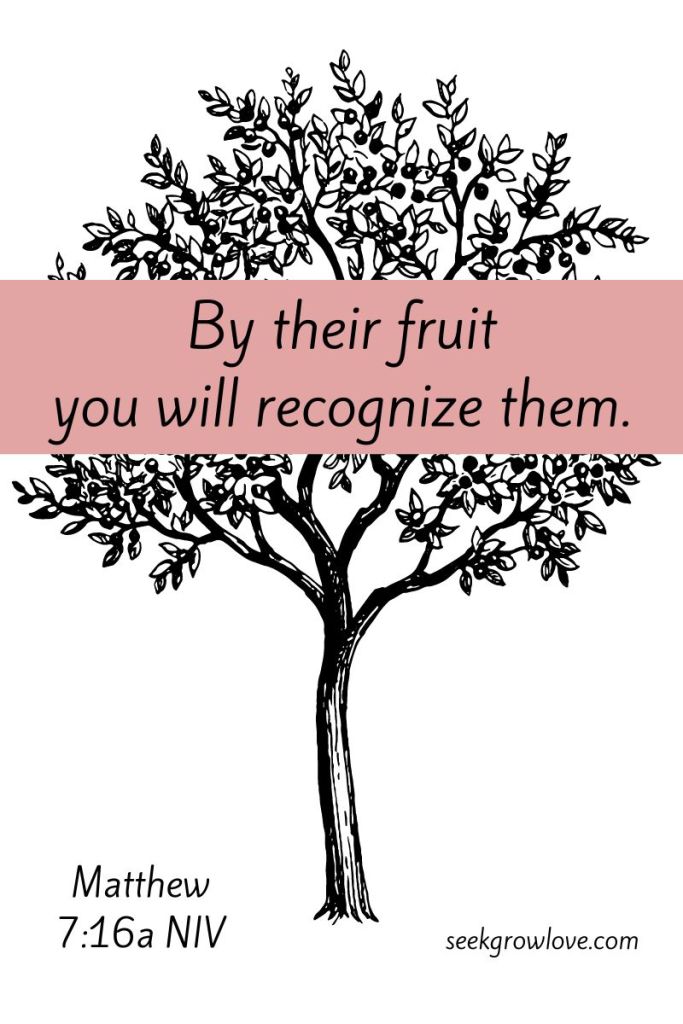
15 “Watch out for false prophets. They come to you in sheep’s clothing, but inwardly they are ferocious wolves. 16 By their fruit you will recognize them. Do people pick grapes from thornbushes, or figs from thistles? 17 Likewise, every good tree bears good fruit, but a bad tree bears bad fruit. 18 A good tree cannot bear bad fruit, and a bad tree cannot bear good fruit. 19 Every tree that does not bear good fruit is cut down and thrown into the fire. 20 Thus, by their fruit you will recognize them. (NIV)
“By their fruit, you will recognize them.” The fruit we bear in our lives is a litmus test for our spiritual health and the strength of our relationship with our Heavenly Father and His son Jesus Christ. We just read yesterday how apart from Christ we can do nothing. So our ability to bear good fruit depends on our willingness to abide in Christ. Take an inventory of your life. Do you see evidence of love, joy, peace, patience, kindness, goodness, faithfulness, gentleness and self-control? Taking this inventory of my life highlights areas where I need to repent of sin and abide more deeply in Christ. It is also important not to just take a cursory, shallow glance at that list of fruits, but to dig deeper and investigate more in depth what the scriptures have to say about the various fruits. For example, with the fruit of love, Jesus tells us in Matthew 5:44, “But I tell you, love your enemies and pray for those who persecute you.” Does my life show evidence of loving my enemies? Whew, I’m going to be real here, that is a tough one! To actually pray for someone who might be actively working against you or for your demise seems so counterintuitive to our human nature and our survival instinct. God, you want me to give my enemy a salt shaker so that they can rub it into my raw wound even more? Doesn’t that leave me vulnerable and unprotected? Do the scriptures support that God leaves us vulnerable and unprotected? In a couple of weeks you will be reading in Ephesians 6:10-17 about the spiritual suit of armor that God provides us. I won’t go too in depth with it since there are devotions coming that week, but that passage shows us that God protects us from head to toe. Also, remember we are talking about the fruit of the Spirit and John 15 reminds us that we are not alone in this battle.
John 15
26 “When the Helper comes, whom I will send to you from the Father, that is the Spirit of truth who proceeds from the Father, He will testify about Me, 27 and you will testify also, because you have been with Me from the beginning. (NASB 1995)
The scriptures also have something to say about who fights our battles. Let’s take a close look at Romans 12:19-21:
19 Do not take revenge, my dear friends, but leave room for God’s wrath, for it is written: “It is mine to avenge; I will repay,” says the Lord. 20 On the contrary:
“If your enemy is hungry, feed him; if he is thirsty, give him something to drink. In doing this, you will heap burning coals on his head.”
21 Do not be overcome by evil, but overcome evil with good. (NIV)
Did you catch that part about putting that love of our enemies into action by feeding them if they are hungry, giving them something to drink if they are thirsty? That’s taking that command to love your enemies to the next level, isn’t it?!?! Are you prepared to do that? Am I? It’s time for a heart check.
It really boils down to trusting God, doesn’t it? Do we believe Him when He says that He’s got it handled? If we find our faith lacking in this area, this is something we can pray about. It brings to mind the passage in Mark 9:
17 A man in the crowd answered, “Teacher, I brought you my son, who is possessed by a spirit that has robbed him of speech. 18 Whenever it seizes him, it throws him to the ground. He foams at the mouth, gnashes his teeth and becomes rigid. I asked your disciples to drive out the spirit, but they could not.” (NIV)
Later we read in verses 21-24:
21 Jesus asked the boy’s father, “How long has he been like this?”
“From childhood,” he answered. 22 “It has often thrown him into fire or water to kill him. But if you can do anything, take pity on us and help us.”
23 “‘If you can’?” said Jesus. “Everything is possible for one who believes.”
24 Immediately the boy’s father exclaimed, “I do believe; help me overcome my unbelief!” (NIV)
That verse always touches my heart because I can relate to it so well. I know what the scriptures tell us, but sometimes my trust and faith are lacking. Sometimes my prayers sound something like this, “Father, I know that Your word tells me that I am to love my enemies, but it’s so hard, God. It hurts so much. I need Your strength to show them the love Your word says I should show them. Father, I know that Your word says that You will work all things together for the good of those who love Him. Help me to love You more deeply and fully and to trust that promise so that my fear does not hold me back from being obedient to Your word to love my enemies. Help my lack of faith in this area. Help my unbelief.”
In today’s passage in Psalm 71 we read how God handled David’s enemies:
24 My tongue will tell of your righteous acts
all day long,
for those who wanted to harm me
have been put to shame and confusion. (NIV)
Our only job in regards to our enemies is to love them and to follow through with loving action that helps meet their needs. God’s got the rest of it.
-Kristy Cisneros
Reflection Questions
If a stranger watched you for an hour yesterday, would they have seen good fruit or bad? Would they guess that you abide in Christ? Do you? How can you do so more and more?
Who might you consider as your enemy? How do you typically treat them? What is Jesus asking you to do for them? Will you? When and how?
My understanding of the fruits of the Spirit has evolved quite a bit over time. I used to think that I needed to strive to demonstrate that fruit in my life and I would get so frustrated every time I would inevitably fall short. I felt like such a disappointment to God. It was actually an egotistical way to approach the matter. John 15:1-8 gives us insight into how we can bear good fruit in our lives:
1 “I am the true vine, and my Father is the gardener. 2 He cuts off every branch in me that bears no fruit, while every branch that does bear fruit he prunes so that it will be even more fruitful. 3 You are already clean because of the word I have spoken to you. 4 Remain in me, as I also remain in you. No branch can bear fruit by itself; it must remain in the vine. Neither can you bear fruit unless you remain in me.
5 “I am the vine; you are the branches. If you remain in me and I in you, you will bear much fruit; apart from me you can do nothing. 6 If you do not remain in me, you are like a branch that is thrown away and withers; such branches are picked up, thrown into the fire and burned. 7 If you remain in me and my words remain in you, ask whatever you wish, and it will be done for you. 8 This is to my Father’s glory, that you bear much fruit, showing yourselves to be my disciples. (NIV)
The critical missing component of my approach was that if it’s a fruit of the Spirit, the fruit produced is a result of the Spirit—not our own efforts. So our effort should not be put into displaying those qualities, but rather drawing closer to the source of that Spirit so that those qualities naturally spring forth. “Apart from me you can do nothing” (verse 5). We are to abide in Jesus since he is the vine and we are the branches. Our Heavenly Father is the gardener and He prunes us in order to increase our fruitfulness.
I find the aforementioned passage to be very encouraging. Our human nature is often inclined to do the very opposite of the fruits of the Spirit, so if we try to master them by our own merit, we are destined to fail. However, God’s word clearly just told us that we cannot bear any fruit apart from Christ. The key is to draw closer to him and to let God prune away the bad stuff in us.
I think David is a great role model in today’s passage in Psalm 70. He is not looking inward and trying to pull from his own strength. In verses 1 and 3 we see where he recognizes his true source of strength.
1 Hasten, O God, to save me;
come quickly, Lord, to help me.
3 But as for me, I am poor and needy;
come quickly to me, O God.
You are my help and my deliverer;
Lord, do not delay.
-Kristy Cisneros
Reflection Questions
Contrast the fruit of the Spirit with human nature? What does each look like and sound like?
Does your life display more human nature (living by the flesh) or evidence/fruit of the Spirit? When do you slip into more human nature characteristics? (when you are worried, stressed, hurried, selfish, etc…)
How can you stay attached to Jesus? How can you make sure his words remain in you? How can you draw closer to the source of this good fruit?
What can you learn from David and apply to your life today?
I can understand why the scriptures describe David as a man after God’s own heart. We read all about how Saul had relentlessly pursued David with the intent of killing him. What we know about human nature would tell us that David would breathe a sigh of relief upon learning that Saul was dead, but that’s not how the story went. The young Amalekite man describes that when he came upon Saul, Saul was leaning on his spear and he carried out Saul’s request to kill him since he was in the “throes of death.” When David learns that the young Amalekite man killed Saul upon Saul’s request, his reaction in 2 Samuel 1 is always a bit surprising to me.
11 Then David and all the men with him took hold of their clothes and tore them. 12 They mourned and wept and fasted till evening for Saul and his son Jonathan, and for the army of the Lord and for the nation of Israel, because they had fallen by the sword.
He was clearly distraught for the death of both Saul and Jonathan—so much so that he had the young Amalekite man put to death.
14 David asked him, “Why weren’t you afraid to lift your hand to destroy the Lord’s anointed?”
15 Then David called one of his men and said, “Go, strike him down!” So he struck him down, and he died. 16 For David had said to him, “Your blood be on your own head. Your own mouth testified against you when you said, ‘I killed the Lord’s anointed.’”
Because David was pursuing God’s heart, he didn’t rejoice in Saul’s death—even though he was an enemy to him. Saul terrorized him for a long time and the Psalms are full of David’s pleas to God to help him in the midst of Saul’s pursuit of him. We read about David’s state of mind during this time in verses 1 and 5 of Psalms chapter 70.
1 Hasten, O God, to save me;
come quickly, Lord, to help me.
5 But as for me, I am poor and needy;
come quickly to me, O God.
You are my help and my deliverer;
Lord, do not delay. (NIV)
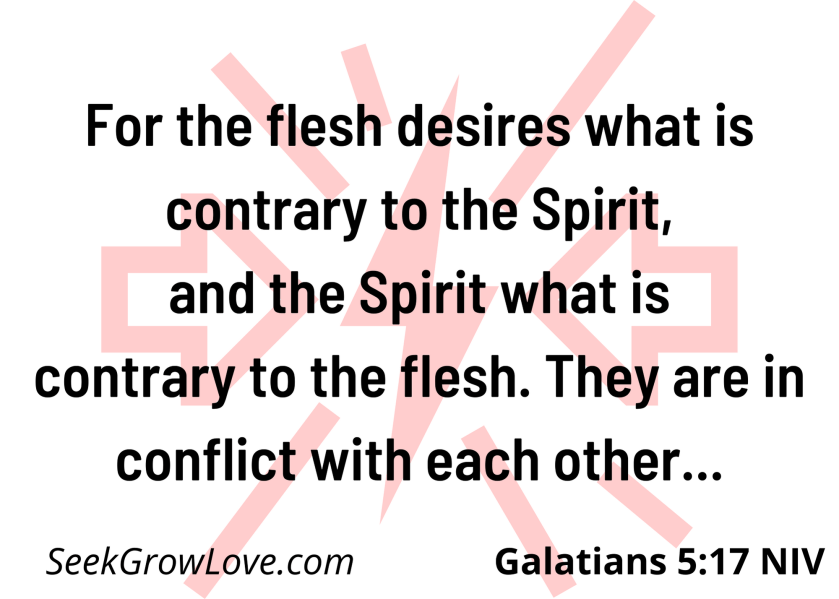
If we pursue God’s heart and walk in His Spirit as referenced in Galatians 5, we are not driven by our desires of the flesh and ruled by our human nature. Instead, we are compelled to pursue what matters to God.
Galatians 5:16-18
16 But I say, walk by the Spirit, and you will not carry out the desire of the flesh. 17 For the flesh sets its desire against the Spirit, and the Spirit against the flesh; for these are in opposition to one another, so that you may not do the things that you please. 18 But if you are led by the Spirit, you are not under the Law. (NASB 1995).
Of course, walking by the Spirit is not a “one and done” endeavor. Each day we are faced with the choice if we will be ruled by our flesh or if we will humble ourselves and be led by the Spirit. I think the key to doing so is to cultivate a deep relationship with our Heavenly Father and to abide in Christ. If we love God with all our heart, mind, soul and strength as we are commanded to do, it is so much easier to find the conviction to let His Spirit lead our lives. Keep in mind all relationships require ongoing work. How are you nourishing your relationship with God and Jesus Christ on a daily basis?
-Kristy Cisneros
Reflection Questions
What does it look like to pursue God’s heart? Can you think of a time when you, or someone you know, acted in such a way (like David’s response to Saul’s death) that was totally against human nature/flesh/sin and perfectly in line with God’s heart and walking by His Spirit?
How are you nourishing your relationship with God and Jesus Christ on a daily basis?
1 Samuel and 2 Samuel are, in your Bible and maybe in your mind, two different books.
However, they are one story. We should not really end 1 Samuel without going on to 2 Samuel, the same way ending your movie marathon of the Lord of the Rings after just watching “The Fellowship” is lacking.
1 Samuel ends with Saul and Jonathan and the other sons of Saul dead on Mount Gilboa, their bodies first desecrated and then given a proper burial by the men of Jabesh-gilead.
But it is David’s response that is striking, and that comes in 2 Samuel. Forgive me for reading ahead, but look at what David does in 2 Samuel 1.
He kills the man who claimed to kill Saul (even though we know Saul killed himself) because this man did not respect the Lord’s anointed.
He laments, not only over Jonathan, but over Saul his enemy.
His heart is broken because of this man who really and truly hated him.
1 Samuel has been a journey, and I am glad you have allowed me to go on it with you over the last two weeks. Here has been my take-away:
Be David and do not be Saul.
Saul did not start off wrong. He began as a shy, possibly humble, man who was given the gift of kingship. But instead of living up to that role, he first consistently and then later constantly rejected the will of God. He offered sacrifices on his own, he directly disobeyed the commands of God so the people would be impressed by his power. He lifted his hands against the Lord’s anointed constantly. When he couldn’t get an answer from God, he turned to demons. As a friend of mine said, Saul is the cautionary tale.
David started off right. A humble young man who worked the field, he was also given kingship. He was found to be a man after God’s heart, who obeyed God. He made mistakes, but he sought God’s forgiveness. He sought to do God’s will, to bless those who blessed him, but to let God give justice to those who cursed him. He gave compassion to the Lord’s anointed, but fought against the enemies of God. At his best, he is a model king, a model disciple, and a model man. Even in his failings, he repents and turns towards God.
My brothers and sisters,
May you start off from this moment right. God can and will forgive you for everything in your past and start you off with the salvation offered through the death of Christ. By “putting on” Christ in baptism, you become a son or daughter of God, a child of the King of the Universe. You are given a type of kingship, and the power of God, the spirit of God, to do all that this kingship requires. You are training to reign with Christ in his Kingdom, and so you are to show love to all people, to show justice to sinners (telling them of God’s justice), to show compassion to all repentant (expressing God’s mercy), and to show honor to God’s anointed, the Lord Jesus Christ.
Bless you as you become “Davids”, following the son of David. Amen
-Jake Ballard
Reflection Questions
In what ways or times have you had a touch of Saul in you? What did it look like? What did God want to see instead? Have you confessed and repented?
How do you treat God’s anointed?
What does it take to become a David? What will you do today to make is so?
——————————
Jake Ballard is pastor at Timberland Bible Church. If you’d like to hear more from him, you can find Timberland on Facebook (https://www.facebook.com/TimberlandBibleChurch/ ) and on Instagram (https://instagram.com/timberlandbiblechurch?igshid=t52xoq9esc7e). The church streams the Worship Gathering every Sunday at 10:30. Besides studying and teaching God’s word, he is raising three beautiful children with the love of his life, plays board games and RPGs, and believes it was fine that Tom Bombadil was not in the LotR movies. If you’d like to reach out to talk Bible, talk faith, or talk about how the LotR movies might be an improvement on the books, look Jacob Ballard up on Facebook (https://www.facebook.com/jacob.ballard.336) or email him at jakea.ballard@yahoo.com. God bless you all!
Sometime in the Advent season, my family gathers round and we read out these words. There is a familiarity to this “scary ghost story”; who hasn’t seen, or watched, or read, or heard some version of *A Christmas Carol*. There are dozens, scores, of different versions: stages plays, to ballets, to movies, to the MUPPETS. Seriously, if you haven’t seen a Muppet’s Christmas Carol, what are you doing in the Holiday season?
As I was saying, my family reads these words every year, and I particularly love Dickens’s dry humor and wit, which is somewhat lessened by the theatrical productions of his creation.
But he also makes very clear why he begins his illustrious novel with a death of a character we know nothing about : “The mention of Marley’s Funeral brings me back to the point I started from. There is no doubt that Marley was dead. This must be distinctly understood, or nothing wonderful can come of the story I am going to relate.”
It is in the exact same vein that the author of 1 Samuel 28 reminds us, “Now Samuel was dead, and all Israel had mourned for him and buried him in his own town of Ramah.” We already knew that from 25:1, but the author wants to be really sure. Absolutely positive that we get it.
Saul is going to attack the Philistines but the Lord doesn’t answer him. And so Saul, in stupidity and desperation, decides to go to Endor, looking for a witch. The witch, in fear and trepidation, speaks as and for Samuel whom she “brought up”. Up from the dead, speaking to Saul. “Samuel was dead to begin with.” This was a big deal. This was massive. We are expecting something wonderful, or maybe in this case, something awful to come of the story which the author is going to relate.
There are some great questions that come to mind when we read this story (see below), but I want us to pick up on what Samuel says to Saul : “Why do you consult me, now that the Lord has departed from you and become your enemy?”
When Saul drags him up, Samuel says “What do you want me to do about it?” Like I said, I expected wonderful or awful; I did not expect grumpy and sassy.
Sometimes, when we find ourselves in sin, and our lives start going poorly, we think, in stupidity and desperation, “more sin will fix this.” Of course, we never say those exact words. Saul didn’t either, but he also didn’t listen to the commands of the Lord. A little compromise here, a little not following the will of God there. “I didn’t kill the sheep so they could be sacrificed!” God stops listening to his prayers, and so he turns his inward sin of rebellion into the outward sin of divination. He does fulfill the prophecy of Samuel in 1 Samuel 15:23.
We tend to do the same. We tell a lie, and to cover up that lie we have to tell more. (Like Junior Asparagus covering up breaking the Art Bigotti Plate.) Instead of dealing with our lust and desires of the flesh head on, we heap false prophecy onto it and say “God told me we should be together.” We lump pride onto sloth: “Sure I was mentally checked out when I was physically clocked in on the job, but I just need some self care. I deserve it! Treat yo self!”
You might think the words used (pride, sloth, lust) in those examples (“stuff that everybody does”) is a bit extreme. Maybe, but sin is usually insidious. Saul didn’t start off thinking he was going to be cavorting with witches in the middle of the night. David didn’t think that avoiding his duty of going to war would end up with him murdering his companion.
Maybe, through you reading the story, you can begin to see that nothing good comes from heaping one sin on top of another. If you find yourself walking down the road of sin, I know how hard it is to change; still, confess your sins, seek the help of pastors and friends who want the best for you, change your ways. Only in turning from sin to the God who wants the best for us will we be able to seek his forgiveness, and not find him as an enemy, but relate to him as a Father who loves his children. Christ will empower us, advocate for us, give us his spirit and put us in a place where God can change us and bless us.
“And so, as Tiny Tim observed, God Bless Us, Every One!”
-Jake Ballard
Reflection Questions
Do you need to confess and stop sinning?: Start off by focusing on the thrust of the devotion; are there any sins in your life that need confession? Where you need help to get out of addictive patterns or habits that are hard to break? Stop the sin as soon as possible so the healing can begin. Only then should we think about the rest of these questions.
Did the magic work?: I have heard some people say the witch was scared *because the magic worked.* As in, she wasn’t expecting a real appearing. But the text indicates that she was scared because she recognized Saul while doing her magic. Saul had killed all the diviners. Why was she scared? The ancient people believed magic worked : The witch in Endor, like the slave girl of Acts 16, make us ask do *we* believe that magic works? Should we be more afraid of participating in the occult and magic than merely saying “that’s make believe”?
Are ghosts real?: Samuel seems to be a ghost. Are ghosts real? What is the Biblical picture of the afterlife? Jesus compared it to sleep, Ecclesiastes talks about the dead knowing nothing and not praising God, but the disciples thought Jesus was a ghost. Does the Bible teach that people can become ghosts? If it doesn’t (and I think it doesn’t), then why did the disciples think people could become ghosts?
Coming *up*?: Where was Samuel coming from? It says Samuel was coming up? If the dead keep on living, we should expect him coming down out of heaven; Samuel seems grumpy, like a man awoken untimely from his sleep. What did the Israelites believe about Sheol?
1 Samuel 24 contains one of my most favorite stories in all of scripture.
David, the prophesied King of Israel, the chosen, warrior king whom Saul rejected but whom a number of people adored, is living in a cave. And, speak of the devil, Saul walks right into that self-same cave to relieve himself.
… Saul goes out to hunt David and goes into a cave to sit upon his “throne”.
David had Saul dead to rights.
He had caught Saul with his pants down (or his robe up) and was close enough and stealthy enough to cut his robe.
Is there any more humiliating, powerless position to be in?
So the question is : why didn’t he kill Saul and end it?
Saul has tried to pin David to the wall.
Saul is currently tracking David’s whereabouts with 3000 men.
Saul is doing this though all David ever did was to honor his king.
Still, David does not end the pursuit; he allows God to be the one who brings justice.
“May the Lord judge between you and me, and may the Lord avenge me on you; but my hand shall not be against you.” (1 Sam. 24:12)
David did not rebel against Saul, David did not hate Saul.
David gave Saul pity on the potty,
Mercy in the men’s room,
Compassion on the commode.
You probably won’t have a king chasing you through the wilderness, but you may have enemies. People who hate you. People who want the worst for you.
Jesus, however, teaches us to be compassionate in the way David is compassionate.
“You have heard that it was said, ‘An eye for an eye and a tooth for a tooth.’ But I say to you, Do not resist the one who is evil. But if anyone slaps you on the right cheek, turn to him the other also. And if anyone would sue you and take your tunic, let him have your cloak as well. And if anyone forces you to go one mile, go with him two miles. Give to the one who begs from you, and do not refuse the one who would borrow from you.” (Matt. 5:38-42)
Jesus gives us this command because there are times when we are being chased and we need to cut the robe… and there are times when we are the ones on the toilet.
The times when we are the hero doing right by another and the times where we are the villain who looks like a madman.
Jesus forgives us in all of these situations and desires that we live and love better.
We are called to do to others what we desire done for us. (Matt. 7:12)
We are called to desire *and work for* the good, even the best, of the other. (Matt. 5:43-48)
“Be perfect,” Jesus says after speaking of loving your enemies, “as your Heavenly Father is perfect.”
God has spared us, even as we were his enemies.
God gave us pity, mercy, and compassion.
God, through Jesus, teaches us to forgive ostentatiously and go beyond what is “necessary,” to not just show love but be love to our enemies.
So the next time you find your enemy in the cave where you are hiding and they are in your hands,
Give them the love of God… while they are in the loo.
-Jake Ballard
Reflection Questions
Grace, Grace, God’s Grace: Have you given your heart to the Lord, to trust in his grace, mercy, and love? God loves you, he wants to forgive your sins, and give you eternal life in his presence. However, his love calls to us rather than demanding from us. Will you trust in the God who desires the best for you, even when you were his enemy?
Your own Saul: Do you have an enemy chasing you down? What does that look like in your life? Jesus asked for forgiveness for the people currently involved in killing him (Lk. 23:34); so he calls you to forgive those who are “seeking your life”. If that feels impossible, ask for the strength of the God who does the “impossible,” and he will make the impossible possible.
Be David, Not Saul: Are *you* chasing someone else down? Are you seeking someone’s life; bent on revenge, or “justice”, or “fairness”, or “making them feel like I felt”? You are called to let it go. Saul is the bad guy, the madman, and God judges against him because he is so focused on his own glory, rather than focused on what God was doing through his people and his anointed. Be David, not Saul, and let the Lord bring about his will.
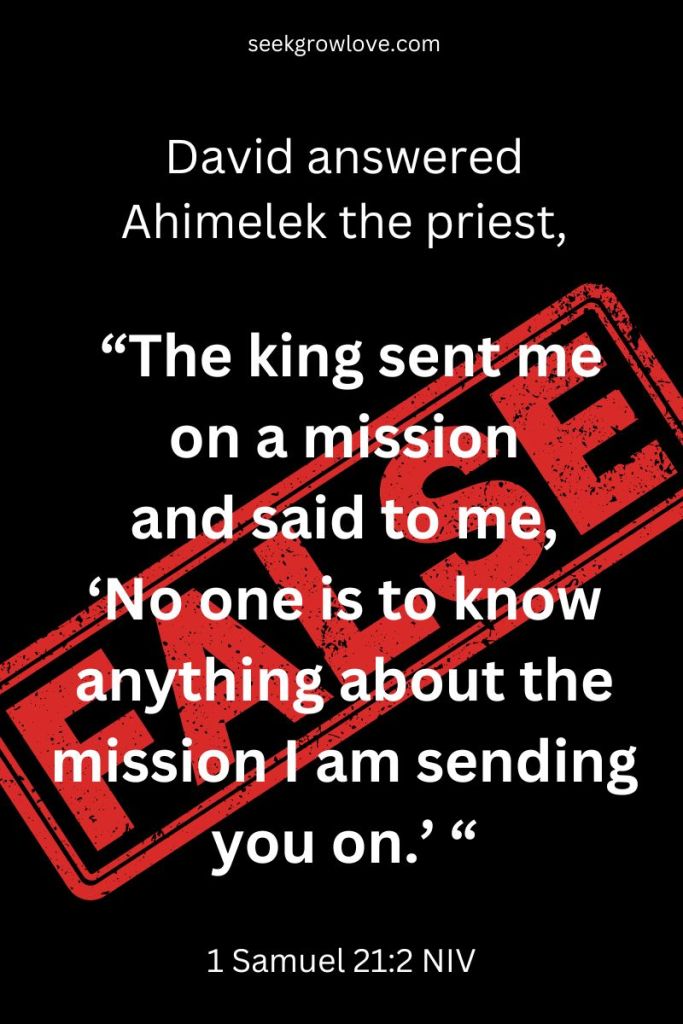
In the beginning of our reading today, we have a strange interaction. If you want to remind yourself, 1 Samuel 21:1-6 is the focus. David is running from Saul, so he goes to the priest, tells him his companions are hungry, and asks if he can have any bread. The priest responds by offering the consecrated, holy bread. David and his companions eat and they are on their way.
The strangeness comes to play because
David lies about what he is doing,
David realizes that his interactions with the priests led to their deaths,
and David, nor his men are supposed to eat the bread.
Time would fail us in trying to understand if David was justified in lying to the priest about his true intention; that is, not to do Saul’s bidding but to run from him.
David wants to make up for the slaughter of the priest, both by housing the survivor and no doubt by desiring to build the temple after he becomes king. (He had many reasons to desire to build the temple.)
The strange part I want to examine with you is that David and his buddies weren’t supposed to eat the bread. The Bread of the Presence, or the showbread, is commanded to be placed in the temple regularly.(Exodus 25:30) While there are different theories on *why* God commanded there to be bread, the name “bread of the presence” or “presence bread” indicates that it was meant to be set in the presence of God always, to remind the priests that God’s presence is in this place, and God is the one with whom we should wish to dine. Leviticus 24:5-9 describe the use of the bread; it was to be a covenant of the people forever and to be eaten by Aaron and his sons. Yet the priest does not ask David (who he knows is not a priest) if he was a priest, but simply if he was clean. David, who we know has lied before this point, may not have known, but answers in the affirmative.
Did David sin? Should he be punished for this?
A good question.
Why did Jesus use this story to justify “working” on the Sabbath?
A *better* question.
In all three synoptic gospels (Matthew 12:1-8, Mark 2:23-28, Luke 6:1-5), Jesus and his disciples are going through fields of grain and picking the heads and eating it. The Pharisees declare this is too much work; things like picking up your mattress, lighting a fire, walking more than a set amount, all considered too much work, based on the Torah and later tradition.
What does Jesus say in response? Yes, my disciples eat grain, but David ate the consecrated bread. And yet, though you would call him unlawful, that is not what God saw.
See, Jesus says, “the Sabbath was made for man, not man for the Sabbath”. (Mark 2:27)
“The Son of Man is Lord of the Sabbath.” (Luke 6:5)
“Something greater than the temple is here.” (Matthew 12:6)
What do we do with that? Let me give a few quick thoughts.
The Bible is a strange book. We’ve talked about how it is more complex than we give it credit for, it is also strange. This does not mean there is no application, but you might need to think for a bit to see what God is saying.
What God is saying through the story of Christ referencing David and his companions becomes clearer we we recognize that we can’t pull stories out of their context. First, Jesus is saying that the laws that were intended to give a nation of slaves rest and worth beyond what they produce were being used by the religious elite to control them. (“The Sabbath was made for man.”) We can only know this by knowing that the pharisees were trying to determine the lawfulness or unlawfulness of any and every action. But more importantly than the cultural context, the written context shapes what we should see in this story: Jesus goes on in every version of this story to heal a man on the Sabbath, a man with a withered hand. It’s pretty clear that “working” on the Sabbath, doing the good things God places in front of us, healing the sick and saving the dying, is not work that takes a back seat, but is the very thing God might be calling us to do.
Finally, Jesus is Lord, even of the Sabbath. Jesus changes everything. As his follower and apprentice, his interpretation of the Bible is the one I want to use, and his way of living out the commands of God, even if that changes them, is the way I want to live. If Jesus says that doing good is lawful, then I will do good on every day, whether or not it is my Sabbath.
May you eat the bread of the covenant in the presence of the Lord.
-Jake Ballard
Reflection Questions
The Lies of Abraham, Jacob, and David : Abraham lied about Sarah, Jacob lied about Esau, and David lied about his mission. Why do you think the Bible records the lies and failures of the patriarchs? One of the Ten Commandments is “thou shalt not bear false witness”, the Hebraic equivalent of lying; does the Bible condone it here and prohibit it elsewhere?
Finding Your Sabbath: Saturday is probably not your day of worship, and you might even work on a Sunday. But do you have a Sabbath? Do you take a day away from the hurry of life, from the bustle of doing, completing, competing, overcoming, achieving, and instead find solace in simply being? The Sabbath, the work-and-rest pattern of life, was given by God to man, because humans are worth more than what they produce and what they achieve. How would you like to live out the gift of Sabbath? Pick a day and let it be a day of rest.
Lord of the Sabbath: Jesus as Lord lived out the commands of God, but also would change them; he made foods clean and abolished the need for sacrifices as much as he kept kosher and celebrated Passover. Jesus is greater than the temple and than the Sabbath. Have you honored the Lord of the Sabbath by both resting when you need to rest and working when he calls you to work? Have you honored the Lord of your life by living the life he showed you and empowered you to live?
If you would like to know more about rest and about the elimination of hurry and are in your 20s and 30s, consider attending the Young Adult Getaway, June 9-12, in Sevierville, TN. Get more information at http://www.yagetaway.com







 Seek Grow Love