In the beginning of Genesis 39, Joseph has just been sold to a new master named Potiphar. During the course of the chapter, Joseph is falsely accused and thrown into prison. The chapter ends as Joseph goes from being a slave to being a prisoner. Sounds pretty bad, right? Strangely enough, the chapter starts out by saying of Joseph the slave, “The Lord was with Joseph so that he prospered, and he lived in the house of his Egyptian master.” The chapter ends by saying of Joseph the prisoner, “The warden paid no attention to anything under Joseph’s care, because the Lord was with Joseph and gave him success in whatever he did.” So God was with Joseph and gave him success and prosperity even as a slave and a prisoner. Sounds very strange to me. It would seem to me that success would be not being a slave and not being a prisoner. But Joseph understood some things that many of us never understand.
We can learn a lot of good things from Joseph. Whatever happened in his life, he kept on trying to live for God. He continued to have a good attitude and he continued to work hard. He didn’t pout, become discouraged, depressed or cry out, “Why me?”
How about you? When you go through tough times, do you continue to seek God and discover His will? Do you try to keep a positive attitude? Would you keep working hard if you were in Joseph’s shoes? We will soon see how God’s plan unfolded in Joseph’s life. Feel free to read ahead in the Bible on this story of Joseph. It is way more interesting than a TV show.
-Jason Turner
(Originally posted for SeekGrowLove on October 23, 2018)
Reflection Questions
How about you? When you go through tough times, do you continue to seek God and discover His will? Do you try to keep a positive attitude? Would you keep working hard if you were in Joseph’s shoes?
What do you think about the phrase, “God was with Joseph”? What might that look like to others? What might that feel like to Joseph? What does it cause Joseph to do?
Do you feel like you can say the same thing about “God was with (your name)” during your hardest trial thus far? Can you say it today? What might that look like to others? How does it make you feel? What does it make you do?
Today we are going to start on the beginning of the story of Joseph and I am pretty pumped for Joseph. He is a really awesome character of the Bible. There are a ton of lessons that you can learn from his life.
Have you ever caught yourself being jealous of another person? It may not even be their whole life but just like parts of. I know I totally have areas where I’m jealous. My personal areas are intelligence, athletic abilities, leadership style, their writing ability or musical talent. Here is the thing I like about me. I do. I think God made me great and I think through God’s grace and patience he is continually making me better in the characteristics that he will use to build his kingdom. You are great too and God made you with the strengths that you have for a reason; to build his kingdom and glorify him. Yet, 99% of us still have issues with jealousy and the other 1% have pride problems. Hahaha.
Let’s get started on Joseph though. The first mention we have of Joseph is Genesis 37 and it starts out with his dreams. You definitely should go read this chapter. It will help out tremendously with understanding this devotion. Joseph was the one of the last born of Jacob’s children and because of that Jacob loved him more than his other sons. To demonstrate his love for his son, Jacob gave him a robe of many colors. His brothers noticed that their father loved Joseph and hated him because of it.
When Joseph was older he had a dream that said that his brothers will bow down to him. Remember, Joseph was the younger brother. After a half second of contemplation you would totally understand why Joseph’s older brothers would not be blessed by this dream. This made them hate him even more. Then another night he had a dream that his whole family including his mother and father would bow down before him. In verse 11 it says “And his brothers were jealous of him…”.
I can empathize with his brothers at this point. I have totally been jealous of some people that I have seen being used by God. I don’t think this is the worst thing in the world. I just want to be able to glorify God like they are and that is not a terrible thing to want. What Joseph’s brothers choose to do next is definitely not good.
Joseph’s brothers sold him into slavery when he was out in the field one day and then lied to their father and said that he had been killed by a wild animal.
Now, why do you think that his brothers did that? I am going to make a huge leap and say they were probably jealous. I know I am way out there on this one.
They were jealous of him for something small back in the beginning of the chapter and now their jealousy grew and grew and grew until they were selling their brother into slavery. They let it build and simmer under the surface until they did something crazy and harsh. I will go out on a limb here and say that if you were to tell the brothers that they would sell their brother into slavery at the beginning of the chapter they would have called you a liar.
Have you ever noticed that if you are jealous of someone, you have a hard time being friends with them? Maybe there is a little extra hostility in your voice that you didn’t intend or you secretly wish they would make a mistake or some sort of small harm would derail them.
I don’t think that what happened to Joseph’s brothers was all of a sudden. They had been jealous of Joseph for a while and because they didn’t resolve this jealousy, they did something that they would come to regret. Love leaves no room for jealousy. It is impossible to love God, love people and be jealous of them. These feelings of envy and jealousy when unkept turn into anger. That is why it is impossible to love someone and be jealous of them.
So how do we keep jealousy from building into anger like what happened to Joseph’s brothers? None of us want unkept jealousy that will ruin our joy and make us do things that we don’t want to do. I am not the authority on this but I can tell what has worked for me. I have found it to be really hard to compliment people I was jealous of. So, I went ahead and complimented them and bragged about them and became a supporter of them. I would tell other people how great I thought they were and it did something weird in my heart. I was no longer jealous of them but I was happy for them and rooting for them.
Another thing that you will need to do is find your strengths, the good things about how God made you, and talk yourself up. Remind yourself that you are made in the image of the maker of heaven and earth and all good things dwells inside of you. If you need help finding your strengths ask a friend what they are and then ask God to help you find your value and worth in Him.
I do all of these things on a semi-regular basis. Let’s keep an eye on that jealousy and remind ourselves of who we are in God, so that we can stay joyful and love others.
Daniel Wall
(Originally posted for SeekGrowLove on Jan 24, 2020)
Reflection Questions
When has jealousy stolen your joy and love for others? How did you treat the object of your jealousy?
Who would you like to work on complimenting and becoming a supporter of?
What are your God-given strengths? How can you work at remembering them and growing them?
What would you suggest to a friend or child who has been struck with jealousy?
“What’s in a Name?” This famous quote from Romeo and Juliet implies that a name is simply and solely a name, that the true value lies in the person who bears the name – and, in the case of Shakespeare’s tragic play, that the person should be loved for who they are rather than hated merely for their family line. While I agree that the person who bears the name is more important than the name itself, I would also argue that names are very powerful and personal, as one thing that a person deeply owns forever. Referring to someone by name can have a profound effect on them. When we go to a restaurant, my husband makes a point to always speak to our servers by name as a way to connect with and respect them as a person rather than simply a service provider.
What does your name mean? Mine (Rachel) means “ewe,” which seems appropriate since the biblical Rachel was a shepherdess. Rachel was the second – but favorite – wife of Jacob, who was known to be a trickster. While there is some discrepancy about the true meaning of his name, Jacob is commonly accepted to mean “supplanter,” and when you read his life story, you will see him live up to his name many times over. In today’s reading, we observed Jacob and Rachel duping her father (who had also deceived them! It must be a family trait on both sides!). Jacob gathered his family for the journey back to his homeland to reconcile with his brother Esau, from whom Jacob had swindled the birthright blessing many years before. Then Jacob found himself alone during the night, thrust into a wrestling match with God (or man or angel, as some translations indicate). Jacob persevered through a fierce fight, but before he would let his mysterious competitor raise the white flag, Jacob demanded to be blessed.
The Wrestler’s response: “What is your name?”
Full stop. Don’t you think this being knew Jacob’s name? Of course. But remember, Jacob had assumed a false identity when he masqueraded as Esau to hoodwink his father into giving him Esau’s birthright, and Jacob had continued in his shifty ways. Maybe Jacob needed to be reminded of who he was so he wouldn’t continue to swim aimlessly in the pool of his own deception. Perhaps the Wrestler wanted Jacob to ponder his delusive choices (which, frankly, had caused a concatenation of unfortunate events) and be a willing participant in God’s bigger, better plan despite his sketchy past – a fresh start as a new man changed by God’s grace.
Jacob answered honestly with his given name and then was granted a new name with a new meaning: “Your name will no longer be Jacob. Your name will now be Israel, because you have wrestled with God and with people, and you have won” (Gen 32:28). The Wrestler chose to keep his own name a secret, but he did leave Jacob/Israel with the requested blessing – and a bum hip, probably so he would be sure to never forget the experience.
The meaning of the name “Israel” is disputed; some possibilities are, “he wrestles with God,” “a man seeing God,” “God perseveres.” Whatever the meaning, Israel indicates a closeness with God and a promise for a new nation. In recent chapters, we also read about Abram and Sarai receiving name changes to Abraham and Sarah to symbolize their new relationship and covenant with God.
God is in the business of changing lives AND names! Did you know that we, too, will be given new names in the Kingdom? Passages in Isaiah (62:2, 65:15) and Revelation (2:17, 3:12) indicate that our names will be changed when we receive our inheritance of eternal life! How awesome will it be to bear names especially chosen for us by our Creator as we live with Him forever!
-Rachel Cain
Reflections:
When you committed to join God’s mission, your name was written in the Lamb’s book of life. Enjoy this song about God changing us and writing our names on the Kingdom roster! (or click here if you want to see some of our own youth perform the same song in ASL at Ohio’s camp!)
Think of who you used to be, and how God has changed you – and continues to change you – into who He wants you to be. What areas of your life do you need to give over to him to allow that to happen? How can you use your story to encourage others?
Today, I’d like to zero in on just one verse: Genesis 30:22, “Then God remembered Rachel; he listened to her and opened her womb.”
Let’s break this down.
Then God – When I read these two words together, I think that other events had to take place first, before God took action on Rachel’s behalf. The ten sons born to Leah and the two maidservants had to be before Joseph and later Benjamin were born to Rachel. There was a purpose to the waiting. If Joseph had been born before his brothers, he would have had more clout in the family and probably wouldn’t have been sold off as a slave by his brothers and ended up working in the house of Pharaoh.
Remembered Rachel – According to my Bible notes, “remember” doesn’t imply that God forgot. It implies that God expresses concern and He acts with loving care; He shows favor.
He listened to her – Apparently, Rachel never stopped asking God for a son. She believed that it was possible for God to grant her this request, even though many years had gone by.
So what does this mean to us?
God’s timing is perfect. More than likely something needs to take place before our heart’s desire becomes a reality. Maybe it’s a sequence of events or maybe it’s a change in attitude. Whatever it is, we have to trust that God knows what He’s doing.
God hasn’t forgotten about you. “The LORD your God is with you, he is mighty to save. He will take great delight in you, he will quiet you with his love, he will rejoice over you with singing.” Zephaniah 3:17
Have Big Faith and keep talking to God. Keep seeking after Him. “You will seek me and find me when you seek me with all of your heart.” Jeremiah 29:13
Many Blessings,
-Bethany Ligon
(Originally posted for SeekGrowLove August 1, 2016)
Reflection Questions
Looking back on your life can you think of a time when you discovered purpose in the waiting?
Abraham was a man of incredible faith. God made astounding promises to Abraham, and Abraham believed God – and this was credited to him as righteousness. Abraham lived a long and faithful life of service to God, then, as recorded in Genesis 25, Abraham died.
We’re picking up the story in Genesis 26 – after Abraham was dead and gone. Genesis 26 starts by telling about a famine in the land that was so bad that Isaac (Abraham’s heir) had to move to have enough food to eat.
Then we find this amazing encounter in Genesis 26:2-6, “The Lord appeared to Isaac and said, ‘Do not go down to Egypt; live in the land where I tell you to live. Stay in this land for a while, and I will be with you and will bless you. For to you and your descendants I will give all these lands and will confirm the oath I swore to your father Abraham. I will make your descendants as numerous as the stars in the sky and will give them all these lands, and through your offspring all nations on earth will be blessed, because Abraham obeyed me and did everything I required of him, keeping my commands, my decrees and my instructions.’ So Isaac stayed in Gerar.”
God promised:
To give Isaac and his descendants all these lands
To confirm the oath God has sworn to Abraham
To make Isaac’s descendants as numerous as the stars of the sky
To bless all nations on earth through Isaac’s offspring (Jesus)
And did you notice why God extended all of these promises to Isaac? “Why” is recorded in verse 5: “because Abraham obeyed me and did everything (emphasis added)I required of him, keeping my commands, my decrees and my instructions.”
Did you catch that? Isaac was promised that he would receive incredible blessings because his dad had obeyed God and had done everything God required.
A couple of years later, in Genesis 26:24, we read, “That night the Lord appeared to him and said, “I am the God of your father Abraham. Do not be afraid, for I am with you; I will bless you and will increase the number of your descendants for the sake of my servant Abraham.”
Again, God extended blessings to Isaac because of Abraham’s faithfulness.
And oh yeah, most of that obedience to God was before Isaac was even born.
We’ve heard about the blessings for ourselves if we follow God – especially eternal life in the Kingdom of God. We don’t often think of the blessings for our descendants because of our faithfulness to God.
When I was young, my dad would have us memorize scripture. One of those verses he had us memorize was Psalm 37:25 which says, “I was young and now I am old, yet I have never seen the righteous forsaken or their children begging bread.”
I think the point my dad was trying to make was that we needed to be righteous, and God would never forsake us. But I remember thinking something like this at the time: “I’m glad my dad is righteous, because in spite of my not necessarily being righteous, I will be blessed because of my dad’s righteousness.”
Now that I’m old, I recognize that the decisions I made, and the example I demonstrated had an impact (for good or for bad) on my kids. As a result, they have picked up both some of my good traits and some of my bad traits. I wish now that I had demonstrated more good examples and fewer bad examples – not only for my own benefit, but also for the benefit of my children.
Now let’s talk about you. It doesn’t matter if you’re a teen, a parent, a grandparent, young, or old. The most important thing you can do with your life is to obey God, and do everything He requires. This will guarantee you eternal life in God’s coming kingdom, and may also give you many blessings in this life (not necessarily including health and wealth). But in addition to your blessings, you may also pass along an inheritance of faithfulness to God to your kids – even those unborn. And then they too can have incredible blessings.
So, if you love your kids, obey God.
-Steve Mattison
Reflection Questions
What are all the benefits/blessings you see to obeying God? Which have you already enjoyed? Which are you still looking forward to?
How are you doing in the faithfulness department? Will God be able to tell your descendants that you obeyed Him, did everything He required, and followed His laws?
What did God reveal about Himself to you today?
(originally posted for SeekGrowLove January 16, 2023)
I have never seen a beautiful piece of wall art with the words “Family Isn’t Everything”. I’ve never seen it on a Mother’s Day mug or bookmark, t-shirt, keyring or tombstone. Rather, we are all very familiar with the motto “Family IS Everything”. Whether it’s from the Walmart aisles, Etsy and Pinterest sites or President Biden’s farewell address, we’ve seen it, we’ve heard it, we’ve lived it. It’s a societal norm or expectation. Those who can’t say Family Is Everything might have really really bad families or really screwed up priorities. OR – they just might be listening to and obeying God and working hard at keeping God and God alone first place in their life. I have a feeling we wouldn’t find Abraham wearing the “Family is Everything” t-shirt. And God blessed him for it.
No doubt Abraham loved and cherished the family that God gave to him. Can you imagine waiting 100 years for the child you could keep? Today’s reading also describes his heartache over losing/sending away his firstborn son Ishmael. Being a parent is hard. Being a godly parent is also not easy. But I am reminded, perhaps as Abraham was, of the purpose God had in giving Abraham a child which was recorded in yesterday’s reading. In Genesis 18:19 God said, “For I have chosenhim, that he may command his children and his household after him to keep the way of the Lord by doing righteousness and justice, so that the Lord may bring to Abraham what he has promised him.” In teaching Isaac to keep the way of the Lord, Abraham needed to live it out himself – not by doing what the world says is right (“family first”), but listening to and following through with what God says, even when we don’t understand why.
And Abraham did. When God said “Take your son, your only son Isaac, whom you love, and go to the land of Moriah, and offer him there as a burnt offering on one of the mountains of which I shall tell you” – Abraham did – “and he rose early in the morning” and got moving. (Genesis 22:2,3 ESV). I admire not only his actions but his speed and timing in listening and obeying. He got going and followed through. He also had a three day journey in which he could have changed his mind, turned around and decided family is everything. But he didn’t. He continued onward to the exact place that God told him to go. At the start he knew he was heading toward the region of Moriah and God would tell him which mountain to go to. I read online that some say the mountain God sent Abraham to was Golgatha, in case you are looking for more foreshadowing and similarities between what God was asking Abraham to do and what He Himself (the loving, righteous and just God) would do for us with His only son whom He loved. Thankfully God did not let His perfect love for His perfect Son keep Him from offering Jesus up to save the guilty condemned, you and I. God’s t-shirt would not say “Family is Everything” but maybe more along the lines of, “I gave everything for my adopted family”.
But, one more point about this mountain that God sent Abraham to…for it was there that God had a great surprise hiding – a ram caught in the thicket by his horns. And it was there that God provided for Abraham and Isaac in a very big way. If you haven’t read Genesis 22 yet today, please do. I am guessing God didn’t place a ram stuck on every mountain nearby just in case Abraham decided to end up at a different mountain than the one God told him to go to. Similarly, if we are looking for God to provide – let’s show up on the mountain He tells us to go to.
-Marcia Railton
Reflection Questions
What does it look like when we live by “Family is Everything” and put family before God? What does it look like when we love the family God gave us dearly and set an example for them of being righteous before God and putting God first?
Is there anything you have tried to withhold from God? What does it mean to you that God did not withhold His Son?
Have you ever been upset God didn’t provide as you wanted Him to – and then realized you were in the wrong place to receive what He had all prepared and ready to give? Does it count to do most of what God says if you aren’t prepared to do all of what God says?
What do you think of Abraham? How do you think he earned the title “Friend of God”? Would you like to be known as a friend of God – could you honestly wear the “Friend of God” t-shirt? What specifically can you do today, this week, month and year to grow more and more like a true friend of God?
Husbands – don’t always listen to your wife – she doesn’t always know. Younger sisters – don’t always listen to your big sister – she doesn’t always know. What trouble we can get into when we follow the advice and direction of those who are trying to solve matters on their own without patiently relying on God’s perfect way and timing. Our reading today of Genesis 16-19 both opens and closes with women deciding how to take matters into their own hands (or into their maidservant’s hands) when they felt there were no other options available to get what they wanted – a child to carry on the family line and receive the family inheritance. Perhaps Sarai figured God needed her help to fulfill the promise God made that Abram would have a son. Maybe she thought she was wiser and knew the best way to get to the desired end result on her timetable. I don’t even want to guess about Lot’s daughters.
At the same time, I realize I am sometimes quick to judge and point fingers, when I sometimes don’t know the whole story and I am not chosen by God to be the judge and jury. For example, Lot’s willingness to offer up his virgin daughters to the lewd and dangerous mob at the door has always bothered me greatly. And maybe it should. And yet…in his second letter Peter writes that God, “rescued righteous Lot, greatly distressed by the sensual conduct of the wicked (for as that righteous man lived among them day after day, he was tormenting his righteous soul over their lawless deeds that he saw and heard)” (2 Peter 2:7.8). Peter is giving Lot a bit (or a lot) more credit than I would have. And then I just read a study note in my ESV Archaeology Study Bible that “Lot may have been attempting to bring down the law on the heads of the culprits” (p39) as in many cultures of that day the punishment was death for a man caught lying with a betrothed virgin. I certainly hadn’t considered that possibility before.
Perhaps sometimes I am not as smart as I thought I was. Perhaps sometimes I work a little too hard to find a bad guy in the story? And yet, I DO need to try to be discerning. I do need to read God’s word to know more and more about who God is and who He wants me to be. So, what are some take aways that can help me know God and who He wants me to be?
Sodom and Gomorrah are destroyed as an example of what happens to the ungodly. (Peter says that, too, in 2 Peter 2). Don’t be Ungodly. There is a right way and a wrong way to live and there are consequences for both which God will bring about in His time and His way.
Humble Hospitality is Huge. Old man Abram is running to get dinner prepared with the finest ingredients for the visitors and then stands while they eat (your guests might think that part is weird – you can sit). Lot won’t take no for an answer and brings the visitors to his home to spend the night and is prepared to protect them with all he’s got. How can you practice some humble hospitality?
Our God is a God who sees. Hagar is right. God not only sees her and hears her but He speaks to her, He encourages her and He shows mercy and care for her AND for her unborn child. I do find it interesting it is not recorded that He tells Sarai what she did wrong (like I did) but there are several verses here devoted to making sure we know that God saw, heard, encouraged, directed and cared for Hagar and her child. Maybe the lesson for myself is don’t be so busy finding the wrong that you don’t do the right. Who does God want me to see so I can encourage, care for and point them in the right direction?
God’s promise to Abram which we talked about yesterday continues to grow – now it is added that from Abram will come nations and kings, and even better, God will be their God and also Sarah (notice the little name change) will be blessed and from her will come her very own son and nations and kings. There is also that part about circumcision and Abraham walking faithfully, and being blameless and chosen to command his children and household to keep the way of the Lord by doing righteousness and justice. These are tied to God’s promises to His people. What does God want you to do to show that you are His?
Perhaps MOST importantly in these chapters and in our lives is the realization and understanding that there is NOTHING too hard for the Lord! In this case they are talking about 90 year old Sarah having a child with 100 year old Abraham. It seems impossible, because normally it is, but our God is not a human, He is not normal. He specializes in the impossible! Your needs are not too big for Him. Your case is also not too insignificant for Him. He is the God who sees and the God who has never and will never run into a project too hard for Him.
– Marcia Railton
Reflection Questions
When have you felt seen by God? When did He show that nothing is too hard for Him? What problems are created when we don’t believe God sees or God can?
What does God want you to do to show that you are His? What does He promise to do for you?
Who does God want me to see so I can encourage, care for and point them in the right direction?
The first 9 verses of Genesis 12 hold SO much promise! In fact, we’ve all heard of a lie that starts out small but just grows and grows – that’s bad. But, what about a TRUE promise from the Lord Almighty that starts out in verse one and just grows and grows and becomes one of the largest and very best promises in the world? Sometimes this is referred to as the Abrahamic Covenant.
In Genesis 12:1 the Lord calls Abram (whose name will be changed to Abraham in chapter 17) to leave his country and father’s house and family to go to a land that God himself will show to Abram. God is telling Abram to leave the known and comfortable and so much of what has been important to him thus far. But God says when Abram does this, God Himself will show Abram the land that God has already picked out and reserved for Abram. In the next two verses we see 7 promises given to Abram:
I will make of you a great nation
I will bless you
And make your name great
So you will be a blessing
I will bless those who bless you
And him who dishonors you I will curse
And in you all the families of the earth shall be blessed. (Genesis 12:2-3 ESV)
That’s a lot of promising promises! He is going to bless Abram in some big ways so that Abram can be a blessing to others, even to all the families of the earth! And God’s not done – He’s got even more good news for Abram. But first, Abram has to get moving. He has to believe the promise enough to start acting on it.
And he does. 75 year old Abram leaves his comfortable couch in Haran and starts out, not knowing where he is going or what the land will look like or when he will get there or what he will have to pass through to get there, but believing that when the Almighty gives His Word He is good for it and good will come of it. So, he moves out in search of the land God will show to him. I love that part! Sometimes decision making is hard and we find ourselves overthinking or second guessing so we don’t move at all. But God told Abram you get moving and I will show you the land! Maybe that means you go through some lands that aren’t the right fit and isn’t what God is saving up for you, maybe you try some ministries that give you more experience and empathy but aren’t where God is going to plant you. It is okay. It is part of the journey. You keep moving. You keep trusting your faithful God to show you when THIS is the land He chose for you.
Can you imagine all the feelings old, childless Abram who got moving and has just travelled about 550 miles from Haran and was now passing through the land of Canaan would experience in verse 7? “The Lord appeared to Abram and said, ’To your OFFSPRING I will give THIS land.’” The promise just exploded and got so much larger! Not only was he now SEEING the land God had said He would show him, but now he also heard that he would somehow, someway yet have offspring?!? Abram’s response – he built an altar to worship the Lord, which also acts as a witness to others.
Sometimes we question God’s timing of the fulfillment of His promises. Is it now, God? When God showed Abram that this was WHERE, the question became WHEN. It wasn’t time for him to settle there, yet. But it was then also promised to his offspring, yet another great part of the promise.
It is good news for us that God does not take back his promise from Abram when Abram is less than perfect (telling less than the truth to try to protect himself in Egypt). In fact, it is after this that the promise has yet another amazing addition with some incredible implications for you and I. Genesis 13:14-16 (ESV) says: “The Lord said to Abram, after Lot had separated from him, ‘Lift up your eyes and look from the place where you are, northward and southward and eastward and westward, 15 for all the land that you see I will give to you and to your offspring forever. 16 I will make your offspring as the dust of the earth, so that if one can count the dust of the earth, your offspring also can be counted.’” Did you catch the NEW piece of the promise? It’s a little 7 letter word that never ends! This land would be given to Abram and his (as of yet non-existent) offspring that would become as numerous as the dust of the earth FOREVER! Abram’s response – he builds an altar to worship and witness and he settles into the land that God had promised and God had shown!
As beautiful as those chapters are – don’t miss chapter 15. Abram is having some doubts. How could all this be? Sure, it sounds great, but he still doesn’t have any offspring! How long God until your promise is fulfilled? The word of the Lord comes to Abram and it is the first recorded time the beautiful, comforting, often repeated phrase, “FEAR NOT!” appears in the Bible. Why do we fear not? Because God tells us HE is our shield and our very great reward! HE has given a very great promise and He is working out the details. He has chosen the land and He will show it to those who believe enough to get moving and in His perfect timing we will settle there and in His perfect timing we will see and cherish our offspring as numerous as the stars. Verse 16 is quoted 3 times in the New Testament: “And he believed the Lord, and he counted it to him as righteousness.” He believed. It doesn’t say he understood. He didn’t have to engineer the plan. He had to believe, and move, and let God show him the land.
Dear Lord, thank you for your promises that are always true and that just keep getting bigger and bigger. Please show me the land You have chosen for me to settle in – both now and when Jesus returns to set up Your Kingdom on this land. Help me get moving in the direction You have laid out. Thank you for the offspring you have blessed me with, help me also see and care for the spiritual offspring you have given. Help me worship You and be a witness to all You have already done and all You have yet to do. Thank you for being my shield and very great reward! Help me remember this so I do not fear but always believe in you and Your great Son. Thank you for your Word, and for keeping it FOREVER!
-Marcia Railton
Reflection Questions
1.When was the last time you made a covenant, a promise, or gave your word? Can your word be trusted? Can God’s word be trusted? How do you know? (Notice that God gave an example in Gen 15 of how trustworthy His word would be when he foretold the 400 years in Egypt and the exodus. Who do you think God included this information for?)
2. In what ways has God blessed you so that you can bless others?
3. What might have happened if Abram would have declined God’s offer and promise to show him a new land? Maybe he was just too comfortable in Ur, and then Haran? Maybe he had a project he wanted to finish? What if he loved his family too much to leave? What might be holding us back from setting out to find the land (or purpose or ministry or Kingdom) God has reserved for us? What might we miss out on if we stay where we are known and comfortable?
4. What similarities and differences can you find between God calling Abram which begins the Abrahamic Covenant and 2,000 years later Jesus calling the disciples at the start of the New Covenant? How are the two covenants connected? Now, 2,000 years after Jesus’ call, what do you feel you are being called to do? What part(s) of the Abrahamic and New Covenants are still being worked out by a faithful God? What land has God already shown you and what land are you waiting for your shield and very great reward to show you?
Our reading in Job is coming to a conclusion with these chapters. Yesterday we heard God show Himself in the power and breath of creation. In chapters 40-41 we see that now God Himself is answering Job about His power and majesty and challenges him to answer. Job is completely overawed by God and finally sees the folly of his positions and arguments. He reacts as the lesson teaches us that God is everything, all power, all majesty, all strength and all knowledge. We in all our human strength and knowledge are nothing compared to God, and this is Job’s confession that turns the whole narrative.
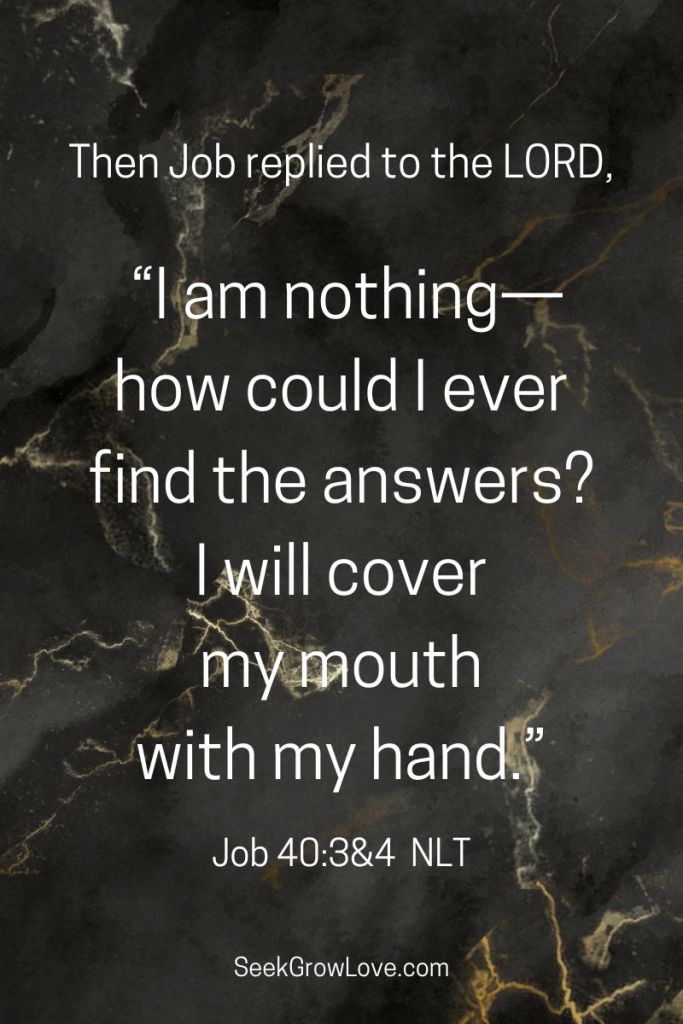
Job 40:1-5(NLT) Then the LORD said to Job, 2 “Do you still want to argue with the Almighty? You are God’s critic, but do you have the answers?” Job Responds to the LORD 3Then Job replied to the LORD, 4 “I am nothing—how could I ever find the answers? I will cover my mouth with my hand. 5 I have said too much already. I have nothing more to say.”
Proverbs 1:7(NKJV) The fear of the LORD is the beginning of knowledge
Fear here is not that of a frightened mind, but an overwhelmed, overawed understanding of the power of God and the feeble strength of man.
Our ministry today is to explain to a fallen world what the message of God is, showing others the way to the truth. Our message is now in the cross of Christ and what God has done for us in Jesus’ life and death. Our responsibility is to show an Invisible God to a hurting world.
1 Corinthians 1:18-25(NLT) The message of the cross is foolish to those who are headed for destruction! But we who are being saved know it is the very power of God. 19 As the Scriptures say, “I will destroy the wisdom of the wise and discard the intelligence of the intelligent.” 20 So where does this leave the philosophers, the scholars, and the world’s brilliant debaters? God has made the wisdom of this world look foolish. 21 Since God in his wisdom saw to it that the world would never know him through human wisdom, he has used our foolish preaching to save those who believe. 22 It is foolish to the Jews, who ask for signs from heaven. And it is foolish to the Greeks, who seek human wisdom. 23 So when we preach that Christ was crucified, the Jews are offended and the Gentiles say it’s all nonsense. 24 But to those called by God to salvation, both Jews and Gentiles, Christ is the power of God and the wisdom of God. 25 This foolish plan of God is wiser than the wisest of human plans, and God’s weakness is stronger than the greatest of human strength.
Job 40:6-11(NLT) The LORD Challenges Job Again 6 Then the LORD answered Job from the whirlwind: 7 “Brace yourself like a man, because I have some questions for you, and you must answer them. 8 “Will you discredit my justice and condemn me just to prove you are right? 9 Are you as strong as God? Can you thunder with a voice like his? 10 All right, put on your glory and splendor, your honor and majesty. 11 Give vent to your anger. Let it overflow against the proud.
Job 42:1-6(NLT) Then Job replied to the LORD: 2 “I know that you can do anything, and no one can stop you. 3 You asked, ‘Who is this that questions my wisdom with such ignorance?’ It is I—and I was talking about things I knew nothing about, things far too wonderful for me. 4 You said, ‘Listen and I will speak! I have some questions for you, and you must answer them.’ 5I had only heard about you before, but now I have seen you with my own eyes. 6 I take back everything I said, and I sit in dust and ashes to show my repentance.”
Then we come to the end of the book. In only a few short verses with little explanation or elaboration we see Job pray for friends and then he is restored to life, health and position. Even double the wealth that he had before. What brings this amazing turnabout?
Job 42:8-10(NLT) My servant Job will pray for you, and I will accept his prayer on your behalf. I will not treat you as you deserve, for you have not spoken accurately about me, as my servant Job has.” 9 So Eliphaz the Temanite, Bildad the Shuhite, and Zophar the Naamathite did as the LORD commanded them, and the LORD accepted Job’s prayer. 10 When Job prayed for his friends, the LORD restored his fortunes. In fact, the LORD gave him twice as much as before!
The ”miserable comforters” do a sacrifice where they lay their hands on the heads of the bulls, transferring their sin to the animals. Then Job changes from self-justification and promotion to making humble prayer for the friends. When we are right with God then He is able to bless us because of His decision to do it, not because of our merit, works or traditions.
What is the conclusion of the matter?
With God I am everything, Without God I am nothing!
James 5:10-11(NLT) For examples of patience in suffering, dear brothers and sisters, look at the prophets who spoke in the name of the Lord. 11 We give great honor to those who endure under suffering. For instance, you know about Job, a man of great endurance. You can see how the Lord was kind to him at the end, for the Lord is full of tenderness and mercy.
-Tom Siderius
Questions for Reflection:
Did you have fun reading the book of Job and the lesson in it?
Has the reading changed your thinking about the “Oldest Lesson in the World”?
Has your heart changed about who God is and who we are?
Acts 17:24-27(NLT) He is the God who made the world and everything in it. Since he is Lord of heaven and earth, he doesn’t live in man-made temples, 25 and human hands can’t serve his needs—for he has no needs. He himself gives life and breath to everything, and he satisfies every need. 26 From one man he created all the nations throughout the whole earth. He decided beforehand when they should rise and fall, and he determined their boundaries. 27 “His purpose was for the nations to seek after God and perhaps feel their way toward him and find him—though he is not far from any one of us.
God answers Job
In our chapter reading today we come to the point where it shows us that God Himself challenges Job and his friends. How this happens, in audible words, or an angelic herald, we don’t know because it doesn’t say. Remember that this is an epic poem which is told as verbal story to people at that time. It is to give us understanding of who God is and how He deals with us in our lives. God starts by challenging Job with the majesty of the physical creation and how Job not only has nothing to do with it but does not begin to understand it.
God is Greater than Man
God starts first with the geological and astronomical pages of creation.
Job 38:1-7(NLT) The LORD Challenges Job 1 Then the LORD answered Job from the whirlwind: 2 “Who is this that questions my wisdom with such ignorant words? 3 Brace yourself like a man, because I have some questions for you, and you must answer them. 4 “Where were you when I laid the foundations of the earth? Tell me, if you know so much. 5 Who determined its dimensions and stretched out the surveying line? 6 What supports its foundations, and who laid its cornerstone 7 as the morning stars sang together and all the angels shouted for joy?
Job 38:19-21(NLT) “Where does light come from, and where does darkness go? 20 Can you take each to its home? Do you know how to get there? 21 But of course you know all this! For you were born before it was all created, and you are so very experienced!
Now in chapter 39 God shows the majesty of the work of His creation in the zoological and botanical realms.
Job 39:1-4(NLT) “Do you know when the wild goats give birth? Have you watched as deer are born in the wild? 2 Do you know how many months they carry their young? Are you aware of the time of their delivery? 3 They crouch down to give birth to their young and deliver their offspring. 4 Their young grow up in the open fields, then leave home and never return.
Job 39:19-21(NLT) “Have you given the horse its strength or clothed its neck with a flowing mane? 20 Did you give it the ability to leap like a locust? Its majestic snorting is terrifying! 21 It paws the earth and rejoices in its strength when it charges out to battle.
The object of most religious teaching today is to bring mankind to a better moral and ethical point in their lives. This is not God’s teaching. God’s teaching is that we need to come to Him and believe, and that the way to believe Him is through the lord Jesus Christ. When we confess Jesus as lord we are saying in our hearts that I am no longer the god of my life, I am no longer the one who decides good and evil, that I am subject to a different ruler than my own heart. We must confess the sinful nature of our hearts to get to this point. Not to just confess the individual sins we may have committed.
True Christianity is our relationship with Jesus our lord and God our Father, not in trying to fix the sins of our lives. This is truly the greatest lesson from the book of Job that we can learn. Stop looking at the morality of this world and events here and look to our Father who is He that has set it all in motion. Our strength is in Christ not in our own arm and power.
Our true ministry is to convey to others the God of grace that we have experienced and walked with. This is to be like Christ in what we do and speak.
I pray as we come to the end of this study of Job that it opens our hearts to hear God as we will see Job hear God.
-Tom Siderius
Questions for Reflection:
Do you truly believe that God has created the heavens and the earth and all that is here?
Have you grown in your understanding of the confession of Jesus as lord?
Do you better see the difference between religion and Christianity?





 Seek Grow Love