
1 Kings 12-14
If you’re like me, you’ve purchased an “assembly required” item and unpacked the contents without thumbing through the instructions. “How hard could it be to turn a few screws and boards into a bookshelf?” Halfway through the build, you realize you used the wrong board in one section, another is fitted upside down, and in your haste, you’re now down at least one screw. Necessity may be the mother of invention, but sometimes innovation comes from darker places—with consequences far greater than a shoddy IKEA build. Pride and fear can quickly lead us into folly as we try to adjust and adapt without seeking counsel. Likewise, our spiritual life was never meant to be self-driven, self-led, or self-defined. To build our relationship with God, we are called to be faithful to His instructions and selfless in their pursuit.
In today’s reading, King Jeroboam is appointed as the new leader of Israel. As he takes the reins, he surveys the political pieces of a recently split kingdom. His people had long worshiped in Jerusalem, which remained part of the rival kingdom of Judah. Jeroboam feared that his people’s loyalty would ultimately shift back to Rehoboam, king of Judah, from the anointed house of David. Instead of consulting the God of Abraham, Isaac, and Jacob or one of His prophets, Jeroboam devises his own solution to keep the people close to home.
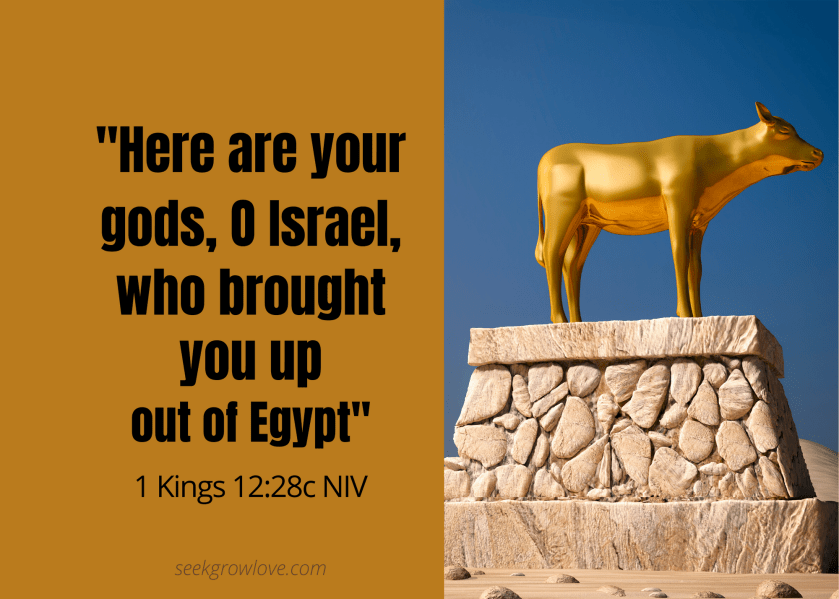
“Jeroboam thought to himself, ‘The kingdom will now likely revert to the house of David…'” So the king made two golden calves. He said to the people, ‘It is too much for you to go up to Jerusalem. Here are your gods, Israel, who brought you up out of Egypt.'” (1 Kings 12:26, 28)
Jeroboam took up his place as both the political and spiritual leader of Israel, but motivated by fear and a desire for control, he led God’s people astray. He created false idols, counterfeit altars, and bogus festivals—all in an attempt to keep his people from returning to the holy city of Jerusalem. Leaving behind the moral clarity of God’s commands, it became easier and more accessible to engage in a made-up religion that appeared similar on the surface to what they knew to be true. They were working with the same pieces, but some were flipped upside down, some placed in the wrong spot, and others lost along the way. As their worship moved farther from Jerusalem, the distance between Israel and God grew greater.
There is a stark warning here for the adjustments and innovations we see in the Church today. We must be careful that our worship, ministry, and evangelism do not favor convenience over obedience or comfort over conviction. If we fail to heed this warning, we may end up with well-developed systems that contain many of the same pieces—but are no longer building the Kingdom of God. Instead, we risk creating idols and events that offer no eternal hope. Granted, we may not be fashioning golden calves, but when we prioritize comfort over truth, we risk building spiritual lives rooted in fear, insecurity, and pride—lives that are void of God’s instruction.
It has never been about innovating what works for us or embracing a “you do you” mentality. God demands surrender and faithfulness in our daily worship, which means we will likely find ourselves worshiping in the city of our enemies from time to time. Resist the urge to craft a god who fits us. Instead, let us be molded to fit His purpose and to build His Kingdom according to His Gospel instructions.
-Aaron Winner
Reflection Questions
- What problems do you think God saw in Jeroboam? Do you think God ever sees these same problems in you?
- What does God desire from us – in our worship and in the way we live our lives?
- What are your thoughts about the following: “If we fail to heed this warning, we may end up with well-developed systems that contain many of the same pieces—but are no longer building the Kingdom of God” ? Have you seen this occur? How can we better heed this warning for our lives and for our church and for the Kingdom of God?





 Seek Grow Love