
-Devotion by Liam Johnson (MN)
Today, I’d like to focus on Boaz’s major role in the book of Ruth: his role as a “Go’el” or “kinsman-redeemer”.
As I talked about three days ago, Naomi experienced probably the worst hardship a woman can go through, losing her husband and her two sons. And, as I mentioned as well, being a woman in the ancient near east without a household-leading man leaves you destitute, without any social power in society. And, for Israel specifically, the matter of inheritance of property becomes a major factor in this loss of name-bearers.
This is where the go’el or “kinsman-redeemer” comes in. There are a few ways the go’el could act:
- Redeeming land – If a relative had to sell the land due to poverty or debt, the go’el could buy it back so that it stays in the family name. (Leviticus 25)
- Redeeming persons – Like above, but if a person sells themselves into slavery, the go’el could buy out their freedom.
- Avenging blood – If someone is murdered, the go’el could enact justice by avenging their relative (Numbers 25).
- Levirate marriage – Though this is separate, as we read in Deuteronomy 25, the go’el could marry a widow of a family member, and any child born as a result of the go’el and the widow would inherit the name of the dead relative.
- This is an interesting situation, and Boaz’s role in Ruth is what explains how this law relates to being a go’el.
Before Ruth 4, almost all interactions with Boaz simply call him go’el (usually translated as some variation on family redeemer, though I just like the word kinsman). In Ruth 3, Ruth proposes to Boaz, asking him to be a go’el. His answer is seen in Ruth 3:10-13
10 Then he said, “May the Lord bless you, my daughter. You have shown more kindness now than before, because you have not pursued younger men, whether rich or poor. 11 Now don’t be afraid, my daughter. I will do for you whatever you say, since all the people in my town know that you are a woman of noble character. 12 Yes, it is true that I am a family redeemer, but there is a redeemer closer than I am. 13 Stay here tonight, and in the morning, if he wants to redeem you, that’s good. Let him redeem you. But if he doesn’t want to redeem you, as the Lord lives, I will. Now lie down until morning.”
The next day, Boaz follows through. He goes to the “other redeemer” and asks him to redeem Elimelech’s land. The other redeemer answers in Ruth 4:4
I thought I should inform you: Buy it back in the presence of those seated here and in the presence of the elders of my people. If you want to redeem it, do it. But if you do not want to redeem it, tell me so that I will know, because there isn’t anyone other than you to redeem it, and I am next after you.”
“I want to redeem it,” he answered.
Of course, Boaz left out a key bit of information there. He adds in verse 5, and the redeemer replies in verse 6:
Then Boaz said, “On the day you buy the field from Naomi, you will acquire Ruth the Moabitess, the wife of the deceased man, to perpetuate the man’s name on his property.”
The redeemer replied, “I can’t redeem it myself, or I will ruin my own inheritance. Take my right of redemption, because I can’t redeem it.”
This is interesting. Why can’t this man redeem the land and marry Ruth?
The initial request was effectively asking him to “buy the land” per the Leviticus 25 law (point 1 above). But the addition of Ruth here complicates things. This means that he’d be buying the land just to pass it on to a son who, while biologically his, would, legally speaking, not be his. In other words, the redeemer refused because this was an entirely sacrificial act: the person acting as go’el does not gain anything from the deal. Now, it very well may be that this closer relative could not financially handle this strain, where he may have had the wealth to invest into the land, but would need the effective ownership of it to maintain financial stability. It is not said, just that he refused.
So, then Boaz fully accepts the role of kinsman-redeemer, which we read the acceptance speech in Ruth 4:9-10
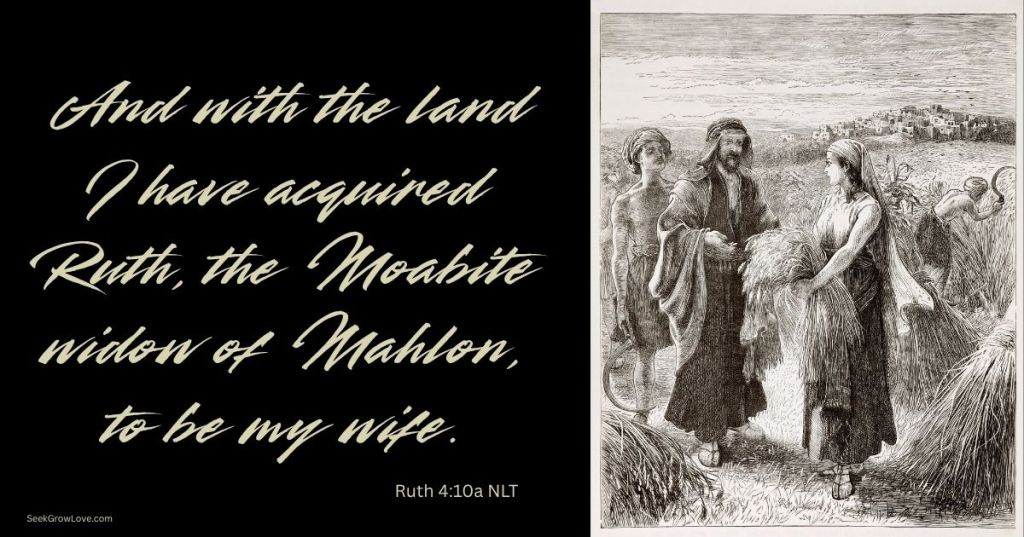
9 Boaz said to the elders and all the people, “You are witnesses today that I am buying from Naomi everything that belonged to Elimelech, Chilion, and Mahlon. 10 I have also acquired Ruth the Moabitess, Mahlon’s widow, as my wife, to perpetuate the deceased man’s name on his property, so that his name will not disappear among his relatives or from the gate of his hometown. You are witnesses today.”
With accepting this, we can now see the full context, which further exemplifies Boaz’s noble character. He fully understood that buying the land was a total loss of money, and that the children he would have with Ruth would not be his, as far as society cares, but instead be children of Mahlon. He prioritized the care of these two widows above financial gain.
Finally, I cannot talk about redeemers without talking about our own. How is Jesus our go’el?
Looking back to the list of potential responsibilities of the go’el, for us, I’d argue that we needed purchasing from slavery.
John 8:34
Jesus responded, “Truly I tell you, everyone who commits sin is a slave of sin.
Romans 6:6b, 16
6 …so that we may no longer be enslaved to sin
16 Don’t you know that if you offer yourselves to someone as obedient slaves, you are slaves of that one you obey—either of sin leading to death or of obedience leading to righteousness?
Romans 7:14, 18-19
14 For we know that the law is spiritual, but I am of the flesh, sold as a slave under sin.
18 For I know that nothing good lives in me, that is, in my flesh. For the desire to do what is good is with me, but there is no ability to do it. 19 For I do not do the good that I want to do, but I practice the evil that I do not want to do.
Galatians 3:22
22 But the Scripture imprisoned everything under sin’s power, so that the promise might be given on the basis of faith in Jesus Christ to those who believe.
But while we were slaves under sin, with Christ, we’ve been freed. Most of these passages above answer their comments on sin saying as such.
John 8:36
36 So if the Son sets you free, you really will be free.
Romans 6:6, 17-18
6 For we know that our old self was crucified with him so that the body ruled by sin might be rendered powerless so that we may no longer be enslaved to sin,
17 But thank God that, although you used to be slaves of sin, you obeyed from the heart that pattern of teaching to which you were handed over, 18 and having been set free from sin, you became enslaved to righteousness.
And we can even see how Peter and Paul both refer to Jesus as a redeemer, ransoming us from our sin.
1 Peter 1:18-19
18 For you know that you were redeemed from your empty way of life inherited from your ancestors, not with perishable things like silver or gold, 19 but with the precious blood of Christ, like that of an unblemished and spotless lamb.
Ephesians 1:7-8
7 In him we have redemption through his blood, the forgiveness of our trespasses, according to the riches of his grace 8that he richly poured out on us with all wisdom and understanding.
Jesus is our go’el, buying us out of slavery from sin, redeeming us back into the family of God.
Reflection Questions
Are you finding yourself seeking out that slavery after you’ve been freed? If you haven’t accepted Jesus, yet, have you considered how you can be freed from sin? Are you willing to sacrifice your time and money if it would help your friends and family? Have you taken a moment to remember the price paid for your freedom?
Prayer
Our heavenly Father,
I thank you for your Son
Who redeems us from our sin
Bought us out of slavery
And set us back on our path to you
Guide us with your spirit
Help us not to fall away
And again with the most thanks
The most joy
That we might finally have peace to live
Because you redeemed us with your Son
Amen

