Redeemed!

Ruth 4Psalm 44Acts 23

-Devotion by Liam Johnson (MN)

Today, I’d like to focus on Boaz’s major role in the book of Ruth: his role as a “Go’el” or “kinsman-redeemer”.

As I talked about three days ago, Naomi experienced probably the worst hardship a woman can go through, losing her husband and her two sons. And, as I mentioned as well, being a woman in the ancient near east without a household-leading man leaves you destitute, without any social power in society. And, for Israel specifically, the matter of inheritance of property becomes a major factor in this loss of name-bearers.

This is where the go’el or “kinsman-redeemer” comes in. There are a few ways the go’el could act:

  1. Redeeming land – If a relative had to sell the land due to poverty or debt, the go’el could buy it back so that it stays in the family name. (Leviticus 25)
  2. Redeeming persons – Like above, but if a person sells themselves into slavery, the go’el could buy out their freedom.
  3. Avenging blood – If someone is murdered, the go’el could enact justice by avenging their relative (Numbers 25).
  4. Levirate marriage – Though this is separate, as we read in Deuteronomy 25, the go’el could marry a widow of a family member, and any child born as a result of the go’el and the widow would inherit the name of the dead relative.
  5. This is an interesting situation, and Boaz’s role in Ruth is what explains how this law relates to being a go’el.

Before Ruth 4, almost all interactions with Boaz simply call him go’el (usually translated as some variation on family redeemer, though I just like the word kinsman). In Ruth 3, Ruth proposes to Boaz, asking him to be a go’el. His answer is seen in Ruth 3:10-13

10 Then he said, “May the Lord bless you, my daughter. You have shown more kindness now than before, because you have not pursued younger men, whether rich or poor. 11 Now don’t be afraid, my daughter. I will do for you whatever you say, since all the people in my town know that you are a woman of noble character. 12 Yes, it is true that I am a family redeemer, but there is a redeemer closer than I am. 13 Stay here tonight, and in the morning, if he wants to redeem you, that’s good. Let him redeem you. But if he doesn’t want to redeem you, as the Lord lives, I will. Now lie down until morning.”

The next day, Boaz follows through. He goes to the “other redeemer” and asks him to redeem Elimelech’s land. The other redeemer answers in Ruth 4:4

 I thought I should inform you: Buy it back in the presence of those seated here and in the presence of the elders of my people. If you want to redeem it, do it. But if you do not want to redeem it, tell me so that I will know, because there isn’t anyone other than you to redeem it, and I am next after you.”

“I want to redeem it,” he answered.

Of course, Boaz left out a key bit of information there. He adds in verse 5, and the redeemer replies in verse 6:

Then Boaz said, “On the day you buy the field from Naomi, you will acquire Ruth the Moabitess, the wife of the deceased man, to perpetuate the man’s name on his property.”

The redeemer replied, “I can’t redeem it myself, or I will ruin my own inheritance. Take my right of redemption, because I can’t redeem it.”


This is interesting. Why can’t this man redeem the land and marry Ruth?

The initial request was effectively asking him to “buy the land” per the Leviticus 25 law (point 1 above). But the addition of Ruth here complicates things. This means that he’d be buying the land just to pass it on to a son who, while biologically his, would, legally speaking, not be his. In other words, the redeemer refused because this was an entirely sacrificial act: the person acting as go’el does not gain anything from the deal. Now, it very well may be that this closer relative could not financially handle this strain, where he may have had the wealth to invest into the land, but would need the effective ownership of it to maintain financial stability. It is not said, just that he refused.

So, then Boaz fully accepts the role of kinsman-redeemer, which we read the acceptance speech in Ruth 4:9-10

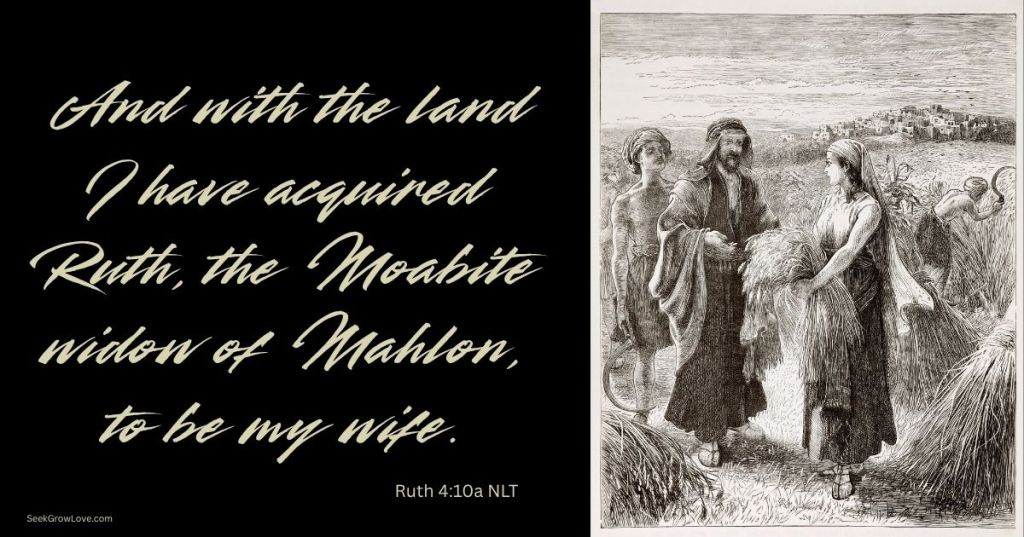
9 Boaz said to the elders and all the people, “You are witnesses today that I am buying from Naomi everything that belonged to Elimelech, Chilion, and Mahlon. 10 I have also acquired Ruth the Moabitess, Mahlon’s widow, as my wife, to perpetuate the deceased man’s name on his property, so that his name will not disappear among his relatives or from the gate of his hometown. You are witnesses today.”

With accepting this, we can now see the full context, which further exemplifies Boaz’s noble character. He fully understood that buying the land was a total loss of money, and that the children he would have with Ruth would not be his, as far as society cares, but instead be children of Mahlon. He prioritized the care of these two widows above financial gain.

Finally, I cannot talk about redeemers without talking about our own. How is Jesus our go’el?

Looking back to the list of potential responsibilities of the go’el, for us, I’d argue that we needed purchasing from slavery.

John 8:34

Jesus responded, “Truly I tell you, everyone who commits sin is a slave of sin.

Romans 6:6b, 16

6 …so that we may no longer be enslaved to sin

16 Don’t you know that if you offer yourselves to someone as obedient slaves, you are slaves of that one you obey—either of sin leading to death or of obedience leading to righteousness?

Romans 7:14, 18-19

14 For we know that the law is spiritual, but I am of the flesh, sold as a slave under sin.

18 For I know that nothing good lives in me, that is, in my flesh. For the desire to do what is good is with me, but there is no ability to do it. 19 For I do not do the good that I want to do, but I practice the evil that I do not want to do.

Galatians 3:22

22 But the Scripture imprisoned everything under sin’s power, so that the promise might be given on the basis of faith in Jesus Christ to those who believe.

But while we were slaves under sin, with Christ, we’ve been freed. Most of these passages above answer their comments on sin saying as such.

John 8:36

36 So if the Son sets you free, you really will be free.

Romans 6:6, 17-18

6 For we know that our old self was crucified with him so that the body ruled by sin might be rendered powerless so that we may no longer be enslaved to sin,

17 But thank God that, although you used to be slaves of sin, you obeyed from the heart that pattern of teaching to which you were handed over, 18 and having been set free from sin, you became enslaved to righteousness.

And we can even see how Peter and Paul both refer to Jesus as a redeemer, ransoming us from our sin.

1 Peter 1:18-19

18 For you know that you were redeemed from your empty way of life inherited from your ancestors, not with perishable things like silver or gold, 19 but with the precious blood of Christ, like that of an unblemished and spotless lamb.

Ephesians 1:7-8

7 In him we have redemption through his blood, the forgiveness of our trespasses, according to the riches of his grace 8that he richly poured out on us with all wisdom and understanding.

Jesus is our go’el, buying us out of slavery from sin, redeeming us back into the family of God.

Reflection Questions

Are you finding yourself seeking out that slavery after you’ve been freed? If you haven’t accepted Jesus, yet, have you considered how you can be freed from sin? Are you willing to sacrifice your time and money if it would help your friends and family? Have you taken a moment to remember the price paid for your freedom?

Prayer

Our heavenly Father,

I thank you for your Son

Who redeems us from our sin

Bought us out of slavery

And set us back on our path to you

Guide us with your spirit

Help us not to fall away

And again with the most thanks

The most joy

That we might finally have peace to live

Because you redeemed us with your Son

Amen
With ALL Your Heart

Ruth 3Psalm 44Acts 22

-Devotion by Liam Johnson (MN)

“I will do everything you say.” (Ruth 3:5)

Ruth shows exemplary faith and trust in her mother-in-law, which is an example we can all learn from. Naomi provides a plan to appeal to Boaz to be a family redeemer, a crazy plan that, even by today’s standards, would be radical.

So remember exactly what this is: a marriage proposal. Ruth is fully on board with marrying a man, not her herself, but for her mother-in-law. This is, at its core, an example of a person fully submitting themselves to another.

This reminds me of John 15:13

No one has greater love than this: to lay down his life for his friends.


In the context of the gospels and this sentence in general, it is about sacrificing your full life for your friends, that is, dying for them. But Ruth shows another way we can lay down our lives for our friends, by giving up our life so that our friends, family, or whoever, might have a better life because of our actions. Ruth could have stayed in Moab (Ruth 1:15) but instead she left security to support her widowed mother-in-law.

Using this context on sacrificial love, take a look at Mark 12:29-31, where Jesus answered the question of the greatest commandment.

29 Jesus answered, “The most important is Listen, Israel! The Lord our God, the Lord is one. 30 Love the Lord your God with all your heart, with all your soul [life], with all your mind, and with all your strength. 31 The second is, Love your neighbor as yourself. There is no other command greater than these.”

When we’re told to love Yahweh our God with all of our heart, life, mind, and strength, do you understand what all means there? Ruth is an example of living a life for someone else. She gave up her own wishes and fully submitted to the will of her mother-in-law. And, while Boaz is certainly a perfect example of loving your neighbor as yourself, Ruth is certainly a good example, too. Remember: Ruth is a Moabitess. So any care and love she shows for an Israelite is showing love for her neighbor.

Reflection Questions:

Are you willing to forget yourself for the sake of your friends and family, when they’re in need? Are you fully in submission to your God, that when he sends you a command, will you say, “I will do everything you say”?

PRayer:

Yahweh, our one and only God,

I thank you for your son, who was the perfect demonstration of both,

To love you with our entire being

And to love our neighbor as we’d love ourselves

Prepare your spirit within us

So that we will live our lives for you

That when you call on us

Help us to say

“Not my will, but yours be done”

Amen

A Noble Character

Ruth 2Psalm 43Acts 21

-Devotion by Liam Johnson (MN)

Boaz has become my favorite man in the Bible, and Ruth 2 highlights the big reasons why.

Ruth 2 opens by describing Boaz as a “man of noble character” (Ruth 2:1), but the first thing we see of Boaz is far more telling. Look how he greets his employees in Ruth 2:4,

Later, when Boaz arrived from Bethlehem, he said to the harvesters, “Yahweh be with you.”
 

“Yahweh bless you,” they replied.

Upon hearing that Ruth is gleaning from his field, he finds her, and further shows his noble character. He learns about her first from his chief servant in Ruth 2:5-7

5 Boaz asked his servant who was in charge of the harvesters, “Whose young woman is this?”

6 The servant answered, “She is the young Moabite woman who returned with Naomi from the territory of Moab. 7 She asked, ‘Will you let me gather fallen grain among the bundles behind the harvesters?’ She came and has been on her feet since early morning, except that she rested a little in the shelter.”

Then when he goes to Ruth,

8 Then Boaz said to Ruth, “Listen, my daughter. Don’t go and gather grain in another field, and don’t leave this one, but stay here close to my female servants. 9 See which field they are harvesting, and follow them. Haven’t I ordered the young men not to touch you? When you are thirsty, go and drink from the jars the young men have filled.”

And while it’s good to isolate how to be a good Godly man from Boaz, we can also pull a bit of being a good Godly woman from this chapter, when he answers a question from Ruth in 2:10-12

10 She fell facedown, bowed to the ground, and said to him, “Why have I found favor with you, so that you notice me, although I am a foreigner?”

11 Boaz answered her, “Everything you have done for your mother-in-law since your husband’s death has been fully reported to me: how you left your father and mother and your native land, and how you came to a people you didn’t previously know. 12 May the Lord reward you for what you have done, and may you receive a full reward from the Lord God of Israel, under whose wings you have come for refuge.”

But Boaz continues showing generosity by giving her dinner before sending her home, and dinner for the week by sending barley home with her (Ruth 2:15-18)

Here’s a few more examples of being a godly man or woman from throughout the Bible:

1 Corinthians 16:13-14

13 Be alert, stand firm in the faith, be courageous, be strong. 14 Do everything in love.

Psalm 112

1 Hallelujah!

Happy is the person who fears the Lord,

taking great delight in his commands.

4 Light shines in the darkness for the upright.

He is gracious, compassionate, and righteous.

5 Good will come to the one who lends generously

and conducts his business fairly.

9 He distributes freely to the poor;

his righteousness endures forever.

His horn will be exalted in honor.

Micah 6:8

Mankind, he has told each of you what is good

and what it is the Lord requires of you:

to act justly,

to love faithfulness,

and to walk humbly with your God.

From Ephesians 5

15 Pay careful attention, then, to how you walk—not as unwise people but as wise— 16 making the most of the time, because the days are evil. 17 So don’t be foolish, but understand what the Lord’s will is. 

Reflection Questions:

Ruth 2 is a chapter that is filled with positive examples for improving yourself in any relationship you’re in. Both as an example in how to be yourself, but also in creating expectations for those with whom you want a relationship (whether friend or romance). Are there any ways you can improve in yourself to be a better friend or partner or spouse? Is there any way you can better help your friend be a better friend or partner be a better partner?

Prayer:

Our Father in heaven,

Thank you for the demonstration of your love in Jesus

Please guide us to being the best person we can be

And help us to seek to be ever better

And to always seek you first

Bitter

Ruth 1Psalm 43Acts 20

-Devotion by Liam Johnson (MN)

While Ruth is so titled for the woman who shows great bravery in following her mother-in-law to unknown land, she is not the main character of the story. Naomi, Ruth’s mother-in-law, is the lead driving character in the whole story.

This book has many themes, the most prominent being love, however this isn’t the theme that I’d like to dive into today. Instead we will follow Naomi as she falls into bitterness for events for which she blames God. Then, we’ll look at how we or those close to us have experienced this same bitterness, events that make us turn to God and say, “Why? Why me?” and we’ll look at how Naomi and a couple others turned from this negative view.

The cause of Naomi’s bitterness is described in Ruth 1:1-5.

1 During the time of the judges, there was a famine in the land. A man left Bethlehem in Judah with his wife and two sons to stay in the territory of Moab for a while. 2 The man’s name was Elimelech, and his wife’s name was Naomi. The names of his two sons were Mahlon and Chilion. They were Ephrathites from Bethlehem in Judah. They entered the fields of Moab and settled there. 3 Naomi’s husband, Elimelech, died, and she was left with her two sons. 4 Her sons took Moabite women as their wives: one was named Orpah and the second was named Ruth. After they lived in Moab about ten years, 5 both Mahlon and Chilion also died, and the woman was left without her two children and without her husband.

Running down what Naomi has gone through so far, we see:

  1. A famine forces her, with her husband and her sons, to flee to Moab, leaving her familial home behind.
  2. Her husband dies.
  3. While she experiences the joy of seeing her sons marry, she then loses both her sons

So, having been forced from her home, losing her husband, and also both her sons, Naomi is now a widow in a foreign land with no men in her life. Bear in mind, in the culture of the ancient near east, a woman has no social power without a man. Her life is in a massive upheaval and with this, Naomi makes a choice – her only choice, really. She will return home to Israel.

It’s easy while reading the Bible to forget that we’re reading about the lives of real humans. But, to put yourself in Naomi’s shoes for just a moment, you can probably imagine what she might be feeling in this moment. Naomi will answer for herself in Ruth 1:19-21, which says,

19 The two of them traveled until they came to Bethlehem. When they entered Bethlehem, the whole town was excited about their arrival and the local women exclaimed, “Can this be Naomi?”

20 “Don’t call me Naomi. Call me Mara,” she answered, “for the Almighty has made me very bitter. 21 I went away full, but the Lord has brought me back empty. Why do you call me Naomi, since the Lord has opposed me, and the Almighty has afflicted me?”

Ruth’s mother-in-law doesn’t feel like “pleasant” Naomi anymore.  All these events have, understandably, made Naomi quite bitter towards her God. (This line in verse 20 is a play on words easily lost in the translation from Hebrew to English. “Naomi” means “pleasant”, while “Mara” means “bitter”. )

Naomi’s feeling that God has left her isn’t a unique instance in the Bible. The psalmist of Psalm 42-43 held a similar sentiment (these two Psalms are likely one psalm, based on the repeated refrain in 42:5, 42:11 and 43:5). He was likely someone during an exile whose psalm held two main prayers: first, help me against my enemies and second, why have you [God] abandoned me?

Psalm 43:2

For you are the God of my refuge.

Why have you rejected me?

Why must I go about in sorrow

because of the enemy’s oppression?


The psalmist asks God to recall him to Jerusalem so he can worship once again. Continuing the psalm in 43:3-4:

3 Send your light and your truth; let them lead me.

Let them bring me to your holy mountain,

to your dwelling place.

4 Then I will come to the altar of God,

to God, my greatest joy.

I will praise you with the lyre,

God, my God.

This bitterness and abandonment that the psalmist and Naomi feel may easily be felt by us too. Through the woes of this world, whether it be the loss of good friends and family; seeing close friends walk away from the faith; or seeing the state of the world, a world which serves itself as god, it can be very easy for us to become dejected, to be in such turmoil. To become bitter as the people ask, all day long, “Where is your God?” (Psalm 42:3).

But throughout this song and prayer, the psalmist repeats this refrain. It is a refrain of hope and faith. Though feeling abandoned by God, he still chooses to praise him. Psalm 43:5 says:

Why, my soul, are you so dejected?

Why are you in such turmoil?

Put your hope in God, for I will still praise him,

my Savior and my God.

Following from the psalmist’s words it may seem easy to say: Why, Naomi, are you so dejected? Why are you in such turmoil? Put your hope in God, still praise him, your savior and your God. However, as with most things in life; it is easier said than done.

So how do we do it? How do we continue to show our faithfulness and love for God when times become turbulent?

Let’s start small and look at how the psalmist talks about God. 42:1-2 (which is the basis for my favorite hymn) tells us:

1 As a deer longs for flowing streams,

so I long for you, God.

2 I thirst for God, the living God.

When can I come and appear before God?

He begins with the longing to see his God (where he can see his God – at the temple). The psalmist speaks only faithfully of his God, remembering leading the festivities in the temple with joyful and thankful shouts. He is depressed though he does not wish to be.

Finally from this psalm, he calls Yahweh by name once in this whole psalm (42-43), which he uses intentionally, as a part of remembering Yahweh’s faithfulness. The singer remembers that Yahweh sends his faithful love, his hesed, by day, and His song is with him by night (Psalm 42:8). All day and all night, Yahweh is with you.

Now, bringing it back to Naomi, she doesn’t have some epiphany, nor does she come back to the joy of her God on her own. No, instead, she is brought back to joy by those around her. The titular Ruth, in a brilliant act of bravery, chooses to follow her mother-in-law to, to Ruth, a foreign land, choosing the unknown path of life over the safer path as Orpah did, in staying in Moab (Ruth 1:15-18). Because Ruth went with Naomi, God was able to work good in her life, through the path of a redeemer, Boaz, who would be the second major factor in restoring Naomi to a pleasant life (Ruth 4:15).

REflection Questions

Have you experienced the bitterness of life, as Naomi and this psalmist have? If you have, how’d you get through it? Did you do as the psalmist, choosing to praise God even when it was hard? Or did your friends and family help you through it, bringing the joy of God in their actions?

Prayer

Here’s a short prayer based on the psalm we read:

God, our God of heaven, how I long for you

Be with me in this life, that we might not forget

For those who seek you, asking “Where are you God?”

Shine forth from your servants

For those who ask, “Why have you forgotten me?”

Remind us who you are, God.

Send your love by day, Yahweh,

And let us sing your song by night

Let our lives be a living prayer to you

Our savior and our God

“Flowers Grow in the Valley”

Ruth 1-4

In my life, I’ve seen many people deal with troubling times and grief in various ways. Most of them initially take the path of least resistance, which often leads them further from God, but those with a strong support system are guided on pathways that lead them closer to God than they’ve ever been. I’ve had my fair share of troubles, and without the help of my school teachers, professors, friends, and family, I wouldn’t have been as close to God as I am today. I heard a song recently called Flowers by Samantha Ebert that contained the lyrics, “I’m a good God and I have a good plan, so trust that I’m holding a watering can, and someday you’ll see, that flowers grow in the valley.” Ruth’s story is a fantastic illustration of the beauty that God can bring to fruition in life’s valleys. 

The book of Ruth takes place during a time of trouble and famine. Naomi lost her husband Elimelek and her two sons Mahlon and Kilion. Ruth and Orpah became widows. However, a glimmer of hope came to Naomi as she heard what the LORD had done for His people (aiding and providing for them in this tough time). She urges her daughters-in-law to return to their mother’s house (because it would be a much easier route for them), but the unexpected happens. Instead of going home, Ruth decides to go with her, stay with her, make Naomi’s people her own, and remain alongside her in death/burial (1:16-17). Naomi tried to “talk some sense” into Ruth but failed to convince her to choose a different path. This resulted in an interesting and intriguing turn of events.

Shortly after arriving in Bethlehem, Naomi and Ruth’s tragic story spreads around town, and the overseer of Boaz’s harvesters and Boaz (who “just so happens” to be one of their kinsman-redeemers) hears of it. Boaz blesses Ruth with protection, provides her with the opportunity to earn an abundance of food, works diligently to ensure she is cared for, and continues the line of David through Obed. This information makes me believe that the “coincidences” along the way were more of a God thing than a perchance thing. As a result, Ruth and Naomi went from two widowed women in one of the biggest valleys of life put in their way to two well-off women blessed with the beauty of God’s providence.

Pain, suffering, and troubled times often bring forth heightened emotions, illogical judgments, and tough decisions. If we’re not careful to keep ourselves in check, we can go down a dangerous path towards death and destruction. In Matthew 7:13-14 we find Jesus urging others in his sermon on the mount to, “Enter through the narrow gate. For wide is the gate and broad is the road that leads to destruction, and many enter through it. But small is the gate and narrow the road that leads to life, and only a few find it.” We are presented with a choice, take the easy route and go back to what’s familiar, or choose the path with a few more hills and valleys that God can use to show us more than we could ever hope for.

-Jeffrey Seiders

REFLECTION Q’s

  1. Ruth took the harder path, went with Naomi, and God provided for her. What paths in your life have you taken that were difficult but God blessed you through them?
  2. Naomi tried to convince Ruth and Orpah to take the easier route, and only Orpah went. When did you take the easy route and how did God work through your decision? 
  3. What valleys are you going through now, and how can you see God’s beauty in them?

A Restorer of Life

Old Testament: Ruth 3 & 4

Poetry: Proverbs Introduction below

New Testament: Luke 19

Shalom! This is Stephanie Schlegel writing this week while my husband and youngest daughter are in Israel for a few weeks. 😊 We lived there for about 30 years and moved back to the States five years ago to care for his aging parents.

The passages for today are so fitting for my life right now, and I hope yours too. 😊 The Scriptures bring us so much hope and peace and sustain us, sometimes verses strike and encourage us more than other days. Overall, the faithful commitment in them isn’t disappointing!

When I met my husband (Bill Schlegel) in Jerusalem, he said he found his Ruth. A woman that would be willing to leave her home country and live with him in Israel where he wanted to stay. Both Boaz and Naomi call Ruth their daughter multiple times, and the LORD/Yahweh is acknowledged for having brought about events.

  • People and elders said, “The LORD make the woman who is coming to your house like Rachel and Leah, the two pillars who built the house of Israel.” (4:11)
  • “Because of the offspring which the LORD will give you from this young woman.” (4:12)
  • “The LORD gave her conception.” (4:13)

It is good to acknowledge that the LORD is the giver and sustainer of life.  Ironically, these days I’m caring for my mother-in-law, like Ruth did. The women told Naomi “Blessed be the LORD, who has not left you this day without a close relative, and may his name be famous in Israel: And may he be to you a restorer of life and a nourisher of your old age, for your daughter-in-law, who loves you, who is better to you than seven sons, has borne him.” (4:14,15)

My mother-in-law has four sons, but she really needs a daughter-in-law these days, especially in rehab with three broken limbs, and I love her! Naomi had had two sons previously, but in her later days, she needed a daughter-in-law to care for her. In general, younger people (grandchildren) can be a restorer of life and nourisher in old age for the elderly.  Maybe this week, think of an elderly person or relative you could visit and encourage them, even a neighbor.  It can be a lonely time for them as they can’t move around as much. Hug them and speak words of encouragement to them in their days of old.

The passage in Luke 19 is also fitting!  Jesus was in Jericho with Zacchaeus and walked up to Jerusalem. He walked past Bethpage and Bethany and came to the Mt. of Olives. Now when one reads those places it sounds fairly simple to walk them, but the walk from Jericho to Jerusalem, which I’ve done, is quite an incline! It took 8 hours to walk the 15 miles with a 3,400 ft elevation increase. Jesus probably walked this a dozen times in his life, including when he was a 12-year-old boy. So, I didn’t have much sympathy when our 14-year-old daughter texted me the other day that Abba (Dad) made her walk from Jerusalem up to the Mt. of Olives, which was less than a mile. Lol I told her Jesus walked multiple times from Jericho to Jerusalem, and not only that but all the way from Galilee to Jerusalem, which is about 80 miles and would’ve taken about 4 days to walk. So, I didn’t want to hear any complaining about a little hike up to the Mt. of Olives.  Here’s a picture of her smiling at the top of it. 😊

Now as he drew near the city, he saw the city and wept over it.”  (Luke 19:41) This would’ve been a similar view Jesus would’ve seen minus most of the buildings, and it would’ve been the temple instead of the Dome of the Rock. “And he was daily in the temple. But the chief priests and the scribes, together with the leaders of the people sought to destroy him” (19:47)

So, despite difficulties we may have in our lives, seek the peace of God and reach out to the encourage the broken. “Blessed is he who comes in the name of the LORD!” (19:38)

-Stephanie Schlegel

Reflection Questions

  1. Think of an elderly person or relative you can visit and encourage. What do you think you would find helpful and encouraging when you are older than you are now?
  2. How can you be a restorer of life? How is Jesus a restorer of life?
  3. What do we learn about the LORD in our reading today? What do we learn about His Son Jesus?

Proverbs Introduction

The book of Proverbs is a collection of “sayings of the wise” which was mostly written by King Solomon.  According to Proverbs 1:2-4, the purpose of the book is, “for attaining wisdom and discipline; for understanding words of insight; for acquiring a disciplined and prudent life, doing what is right and just and fair; for giving prudence to the simple, knowledge and discretion to the young.”

Spoiler alert: Proverbs 1:7 gives the answer right away, where it says, “The fear of the Lord is the beginning of knowledge, but fools despise wisdom and discipline.”

Solomon gave advice on many topics, some of which include.  

  • How to live life – Proverbs 3:5-6, “Trust in the Lord with all your heart and lean not on your own understanding; in all your ways acknowledge him, and he will make your paths straight.”  
  • Money – Proverbs 3:9-10, “Honor the Lord with your wealth, with the firstfruits of all your crops; then your barns will be filled to overflowing, and your vats will brim over with new wine.”
  • Hard work – Proverbs 6:6, “Go to the ant you sluggard; consider its ways and be wise!”
  • Alcoholism – Proverbs 20:1, “Wine is a mocker and beer a brawler; whoever is led astray by them is not wise.”
  • Compassion – Proverbs 21:13, “If a man shuts his ears to the cry of the poor, he too will cry out and not be answered.”
  • Childraising – Proverbs 22:6, “Train a child in the way he should go, and when he is old he will not turn from it.”
  • Revenge – Proverbs 24:29, “Do not say, I’ll do to him as he has done to me; I’ll pay that man back for what he did.”
  • Enemies – Proverbs 25: 21-22, “If your enemy is hungry, give him food to eat; if he is thirsty, give him water to drink.  In doing this, you will heap burning coals on his head, and the Lord will reward you.”
  • Obeying God’s law – Proverbs 28:9, “If anyone turns a deaf ear to the law, even his prayers are detestable.”
  • Defend the poor – Proverbs 3:8-9, “Speak up for those who cannot speak for themselves, for the rights of all who are destitute.  Speak up and judge fairly; defend the rights of the poor and needy.”

As you read through Proverbs, I challenge you to consider how you can benefit from applying these proverbs to your own life.  

-Steve Mattison

The Lord be with You

*Old Testament: Ruth 1 & 2

Poetry: Psalm 118

New Testament: Luke 18

Today we begin reading the book of Ruth, which is both enjoyable and easy to read; a book without heavy theology to parse. The importance of the book is made plain at its end (for a preview, look to Ruth 4:17), in that it identifies a certain history of the family of the later King David. In that sense, it serves the Old Testament purpose of remembrance. In this case, it establishes a back story for the royal family (which ultimately leads to Jesus himself), but it also shows the providential role of God in that family. Like the passages in the Book of Judges, an important purpose of the text is to remind Israel how God established a relationship with the nation and then provides, cares for, and protects the nation.

Chapter 1 of Ruth provides the context for the remainder of the book: a family’s migration to Moab, and Naomi’s return to Bethlehem with the unexpected companion, Ruth. Chapter 2 is where the action of this story is established, with Ruth going to glean in Boaz’s fields and the repeated acts of kindness that he shows to her. We must also recognize the extent of his kindness as well: Boaz is obligated to leave some of his unharvested crops for the poor (see Leviticus 23:22), but he goes above and beyond this in his instructions to his servants to purposely leave grains for Ruth. She must have been confused, perhaps embarrassed by the kindness of Boaz, but it all leads to Naomi recognizing Boaz:

“The man is our relative, he is one of our closest relatives.” (Ruth 2:20 NASB)

Unfortunately, the depth of the term “closest relative” is not adequately captured in translation. The Hebrew term means “kinsman redeemer” – a family member that satisfies an obligation or vengeance of another in the extended family. Specific examples are the man that, following the Torah, marries his brother’s widow to preserve land inheritance, but also one who redeems a family member from slavery. This usage takes us to a second purpose of the Old Testament: prefiguring. Boaz, as a “kinsman redeemer” for the family of Naomi, prefigures Jesus as the one that redeems his family: Israel and (as we now know) Gentiles grafted in.

One aspect of Ruth that I greatly enjoy is the ordinariness of the spiritual expression of its characters. Without being ostentatious, the characters of the book recognize the providential role of God repeatedly and reflect it back to others to further recognize God’s role in their daily lives. Consider the statement of Ruth and Orpah in 1:8,9:

“May the LORD deal kindly with you as you have dealt with the dead and with me. May the LORD grant that you may find rest, each in the house of her husband.”

It is not enough for Naomi to wish her daughters-in-law success in their presumed departure; she specifically calls on God to give them that success in their new lives.

Then consider the dialogue between Boaz and his servants in 2:4:

Boaz to his servants: “May the LORD be with you.”

Servants’ response: “May the LORD bless you.”

I think the implication is that Boaz and his servants lived lives suffused in the presumption that God would be with them in every action, in every step along every path. Think about it further: Boaz and his servants were not going to war or going on a trip; they were simply going to the fields for the ordinary work of the day. Yet, he begins the day with a blessing on his servants.

In today’s culture, we increasingly compartmentalize our lives, even our spiritual lives. We work for some hours of the day, we take care of our daily obligations, and, hopefully, we set aside time to relax. More than likely prayer is a “carved out” time and time reading scripture may have to be scheduled. The alternative is to suffuse the entire day with the recognition that God is with us at every moment, and that prayer can and should be spontaneous and simple – ordinary. That we can take any moment to request God’s blessing on another.

This reminds me of an experience from childhood that might be odd to some. One summer, sometime in my teenage years, I had taken my youngest sister on a bike ride to the post office ostensibly for an errand, but mostly to be outside. At the post office, we encountered two nuns in the waiting area. (This was not out of the ordinary, there was a very active convent in my hometown.) One of the nuns leaned down, laid her hand on my sister’s head, and spoke a very simple blessing on her. Then she went back to her business, without skipping a beat. For that woman, living a life devoted to serving others in the name of God, speaking a blessing on a young child was utterly ordinary – she simply wanted to express God’s love to a child.

One of the messages of the Book of Ruth is that God is present in all parts of our lives. We can endeavor to purposefully include our appreciation for God for who He is and to share His love for all people in every moment of our day.

-Dan Siderius

Dan Siderius is a member of the Fair Oaks Community Church of God in Virginia. He lives in central Maryland with his wife and daughter and works as a research scientist for a government laboratory. Apart from work and parenting, he enjoys studying history, gardening, and all varieties of cooking.

Reflection Questions

  1. How can you break your spiritual life out of its compartment this week and mix it with your ordinary every day life? What are the benefits to doing so?
  2. How and to whom can you share remembrances of God providing, caring for and protecting? How can you seek to more regularly and often request God’s blessings on others?
  3. In what ways are Boaz and Jesus similar? In what ways are they different?
  4. What do we learn of God, and His Son Jesus, in our Bible readings today?

Beauty in the Midst of Chaos

Ruth 1

March 3

One of the major themes of the entire Bible is God blessing the entire world through His people, not just taking care of His own in one particular land. This was part of the original promise to Abraham, that he would be a father of many nations, not just one (Genesis 17:4). It was also the original mission of Israel, to be a “light to the nations” and bring God’s glory to other lands outside of their own (Isaiah 49:6). That mission has now extended to the Church, as we proclaim salvation to the ends of the earth, not to just one people-group or nation (Matthew 5:14-16). With this in mind, we come to the story of Ruth, a non-Israelite who was blessed by God for her faithfulness to her mother-in-law.

Ruth’s mother-in-law, Naomi, had just lost her husband and both of her sons. I can’t even imagine the pain that she must have been feeling; no parent should ever have to bury their child (let alone two!). She was wanting to go back to Judah amongst her native people, but Ruth refused to let her go alone. Ruth followed her into a country that she didn’t know, and put herself at the mercy of Naomi’s God, YHWH, to take care of her. Because of her radical faithfulness and trust, she eventually meets the man of her dreams, Boaz, and the two live happily ever after. In fact, their family line is the one that Jesus would eventually come through (see Matthew 1:5). What’s even more impressive about this love story is that all this was happening during the tragic reign of Israel’s judges, just one book before this one. In one of the darkest times in Israel’s history, God was still working behind-the-scenes, creating beauty in the midst of chaos.

-Talon Paul

Questions to Consider

  1. Do you trust that God is doing wonders outside of your native country? Do you consider believers of other countries to be brothers and sisters? Will you pray for them today?
  1. When people are going through a difficult time, sometimes the best thing we can do is simply be there for them and walk with them through it. Have you ever had a friend be there for you when you needed them most? Are you willing to be that friend to someone else? Sometimes people don’t need advice; they just need a shoulder to cry on.
  1. If you are in a dark season of life, God is still working out something beautiful, even if you can’t see it yet. Will you continue to trust God when life seems bleak? Will you remain faithful to Him, even when it seems like nothing is going right?

All You Need is Love

Ruth 3-4 and John 15

            “All you need is love.”  That song, written by John Lennon and sung by the Beatles in June 1967 (during the so-called “summer of love”)   was broadcast live and seen by over 400 million viewers in 25 countries at the time.  It was a kind of sappy, feel good, hippie anthem/anti-war protest song (this was during the height of the war in Viet Nam).

            The late 60’s was a time of radical change in America.  Young men were coming back from Viet Nam in body bags and people were burning their draft cards.  Desegregation was making strides through Dr. King’s call to non-violent protest and some progress was being made, until Dr. King was assassinated in Memphis in 1968 and peaceful protest turned to violent mobs.  As the 60’s gave way to the 70’s and 80’s many of the hippies grew up and became yuppies trading their free love,  pot and “make love, not war” peace signs for cocaine and dollar signs on Wall Street.

            Now we’re in 2021 and the BLM movement tells us that racism is still alive and well.  All that love that John Lennon said  was all we needed seems to be in short supply these days.

            Ruth is an interesting kind of love story that we need to study today.  It shows that true love makes sacrifices and takes risks for the benefit of others.  After Ruth’s husband dies and her father-in-law dies Ruth is encouraged to go back to her people and find another husband, but she loves her mother-in-law enough to sacrifice doing what is most convenient for her.  She goes to a foreign land where she lives a very marginal existence of grabbing the scraps of life.  She is a foreign woman without a husband living far from her family.  It was a perilous existence full of danger and risk, yet she does it out of love for Naomi.

            There are lots of interesting details to the story that no doubt get lost in 3000 years of cultural distance. Kinsmen redeemer is a foreign concept in our society.  In ancient Israel there were two things that mattered most- having an heir and having land that belongs to the family and stays in the family for generations.  When a man died without leaving behind a male child to continue the family name and inherit the land and care for the women in their old age it was up to the next available unmarried male relative to marry the widow and their child would actually be the heir of the son who died.  Many men didn’t like this set up and refused to participate in it.  It was a sacrificial act for a man to take on that responsibility for his dead relatives family and legacy.

            Boaz was a man of great character.  In many ways he could have taken advantage of Ruth’s helplessness and dependency and used her to his advantage.  He did not, instead, he looked out for her and her mother-in-law by making sure they received more than enough food.  He didn’t take advantage of her sexually, instead, he did what was right and at personal cost he took over the role of the kinsmen redeemer and made Ruth his wife and took care of Ruth’s mother-in-law, Naomi.  He acted in a very loving way toward Ruth and Naomi.  Ruth acted in a very loving way toward Naomi.  Naomi was protected and cared for.  Ruth was protected and cared for.  She and Boaz were blessed with a son.  That son, Obed was the grandfather to David who later became the King of Israel, and they were ancestors of Jesus.

            “All you need is Love.” There’s a lot of love in the story of Ruth. Love really is important, it’s foundational to everything.  But love must be rightly understood.  It’s more than what we typically think of as love – warm feelings, romantic notions and sappy songs are not what love is about.  Love is about commitment and sacrifice, it’s about doing what is hard in order to benefit the person you love.  Love is a willingness to take the less easy route.  Love is doing the right thing even when it would be easier and less complicated to do the wrong thing.

            Jesus takes up this theme of love in John 15.  He was about to go to the cross and suffer and die.  He is giving a message to his friends and disciples to sustain them through the difficult hours and days ahead.  The foundational message he gives them is love: “12 My command is this: Love each other as I have loved you. 13 Greater love has no one than this: to lay down one’s life for one’s friends. “

            Jesus teaches about love and exhorts them to love and then he shows them what love looks like by sacrificing himself as an offering for the sins of the world, his friends the disciples, and for us as well.  This love that Jesus demonstrates is a reflection of God’s love for us that is shown in giving his son, Jesus that we might have eternal life (see John 3:16).

            “All you need is love?”  Yes, if we mean the kind of love modeled by Ruth and Boaz which ultimately led to Jesus.  “All you need is love?”  Yes, if we mean the kind of love modeled by Jesus who gave his life for our sins and by God who gave His only begotten son for our salvation.  Love is not just peace signs and romantic songs- it’s commitment and sacrifice and placing the needs of others ahead of our wants and desires.  Who and how can you and I love today?

-Jeff Fletcher

Today’s Bible reading passages can be read or listened to at BibleGateway here – Ruth 3-4 and John 15

Little Decisions, Lasting Consequences

Ruth 1-2 and John 14

  Have you ever looked back on an event or person in your life that, at first seemed very inconsequential at the time, but when you looked back you realized that that person or event profoundly impacted your life?  I have.

            When I was about 16 my brother-in-law, Dale, who was a pastor but also drove a charter bus part-time asked if I wanted to go with him on a trip to the city.  He was bringing a group of young people from across the country on a Youth Caravan into nearby Washington DC to tour the national landmarks.  He thought it might be fun for me to come along and spend some time with other young people from the Church of God.  So I said, “sure”.

            This Youth Caravan had been together and had travelled cross-country for several weeks bonding and were coming to the end of their trip.  I didn’t know any of them well and I was a bit shy so I sat up in the front of the bus near my brother-in-law, Dale, while they sat in the back and visited with each other.  Then, one of them left the safety of their group and came up and sat next to me and we had a friendly chat.  We ended up spending the day touring the Smithsonian museums and other famous DC landmarks.  Making a new friend was nice but also nice is that through that friend I was able to make several more friends among that group.  After the day spent sightseeing they gave a concert at our church and then they headed out for their next caravan stop and I went back to my normal life and didn’t think a whole lot more about it, other than grateful for making some new friends who lived around the country.  This was before social media, texting, snapchatting etc… so staying connected wasn’t easy, but we did write a few letters via snail mail over the next couple of  years.

            A couple of years later this friend’s brother became my new pastor at my church.  This friend came to visit him at our Church and we briefly reconnected.  The friend was getting ready to attend Bible College and I was going to a local university.  By the following summer I made the decision to also attend Bible College and during National Church Camp I reconnected with that friend.  By the end of that camp we decided to be more than just friends and just over a year later my friend Karen and I were engaged and then married.  37 years later we have 11 children, 12 grandchildren and have served in ministry side by side in 4 states and two countries. 

            All those initial little decisions- to accept my brother-in-law’s offer to ride on the bus, her decision to leave the group and come up and talk to me, her brother’s  decision to come and be the pastor at my Church, my decision to attend Summer Church Camp and Bible College- and almost 40 years later the impact those initial decisions had not only on our lives but our children, grand-children and future generations.  Who knows how many lives will ultimately be impacted by those first little choices.

            Ruth is that kind of story in the Bible.  It starts with some little choices that were made- An Israelite man and his wife and two children are living in a time when there’s a food shortage so they leave their country to go to a place to find food.  They are refugees looking for a place to live.  They make the choice to go to Moab- outside of Israel.  There the sons make choices to marry women from among the Moabites- who are not their people.  The man dies and both of his sons die.  This leaves his wife a widow living with no family in a foreign land with no one to provide for her.  She makes the decision to go back home to Israel to see if her family will help her- another small decision.  She tells her two young daughters-in-law who are also widows to go back to their families and find new husbands while they are still young.  One daughter-in-law goes back home, but the other, Ruth, refuses to leave her mother-in-law.  She is steadfastly loyal to her deceased husband’s mother and will not abandon her.  Ruth makes the choice to leave Moab with her mother-in-law and go to Israel and she herself becomes a stranger in a foreign land.

            While in Israel an extended member of Ruth’s husband’s family chooses to be kind to her and makes sure that they have enough food and other provisions.  Again, a simple decision to be kind by Boaz. 

Where do all of these little decisions lead?  Ultimately, they lead to Jesus.  As you will see in tomorrow’s reading- Boaz and Ruth eventually get married.  Ruth becomes the grandmother of a man named Jesse who was the father of David who later becomes King of Israel, and eventually one of their descendants was Jesus (when you look at Jesus’ family tree in Matthew 1 you will see Ruth’s name).

God takes little decisions that at the time we might not pay much attention to, and uses them to make amazing things happen that have lasting consequences.  God is always at work, even in ways that we don’t see at the time or fully understand.  God is at work in ways that we sometimes don’t realize until long after the fact.  Trust that God is at work in the day to day choices you make.  Should I go to church today or stay home?  Should I talk to this new person or should I stay in my comfort zone?

In today’s reading from John 14 Jesus affirms that we should not “let our hearts be troubled.”  Jesus says he’s going to prepare a place for us.  Jesus is working behind the scenes getting everything ready for the day when he will bring to earth his father’s Kingdom forever and ever.  We don’t always recognize the importance of  our choices or events as they are happening in real time,  but if we trust God to be a loving Father and Jesus Christ to be a faithful savior and king, we can trust that they are working every day, often behind the scenes in seemingly small ways, to bring about a future when everything will be as it should be. 

-Jeff Fletcher

Today’s Bible reading passages can be read or listened to at BibleGateway here – Ruth 1-2 and John 14