Unleavened

Old Testament: Joshua 11 & 12

Poetry: Psalm 50

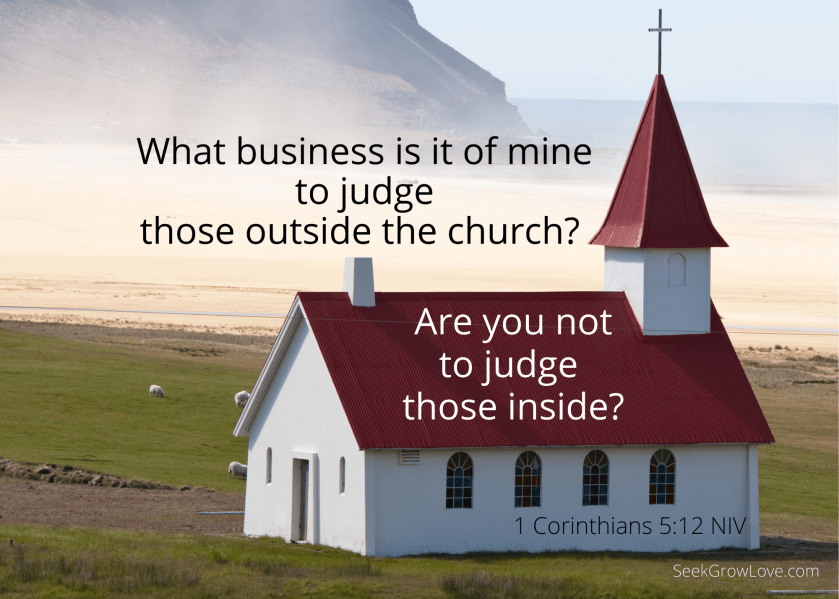
New Testament: 1 Corinthians 5

As is frequent with God’s word, we see connections, themes, and promises fulfilled which transcend centuries, and today’s readings are an example of this. From our Old Testament reading of Joshua we see a thorough purging and annihilation of pagan people who were not followers of God in the land God wanted inhabited by his chosen people. Terms like “captured”, “struck every person”, “no survivor”, and “utterly destroyed” used more than once paint a pretty clear picture of what Joshua and the Israelites were busy doing. But, why? That is also repeated throughout, and while it could be summed up as “God said so”, it seems more beautifully stated in Joshua 11:15,

“Just as the Lord had commanded His servant Moses, so Moses commanded Joshua, and so Joshua did; he left nothing undone of all that the Lord had commanded Moses.” New American Standard Bible (La Habra, CA: The Lockman Foundation, 2020), Jos 11:15.

Over a thousand years later, our New Testament reading in 1 Corinthians written to the church in Corinth also references instructions on purging out the evil. And just like the pagan people and cultures surrounding and within the promised land in the time of Joshua, Corinth was certainly a place full of evil. A city known for immorality (not immortality as I just accidentally typed!), for all varieties of sexual sins and deviance, statues and idols of lovely false gods like Aphrodite and none other than a thousand prostitutes kept busy at the temple. One could imagine as new converts came out of this culture to Christianity, and for the existing church functioning within that society, there were some things that needed cleaned up. And then there were some things that just straight up needed called out, purged, and done away with. Finding ourselves progressed another couple thousand years from there, I think we can relate.

Tomorrow, the Jewish people and those celebrating Passover will be starting their remembrances and celebrations. I really like that the Jewish holidays have Biblical and spiritual meanings, and Passover is directly mentioned in our New Testament reading today. One instruction the Hebrews were given for the Passover was to remove the yeast/leaven from their homes on the first day. Today, there are all sorts of traditions on how to do this for Passover including varieties of special cutlery and cleaning to remove every speck of potential leaven from  cookware to corners of homes and cabinets. Even the kids are apparently often helpful at finding those hard to reach remnants. As Christians according to 1 Corinthians 5, we know Jesus is our Passover lamb, which brought about a huge culture change, and one I am incredibly thankful for because I absolutely do not want to be doing anything with the blood of lambs or goats! But, while Jesus’s sacrificial life and death is a tremendous gift and blessing that reconciles us with God, scripture also tells us we can’t just be thankful for Jesus and leave whatever filth we have in our lives, homes, and churches.  Leaven is often correlated to sin in scripture, and today’s reading is very clear. Leaven is not good in this case. It will creep into every corner of the loaf. It contaminates. If we tolerate evil, we will contaminate ourselves and the body of Christ if we are a member of it. If we ignore it and don’t even look for the small hidden pieces of leaven in our lives, the leaven is very efficient at growing, attracting bugs, and all the rest.

We are forgiven and cleansed through our Messiah who took the place of the Old Testament sacrifices. We also know we are human beings living in another Corinth, and it is easy to be deceived when society is screaming “that’s not leaven, that’s just fine”.  May we all prayerfully consider the internal, spiritual leaven within ourselves along with any other things we might be cleaning up this spring. While smudges on windows, crumbs under the stove, and dead leaves in landscaping simply do not matter in the big picture, the spiritual stuff is a life and death matter. I love these verses in Psalm 19: 12-14 which talk about intently looking for the hidden pieces of leaven in our hearts.

But who can discern their own errors?

Forgive my hidden faults.

Keep your servant also from willful sins;

may they not rule over me.

Then I will be blameless,

innocent of great transgression.

May these words of my mouth and this meditation of my heart

be pleasing in your sight,

Lord, my Rock and my Redeemer.

-Jennifer Hall

Questions:

1. What similarities do you see between the culture in Joshua’s day, the city of Corinth, and today?

2. Have you ever seen someone’s sin in the body of Christ negatively impact others in the church family?

3. What challenges do you and the church face in identifying sin and right/pure actions from a Biblical worldview in today’s society?

Astronomical Measures

Old Testament: Joshua 9-10

Poetry: Psalm 49

New Testament: 1 Corinthians 4

My inner science nerd was more excited than a kid in a free candy store last week as I donned my (un)fashionable cardboard glasses in preparation for a once-in-a-lifetime event: for the first time in over 200 years, my Midwest residence would be within the path of totality for a total solar eclipse – an alignment promised to not reoccur in this area for three quarters of a century. Seven years ago, we watched a partial eclipse (around 90% totality) from our home, which was very… underwhelming. However, after learning that there is a vast difference between even 99 and 100% totality, I bought into the hype and prepared for amazement. We hosted a watch party on our church property and our friends even flew in from Alaska to experience it with us! The weather was abnormally lovely for April. As the coverage increased, we detected a cool wind breaking through the warm air, and then street lights began to light up. Then, the millisecond that it reached total coverage, a wave of deep twilight blanketed the field and an evening chill washed over us; I could instantly sense the distinct change in my peripheral vision from behind the safety of my glasses. For about 3 minutes, we eschewed our disposable spectacles as we stared into the void of the sun, soaking in the uniqueness of a mid-afternoon that felt like a near-midnight. We were awed by the surreal experience and applauded the workmanship of our Creator! And then, as suddenly as it had been hidden, the sun again commenced its glorious shine, changing the temporary night back into day. 

Our reading in Joshua today tells of another rare astronomical event – “the sun stopped in the middle of the sky and delayed going down about a full day” while Joshua fought the Amorites. There are many theories about what actually went down on the day the sun didn’t, from an annular eclipse (which even secular scientists agree did occur in Canaan around that time) to a variation in rotation speed and everything in between (you can start your rabbit hole dive here), but what is most important is that God did something very miraculous to help Joshua win the battle. God was on Joshua’s side, and he took “astronomical” measures to help Joshua do what God had called him to do. Joshua and his men put forth the effort as wise and persistent soldiers, but they called on God for a miracle to help them win the battle – and He did, in an awesome display of His power. “There has never been a day like it before or since, a day when the LORD listened to a man. Surely the LORD was fighting for Israel!” (Joshua 10:14, NIV)

God fought for His people, and God fights for us. God is on our side, and He loves to show up in mighty ways. BUT… God usually expects us to be actively involved as well. Joshua had to go out and fight the battle – many of them, actually – and God showed up, often miraculously. This is a good reminder for our own lives. God has given us gifts and abilities, and He wants us to be engaged and active in this life. (For example, we don’t really have a legitimate reason to complain about not having a job if we’ve never submitted any applications, right?) Sometimes the best and only thing we can do is pray and let God work, but often, we will pray while we fight right there on the battlefield, trusting in God’s supernatural provision. He still performs miracles! 

In whatever battles you will face, remember that God is with you and still works in miraculous ways. Keep your eyes open to see His handwork in your life! 

-Rachel Cain

Reflection: 

– Watch for God moments in your day and thank him for them. It might be something as small as a daffodil field to bring a smile to your face as you drive to work, or as large as seeing God’s might during a solar eclipse. Either way, praise Him in all those moments! 

– How can you depend on God more to fight your battles? How might God be calling you to be more engaged in the battles yourself?

Keep Walking

OT – Joshua 5-6

Poetry – Psalm 47

NT – 1 Corinthians 2

Keep walking, but you won’t knock down our wall. 

Keep walking, but she isn’t gonna fall! 

It’s plain to see your brains are very small 

to think walking will be knocking down our wall.

– the Pea soldiers, from Veggie Tales “Josh and the Big Wall”

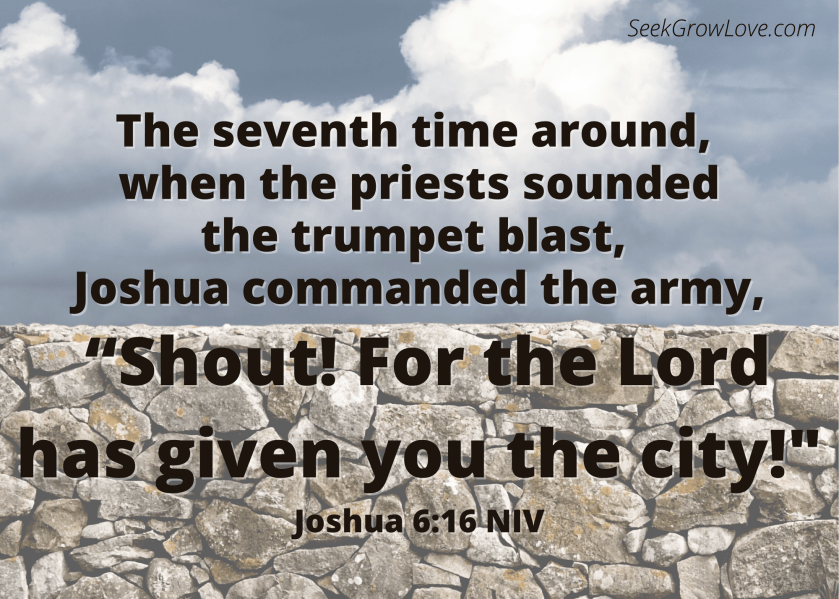
I’ve never been in the military (even preschool gymnastics was beyond my capabilities, and let’s just say I was usually a last pick in gym class), but even I can imagine that the mighty Israelite soldiers felt mighty silly walking around the city once a day for six days. Just walking behind the ark. And blowing some trumpets. Wow, fierce. I wonder if they wondered what God was thinking? Had they accidentally signed up for the (mostly-silent) marching band instead of the military? But on the seventh day – seven is the biblical number of completion – they marched around the city seven times, and then, a different kind of trumpet blast sounded, and Joshua ordered everyone to shout. And then, the wall collapsed. The mighty, impenetrable wall of the great city of Jericho, along with everything inside (save Rahab and her family), became a pile of rubble. Yet again, the people obeyed what seemed like ridiculous commands for an impossible task, and God worked through it all. I don’t know why God chose to take over Jericho in such a strange way, but I bet part of the reason was to display His awesome power and make sure everyone knew that He was the One True God. 

Psalm 47 even sounds like a song of praise that might have been shared after conquering Jericho: “He subdued the nations under us… He chose our inheritance for us… God has ascended amid shouts of joy, the LORD amid the sounding of trumpets…”

All of our lives should reflect back to the power of God. In our New Testament reading today, Paul also says, “My message and my preaching were not with wise and persuasive words, but with a demonstration of the Spirit’s power, so that your faith might rest not on men’s wisdom, but on God’s power” (I Cor 2:4-5) Just like when God made it clear that it was only by His power – not the marches and shouts – that the walls fell down, God likes to use ordinary, untrained people to do His biggest work, so His might is evident through their humility. 


God displays His power by working in big ways through us. He doesn’t NEED us; after all, God created the whole world without any input from mankind! But He wants to use us as part of HisStory, to help tell the world the greater message of His saving power. Will you join in the Greatest Mission of all time? 

-Rachel Cain

Reflection Questions

  1. How will you join in the Greatest Mission of all time?
  2. How/when have you seen God at work doing what seemed impossible in a way that you wouldn’t have expected? Who did He use in the mission?

Creating Memory-Sparkers

OT: Joshua 4

Poetry: Psalm 46

NT: I Corinthians 1

As a history buff, I love touring historical monuments. Even pre-digital-selfie days, I would try to capture a film-based image of myself at national memorials and important sites to remember the adventure. When we’ve studied certain landmarks and events in our homeschool, I’ve proudly shared my visual memories with my (thoroughly unimpressed) children. I’m hoping they will be more impressed when we take them on a historical tour of the East Coast next month, but I’m already preparing myself to accept their inevitable apathy (while I have enough fun for the whole lot of us!). 

In Joshua chapter 4, we find the throng of Israelites having just completed the journey across the Jordan River (no simple task, especially at flood stage). What do you think was of first priority? Moving on to their destination? Getting a snack? Setting up camp for the night?

No, God had bigger plans – plans that might seem trivial to us, but that were much more important in the eternal perspective. He told Joshua to select twelve men (one from each tribe) to select a large stone from the river and bring it to their campsite for the night. They would then stack the stones near the river to build a monument representing the twelve tribes of Israel. “In the future, your children will ask, ‘What do these stones mean?’ Then you can tell them, ‘This is where the Israelites crossed the Jordan on dry ground. For the Lord your God dried up the river right before your eyes, and he kept it dry until you were all across, just as he did at the Red Sea… so that all the nations of the earth might know the power of the LORD and that you might fear the LORD your God forever.’” (Joshua 4:21-24, NLT)

God knew that the Israelites had a tendency to worship other gods and forget His faithfulness. With more challenging battles ahead, God wanted them to have a visual reminder of how He had provided for them in miraculous ways. Not only that, but He wanted the other nations to know the power of God! This monument served as a memory-sparker to help the Israelites pass down the legacy of their God to their children. 

As a parent, I know firsthand how easy it is to get caught up in the day and forget to share about God’s faithfulness. But God, who created children, surely knows that two of the favorite activities of children are 1) playing with rocks and 2) asking a bazillion questions, so a large and unavoidable monument made of rocks was the perfect reminder for parents to share with their children about God’s provision! But God didn’t want them to remember him only when they passed the monument; he wanted his people to remember him all of the time! 

Deuteronomy 6:4-9:  Hear, O Israel: The Lord our God, the Lord is one. Love the Lord your God with all your heart and with all your soul and with all your strength. These commandments that I give you today are to be on your hearts. Impress them on your children. Talk about them when you sit at home and when you walk along the road, when you lie down and when you get up. Tie them as symbols on your hands and bind them on your foreheads. Write them on the doorframes of your houses and on your gates.

That section of scripture contains the Great Shema, a major tenet of our faith. Don’t overlook the part about remembering God’s faithfulness! We are called to talk about God constantly throughout our day, remembering Him together from the time we get up until we go to bed and all the time in between. This can even be as simple as praying when we hear an ambulance or thanking God for lovely nature. 

We might feel inadequate for such an important task as helping those around us to remember God throughout the day, but remember the words of Paul from our reading in I Corinthians 1:27-29: “God chose the foolish things of the world to shame the strong. He chose the lowly things of this world and the despised things and the things that are not – to nullify the things that are, so that no one may boast before him.” Even Moses, the man chosen to lead God’s people out of slavery, insisted that he could not do it because of a stutter, among other excuses. (We all like to give excuses, don’t we?) But God used Moses in mighty ways, and He has plans for us too – if we will choose to remember his ways and live for him. 

-Rachel Cain

Reflection:
-What are your excuses for not doing some of the things God has asked you to do? Debunk those excuses and pray to God to soften your heart. 

-How can you help pass along the message of God’s faithfulness? What memory-sparkers would God like to see you create? How can you remember and speak of God and His faithfulness more throughout the day?

Rahab – Used by God

Old Testament: Joshua 2

Poetry: Psalm 44

New Testament: Romans 15

Isn’t it funny how you can read the same passage of scripture numerous times and still find new nuggets within it? I know the story of Rahab quite well, and since I love studying strong women of the Bible, I even read a historical fiction novella about her (“Unashamed” by Francine Rivers, if you’re interested). Still, I discovered a rabbit trail of new insight into Rahab through an oft-overlooked Bible feature: the footnote. 

In the first verse of Joshua 2 (NIV), upon noticing a footnote following the word “prostitute,” I glanced to the bottom of the page to find this clarification: “or possibly, an innkeeper.” Excuse me? “Innkeeper” and “prostitute” are very different occupations! As I dug deeper, I found respectable commentaries arguing on both sides of the fence why one interpretation was definitely more likely than the other, and some even suggested that she operated both an inn and a brothel. In either case, Rahab was a Gentile who, because she met many travelers, was privy to a lot of information about the happenings outside her city walls, including the miraculous power of the God of Israel. When the king’s men came to inquire about the spies, she not only hid them, but committed treason by leading the guards astray to chase after the spies, knowing full well they were hiding on her roof. Rahab risked her life to protect the spies, and the spies honored her request to spare her life (and the lives of her family) when they would later take over Jericho. Not only was her physical life spared, but Rahab married Salmon (who was perhaps one of the spies), became grafted into God’s chosen people, and is mentioned as an ancestor to Jesus. 

Let’s assume that she was a prostitute, as many interpretations of the Bible seem to imply. This woman was super important to the success of God’s people. Though we think she had a dark past, Rahab feared and trusted God perhaps even more than the Israelites did. How cool is it that God used not only a Gentile, but a promiscuous one at that, to help His people gain their Promised Land! It really gives us all hope that God can use us no matter our histories. In Romans 15, Paul reminds his readers that he is preaching not only to his fellow Jews, but also to help the Gentiles know about the saving power of Jesus. Thank God that his grace is for all of us! 

Psalm 44 ties well into this storyline of conquering Jericho, confirming over and over again that it is only by God’s power that people throughout history have conquered their enemies: “They did not conquer the lands with their swords; it was not their own strength that gave them victory. It was by your mighty power that they succeeded… only by your power can we push back our enemies; only in your name can we trample our foes… it is you who gives us victory over our enemies.” (Psalm 44:3,5,7)

I’ll close with this blessing for your day from Romans 15:13 (NIV): “May the God of hope fill you with all joy and peace as you trust in him, so that you may overflow with hope by the power of the Holy Spirit.” 

-Rachel Cain

Reflections: 

– God has a history of using “unworthy” people (like Rahab) for His glory. Reflect on your life, your unworthiness. How has God used your story for His glory? In what ways can you allow Him to do that even more in the coming years? 

– Can you think of anyone in your life whom you would have judged as unworthy, whom God has saved for his glory? Praise God for His faithfulness to all of us! 

– For further reading about Rahab, check out this article: https://tidings.org/articles/her-name-is-rahab/

A Good Leader

*Old Testament: Joshua 1

Poetry: Psalm 43

New Testament: Romans 14

Ahh, don’t you just love the political campaign season?! The mud-slinging ads, heated debates, and unwelcome solicitation of political literature are so refreshing to the soul! (Can you detect any sarcasm?) While I care deeply about this world in which my children are growing up and will always be grateful for the brave men and women who paved the way for freedom and suffrage, all the negativity and animosity around the primary and general elections, especially in a presidential election year, wear on my spirit. 

Speaking of elections and leaders, did you know that George Washington never wanted to be President? The great military general was relieved when the Revolutionary War ended so he could continue living simply on his Virginia farm, Mount Vernon. The only president to be voted in unanimously by the Electoral College, Washington spent exactly zero dollars on his campaign. He took his role as President very seriously, but feeling the weight of the country on his shoulders, he set the precedent for serving only two terms because he was more than ready to retire. One could argue that it was his humility that made him a great leader; others had grievances against him, claiming that many of his actions were quite negative. Though we can be prone to consider him a flawless leader, George Washington definitely had his share of critics by the time he left office. 

Biblical leader Moses had been a great guide for his people (the Israelites) and Joshua became leader of Israel following the death of Moses. He had been an assistant to Moses and, like Washington, seemed to have unanimous support. The theme of Joshua chapter one could be COURAGE. God knew that the tasks ahead seemed impossible, from crossing the flooded River Jordan to fighting all of the established cities that stood between the Israelites and their Promised Land. God reminded them that He would be present every step of the way. It wouldn’t be easy, but they only needed to obey, and He would fight with them. The people rallied around Joshua, promising in verse 16 to do whatever he commanded. 

Did you notice the directive (Joshua 1:7b-8) sandwiched between the reminders to “be strong and courageous”? The LORD reminds his people to follow all the commands given to Moses and to “meditate on the Book of the Law day and night, so that you may be careful to do everything written in it. Then you will be prosperous and successful.” God wants His people to have success and to enter their Promised Land, but it is conditional; they must stay true to Him, not straying from His ways and His laws.

Though these words were spoken to a distinct group of people at a specific time in history, I think they are still applicable to us today. God wants us to be strong and courageous to do the work He has called us to do for Him, but it is important that we are careful to follow His ways and stay in the Word. While you and I will most likely never be in charge of a country or even millions of people, we all lead in some ways. As a parent, I lead my children so they can become responsible, God-fearing adults. As a tutor, I lead my students in understanding math and reading concepts. In my church family, I try to encourage and help other people, both tall and small, learn more about God. In all of these areas, if I did not depend on God’s wisdom and strength to help me, I would fail. I could say that my leadership doesn’t matter all that much compared to being a President or a famous leader from the Bible, but in reality, the small steps you and I take as leaders can have eternal influence, especially when we are investing in the spiritual lives of others in the family of God. Lead with God as your Guide. Keep focused on His Word as you do His work. 

-Rachel Cain

Reflection questions: 

– Make a list of all the big and small ways you lead – at home, at your job, at church. How do you (or should you) rely on God’s strength to lead? 

– Where might God be calling you to step up as a leader, or back down so you can pursue other things he has for you? 

Your Choice

Joshua 24

February 26

Like Moses, Joshua had an opportunity to give a farewell message to the Israelite people he had led before dying. Under his leadership things have gone well. One of the greatest compliments given to a godly leader would be that your people served the Lord throughout your tenure. In verse 31 Joshua gets just that. 

Joshua uses these last moments to remind (common theme in this book) the people of where they came from and what God has done to get them to the promised land. God was the sole source of their successes and their only failures were when they tried to do it on their own. 

The part of his speech that gets the most attention is a challenge. After telling them all what God has done he looks out at the people and asks them to make a choice. If serving this God I have described is undesirable, then choose for yourselves this day whom you will serve. Don’t wait, waiver or wander. As for me and my family, we will serve the Lord. 

It is a choice that is set out before each individual both then and now. Half commitments are not acceptable. It is a decision that we continue to make each day as we face the temptation to wander. Like Joshua, as for me and my family, we will serve the Lord. 

-John Wincapaw

Questions for Reflection and Discussion

  1. Look at Genesis 12:1-7 to see the significance of gathering the people at Shechem for these final words from Joshua.
  2. As Joshua recounts the history of the Israelites, what part did God play? Consider your own history – where has God been at work to bring you to where you are today (both during your lifetime and your ancestors)?
  3. What other ‘gods’ (popularity, addictions, wealth, power, affection, leisure, hobbies, security, or a significant person) have you been tempted to serve? When have you made a wrong choice?
  4. What do you choose today? Why? What can be a reminder of your commitment?

Nothing is Impossible with God

Joshua 10

February 25

The people of Gibeon heard of the victory at Jericho and quickly created a peace treaty with the Israelites. This ruffled the feathers of the 5 surrounding nations and their kings declared war on Gibeon.

The king of Gibeon cries out to his new ally – come help us. With God’s direction and encouragement, Joshua gathers his best fighters and comes to the rescue. The passage tells us that he surprised the armies and with the help of God’s hand they push the enemy back. 

Joshua sees that victory is at hand but fears that the enemy may be able to escape in the night. So Joshua looked up to the sun and told it to stand still, and miraculously, it did! 

Verse 14: There has never been a day like it before or since, a day when the Lord listened to a human being. Surely the Lord was fighting for Israel!

I would suggest it is rarely (possibly never) a good idea to give God instructions. God is capable to do what we see is impossible. That does not mean we can tell him to provide us with all of our desires and entertain us with cool magic tricks. To be clear, that is not what Joshua did. God has already given the order, promised he would be with them and would hand over his enemy. Joshua was looking for God to provide him an opportunity to do what God already said He would do. 

God will do miraculous things in our lives. Especially when we ask Him to do things that he already wants to do. If there is calling in your life that seems impossible to you, know that your God wants to help you fulfill what he is calling you to do. What may be impossible to us – is not for God!

-John Wincapaw

Questions for Reflection and Discussion

  1. There is an interesting story in the previous chapter (Joshua 9) of the Gibeonites deceiving Joshua in order to create a peace treaty with the Israelites. Why do you think Joshua – and God – still fought to protect them?
  2. If social media had been around at the time, what would those who witnessed the sun standing still post?
  3. What does it mean to you that the Almighty and All Powerful God can and has used His powers over His created world to influence or control an outcome?
  4. Is there a job you think God wants you to do that you feel you need more time for? How can you better order the rest of your day and projects to give the required time to God’s project?

Do we learn from our past mistakes?

Joshua 6

February 24

The Israelites’ failures in the desert can be summarized simply down to disobedience. Even though God was leading the way, they stubbornly chose their own. Will the new generation do the same? 

Once they have crossed the Jordan, the people have dedicated themselves to follow and obey. God quickly puts that to the test. He promises them Jericho but he tells them to take it in the most unorthodox way. He is going to show them that it will all be done by his power and not theirs. 

Imagine being excited to fight for God! He has proven he is with you. You are ready to go out on his behalf and the order comes down the command chain that we are not fighting but instead we are marching. Talk about a let down. You get to come back to camp and tell everyone of your great triumphs – err, a few miles walk around a city wall. And it gets worse. They have to do it for 6 days without seeing any results. 

I’m sure there was plenty of confusion and likely complaining. But on day 7, it was different. They got to walk around 7 times and wait for it, SHOUT! Talk about a warrior’s perfect picture of their first battle. I’m sure this tugged on all their desires to take this in their own hands and do what they were trained to do – fight. 

They were faithful – and after the 7th trip on the 7th day, they let out a shout and the wall collapsed and they finally got to fight. Although they did not understand God’s way in the beginning or during the process, it made sense in the end. They were able to go in and take the city without loss. Had they tried any other way, this level of success was unattainable. 

Most had learned that following God’s way (even when you don’t fully understand) was the best path. If interested in finding out again what happens when they disobey, you don’t have to look far, just read the next chapter. 

-John Wincapaw

Questions for Reflection and Discussion

  1. When would God have you be silent? How well do you do this? When would God want you to SHOUT? How well do you do this?
  2. In what ways does God’s battle plans today seem crazy to a world that does not follow and obey God?
  3. Why was Rahab and her family spared (see Joshua chapter 2)? How can we be involved in saving lives from the coming destruction?

Prepare Yourself

God is going to do wonders among you!

Joshua 3

February 23

It is finally time. The Israelites are finally getting to go into the promised land. The years of wandering are over. The last day starts very similar to the first. They are standing in front of a large body of water that needs to be crossed. God once again shows that a large body of water is not an obstacle too big for Him. 

God gives Joshua the plan and again lets him know that he will be with him along the way. He gives him the words to say to get the people to follow. Joshua prepares the people for the miracle that is about to happen. Different translations may say cleanse, sanctify or prepare – but essentially get ready, God is going to do something awesome. 

The directions are to have the spiritual leaders carry the Ark of the Covenant (signifying God’s throne and presence) and the people were to follow. They were to take a couple steps into the water and stop. 

I love this! How much easier would it have been if God separated the water before they started moving. No faith required. Instead, they had to trust God would do what he said he was going to do. The waters begin to separate after their feet hit the water. 

Again, the Israelites get an amazing miracle to help them remember their God is with them and for them. Once everyone made it to the other side, God asked Joshua to set up a memorial. They were to set up another reminder for the generations to come to remember the events that took place. 

-John Wincapaw


Questions for Reflection and Discussion

  1. Everyone wants God to work in their lives, but are you ready for it? Is there something in your life that may be stopping God from doing something great? What might God be asking you to do to prepare, sanctify, consecrate or purify yourself?
  2. The Israelites had to get their feet wet before the water parted. Is there an obstacle in front of you? Describe it. To overcome it, what is a first step you can take in faith?
  3. When God does something amazing, it is important we set up ways to use it to tell others about his greatness. What has God done in your life that you could share with someone else? How will you share it? With whom? When? Where?