A Goldmine

Old Testament Reading: Genesis 31 & 32

Psalms Reading: Psalm 18

New Testament Reading: Matthew 17

In a year that we are searching in His words for who God is, Psalm 18 is a goldmine. Almost no seeking is required, just taking it in, line after line after line. In 50 verses David shares who His God is: what God has done and why, what He loves, what He doesn’t love, His super powers, what He offers and provides and gives, what is perfect about Him, what He delivers us from, and why He is worthy of praise.

The first time I read Psalm 18 this week I journaled what I saw regarding God – it was the first Psalm that took a full page to record my observations, and I am sure I missed some. Here’s just a sampling from my journal page (with some added thoughts):

  • God – MY strength, rock, fortress, deliverer, refuge, shield, horn of salvation, stronghold, worthy of praise… (written by David so he was the original “MY” referred to – but not the only – thank you God for being MY strength, too)
  • He hears me from his temple…(I am not used to being heard by the “higher-ups” – but here is the Highest of them all, and He hears me.)
  • He gets angry – earth trembles and quakes, mountains shook…
  • He reached down from on high and rescued me…
  • He’s my support…
  • To turn from Him is evil…
  • God saves the humble…not so the haughty… (Be humble, don’t be haughty)
  • To the faithful/blameless/pure – He shows Himself to be faithful/blameless/pure…. (but don’t be crooked with Him, unless you are curious what His other side looks like).
  • The LORD lives!…

As I re-read I began looking for what verse or phrase I would choose to create a picture to accompany the devotion – there were way too many I wanted to use! Here are some of my personal top choices, that I didn’t end up using…

“I call to the LORD who is worthy of praise, and I am saved from my enemies.” (vs 3) – (My enemies will look different from David’s – we each have a different purpose from God to fulfill and different enemies to overcome – but we both have the same God who is worthy of praise and who saves from the enemy.)

“He rescued me because He delighted in me.” (vs 19) – (Thank you God for delighting in me – and rescuing me. Your love and your power work perfectly together. And I am the blessed recipient of both.)

“My God turns my darkness into light.” (vs 28) – (How’s that for a lightbulb moment?)

“You give me your shield of victory, and your right hand sustains me; you stoop down to make me great.” (vs 35) – (Don’t you love the picture that creates in your mind! Re-read it again slower. How is God trying to pass you His shield of victory today?)

“As for God, his way is perfect; the word of the LORD is flawless.” (vs 30) – (Is there anything else in this world that is perfect? We are so used to flawed, broken and mediocre – but that is NOT My God – his way and his word are perfect – and they are for me!)

What pictures/passages do you like best in Psalm 18? What do they tell you about God? Is He YOUR God, too?

Remember those book reports you did back in elementary school when you had to create something to show you learned something from the reading – a mobile, a shoebox diorama, a character chart. I encourage you to create something from Psalm 18 – a journal page, memory verse cards for your bathroom mirror, a friend’s refrigerator and the wallets of all your family members, a wall hanging for your home or your neighbor’s, a card or text for a friend who is feeling surrounded by enemies today.

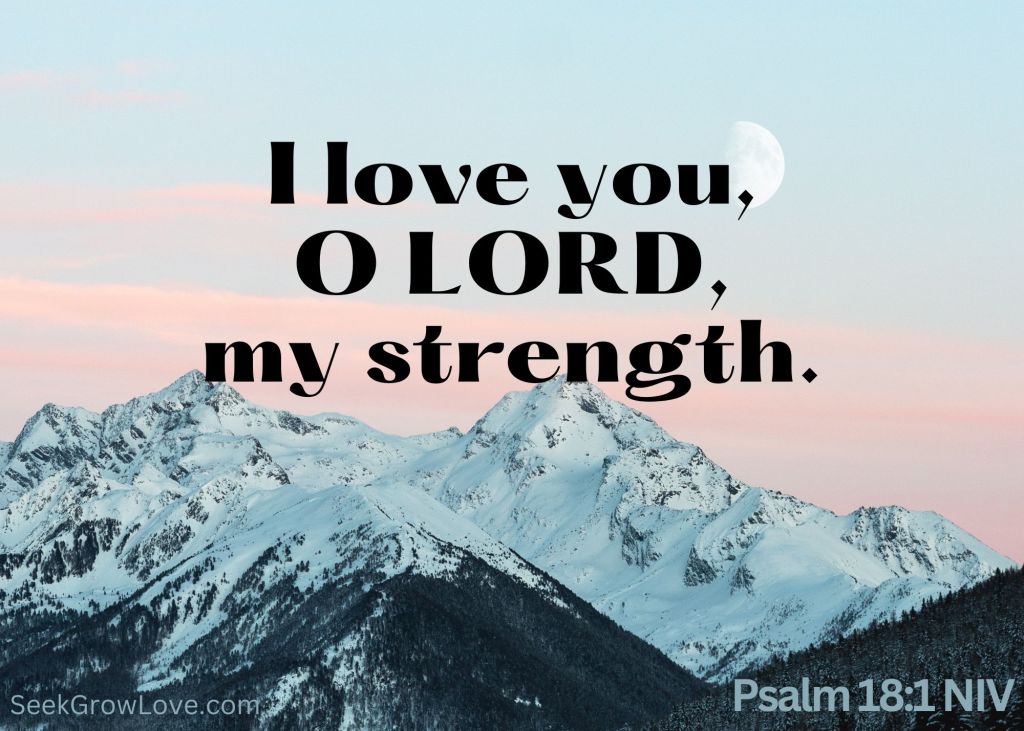
Read His words and remember and share. God is worthy of praise. “I love you, O LORD, my strength.” (Psalm 18:1 NIV)

-Marcia Railton

If you were hoping for a devotion today over Matthew 17 and the Transfiguration which is a very interesting “highlight” of Jesus’ earthly ministry, here’s a good one called A Mountain Top Experience by Rebecca Dauksas.

Reflection Questions

  1. In what way do you think God wants to give you His shield of victory today? How might you receive it? What enemies is God able to help you overcome?
  2. How might your day be different if you remember all day long who Your God is?
  3. Just as we can benefit from David sharing with us how God has helped him, how can you share with others how God has helped you and how might it benefit them?
  4. What pictures/passages do you like best in Psalm 18? What do they tell you about God? Is He YOUR God, too?

He Sees and Examines

Old Testament Reading: Genesis 17 & 18

Psalm Reading: Psalm 11

New Testament Reading: Matthew 10

Yes, indeed. You can be guaranteed, God sees (you can review yesterday’s devotion if you missed it). For many people in innumerable situations across the centuries, the fact that God sees has given reassuring peace and comfort. The oppressed, the grief-striken, the helpless, the victim, and the fatherless have all been introduced to the God who sees and His Son who changes lives.

In today’s Psalm 11 it even records, “He observes the sons of men; his eyes examine the sons of men. The LORD examines the righteous.” (Psalm 11:4b, 5a NIV). He examines the righteous – that’s much more than a casual “see” and walk on. It gives me a picture of a kind, thorough, knowledgeable doctor. He has listened to your list of ailments and what you hypothesize might be needed but his careful examination will reveal the true issues and in wisdom he will prescribe and deliver what you really need at just the right time. “The LORD examines the righteous.”

It is a comforting first half of Psalm 11:5. The verse doesn’t end there. We are reminded that it is not ONLY the righteous God sees. And when he sees the unrighteous – he also takes action. “…but the wicked and those who love violence his soul hates. On the wicked he will rain fiery coals and burning sulfur, a scorching wind will be their lot. For the LORD is righteous, he loves justice; upright men will see his face” (Psalm 11:5b-7 NIV).

God sees.

God examines.

God acts.

God loves justice.

In our Genesis passage we see God seeing Sarai and Abraham. He has been promising that Abraham will be the father of many descendants, a great nation and kings. But they are old – with no child of their own. Sometimes it’s hard to keep believing that God sees. God reminds them, “Is anything too hard for the LORD?” (Genesis 18:14 NIV). Sarai tries to get away with a little lie – saying she didn’t laugh at the crazy idea that within the year she, an old woman, would have a baby. But God sees even the little laugh. He examines the righteous (not the perfect – but the righteous). Don’t try to fool the all-seeing God.

Then the story turns…to God preparing to visit Sodom, a city full of sin . He has heard of their wickedness. Is it time for Him to act? Is it time for justice? We will have to see tomorrow when we read Genesis 19. But, if you want a little hint, recall what the Psalmist said regarding what God will do to the wicked: he will rain fiery coals and burning sulfur. Even in our Matthew passage, where Jesus is preparing his disciples to go out into the towns of Israel, knowing full well that many will not accept them or the message they bring, he references Sodom and judgment.

God does see.

It is reassuring to the righteous.

It is judgment for the wicked.

What does He see in you?

He isn’t fooled. He sees. He examines. He loves justice.

-Marcia Railton

Reflection Questions

  1. What does God see in you? What might His examination reveal are your true ‘health needs’ to be addressed, and the remedies He is offering? Are there any areas where you have been trying to lie to God?
  2. Matthew 10 is one of those chapters you could read every day for a week or more and still find new insight. Jesus is preparing his disciples to share the good news of the kingdom in a world that sometimes/often rejects it. What is helpful for you to hear from Jesus? Are we to just give up and keep silent if the world rejects the message?
  3. In today’s Scripture reading you see God is ________.

Rest in Peace

Thursday, January 5, 2023

Old Testament Reading: Genesis 3 & 4

Psalms Reading: Psalm 4

New Testament Reading: Matthew 3

Cheese. If I had to pinpoint a single food that will assure tossing and turning, vivid dreams, and even a bit of snoring, all it takes is a serving size before bed and a restless night is almost guaranteed. Nevertheless, if cheese alone caused distress in my sleep, it simply would take some discipline in my diet to cure this issue. My resting is subjected to more interruptions. The rumblings of my mind often disturb the counting of sheep more than the rumblings in my gut. Thinking about the stresses of work, school, family or reliving the failings of my day can be the late night double feature playing inside my head. Without the perspective that comes from God, it is hard to find rest.

“Then the Lord said to Cain, “Why are you angry? Why is your face downcast? If you do what is right, will you not be accepted? But if you do not do what is right, sin is crouching at your door; it desires to have you, but you must rule over it.” Genesis 4:6-7

“Tremble and do not sin; when you are on your beds, search your hearts and be silent. Offer the sacrifices of the righteous and trust in the Lord.” Psalm 4: 4,5

Like Cain, the source of this restlessness often stems from some type of disconnection from God. We are hanging on to something that the eternal God has made clear is His area of reckoning.  Our past. Our future. Our sin. Our fear. Our stress. Our anger. All of these are the cheese that is gumming up the works of the rest we can find in God even when we are weak and heavy laden. Continually turning towards the issues provides anything but relief, further stalling your slumber.  Furthermore, sin is waiting outside our door when we choose to act without the “green light” of God’s will. Instead of searching your finite mind for an answer, humble yourself and seek the face of the infinite God. 

This works well beyond the confines of your covers. It can be found behind a steering wheel when you are driving away from another argument, sitting at a desk reminded of the endless list of things that you won’t get done today, or kneeling behind a closed door drowning in depression of loss. The solution is the same in all situations: worship God Almighty.  When we are reminded of who He is, we don’t have to hold the answer because He has readied one and is holding onto us. While it’s possible to receive revelation in these moments (James states that our God gives wisdom generously to all without finding fault), the answer we may receive is His presence into our mercy, fears, and shortcoming, which is the relief we so desperately need to quiet our minds and catch a few winks. The silence is not rejection or a stalling tactic. The silence is the peace that comes from trust in the Lord so you can rest in peace.

“In peace I will lie down and sleep, for you alone, Lord, make me dwell in safety.” Psalm 4:8

-Aaron Winner

Reflection Questions

  1. Where could your life use a little more peace? Where have you looked for it?
  2. What do we learn from the narrative of Cain and Abel regarding peace, and also the lack thereof? What do we learn from David’s example in Psalm 4?
  3. In your Bible reading today, what do you discover about God and his character? Thank Him for it.

Sit, Stand, Step

Psalm 1

Dr. Albert Mehrabian, a leading researcher in the field of body language, estimates that over half of our social communication is done through nonverbal cues.  Where we place our hands and feet, how or where we choose to stand or sit, the angle at which we hold our head, or even in the position of our eyebrows communicate our desires, our emotions, and our confidence (or lack thereof). Additionally, about one-third of how we send our message is with the tone and inflection in our voice, not the words themselves.  In fact, less than 10% of our social cueing has to do with our spoken word choices. The conclusion of the study is similar to the first verse of Psalm 1: where we choose to sit, where we choose to stand, and where we choose to step communicates our posture to our Heavenly Father and the world around us vastly more than words alone.

“Blessed is the one who does not walk in step with the wicked or stand in the way that sinners take or sit in the company of mockers. but whose delight is in the law of the Lord,and who meditates on his law day and night. That person is like a tree planted by streams of water, which yields its fruit in season and whose leaf does not wither— whatever they do prospers.” – Psalm 1:1-3

There is a good chance that today holds a contrast to where your feet landed yesterday.  Most likely, this Monday represents a return to work, school, or some other social role you will have to step into, stand up in, or sit through. As you enter the threshold, who or what are you walking towards or away from? Where and what are you standing beside or standing in the way of? How and who do you find yourself sitting beside, dwelling with, and meditating upon? Take note not only of the words you say aloud, but the thoughts and signals you send with your body because God doesn’t want a tithe of lip service; He desires the whole of your soul as a living sacrifice.

There is a blessing for living close to the commandments of our Creator.  Those who put their roots down with God are the direct recipients of the Living Water He provides. When we walk in His ways, when we stand on His promises, when we sit and meditate on His statutes, it completely changes our body language. We don’t wither, but we become confident in the hope we have. We are not empty vessels filled with cliche Christianism, but we bear the fruit of the Spirit for others to see.  We can simply sit and delight in the joy of the Lord because we serve a God of promises and follow-through.  Our posture, our actions, and our words stem from the refreshing source from which we draw life more abundantly. Wherever we step, stand, or sit, let the Living Water flow and the Kingdom of God flourish.

– Aaron Winner

Reflection Questions

  1. Compare and contrast the person in Psalm 1:1-3 to the person in verses 4-5? How would you describe each and what makes them different?
  2. Who or what are you walking, standing, sitting amongst? What do you find delight in? What are you meditating on? Are there any changes that ought to be made in order to be where you want to be at the end – of 2023, or of this life?
  3. What do we learn about the LORD God in Psalm 1? Mark it in your margins, journal it, pray to the God of Psalm 1.

AND -in preparation for tomorrow, when we will begin a chapter by chapter New Testament reading – here’s a little…

Introduction to the Book of Matthew

Before we introduce the book of Matthew, let’s quickly contrast it with the book of Genesis and the whole Old Testament.

The book of Genesis begins the Old Testament (and the Bible).  The theme of the Old Testament can be summed up in Genesis 5:1, which says, “This is the book of the generations of Adam…”.  The rest of Genesis 5 has another recurring theme, “… and then he died”.   The Old Testament was the story of Adam, his sin (and the consequences of that sin), and his descendants.  It illustrates the truth that “the wages of sin is death” (Romans 6:23a).  The Old Testament contains many of God’s promises – waiting for fulfillment.

The book of Matthew begins the New Testament.  Matthew starts with, “This is the genealogy of Jesus the Messiah the son of David, the son of Abraham.”  This begins the story of Jesus, and reveals “the gift of God is eternal life in Christ Jesus our Lord.” (Romans 6:23b)  The New Testament describes the fulfillment of God’s promises made in the Old Testament.

Matthew was one of Jesus’ 12 apostles, whom Jesus called from being a tax collector (read hated outcast) to being in the inner circle of the Savior of the world.  Many years after Jesus’ ascension, Matthew wrote the book of Matthew to convince a Jewish audience that Jesus was (and is) the Messiah – God’s chosen and anointed deliverer for His people – who fulfilled so many of the prophecies in the Old Testament.

Even though the Bible doesn’t contain anything that Matthew himself said, the book of Matthew which he wrote reveals Jesus as the Messiah promised and sent by God.  May the book of Matthew speak to you and reveal God’s great gift, Jesus the Messiah, to you in a whole new way as we seek to grow in Christ together this year.

-Steve Mattison

Download and print the 2023 Reading Plan below. You can choose to follow along in 1,2 or 3 readings a day. If you read all three you will read through the whole Bible in 2023.

The End

Sunday, January 1, 2023

Psalm 119

Welcome to the first post of our 2023 SeekGrowLove Bible reading plan! We are beginning the year with a little time in Psalm 119, and in the next couple days will add in the other Old Testament and New Testament readings. You can download and print the whole plan found at the end of today’s post. Every time we begin a new book of the Bible, we will include a little introduction written by Steve Mattison.

Introducing the Book – Psalm

The book of Psalms was Israel’s songbook.  It contains a collection of psalms (or songs) that primarily focus on praising God for who he is and for what he has done.  The Hebrew title is, “the book of praises.”  Most of these psalms are prayers to God written by King David, although other authors, ranging from Moses, to Solomon, to the sons of Korah also contributed.

The book of Psalms teaches us to seek God with our whole heart, to tell Him the truth and to tell Him everything, and to worship Him because of who He is, not just because of what He has done.  It contains a range of topics, from people crying out to God from the depths of their despair, to those praising God with jubilation from the depths of their hearts.  

The book of Psalms has spoken to me in my lowest lows as well as in my highest highs.  May the inspired words in this book resonate well with you as you read these psalms this year.

Psalm 119 Devotion

Who in their right mind is thinking about the end right now? Really? Terrible title. TERRIBLE. This is the time of fresh starts! New beginnings! Redos! Our mind focused on the brief novelty of this moment’s pants kicking; the annual motivation for improvements we have put off for weeks, months, or even years. While we might commit to a dream today, I would say there is little thought given to the realities of December 31st, 2023: 365 calendar days away. Whether it’s gym memberships, nicotine patches, cauliflower pizzas, saving accounts, or even bible reading plans, have we bought into the idea that we are preparing ourselves for a full year of commitment in our resolutions? Look at your Google Calendar or your bank statement: what have you planned and paid for in a full-year upfront knowing that it will change your life by the end? Or is your resolve more like the free 7-day trial, leaving one foot in 2022 in case you want to make a getaway?

“How can a young person stay on the path of purity? By living according to your word.  I seek you with all my heart; do not let me stray from your commands.  I have hidden your word in my heart that I might not sin against you.” Psalm 119:9-11

I will go ahead and say, it is not fiscally responsible, or even logically feasible, to pile up a year’s worth of cauliflower pizza into a deep freeze, but our commitment level to any life-changing resolution, should count the cost of sacrifice with the end in mind.  This is an echo of what our Heavenly Father has done through Jesus Christ. Paul speaks to this in Colossians 1:16 when he states “For through [Jesus] were all things created, things that are in heaven, and things that are in earth, visible and invisible, whether they be thrones, or dominions, or principalities, or powers: all things were created by him, and for him.” Our eternal God has dictated to us the rules, plans, and ordinations of his personal and universal will that will lead us to a relationship with Him, which has ended the penalty of sin with the blood of Jesus Christ and leads to the big finale, the Kingdom of God. Knowing the end, it is much easier to keep to and dictate the decrees of each day.  Without the end in mind, we are just tragic creatures of toil, mindlessly moving from one task to the next.

“Teach me, O LORD, to follow your decrees; then I will keep them to the end.” – Psalm 119:33

Our God is not a God of chaos (1 Cor 14:33). He works in logic and rules that are shared with us because WE as heirs according to the promise are included in the end. We don’t have to feel out the way, make up the path, or bump down the lane.  God has made his moral law clear. It is not just a list of “thou shalt nots” but enhancements and boundaries provided for our own physical safety, societal responsibility, psychological well-being, and the eternal enhancement of the connection and relationship between the Heavenly Father and his children. He is not a part-time parent, nor can we be part-time children. You can’t periodically pause your subscription or ghost your way out of the membership. Our life is better lived, today and eternally, when we are resolute to learning and practicing His ways that are forged in the ultimate love and truths. We become devoted.

That devotion begins with finding a way to be connected to the Word of God every single day.  It could be found in this blog. It could be found in personal study, podcast, prayer time, or all the above. What I propose, if we truly are wanting to grow in the word of God this year, to engage and act upon His message that is delivered through His word, you and I must set alarms, write in on our mirrors, put it in our checklist and calendars, and make it priority.  Being here to read every day provides an opportunity to do that alongside others who are also seeking out a devoted life to Christ. If our end of life is found in 2023, if Jesus returns, or the Lord tarries for another year and He still gives us life, how much more abundant will December 31st, 2023 be if we have committed ourselves fully to understanding the precepts, the statutes, the laws, the understanding, and the wisdom of your heavenly Father? Let’s be committed to the end, even if we are at a loss of where to begin our year.

“May my lips overflow with praise, for you teach me your decrees.  May my tongue sing of your word, for all your commands are righteous.  May your hand be ready to help me, for I have chosen your precepts. I long for your salvation, Lord, and your law gives me delight.  Let me live so that I may praise you, and may your laws sustain me.” -Psalm 119:171-175

-Aaron Winner

Reflection Questions

  1. In reading through Psalm 119 what do you see of God’s character – how does He show who He is through His inspired word? This is a question we will be asking regularly this year (sometimes phrased differently). We think you will find great benefit in journaling, or making notes in your Bible margin, on how you see and what you learn of God and His character from His written word every day this year.
  2. What are your favorite verses of Psalm 119? What words are used in Psalm 119 to name God’s law or directions for life? What are the benefits given for knowing, following, loving these words of God? What do you find about the results of neglecting these words of God? How would you rate your knowledge of and then, love for, the words of God?
  3. Where do you want to be at the end of 2023? What steps will help you get there? Spend some time in prayer to the God of Psalm 119.

NO Pit TOO Deep

Look UP!

Psalm 130

Friday, July 15, 2022 

                The comedic author Erma Bombeck once wrote a book entitled: “If life is a bowl of cherries, what am I doing in the pits.”  It’s a funny play on words using “the pits” as the antithesis of the good life.  The “pits” she’s talking about are not really cherry pits, those things you spit out after you have eaten the deliciously sweet cherry, but the pits of despair.  Webster’s Dictionary defines  “the pits”: “something that is very bad or unpleasant. You caught the flu on your birthday? That’s the pits! This rainy weather is the absolute pits.”

                You’re in the pits when things are going horribly wrong, or when you are feeling low.  You feel low when you are depressed, like there is something heavy weighing down on you.

                Psalm 130 is known as a penitential psalm (Psalm 6, 32, 38, 51, 102, 130, 143).  It starts out very low, “Out of the depths I cry to you, LORD”.  This person is in deep despair because they are weighed down by feelings of guilt.  They have done something terribly wrong and they are weighed down with the heaviness of regret.

                In the Bible there are stories of people who are down in the pits of despair who cry out to God.  When Joseph was taken by his brothers and thrown into a dry cistern down in the earth, he was in the pit.  When Jonah was swallowed by the whale (or great fish), he was in the pit.  When Daniel was thrown into the den of lions he was in the pit.  But each of these people when they were in the pit cried out to God.  And that’s what this Psalm writer does from the depths, they cry to God.  They cry for mercy.

                They acknowledge that it is only by God’s mercy that they are able to get out of that pit.  If God kept a perpetual record of our sins that we had to carry around with us all of our lives none of us could stand under the weight.  Imagine trying to swim holding a 100 lb barbell in your hands… you would sink to the bottom in an instant. 

                Psalm 130 is also one of the songs of ascents.  This selection of Psalm from Psalm 120-134 were sung by worshippers journeying to the temple in Jerusalem to worship God by offering sacrifices.  They would sing the songs of ascents as they climbed up Mt. Zion.  They would sing them as they walked up the steps to the temple bringing with them their sin offering, their guilt offering and other reminders of their need for God’s mercy and forgiveness.

                Notice as the Psalm begins they are “in the depths crying for mercy” lamenting that no one can stand in God’s presence as long as God remembers their sins.  But feel them rising up as they get closer to the top of the mountain, closer to Jerusalem, closer to the temple, closer to God.  There is the hope of forgiveness.  There is this longing for God, they are waiting with their whole being for God, they are putting their hope in God.  As they look up and draw closer to God they are literally coming up from out of the pits, out of the depths of misery and despair into God’s mercy and forgiveness into the arms of God’s unfailing love and full redemption.  They are being bought from slavery to sin and given freedom in God.

                So many people today, like this Psalmist, are in the pits.  The rates of depression are incredibly high.  A study in 2020 showed that 37 million Americans take anti-depressant medication (the numbers undoubtedly have gone up in the 2 years since then due to Covid lockdowns).  Over 100,000 people died in 2021 from opioid/fentanyl overdoses.  People take these pain killers not for physical pain but to try to relieve existential pain and despair.  Suicide rates are rising because people find themselves in the pits and can’t find a way out. 

                Psalm 130 says to them and to us…. Look up, there is a way out.  God is the way out of that pit of despair.  God rescued Joseph from the pit and  he became the most powerful man in all of Egypt and saved his whole family from starvation.  God rescued Jonah from the pit of the whale and Jonah preached salvation to the entire city of Nineveh and they were restored to God.  God closed the mouths of the lions and Daniel was rescued by God from the pit of lions.  Even Jesus was in the pit of despair on the cross from which he cried out, “My God, my God, why have you forsaken me?” as he took the total weight of the sin of the world on his shoulders.  God rolled back the stone and rescued Jesus from the pit of the tomb and brought him out to everlasting life.

                There is no pit too deep for God to bring you out of if you will cry out to him, look up and move toward him.  Ascend from the depths of despair to God’s mercy and forgiveness and true life through faith in Jesus Christ.

-Jeff Fletcher

Reflection Questions:

1.        When was a time that you were in the pits?  How did God help you out of that pit?

2.       If you’ve experienced God’s saving hand in the pit, who can you share that hope with to help them out of the pit?

Love that Endures Forever

Thursday July 14, 2022

Psalm 136

            “We got spirit, yes we do, we got spirit, how about you?”

                        “We got spirit, yes we do, we got spirit, how about you?”

            “We got spirit, yes we do, we got spirit, how about you?”

                        “We got spirit, yes we do, we got spirit, how about you?”

That takes me back over 40 years to my high school days.  The cheerleaders out on the sidelines leading the call and response cheer to help get the crowd involved and pumped up to keep the team motivated.

            Call and response is a part of the culture.  In music, particularly jazz and some rock and roll,  the call and response is a form of music with a long history.  One instrument plays a riff, and another answers back.

            Call and response is a big part of African worship.  I once preached a community service with several hundred in attendance including a sizeable contingent of black worshippers who really got into the call and response and kept me, the preacher, energized.

            The call and response is an old form of worship and Psalm 136 is a great example of how call and response was incorporated into the ancient Hebrew worship tradition.  As you look through this great Psalm of praise and worship it’s all about call and response.  One calls out,  “Give thanks to the Lord for he is good” and the other responds right back, “His love endures forever”.  The other calls back, “Give thanks to the God of gods.” And the other responds: “His love endures forever.” And so it goes, call and response, call and response.  It’s an interactive prayer in two voices and it tells a powerful story of Israel’s gratitude to God for his endless love and mercy and faithfulness to his people.

            With each successive call, this Psalm tells the story of God’s greatness.  God is greater than anything else that people worship.  God’s greatness is revealed by his acts of creation. He made the heavens, the lights, the sun and moon and stars, this part of the Psalm shows God’s universal greatness to all people.  Then, the Psalm shifts to how God reveals his greatness particularly to His people, Israel, by recalling the story of the Exodus and how God showed His faithfulness in delivering his people from slavery.

            With each call revealing God’s creative and saving acts there is a response proclaiming the permanence of God’s love.  The Hebrew word, “hesed” is a challenging one to translate.  If you look at various translations of Psalm 136 you will see it translated as love, mercy, steadfast love and faithfulness.  Hesed is a word so full of meaning that it takes a lot of words to try to capture the fullness of it’s meaning.  And that makes sense.  God’s love and mercy and faithfulness are so great and so dependable that it can’t be contained in one simple definition or translation.

            As you go about your day, pay attention to all of the ways that God reveals his love and mercy and faithfulness to you.  Be sure to give thanks to the Lord, for he is good, His love endures forever. 

            As an added bonus, listen to Michael W. Smith rock out on the song: Forever, which is based on this Psalm: https://youtu.be/3lPdtqgouCc

-Jeff Fletcher

Reflection Questions:

  1.  Choose one element of God’s power or character that is included in the Psalm and think about how God has revealed that to you in your life.
  2. Try writing your own Call and Response Psalm to God.  What parts of God’s story revealed in creation, the Bible and your own life experience would you include in the call?  Which element of God’s character would you magnify in the response?
  3. Do a word study on “Hesed” (Bible Gateway lets you compare multiple translations in parallel – for example, see Psalm 136:1 in various translations).  What would your definition of Hesed sound like?

The Words of the God You Love

Psalm 119

Wednesday, July 13, 2022 

            Back when I was a child, at Church camp when you stood in line for a meal they made you say a Bible verse.  Us young boys learned that John 11:35 was the “go to verse” for quick memorization: “Jesus wept.”   A two word verse, easy to memorize- boom “Jesus wept!” the legal requirements are met, now can I eat? 

            Bonus round—what is the shortest book in the Bible?  2 John or 3 John depending on how you measure it.  2 John has the fewest verses, 3 John has the fewest words.  For fun sake, Obadiah is the shortest book in the Hebrew Bible (The Old Testament).  We can argue about anything, can’t we?

            But there is no argument about the longest chapter in the Bible- Psalms 119 is the big winner.  Psalm 119 has 176 verses.  Compare that to the shortest chapter in the Bible – Psalm 117 which has only 2 verses. Not only is Psalm 119 unique because of its length, but its structure is quite unique as well.  Psalm 119 is written as an acrostic poem.  It is made up of 22 sections which are 8 verses each and each section begins with a different letter of the Hebrew alphabet, beginning with the first Hebrew letter “aleph” and ending with the final Hebrew letter, “taw”.  This was likely a device that helped the student to memorize the Psalm, which good little Jewish boys and girls did.

            Obviously with 176 verses we can’t look at the whole Psalm in one brief devotion and we won’t even try.  I’ll just point out something basic for you to consider and then focus on one section in some detail.

            Something basic for us to consider is that this Psalm is devoted to an appreciation of God’s Word.  Different Hebrew words are used in the Psalm including “Torah”, which can mean: “teaching, direction, guidance and law”; “Debar” which means “word” and “Misva” which means commandment or ordinance.  The entire Psalm is devoted to having a love for God’s word or commands or teaching.   This clear expression of love for God’s word is important.  In many places in the Bible, beginning in the Old Testament in places like Deuteronomy 6:5 , we are told to love the LORD/YHWH/God with all of our hearts.  Here in Psalm 119 we are told to also love God’s Word  or teaching.  Vs. 97 says “O how I love your ‘Torah’ (law/teaching) I meditate (think about/ponder deeply) on it all day long.”

            I don’t know about you but there are only a few things that I’ve ever thought about literally “all day long”. (One of them was my wife back when we first began dating, and another may or may not be Krispy Kreme hot donuts-they are beautiful and delicious and hot).  You usually only think about something constantly if it’s someone/thing that you really, really love a lot, or something that you are really, really worried about.  In the case of Psalm 119 it’s clear that the writer is thinking about God’s Word all day long because he/she loves that Word.

            Is there a difference between loving God and loving God’s Word?  In one way, yes.  There are people who diligently study the Bible simply as literature or history.  They tear it apart and analyze it like someone might dissect an animal or human cadaver or look at tiny things in a microscope.  But in this case, the person writing the Psalm loves God’s Word and thinks constantly about God’s Word because it’s God’s Word and this person loves God wholeheartedly so he also loves God’s teaching, instructions, commandments.  Jesus would later tell his disciples “If you love me you will keep my commandments.” (John 14:15).

            Let’s go back to that thing that I said I have literally thought about all day long (not the Krispy Kreme donut, but my wife, Karen, who is also beautiful, delicious, hot and begins with a K- sorry, but I needed to include that in order to embarrass any of my adult children who might be reading this devotion today, you’re welcome).   Because I love my wife I usually try to pay attention to the words she speaks to me. (I’ll admit, I’m not always perfect on this, but in my defense, sometimes she’s just talking to herself and I have to clarify who the intended listener is, me or herself, sometimes I miss the things that I’m supposed to hear).  Part of love is paying attention to the words spoken by the one we love.  So, for the Psalmist, he loved God so he also loved God’s word.  So for Jesus, if we love him we also need to keep his commandments/teaching/words.  So the overall theme of Psalm 119 is “I love God and so I also love God’s word.”

            The section of Psalm 119 I want you to think about is the second section- verses 9-16 which begins with the Hebrew letter “Beth” ב.  It begins with a question and answer:  “How can a young person stay on the path of purity?”  That’s a great question and reveals the important desire that forms the content of this person’s heart.  They love God so much that they want to know how to keep on the right path, the path of purity.  They want to know how to live a life that is pleasing in the sight of God.  The answer is by living according to God’s word.  If a person wants to walk a path that is pleasing to God then he or she needs to follow the word of God.  God has revealed to us, by His word, how to live a life that is pleasing to him.  We need to follow that path. 

            In order to stay on that path of purity we must be intentional.  We need to seek God with all of our heart.  Why do I want to pay attention to and follow God’s word?  Because I’m seeking God with my whole heart.  How do we avoid falling into sin? By putting God’s word deep into our hearts.  He speaks about the Law with strong emotional words: joy (rejoice), meditate and delight.  For him staying on a path that is pleasing to God brings him such joy that he is thinking deeply about God’s word all of the time and finds his delight in doing what God’s word says.

            You can love someone’s words without loving the person, but you really can not love a person if you don’t also care deeply about the words they use to convey what is important and meaningful to them.  The next time you look at your Bible, consider this: out of all the trillions of words that have ever been spoken or written in the history of the world, these words contained in this Bible are the words that were spoken by God to human beings in order that we might know, love and serve God.  So why would we not love the words that come from the God that we love, and why would we not obey the words that come from the God that we love?

            Do you want to keep your way each day pure (pleasing in God’s sight).  Then pay attention to those words each day, think deeply about them, immerse yourself in them, delight in them, find joy in reading and obeying them because you love those words because they are the words of the God you love.

-Jeff Fletcher

Reflection Questions:

  1.  Which words from today’s reading (Psalm 119) will you choose to think deeply about?
  2. Which words from today’s reading will you take special delight in thinking about?
  3. Which words from today’s reading will bring you the most joy?
  4. How will these words from God help you when you find yourself tempted to go in a direction that is not in keeping with loving God?

SHOUT!

Psalm 100

Tuesday, July 12, 2022  

            I love going to baseball games in a packed stadium full of loud and excited fans.  The same could be said for football, basketball, hockey or even soccer (but I’ve never been to a professional soccer game).  I’ll stick with baseball since it’s my favorite and I just went to a Washington Nationals game a few days ago.

            In sports they talk about having “the home team advantage”.  That comes with having the energy of thousands of cheering fans joining together to encourage you at just the right time, spurring you on, giving you that extra boost of adrenaline or confidence.  Who doesn’t get an extra boost by hearing people enthusiastically offer you encouragement?  If you’re on the pitching mound and your trying to get that last out, and 50,000 people are screaming for  you with every pitch, it has to give your fastball just a little extra pop.

            Games have their own rhythm and language. It’s very similar to a worship experience:  The National Anthem followed by the announcement of the line-up is like the call to worship.  The program is kind of like the bulletin.  There’s a big screen with information on it just as many churches have on the wall behind the pastor.  Instead of bread and wine for communion they serve beer/coke and hot dogs.  And just watch what people do when their team hits a home run- they stand up and raise their hands in the air and shout, just like they do in Church with a big hallelujah during a worship song.  When you go to games regularly you see the rhythm of the game and can anticipate what’s coming. (Be sure to stand up in the 7th inning for the stretch).  At times, they flash instructions up on the score board: “Let’s Go Nats” with a loud organist leading a kind of call and response.

            Psalm 100 is a powerful Psalm which instructs us in how to worship God.  It contains seven commands: Shout!, Worship, Come, Know, Enter, Give Thanks, Praise Him.

            There are certainly times and places when silence and solitude are very appropriate and meaningful forms of worship, but there are also times when God wants his people to rock the rafters off the room of the house.  Here God’s people are instructed to get loud and let the world know how great God is.  Don’t keep it to yourself, shout!

            The word for worship has to do with both worship and service.  Our public worship is united with our daily service to God.   We are to worship and serve God with gladness.  Worship and service are not a duty that we have to do, but a joy that we get to do.  Just as I go and happily cheer on my favorite baseball team (the Nationals), I get to come and worship my great and mighty God.

            Come before Him with joyful songs is a reminder of the importance of gathering.  In ancient Israel the people would come from all over the nation and beyond to gather at the temple of Jerusalem to praise and celebrate God.  Sure, I like watching baseball on a 60 inch flat screen t.v. with surround sound in my recliner, but it’s still not the same energy I get when I sit in a stadium with 40,000 people on a Saturday afternoon in June when the stadium is shaking and my ears are ringing.  During Covid lockdowns many were forced to worship in front of a computer screen, and that was better than not worshipping at all, but nothing beats coming together with other believers to sing joyful songs.  The Greek word for Church: ecclesia means literally “the assembly.”  True church needs to come together.

            The center command in Psalm 100 is to know.  Know that the Lord is the God who made us and that we are his people.  Jesus said that we are to love God with our heart, soul, mind and strength.  To know God with our mind means that we think about God, who He is and what He has done for us, his people.  We are blessed to have a written record- the Bible, coupled with the verbal record- the testimony of others so that we continue to know God with our minds and have God shape our thinking.

            The fifth command is enter His gates.  There is no longer a temple in Jerusalem for us to enter to worship, but we have Jesus and his Church as the true and living temple.  When we gather in the name of Jesus to bring worship to God we are entering his gate.

            We enter those gates to worship with thanksgiving.  Gratitude to God is foundational to true worship.  Failing to be grateful to God leads to all kinds of sin and brokenness.  Paul said it very clearly in Romans 1: 21,”For although they knew God, they neither glorified him as God nor gave thanks to him, but their thinking became futile and their foolish hearts were darkened. “  When we fail to give thanks to God and give God the glory it ruins our thinking and our hearts.  Take time every day to give thanks to God.

            The seventh and final command is Praise Him.  When someone hits the ball over the fence, everyone stands and cheers.  When the pitcher strikes out three in a row everyone stands and cheers.  The energy of the teammates and fans really does lift a player.  I had the benefit of watching the Nationals during the 2019 season when they won the World Series.  They were the most celebrated team: the crowd shouted, they danced, they screamed, they cheered and 40,000 people did the “baby shark” together.  I saw that team literally come back time and time again to win because the level of praise was so great.  If we can scream and shout and praise a man for hitting a home run or throwing a strike out, how much more can we praise the one who made us and gave us not only the gift of life today, but the hope of everlasting life in his coming Kingdom.

-Jeff Fletcher

Reflection Questions:

  1.  How much shouting do you do in worship?  If not much, what’s holding you back?
  2. What difference does it make to you in worship when you come together with other believers instead of just being alone?
  3. How often to do you tell God, “Thank You”?  Do you want to show your gratitude more to God?  What’s keeping you from doing it?

You Don’t Have to Pretend with God

Psalm 77

Monday, July 11, 2022

            I remember as a kid we had about a 30 minute drive to Church every Sunday.  Now, you put 2 adults and 3 kids in a car for a half hour and there’s bound to be some excitement, maybe even some conflict.  Somebody is going to say or do something to annoy someone else and that kind of stuff is contagious so that by the time we get to Church everyone’s cross with each other and in a bad mood.  But it always amazed me that when we got out of the car and walked into church people smile and we smiled back, how are you?  I’m fine, how are you.  It was like someone flipped a switch and we instantly turned off all of the bad feelings.  Was it really that easy?  Of course not.  We just stuffed the bad feelings back inside and pretended it was okay. 

            Human beings learn to do that a lot.  We hide our pain and gloss it over with fake smiles and civility.  Now, there’s a certain amount of this that is necessary.  If you work at Chick Fil A and you had a fight with your boyfriend before your shift started, the Jones family doesn’t want to buy your drama along with their chicken sandwich so you learn to tough it out, smile and at the end of the order respond, “My pleasure.”  But you can’t hide those bad feelings forever.  Everyone needs someone that they can go to and share their hurt and sadness and tears.  Ideally, church should be a place where we can do that, where we can find grace even on our worst days.  I realize that not all churches feel like safe spaces to share our painful emotions so some keep on pretending.

            The Bible reminds us over and over again that we don’t have to pretend with God.  The Psalms are an example of how open God is to receiving all of our feelings.  There are Psalms of joy and thanksgiving, “Let everything that has breath praise the Lord”!  There are also songs of complaint, “My God, My God, Why have you forsaken me?”  The Bible says that we should rejoice with those who rejoice and weep with those who weep.  God wouldn’t ask us to do something that He is not willing to do.  God is willing to share both our joyful moments and painful experiences.  God wants us to feel freedom to bring everything to him.  When you pray God wants you to bring your whole self to him, the parts that love and celebrate, and the parts that hurt and complain.  In fact, there is one type of prayer that is specifically about bringing our pain to God.  It’s called a prayer or a psalm of lament.

            Psalm 77 is a psalm of lament.  Take a minute to read Psalm 77 if you haven’t already.  There’s no warm up here- there’s no “Dear Lord, you are holy, great and glorious.  Dear Lord, on this day we thank thee for all they bountiful gifts and we ask thee to bless us…. Etc…”   Instead he jumps right in with essentially “God my life sucks right now and I keep telling you about it and I’m not getting anywhere.  Have you forgotten me God?”  That’s a prayer of lament.  There’s no pretense here.  God, things are terrible, I feel awful and it doesn’t feel like you even care.” 

            As you read Psalm 77 you might notice that the whole first half of the Psalm is just full of complaining.  It’s like the prayer brings all of these painful feels to God and gives a big emotion dump.  And then between vs. 9 and 10 I feel there’s kind of a pause… we got all of the pain and anger out on the table.

            Just as an aside, did you know that the practice of writing down a painful or traumatic memory can aid in the process of healing that trauma?  Something about the practice of writing actually moves the trauma from a part of your brain that has trouble letting go, to another part that is more able to deal with it.  Could it be that the very process of writing down his prayer of lament to God helped his brain begin the process of healing?

            In the second half of the Psalm he is able to think and remember differently.  He is able to recall all of the ways in the past that God has done miracles and healing and turned sadness into joy and darkness into light and death into life.  It’s a totally different feeling from the first half of the prayer.  The complaints have given way to praises.  The despair  has given way to hope.  The painful and traumatic memories have fallen away and revealed a powerful and compassionate God who can and will make all things right if we continue to trust and pour out our hearts to him.

            So next time you’re carrying a lot of pain and hurt, you might have to suck it up and sell someone their chicken sandwich and smile about it, but then when you have the space and the time, bring that pain to God in prayer and allow him to heal and transform your heart.

-Jeff Fletcher

Reflection Questions:

  1.  When you are hurting and need to tell someone how you are really feeling, who is your go-to person?
  2. When  was the last time you brought a painful feeling to God in a prayer of lament? 
  3. If you’ve never felt safe or comfortable bringing pain or complaint to God, bring that fear to God and ask God to help you explore what might be keeping you from feeling free to be open and honest with all of your feelings.