One of the great truths of the Bible is the humanity of Jesus Christ. Jesus, our Lord and Our Savior, was born of the virgin Mary through the power of God’s Holy Spirit. Our God created Jesus to be His messiah – God’s chosen One to save his people and rule as King in His future kingdom. Jesus always existed in the mind of God. In the beginning was the Word (John 1:1). The Word, or Logos in Greek, is the eternal program of salvation and restoration through Jesus Christ. It is the wonderful plan of God to make a way for believers to enjoy fellowship with Him in the eternal coming Kingdom. As such, at a time of God’s choosing, He created his messiah. He brought his great plan of salvation, the Logos, into reality. Our Lord Jesus was born into the world, a little baby, born of the virgin Mary and celebrated as our Lord and Savior. He was born into the world through God’s power to be fully human, and fully God’s son. He is the begotten one (first among everything).
The book of Hebrews tries to explain why Jesus had to be made perfect and why he had to be a human – like you and me. But why did Jesus have to be just like us? Jesus was created by God to be His only Son. In order to serve both God and mankind, Jesus had to be a special man – the sinless and perfect Son of man. Both divine (Son of God) and human (Son of Mary) – He is the perfect one to exist as the “mediator between God and men, the man Jesus Christ” (1 Timothy 2:5). Hebrews 2:14-18 teaches us that He had to be made with flesh and blood – he had to be a man. This is so His death on the cross might break the power of the fear of death. His resurrection is proof that a man can be raised up to eternal life. He was created specifically to save Abraham’s descendants of faith (that’s you and me). In being a man, he could be God’s High Priest, serving God and making atonement for the sins of the world (Hebrews 2:17,18).
With Christmas coming very soon, we remember the birth of Christ. That little child, born and placed in a manger, the son of Mary, would become the savior of the world. In God’s great wisdom, He made a way for us to enjoy fellowship with Him forever in His coming Kingdom. Thank Him for the gift of his Son, His human Son, the Christ Child who takes away the sin of the world.
Welcome to the 2025 Seek Grow Love Bible Reading Plan! We will be reading through the whole Bible in a chronological reading plan this year.
In our 2025 Bible reading plan we will read through the complete Bible chronologically. The daily devotions will be written by a variety of people – from pastors and Bible college professors to high school students – all seeking to know God more and more, and willing to share their thoughts on God’s word with us. Reflection questions are included to help us think further – and could be useful if discussing with a Bible reading buddy, family devotions, or a small group Bible study.
Subscribe at SeekGrowLove.com to receive the daily email devotions and questions. Print the full 2025 Seek Grow Love Bible Reading Plan booklet found below and share one with a friend or Bible reading buddy! Or, you can print just January on a full page to get started with a larger font (the other months will be available later).
God has wonderful things in His Word to show us in 2025! Praying for you and your journey in His Word!
Treasures and worry – those two things go hand and hand so often. No matter how much treasure or money one has or doesn’t have it is common to grow anxious about getting more or protecting or hoarding what one already has. And I am guessing it isn’t just a modern problem, as Jesus so wisely blends his teaching on these two topics in the second half of Matthew 6.
Today’s passage has so much wisdom! Make sure you read it for yourself – even multiple times – it is short. Jesus begins this section (Matthew 6:19-34) by warning about storing up wealth here on earth where all sorts of uncertainty can steal it away in a jiffy (and that was even before the stock market). He asks us to examine what we hold dear, “For where your treasure is, there your heart will be also” (6:21). And your heart can’t love and treasure both God and money. You have to choose which you will serve. Which will you go after? Which will you give your life to?
It is recorded that immediately after saying, “You cannot serve both God and money.” Jesus said, “Therefore, I tell you, do not worry about your life…” Do you notice the correlation? If you choose to serve money – be prepared for the worry that goes along with that – do you have enough, will it buy what you want, will you look good enough, will it run out, what will you do if or when it does? But, if you choose to be wholeheartedly devoted to serving a great big God and keeping His first things first in your life, the rest of the worries of life practically dissolve as you put your trust in the One who cares for the birds of the air and the lilies of the field and loves you so much more. What comfort and peace comes to replace the worry and striving when we know that God knows what we need and He is the best at providing that and more when we seek Him first.
Right now, we are half way into an anti-worry/money experiment at our house. About a year and a half ago my husband decided it was a good time to start looking for a new job. I was working hard at giving him my full support. And yet…there was a little cloud of uncertainty as to if this was the right timing – because anyone serving money would be quick to say it didn’t make any sense to change jobs then. At the time his current employer was an educational institution which generously paid out very healthy tuition benefits to the school of choice for our college age kids. It was a pretty good deal we had already benefitted from for several semesters and many college bills. But, we still had two in college and weren’t sure how in the world we would make up all the thousands and thousands of dollars we would not receive for their college bills for the next three years, while also not wanting them to graduate deep in debt.
The unknown can be hard! Of course we want to provide for our kids and be wise with our finances and sometimes it’s hard to know what that should look like. But while wrestling with this decision: pursue a new job now or wait – a light-bulb moment gave me peace. My light-bulb said, “Marcia, you have been trusting (insert name of husband’s employer) to pay those college bills, but don’t you know that God can be trusted much much more?” And with that came peace, not all the answers of where the money was going to come from – but peace that my God was indeed much bigger than anything or anyone else I could put my trust in – and He knows what I need and He can provide it in ways I never would have thought of.
So, we are half-way in. We had three years of college bills left and now we have just 1 ½ years. My husband DID start a new job and it has been a great change for us all! He likes his new employer and responsibilities a lot. And, he is able to work from home and my daycare kids and I love that! I have found I also enjoy tutoring and teaching sewing lessons and the people that has brought into my life, which I probably never would have thought to try if I hadn’t been searching for ideas to contribute a little bit more. And those college bills, they are getting paid. We aren’t even always sure how, but the money is there over and over again. Ask me again in 1 ½ years and I am sure I will have even more examples of God’s overwhelming faithfulness.
Our Father loves to prove Himself true and reliable, but we will never know it and see it and experience it for ourselves if we keep serving and trusting in our man-made treasures and pleasures.
Keep Him first! He is big enough to provide what you need and more and He also knows what you don’t need. Keep your eyes on Him, His righteousness and His Kingdom. You don’t need a fast buck or a larger bank account. You need eternal life and your treasures on earth can’t buy that. Release your worry and grow in your trust in the God who creates, sustains, and makes all things new.
-Marcia Railton
Reflection Questions
Every life serves something or someone, sometimes self. Who or what are you trying to serve? Are there any instances where you are missing the mark or competing with mixed loyalties or masters? What corrections can you make? Will you? Why or why not?
How has God shown Himself faithful in providing?
How can you focus on God, His Kingdom and His righteousness? If you do that well, will this help you worry less?
Looking for some more help on overcoming worry (especially over money)? I found very helpful a UPS driver illustration Rick McClain shared in a SeekGrowLove devotion in 2021 and have brought it to mind many times since. You can read it here.
In school, I admittedly was never good about doing my homework. In fact, I could probably count on my hand how many assignments I got done at home while in high school. However, I felt confident enough in making up the lost points from a class when it came to the final tests given. I did fairly decently when it came time for testing, so I always felt justified in “slacking off” from my duties of homework. I mean, it was only 5% of my grade anyways, so why should I care about an insignificant grade?
God also tests us, but this testing isn’t a “one-time” thing; His testing stretches across our entire lifetime. And unlike a test in school, every “homework assignment” given to us in this life does count as part of the test. Psalm 11 tells us that “the LORD tests the righteous and the wicked” (verse 5), meaning that everyone is facing this test during their lifetime, being judged by how we respond in every situation. We cannot afford to “slack off” on any assignment that we are tasked with, but must do our best to do what is right in every situation, because God loves righteous deeds (verse 7).
Thankfully, we have a wonderful example of what we are supposed to do in every situation: Jesus. Although we should never “copy” another student’s answers in school, we can and are expected to copy what Jesus does. He has given us every answer that we need to “pass” this ultimate test of God’s: it’s our job to simply obey, and do that over and over again. Like Jesus, we must seek to do right in every situation, so that God will grant us the greatest grade you’ll ever receive, which ironically involves the missing letter of any grading scale in school: an E+ (eternal life).
Brothers and sisters, we cannot afford to slack off in any situation, but must always be ready to give an answer for the hope within us (1 Peter 3:15), and always be ready to do the right thing. What will you do today to copy Jesus’ example?
-Talon Paul
Reflection Questions
Do you often remember that God is observing the whole earth – including you? What would He have recently seen from you that might not help your eternal grade? What could you have done instead that would have been copying Jesus’ perfect example?
Do you often remember that you will receive an eternal grade? Does that make it easier or harder to choose to seek to do what is right?
When the Lord examines you today what will He see?
Hello all! Today we will be covering the first chapter of Hebrews. One of the main purposes of Hebrews was to reassure the Jewish Christians that Jesus is necessary. We see this purpose played out in chapter one, as the author describes the importance and glory of Jesus in chapter one.
To start off the book and chapter, the author compares Jesus to the prophets of the Old Testament. The Jews loved and adored the prophets of the Old Testament, and they viewed their words very sacredly. Therefore, it makes total sense that the author would begin by comparing Jesus to the same prophets that the Jews love. Not only does he compare Jesus to the prophets, but he raises Jesus above the prophets by saying he was “appointed the heir of all things.” The prophets are crucial to both us and the Jews, but Jesus is even more important. Jesus is described as being the “radiance of the glory of God and the exact imprint of his nature.” That’s some pretty high praise. This should begin to reassure the Jewish Christians of the importance and necessity of Jesus Christ.
The author not only compares and raises Jesus above the prophets, but he compares Jesus to the angels as well. In verse 5, the author rhetorically asks “For to which of the angels did God ever say, ‘You are my Son, today I have begotten you’?” The answer to that question is none of them. No angel is God’s son. This verse is detrimental to the Jehovah’s Witnesses because they hold the belief that Jesus is the archangel Michael. We know though that Jesus is the Son of God. Therefore, sorry Jehovah’s Witnesses, but no angel, including the archangel Michael, is God’s son.
We continue along in the chapter, and verse eight reads, “But of the Son he says, ‘Your throne, O God, is forever and ever.” Hold up. Wait a minute. Put a little SAY WHAT?! The Church of God is so strong on the doctrine that God is one, and Jesus is the Son of God, not God the Son. Do we have it wrong though? Upon first look, it appears Jesus is God. Let’s take a deeper look at this then.
First off first, this is quoted from Psalm 45. Psalm 45 is about a king, not God. This isn’t trying to dictate any sign of deity, rather a sign of authority. For surely the Psalm writer of Psalm 45 wasn’t trying to give the king any form of deity. Furthermore, verse nine states, “therefore God, your God, has anointed you.” First, God doesn’t need anointed. If Jesus were God, then he wouldn’t need to be anointed. Second, the king in Psalm 45 that has the word “God” ascribed to him has a God. God can’t have a God. There is no higher being than God. Jesus can’t be God and have a God. Therefore, we can read verses eight and nine, as attributing authority to Jesus, not Jesus actually being God.
Another tidbit to point out, the ESV uses the phrase, “But of the Son he says,” in verse eight. However, a more accurate interpretation of the Greek reads, “with respect to the Son.” This is important in verses 10-12, as those verses aren’t talking about Jesus. It is in respect to the Son, Jesus. Verses 10-12 talk about the magnificence of YHWH. The author of Hebrews does this because in verse thirteen, he quotes Psalm 110:1 (the most quoted Old Testament scripture in the New Testament). By glorifying God in verses 10-12, the author is also glorifying Jesus because Jesus has the sole privilege of sitting at God’s right hand. Jesus is sitting at the right hand of the Creator of the heavens and the earth! That’s a huge privilege to have, and that privilege is held by Jesus and Jesus alone.
The final verse of Hebrews chapter one is quite possibly my favorite. It reads, “Are they (the angels) not all ministering spirits sent out to serve for the sake of those who are to inherit salvation?” The angels are sent out to serve for the sake of those who are to inherit salvation. Uh, hello! That’s us! We are the ones who are to inherit salvation. The angels are sent out to minister to you! Isn’t that awesome?!
The author of Hebrews reassured the Jewish Christians of the importance of Jesus. The author also encouraged them by stating the angels are sent to minister to them! Again, I hope this passage can impact you in the same manner that it would have for the Jewish Christians, “for the word of God is living and active,” (Just a teaser for Thursday’s reading).
In Christian love,
Kyle McClain
Fun fact of the day: the first four verses of Hebrews is one long sentence in Greek. Wow!
(originally posted for SeekGrowLove on February 5, 2018)
Reflection Questions
How many times is the Old Testament quoted in Hebrews 1? What does this tell you about the writer and his purpose?
The writer calls Jesus an exact representation of God. Is a representation ever the same thing as what it is representing?
How would you describe how Jesus is presented in Hebrews 1? What position does he have? Who gave it to him?
Have you ever been asked to guard something? If you’ve ever played a team sport it’s likely that you guarded someone or something. When you play defense in basketball or hockey you guard someone. In basketball and football, there are positions called guards. In baseball, the catcher is responsible for guarding home plate.
We encounter lots of guards in life- prison guards, security guards, the National Guard. Celebrities and politicians and other rich and powerful people often have bodyguards. If you’re out with a friend at a busy place and they go to buy food or use the restroom they might ask you to “guard my seat”.
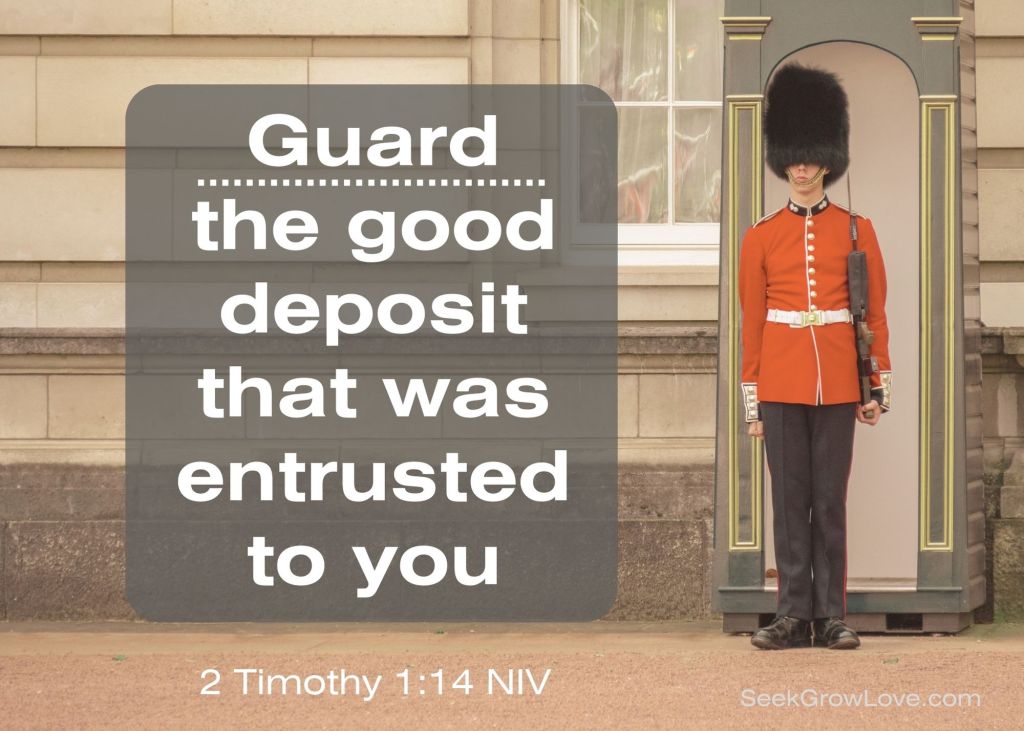
To guard something means that you have been entrusted to protect someone or something that is valued by another. In today’s reading of 2 Timothy 1, the Apostle Paul has written to Timothy and reminded him about all of the goods that have been entrusted to him in his life. He speaks about the sincere faith that began in both Timothy’s grandmother and mother now in him. He describes this faith as something that has been entrusted to Timothy and must be guarded. I have the image of going to the bank and bringing my paycheck and giving it to the bank officer and asking her to guard my money until I needed it. I am entrusting my deposit with the bank. Here, Paul is entrusting his spiritual deposits to Timothy. Just as Timothy’s grandmother and mother made spiritual deposits in his life, Paul too made spiritual deposits. Now it’s up to Timothy to both guard those deposits and also put them to good use. Paul freely changes metaphors to that of fire. A fire that has started often needs to be fanned, given more air, until it grows enough to really burn. Protect the deposit and fan the flame. This is Paul’s counsel to Timothy.
You’ve undoubtedly had many people make faith deposits in your life. For some, like Timothy, it was a grandparent or parent or other spiritual teacher or mentor. Maybe it was a Sunday School teacher or youth leader, maybe it was a pastor or a counselor at Church camp. For many, it was likely a combination of many people who taught by words or actions what it means to know Jesus Christ and follow him as a disciple. I know in my nearly 60 years of life there have been countless people who have made faith deposits into my life, and who have helped me with my spiritual formation. These people have shared incredible gifts of faith with me. I feel a particular responsibility to not allow those gifts to go by the wayside, to be left unvalued, unused, and unguarded. I take the deposits of faith that have been entrusted to me and put them to work for Jesus Christ and for the Kingdom of God. This is an incredibly important responsibility and one that I do not take lightly. I owe a tremendous debt of gratitude to those who made faith deposits in my life and so I want to “pay it forward” by making faith deposits into the lives of others. This is why 45 years after I first attended Youth Camp (Now FUEL) I’m still trying to make faith deposits. I hope and pray that you guard what has been entrusted to you and fan into the flame the gifts that have been given to you so that God’s word will continue to spread like wildfire into a world that needs more faith.
Jeff Fletcher
Reflection Questions:
Take a moment to write down the names of people that you can think of who have made faith deposits into your life. Say a prayer of thanks for them, or send one of them a note and say “thank you” for the faith deposits they’ve made in your life.
What are some ways that you can fan into flame the gifts that have been given you? What specific things will you do to help spread the faith in Jesus Christ shared with you?
How can you best guard what has been deposited into your spiritual bank account by others?
Tik Tok. It’s a fad. Fads are nothing new. My grandparents probably said “23 skidoo”. (I have not verified the spelling). The generation right before me were really into hula hoops and they danced “the twist” and the “watoosi”. My generation had pet rocks and mood rings.
Fads come to church too. Anybody still have a WWJD wristband? Are there any Prayer of Jabez plaques in your house. (Ask your parents about these fads). Many religious fads can be innocuous. Some fads can be pretty significant for good or for bad. The Late Great Planet Earth promoted a view of the rapture that had vast societal and political implications. A resurgence of Calvinism is impacting the way many Christians view the church’s role in society. The recent trend of doing church online and eschewing in person worship which began during the Covid lockdown has continued for many and may be weakening many congregations. (Who needs to spend an hour or two at church when you can watch a 45 second tik tok sermon in your pajamas?) But I digress.
What exactly do we mean by the term “fad”? “Sociologists classify fads as a form of ‘collective preoccupations’ where many people over a relatively broad social spectrum engage in a similar behavior and interpret it in similar ways in order to identify their place in society” (See Pop Culture Christianity: What fad would Jesus follow” by Jim White). Another definition is: “An intense and widely shared enthusiasm for something, especially one that is short-lived and without basis in the object’s qualities; a craze.” Fads are not a modern phenomenon. It appears that even the Apostle Paul had to deal with the religious “flavor of the month” in his first century ministry.
As we have been reviewing Paul’s life and teachings this week we have seen how he was specifically met by and called by Jesus Christ to bring the good news of the Kingdom and the name of Jesus Christ to the Gentiles (everyone that wasn’t a Jew). Paul traveled extensively presenting the Gospel to new groups of people and then following up to see how they were doing in the faith. In today’s reading in 2 Corinthians 11 Paul is writing to the Church to offer correction to their following a new religious fad. New teachers came in behind Paul who apparently were more slick and polished than Paul was and who had packaged a different message that was appealing and persuasive and was drawing the Corinthian disciples away from their “sincere and pure devotion to Christ” (vs. 3).
Paul goes on to use some very strong language to warn the Church against blindly following these fancy new teachers and their faddish preaching. He uses words like: deceived, led astray, another Jesus, a different spirit, a different gospel, false apostles, disguised as preachers of righteousness just as Satan is disguised as an angel of light. That’s a lot of clear, hard teaching. It’s not always easy to hear clear, hard teaching, but it’s sometimes needed. 7 years ago I had a doctor who gave me some clear, hard teaching. He diagnosed me with cancer. The cancer needed treatment. I needed surgery or radiation or both (it ended up being both). If I chose to ignore the doctor’s warning I probably wouldn’t still be around today. Fortunately, he cared enough to tell me the hard truth and fortunately I received it and acted upon it, had the surgery and radiation along with a lot of prayers, and I’m still around.
I’m not sure how the Christians in the first century Church of Corinth responded to Paul’s hard teaching. Did they accept it and act accordingly or did they ignore it and keep on doing what they were doing, following the latest fad instead of returning to their pure devotion to Christ?
Paul tried to appeal to his listeners by laying out his resume, his credentials. He talked about his background and the foundation he received. He talked about how his dedication to Christ was evident in his actions and his willingness to keep going amid so much opposition. Paul recognized that when he went around preaching the gospel and telling people about God’s Kingdom and God’s chosen King, Jesus, he was involved in spiritual warfare. The enemy or evil one tried to stop him wherever he went – that’s why he had so much opposition.
Do you ever run into opposition or challenges when you are trying to do what God told you to do? 500 years ago a teacher named Ignatius helped his students practice discernment of spirits. I think he had some helpful teaching. He said, rightly I believe, that when we are doing morally bad or sinful things, the evil spirit or enemy of God makes them look and feel pretty good. I’m not going to lie, sometimes doing bad or sinful things feels good in the moment. The devil wants you to feel good about doing bad so he “rewards” you with those temporary good feelings. Meanwhile, God comes along and drops bad feelings like guilt or shame (what a buzz kill). Just like my doctor- I’m enjoying life and he has to ruin my fun by telling me I have cancer. But guess what, listening to him saved my life. And listening to the guilt when we are doing things that bring us away from God can save our spiritual life by turning us away from sin back to God’s path for our lives.
Here’s the flip side to discernment. When we are sold out on following Jesus Christ, when we are on fire for the Lord and willing to take up our cross and follow Jesus, the evil one comes along and tries to throw as many challenges and obstacles in our way to trip us up and get us to give up our faithful commitment to God. But while the enemy is trying to destroy us, God will come along with his spirit and offer us his love, comfort and the promise that he is with us. He might use a song, a scripture, a sermon, another Christian, a beautiful sunrise, a rainbow in the sky, who knows what God will do to let us know that he is with us?
For me, when I was diagnosed with cancer one of the things that helped get me through it was my Church family. When I was going through 6 weeks of daily radiation every Sunday my Church prayed for me in worship. When I was going in for surgery, my church filled the sanctuary with happy face balloons and signs of encouragement. I was surrounded with love and encouragement. That kept me going. Now I try to return the favor and show love and encouragement to others when I sense the evil one is trying to trip them up. Maybe someone reading this today has been under attack from the evil one. Be encouraged! God is with you. Turn to Him, keep the faith. And be sure to use good discernment when a new fad comes along. Some may be harmless, but others might be a tactic that the enemy is using that might appear innocent but is actually turning your heart away from it’s sincere devotion of Christ. The enemy has been doing this a long time and he’s pretty skilled… don’t let him trick you.
-Jeff Fletcher
Reflection Questions
Can you think of examples of religious fads that might appear innocent but can be potentially dangerous?
How might you use the tools of discernment to better evaluate things in your life, good and bad?
How might God use you to lovingly warn or share hard truth with someone who might be on a path that’s leading them away from Christ?
“There Ain’t no grave, gonna hold my body down. There ain’t no grave, gonna hold my body down. When I hear that trumpet sound, gonna rise right outta the ground. There Ain’t no grave gonna hold my body down.” I love hearing Johnny Cash sing that song with his old, gravelly voice. He recorded it not long before he died. I imagine he was thinking a lot about death at that point in his life. Most old people do think about death. And most young people I know don’t think much about death. We all know vaguely that we are mortal and that one day, somewhere far down the road we will have to face our own death, but we usually try to distract ourselves from the reality of death by thinking about other things. In his Pulitzer Prize-winning book The Denial of Death, Ernest Becker wrote: “Modern man is drinking and drugging himself out of awareness…”. I think that’s pretty accurate.
Personally, I never thought much about my own death until I was diagnosed with cancer 7 years ago (I’m still here). Cancer doesn’t automatically mean you are going to die, in fact, the majority of people with cancer do not die from cancer, at least not right away. There are many treatments to delay or send many cancers into remission. But I can tell you from experience when you hear the word cancer it does make you at least think about death, not just as a remote possibility but as something that you will actually have to experience someday. I imagine an accident or other near-death experience will do the same thing. PTSD (Post-Traumatic Stress Disorder) can be caused by exposure to death or fear of dying.
People deal with the fear of death in a variety of ways. One approach goes back to the time of Epicurus 300 BC who taught that there was no judgment or afterlife. When you die you simply cease to exist. There is no future reward beyond this life, and there is no fear of future punishment. Modern day atheism has embraced this approach to death. Another common approach to dealing with death is the denial of death by believing in the natural immortality of the soul. We are all immortal by nature. Our bodies die but our souls are immortal and when our bodies die our souls live on in another place like heaven or hell or come back in another form, reincarnation.
The Apostle Paul offers a third, biblically consistent, and hope-filled understanding of death. We are mortal by nature, not immortal. Death is a reality, but it does not have to be the final reality. In Christ there is the hope of the resurrection from the dead. Just as Christ died and went to the grave and on the third day was raised from the dead (in the same way that Jesus had previously raised Lazarus from the dead) Paul hoped that in Christ he too might attain the “resurrection from the dead.” (Philippians 3:11 NRSV).
Paul’s hope was that his savior, the Lord Jesus Christ who is currently in heaven will come and transform “the body of our humiliation” (Phil 3:21) into a glorious body like Jesus is today. Paul’s term “the body of our humiliation” can also be translated as “of low estate” or even “vile”. In my work at a hospital chaplain, I am daily acquainted with how our bodies suffer decay and corruption. When people are sick the fragility of their bodies is exposed. The fragility of Jesus’ body was also exposed in his crucifixion. Ultimately, our fragile bodies will suffer disease, injury, and slow decay and we will die. But our hope in Jesus Christ is that he will come again and raise our bodies up in glory, in bodies that are no longer corrupt and subject to death. This is our blessed hope.
For Paul there was a daily awareness that he had not yet arrived at the fullness of the resurrected body, that will only happen when Christ comes at the end of this age. So for now Paul’s focus was to “press on” (Philippians 3:12) or “strain forward” (3:13). It gives us the image of a runner keeping his eye on the finish line. Paul is saying “keep your eye on the prize”.
Paul contrasts this way of being with those whom he says live as though they were “the enemies of Christ”. Their gods are earthly things (their belly or human appetites- 3:19). Paul makes their end clear – destruction (3:19). For Paul, humans are mortal, death is a reality that we will all face one day. For those who make themselves an enemy of Christ by rejecting him and making their own appetites their gods, the end is final destruction. But for those who put their hope in Jesus Christ, whom God raised from the dead, their hope is to be raised up from among the dead to be transformed into a glorious body like Jesus has been transformed into at his resurrection. A body that is not corruptible and cannot die. They will be clothed in immortality by Jesus upon his return from heaven.
I hope that you, like Paul and like me and countless other believers, trust in Jesus Christ and keep pressing on to follow him. Keep your eye on the prize.
“There Ain’t no grave, gonna hold my body down. There ain’t no grave, gonna hold my body down. When I hear that trumpet sound, gonna rise right outta the ground. There Ain’t no grave gonna hold my body down.”
-Jeff Fletcher
Reflection Questions:
What value can you see in understanding the reality of death and the hope of bodily resurrection at the return of Christ as opposed to the no hope of life after death or the natural immortality of the soul?
Paul named those who were doomed for destruction as those whose gods were their belly/appetites. What might you name as other appetites/gods of people today? In what ways do pursuing those gods lead to destruction?
What does the promise of resurrection from the dead reveal to us about God’s character and plan for the world? What difference does that make in your life?
As I was driving home today listening to my favorite oldies station (All the best rock music was in the 60’s through 80’s, everyone knows that) I heard “How Deep is Your Love?” by the Bee Gees. (Disco, but still better than today’s stuff). “How deep is your love how deep is your love, I really need to learn?”
Isn’t that THE question we all ask constantly throughout our lives? “Do you love me? How much do you love me? What are the limits of your love for me?” We all want and need to know that we are loved.
One of the foundational needs of every human being from the moment of birth is to know that they are loved and securely attached to a loving caregiver. “If I’m cute, do you love me? If I cry do you love me enough to pick me up and comfort me? If I make a stinky mess do you love me enough to clean me up and put a fresh diaper and clothes on me? If I take a pair of scissors and cut holes in your suit jacket will you still love me Daddy? (Extra points if you figure out which Fletcher kid actually did than when they were 4).” The answer is, “Yes, I still love you.” And I love you when a tree somehow jumps in front of the car as you’re driving (A different Fletcher kid, at age 16). “Will you still love me when I disobey you or when I reject your values and beliefs?” “Yes, even when you break my heart, I will still love you.”
In Ephesians 3 Paul shares something for which he is earnestly praying for his readers. Paul is praying that they might ask Jesus “how deep is your love” and that God might give them the power to comprehend just how much Jesus loves them. He writes in vs. 17-19 “that you, being rooted and grounded in love, may have strength to comprehend with all the saints what is the breadth and length and height and depth, and to know the love of Christ that surpasses knowledge…”(ESV). Essentially, Paul is saying that he wants them to know the unknowable, the unlimited love of Christ for them in all of its dimensions. How high, how wide, how long, how deep is the love of Jesus Christ for us? As you read through the gospel accounts of Jesus’ life you can see his love in action. Jesus touches the untouchable leper, love in action. Jesus doesn’t condemn the woman caught in the act of adultery, love in action. Jesus feeds 5,000, love in action. Jesus turns water into wine to save the wedding celebration and spare the father shame, love in action. Jesus undergoes betrayal, rejection, and false accusations, and is spit upon, mocked, beaten, scourged, and crucified, all love in action.
How do we begin to understand this love according to Paul? By Faith. We have to trust Jesus enough to allow him into our hearts so that we may begin to experience that love and be transformed inside out. Paul says that like a tree we have to sink down our roots into that love (vs. 17). Jesus referred to himself as the vine and his disciples as the branches. (John 15:4-6) In order to bear the fruit of the spirit (love, joy, peace, patience, kindness, goodness, faithfulness, gentleness, and self-control- Galatians 5:22-23) we need to maintain a continuous connection to Jesus.
“Do you love me?”
Jesus answers a resounding “yes!”
“How much do you love me? “
Jesus answers, “I love you so much I died on the cross for you.”
“What are the limits of your love for me?”
Jesus answers- “Put your complete trust in me and ask God to show you the full dimensions of my love, it’s a love beyond human comprehension.”
To summarize Paul, we need the faith to believe in the reality of Jesus’ love and be willing to trust and sink our roots down into that love to draw on the love of Christ and maintain an ongoing connection.
My prayer for you today echoes the prayers of Paul. May you have the power to know the breadth and length and height and depth of his love so that God can fill you to overflowing.
-Jeff Fletcher
Reflection Questions:
How important is it for you to know that you are loved?
Reflect on your life, can you name some ways that Jesus has demonstrated his love for you?
How does God, as our Father, ultimately reveal his love for us through the love of Jesus? If you are not sure, take some time to pray and ask God to show you today.
In the Movie, Forrest Gump, the titular character, Forrest Gump, met three different Presidents in the Oval office. First, he met President Kennedy while a member of the All-American football team. He later met President Johnson to receive the Medal of Honor. Finally, he met President Nixon to receive an award for player of the year while on the national Table Tennis team. Of course this was all fiction, but wouldn’t it be kind of cool to actually be invited to meet the president?
As we review Paul this week, today we read in Acts 26 that Paul was given a chance to meet, not the president, but the King. Paul appears before King Agrippa. The back story is interesting and you can read about it in Acts 21-26. Here’s the Cliff Notes version: Paul came back to Jerusalem after his third missionary tour, he was accompanied by several people including some Gentile believers in Jesus. Paul went to the Temple to offer a sacrifice of purification (he was still Jewish and did not want to be offensive to his fellow Jews). The Jews who opposed Paul for being a Christian used this event as a chance to try to get rid of Paul and falsely accused him of bringing a Gentile into the temple. Paul was arrested and given multiple trials in several different locations. This gave him a chance to keep giving his testimony and preaching Jesus Christ in all kinds of high places including before the Jewish ruling court, the Roman Governor, the King of Israel and Paul hoped to ultimately be sent to Rome where he could preach the good news of Jesus Christ to Caesar.
In today’s reading Paul is on trial before King Agrippa, but he’s using this as an opportunity to proclaim the Gospel to the King. It’s no small irony that in trying to silence Paul and prevent him from preaching Jesus Christ, his enemies actually gave him a huge platform to preach Jesus Christ.
This reading is helpful in that it shows us an example of how Paul preached Jesus Christ. He begins by drawing a point of connection between himself and his audience. He begins by talking about those points that he and King Agrippa both have in common. He shows respect to Agrippa. I think this is so important, especially in today’s world where people are so divided and confrontational. The person of God who seeks to share Christ should treat others with respect. The only difference between you and an unbeliever is faith. You may be the first one who is proclaiming Jesus Christ to another. Don’t demean or put down your audience. Show them respect. Honor what truth they already have, even if it isn’t all the truth that you have. Try to find areas where you can connect with them. Attempt to build a bridge and not a wall.
Paul talks about his credentials as a faithful Jew who followed the Torah all his life. He claims his past and who he was, and then he shares how God has brought something new into his life through faith in Jesus Christ.
-Jeff Fletcher
Reflection Questions
What key points can be learned from Paul about how to preach Jesus Christ? Of those you list which is an area you you could use some experience or refinement?
How well do you show respect to unbelievers? Why is it important? What happens when we don’t?
How are your bridge-building skills? Think of a specific unbeliever you would like to have a conversation with about Jesus. How can you show them respect? What do you have in common already? What pieces of truth might they have that you can acknowledge? Why do they need Jesus? Why do they need you to tell them?
Where has God placed you to share about His Son?
Ecclesiastes Introduction
Solomon (the teacher), the son of David wrote the book of Ecclesiastes to probe the meaning of life. Solomon attempted to find fulfillment in every pleasure he could imagine – only to find that everything was meaningless. He then pursued accomplishments, and found that they were meaningless as well. In fact, without God, everything is utterly meaningless.
Most of the book is pretty depressing until we get to chapter 12, where Solomon finally revealed his insights in verses 13 and 14, “Now all has been heard; here is the conclusion of the matter: Fear God and keep his commandments, for this is the whole duty of man. For God will bring every deed into judgment, including every hidden thing, whether it is good or evil.